Tag Archives: Satire

225. ADAPTATION. (2002)

CHARLIE KAUFMAN: I’ve written myself into my screenplay.

DONALD KAUFMAN: That’s kind of weird, huh?

Adaptation.

Must See

DIRECTED BY:

FEATURING: , , Chris Cooper, Brian Cox

PLOT: Screenwriter , fresh off the hit Being John Malkovich, is contractually and mentally trapped as he is forced to plow his way through an impossible project: “writing a movie about flowers.” Things go from bleak to bizarre as he finds himself competing with his endearingly oblivious twin brother, Donald, who also aspires to be a screenwriter. Charlie slips further and further past the deadline, until things come to a head in the film’s swampy denouement where he comes face-to-face with both the writer of and titular character from “The Orchid Thief,” the book he is adapting for the screen.
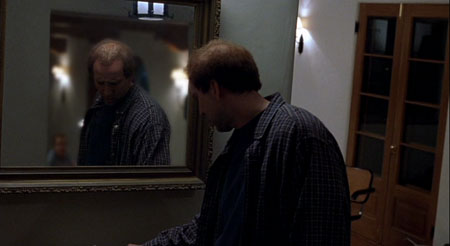
Still from Adaptation. (2002)

BACKGROUND:

  • The screenplay for Adaptation. was on Charlie Kaufman’s to-do list since the late ’90s. Tasked with adapting Susan Orlean’s novel-length essay “The Orchid Thief” and suffering the same problems as his doppelganger, he kept his progress secret from everyone other than Spike Jonze until 2000, when the movie was green-lit for production.
  • Screenwriting guru Robert McKee and his seminars are real. He personally suggested Brian Cox play him in the movie.
  • Adaptation. handily recouped the producers’ investment, with a return of $32.8 million worldwide on a $19 million outlay.
  • Nominated for four Oscars: best actor for Cage, supporting actor for Cooper, supporting actress for Streep, and adapted screenplay for Charlie and Donald Kaufman. Cooper was the only winner.
  • Though “Donald” Kaufman’s serial killer script The 3 was never shot, the idea may have inspired two subsequent movies, 2003’s Identity and 2006’s Thr3e.

INDELIBLE IMAGE: Returning from a misfired date, Charlie finds his twin brother already back home from a writer’s seminar, brimming over with newly adopted wisdom. As Charlie stands in front of his hallway mirror, Donald’s face is captured in the reflection as he expounds upon his own screenplay’s “image system” involving broken mirrors. Charlie’s expression goes from dour to disbelieving at this inanity, and the viewer sees the movie mock both itself and screenplay tricks. A further twist is added by the fact that the blurry reflection in the mirror is the face of the actual Charlie Kaufman talking to Nicolas Cage.

THREE WEIRD THINGS: Film-within-a-film-within-a-screenplay-within-a-screenplay ; Ouroboros; orchid-snorting

WHAT MAKES IT WEIRD: For all its unconventionality, Adaptation is amazingly self-deprecating. Spoilers unravel in opening scenes and are tossed aside, coastal city elites are presented as real people with the petty little problems real people have, and Nicolas Cage gains a bit of weight and loses a bit of hair to provide the compelling double performance as the Kaufman brothers. Events seem scattershot, only to have their purposes later clarified as the tightly structured flow keeps the viewer jumping from moment to moment, always questioning which parts of this convoluted tale are actually true.

COMMENTS: Between its thorough description of the protagonist Continue reading 225. ADAPTATION. (2002)

224. JAPANESE SUMMER: DOUBLE SUICIDE (1967)

Muri shinjû: Nihon no natsu

“I think that our only route to freedom and our only route to pleasure can come after we have first recognized that freedom and pleasure are not possible in this world.”–Nagisa Ôshima

Recommended

DIRECTED BY:

FEATURING: Keiko Sakurai, Kei Satô, Masakazu Tamura, Taiji Tonoyama

PLOT: An oversexed eighteen-year old girl wanders a city looking for a man to sleep with her—any man. She takes up with a strange, reserved older army deserter, but fails to convince him to service her, as he has a death wish and is only interested meeting someone who will kill him. The two are abducted and taken to a compound where outlaws are being recruited to fight in a secret underground war; meanwhile, television reports tell of a foreign sniper killing civilians on the streets, driving all of Japan to hide in their homes.

Still from Japanese Summer: Double Suicide (1967)

BACKGROUND:

  • Disappointed by the timidity of the Japanese studio system and the political controversy surrounding his 1960 movie Night and Fog in Japan, Nagisa Ôshima formed his own production company in 1965. Japanese Summer: Double Suicide was one of the baker’s dozen of self-produced films he directed between 1965 and 1972, and the first one to indulge in wall-to-wall surrealism.
  • Stars Keiko Sakurai and Kei Satô also appeared in Nagisa Ôshima’s next film, Death by Hanging, which was Sakurai’s only other acting credit.
  • Ôshima would go on to cult success in the West with his sexually explicit provocation In the Realm of the Senses (1976), and with Merry Christmas, Mr. Lawrence (1983) starring .
  • This feature should not be confused with Masahiro Shinoda‘s 1969 arthouse hit Double Suicide, a fourth-wall breaking adaptation of an 18th century Japanese play about doomed lovers. Although entirely unrelated, Shinoda‘s film is worth seeing in its own right.

INDELIBLE IMAGE: In what just might be a bit of symbolic foreshadowing, the two main characters lie down on top chalk outlines around which, moments ago, reverent monks had been circling and chanting. (Curiously, the outlines are sketched on what should be a busy four-lane highway, yet there is no traffic).

THREE WEIRD THINGS: Virgin nympho; deserted highways; “a Japanese Dallas”

WHAT MAKES IT WEIRD:  Starring a nympho who can’t get laid and a suicidal man who can’t get killed, Ôshima’s surrealistic Sixties satire carves out a unique space somewhere between a ian joke and an extended zen koan.


Original trailer for Japanese Summer: Double Suicide

COMMENTS: When our on-the-make nymphomaniac meets the Continue reading 224. JAPANESE SUMMER: DOUBLE SUICIDE (1967)

CAPSULE: MISS MEADOWS (2014)

DIRECTED BY: Karen Leigh Hopkins

FEATURING: Katie Holmes, James Badge Dale, Callan Mulvey, Jean Smart, Ava Kolker

PLOT: A prim and proper substitute school teacher moonlights as a vigilante.

Still from Miss Meadows (2014)

WHY IT WON’T MAKE THE LIST: Miss Meadows has cult ambitions and tone issues, but it’s too restrained, not messy enough, and too afraid to wade into weirdness.

COMMENTS: In-movie, Miss Meadows is described, rather too ambitiously, as a “Pulp Fiction Mary Poppins.” Oh, Katie Holmes nails the “Mary Poppins” angle, alright. Dressed in flowery frocks with white gloves and ankle socks, reading books of light verse, correcting others’ grammar, and signing off with her signature phrase—“toodle-oo”—she is an anachronism that never existed, so whitebread and out-of-place in modernity that she’s uncanny. Holmes’ casting was inspired, and at times she almost steers the movie into legitimate character study mode. But, unlike Pulp Fiction, the script she’s trapped in offers no surprises, clever dialogue, or grit.

The opening, where Miss Meadows taps her way down a tree-lined boulevard greeted by CGI-wildlife of varying believability, only to find herself hit on by a scumbag whom she must blow away with her ladylike peashooter, pretty much encapsulates the entire film. The movie does venture down a few seedy alleyways, with little success. Since Miss Meadows is a sexless construct, Holmes’ flirtations with the local sheriff require her to break character and briefly act like a real human being (which she does by dancing to imaginary accordion music), but heat never develops between the two. Conversations (on a yellow rotary phone) with her equally deranged mother serve as an attempt to add another dimension, but one which only ends in obvious revelations. But it’s Meadows’ tea party with antagonist Callan Mulvey, an accused child abuser furloughed from prison in a recent budget crunch, that offers the biggest missed opportunity for the film to develop some depth. Mulvey is the only character who can stand up to Meadows and challenge her sincerity, questionable social agenda, and sanity, but the script abandons its feint towards developing this character into a true foil. That failure leaves the movie with little to rely on: it’s a toothless non-satire, an underdeveloped romance, and a black comedy with no real darkness. Miss Meadows founds itself on a coarse irony, then fails to do much with the premise you couldn’t find in a one-sentence logline.

WHAT THE CRITICS SAY:

“Holmes’ performance helps Miss Meadows considerably: It’s so relentlessly upbeat and deliberately artificial that it admits no cynicism or judgment, and it makes the film daringly weird, like a less-bloody but no less savage version of Lucky McKee’s May, with less mutilation and more tea parties.”–Tasha Robinson, The Dissolve (contemporaneous)

219. THE PORNOGRAPHERS (1966)

“Erogotoshitachi” yori Jinruigaku nyūmon

“What kind of fish is that? What is it doing there?

“Very strange…”–dialogue spoken over the opening credits of The Pornographers

Recommended

DIRECTED BY: Shôhei Imamura

FEATURING: Shôichi Ozawa, Sumiko Sakamoto, Keiko Sagawa, Masaomi Kondô

PLOT: Ogata makes illicit pornographic films to support his widowed landlady, who is also his lover, and her two teenage children. The widow believes her ex-husband was reincarnated as a carp she keeps in a fishbowl next to the bed and that he disapproves of the arrangement, but she cannot control herself. When she dies, she insists Ogata marry her daughter, but the pornographer has become impotent and obsessed with building a mechanical woman to be the perfect mate.

Still from The Pornographers (1966)

BACKGROUND:

  • Shôhei Imamura apprenticed as an assistant director under Yasujirô Ozu, and although he was considered a major figure in the Japanese New Wave, his movies are little known outside his native land. In the West, The Pornographers is his best-known work.
  • The scenario was based on a 1963 novel by Akiyuki Nosaka (who also wrote the story on which Grave of the Fireflies was based).
  • The Pornographers was made by Nikkatsu studios, who ironically turned from producing art films to making pornography (“pink films”) soon after the scandal over ‘s “incomprehensible” Branded to Kill in 1967.

INDELIBLE IMAGE: Shôhei Imamura frames many of the shots in The Pornographers oddly, including a couple of bedroom scenes viewed through a fish tank; the idea is that we are watching the jealous carp as he spies on his human wife making love to Ogata. The weirdest of these shots, however, has to be a Haru’s deathbed scene, also shot through the carp cam—improbably, this time, from above, as if the fish is looking down from heaven on the spouse who is soon to join him.

THREE WEIRD THINGS: Carp ex-hubby; slow schoolgirl porn star; Ogata floats away

WHAT MAKES IT WEIRD: A cavalcade of perversions flecked with short dream sequences and unannounced flashbacks, almost every scene in The Pornographers is eccentric, if not flatly surreal. The main character delivers a philosophical monologue as he walks though an orgy, the matron freaks out to the surf-rock soundtrack in her head, and a new wife strips to garter and stockings as she walks down the corridor to meet her mother-in-law for the first time. Although the story is based in realism, the film’s tone is melodramatic and dreamily erotic—but, ironically, hardly pornographic at all.


Original trailer for The Pornographers

COMMENTS: The key to understanding The Pornographers may be Continue reading 219. THE PORNOGRAPHERS (1966)

CAPSULE: STARRY EYES (2014)

DIRECTED BY:  Kevin Kolsch, Dennis Widmyer

FEATURING: Alexandra Essoe, Lou Deszeran

PLOT: A struggling young L.A. actress finally gets a callback, but the auditions are increasingly humiliating, and the casting director wears a pentagram…

Still from Starry Eyes (2014)

WHY IT WON’T MAKE THE LIST: It’s got a little bit of backloaded weirdness in its final act, but mostly, it’s just a clever but minor indie horror whose primary impact will be as a calling card for lead actress Alexandra Essoe.

COMMENTS: Starry Eyes‘ script was obviously written by people who have stood up and read lines from an unfamiliar script in an attempt to impress poker-faced executives who silently assess their appearance, talent and general suitability as a human being. The movie makes auditioning feel (at times literally) nightmarish. Starry Eyes really makes you feel Sarah’s objectification as a struggling L.A. actress, and not only in the obvious ways. In fact, her daytime stint in hot pants and cutoff t-shirt at “Big Taters Family Restaurant” is less humiliating than the auditions she attends. The “Big Taters” subplot is interesting, because breastaurant waitressing is presented as a more honest and, in a way, honorable line of work than acting; her boss may ogle her, but he actually gives her good advice, whereas the casting agents are arrogant procurers who shamelessly leverage her starlet ambitions. Food service just wants her for body, but the movie industry wants her soul.

Astraeus Pictures not only makes B-movies, but they are staffed entirely by renegades from a low budget horror set. The bow-tied assistant casting director is fey and over-enunciates; his female superior is severe and androgynous, like a patrician riding instructor or a warden at a women’s prison. The producer himself has the studied smile, raised eyebrows and smarmy positivity of an overeager motivational speaker, or a hammy horror movie villain. Essoe’s performance, by contrast, is totally naturalistic, and extremely intense when anxiety attacks make her tear the hair out of her head in bloody clumps. The campiness of the moguls’ portrayals is a deliberate attempt to make them seem strange and artificial (and even hypocritical, since they demand authenticity from the auditionees they torment).

Sill, reasonable aesthetic choice though it may be, I think the hammy performances from the Hollywood phonies are a bit overplayed. The other major detractor from a generally solid horror outing is the weak second act, where Sarah spends too much time hanging out with her indie filmmaking friends. These digressions set up a necessary contrast between the creative freedom of the poor artsy types and the corporate bondage offered by Astraeus, but they don’t do favors for the pacing. Fortunately, the final act takes a turn into ian body horror, as Sarah transforms from a nobody wannabe into one of  Hollywood’s merciless bloodthirsty elites. “Dreams require sacrifice,” taunts the producer. The idea of selling your soul for a starring role isn’t a new or original one, but Starry Eyes is effective because it’s made by people who understand the agony and temptation of the quest for stardom from the inside.

WHAT THE CRITICS SAY:

a mumblegore Mulholland Dr., following a would-be startlet’s (self-)destructive fugue through the dreamworld of Tinsel Town.”–Anton Bitel, Grolsch Film Works (contemporaneous)