In this metaphor-heavy animation about the decommunization of a city in Ukraine, a bald eagle lays an egg midair that forms into a cloud-mushroom.
Tag Archives: Satire
CAPSULE: MONDO HOLLYWOODLAND (2019)
366 Weird Movies may earn commissions from purchases made through product links.
DIRECTED BY: Janek Ambros
FEATURING: Chris Blim, Alex Loynaz, Alyssa Sabo, Jessica Jade Andres, Ted Evans
PLOT: A being from the 5th dimension enlists the help of a purveyor of magic mushrooms and observes a cross-section of the town’s residents in an effort to define the concept of “mondo.”

COMMENTS: The fabled Hollywood sign, symbol of dazzling entertainment throughout the world and physical representation of the film industry’s outsized sense of self-importance, began its existence as an advertisement. “HOLLYWOODLAND” arose in the Santa Monica mountains nearly 100 years ago to lure prospective Southern California residents to a new real estate development. The last four letters were stricken when the sign made its shift from billboard to civic symbol, and the sign enjoyed a meteoric rise to stardom.
So while the most obvious inspiration for the title of Mondo Hollywoodland would seem to be the similarly named 1967 quasi-documentary about the region’s curious subcultures, the newer film leans more into Hollywoodland’s origins as a neighborhood. The Dream Factory is ever-present in the lives of the absurd, deluded, ridiculous people chronicled here, but they are still people, and this is a movie that looks for the community among them.
Early on, when the narrator identifies himself has being from the 5th dimension (presumably not the band), we can take comfort in knowing that everything about to ensue is pretty silly. Further exemplifying the flimsy structure of this endeavor is the decision to divide Southern California society into three classes, each of which is trying to buy into the Hollywood dream despite repeatedly seeing the cracks in the façade.
We begin with the Titans, ostensibly the power brokers who make blockbuster entertainment and break the hearts of aspiring stars. And yet our focus on Ted, a perpetually coked-up mid-level executive desperately trying to bring a Disney Channel starlet to heel, reveals these masters of the universe to be puny. There is no world beyond sci-fi epics and last-minute dialogue changes for these Titans, and Ted’s triumphant fist pump (earned by completely caving in) belies his fear at losing what little power he has.
The Weirdos occupy the opposite end of the spectrum, determined to better their world and generally clueless about how to do so. Hoping to take down a Trump-allied neo-Nazi, they pass out flyers at a gun-sense rally. Meanwhile, on the artistic front, they advocate for harmony. One even mediates a conflict between two pieces of wood. They are obsessed with politics, the state of the world, and whether their empathy and good intentions are enough to bring about utopia. At least, they are when they’re not tripping. Weirdo Daphne is so disillusioned with the slow pace of change that she takes matters into her own hands, torching a car. “Hope they got the message,” she says, even though it’s doubtful if even she knows what the message might be.
Enter the Dreamers, certain that their taste of fame and fortune is just around the corner. Not surprisingly, this section of the film flirts with sadness, as all these dreams seem to be deferred. From an agent whose clients are all up for the biggest roles but never get the gig to an acting coach whose credibility derives entirely from his stint on “Mad About You” to a wannabe fitness guru who longs for even the reflected glory of training the stars. Central to this section is Anna, the granddaughter of a one-time Grace Kelly stand-in who goes on a date to a concert by the grandson of Bing Crosby. The barest glimmer of Hollywood’s allure is being pushed away by generations.
Boyle, the hapless mushroom dealer, is our connecting thread, popping in and out of stories while still carrying on his own peculiar battle against the rats hiding in his rented bungalow. Regularly high on his own product, he is frequently flummoxed by the simplest interactions, and wants only for things to be “groovy,” a condition that has eluded him since the disappearance of his cat. But he also becomes the unifying force that brings our Titan, Weirdo, and Dreamer together in a genuinely hilarious low-rent heist. They’re a marvelously motley crew, and the success of this scene at the film’s climax is a tribute to the laid-back vibe Mondo Hollywoodland cultivates.
We never learn, precisely, what “mondo” is to this crowd, but if it means anything, it’s a special kind of magic that happens when aspirations manage to outdistance reality. Mondo Hollywoodland is self-evidently a Dreamer’s enterprise (having nabbed actor James Cromwell as an executive producer, the film’s publicity spares no effort to highlight the connection), but it is determined to face down the formidable opposition of a negative world and to be, in the end, groovy.
WHAT THE CRITICS SAY:
SATURDAY SHORT: TERRORVISON 3000
Four friends have a Cronenberg-esque experience watching TV in a crammed room.
FANTASIA FILM FESTIVAL 2021: STRAWBERRY MANSION (2021)
366 Weird Movies may earn commissions from purchases made through product links.
Rent Strawberry Mansion on-demand

DIRECTED BY: Kentucker Audley, Albert Birney
FEATURING: Kentucker Audley, Penny Fuller, Grace Glowicki, Reed Birney, Linas Phillips
PLOT: In the future, dreams are taxed, and when a dream auditor goes to check in on an elderly woman who’s off the grid, he finds himself drawn to dreams that are more free than his own.

WHY IT MIGHT JOIN THE APOCRYPHA: With themes reminiscent of Eternal Sunshine of the Spotless Mind and a handmade aesthetic straight from The Science of Sleep, Strawberry Mansion is the 2020s American indie version of a turn-of-the-millennium Michel Gondry movie. It may be a tribute, but it’s a worthy trip of its own.
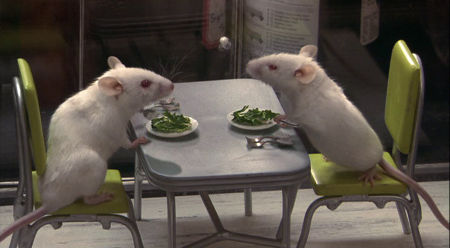
COMMENTS: Dream movies are tricky, and making a dream movie on a low budget is even trickier. Strawberry Mansion addresses these limitations up front. The introductory dream is minimalist: an everyday kitchen, but painted entirely pink, into which comes a friendly visitor bearing a bucket of fried chicken. Throughout the movie, dreams will be conveyed using these types of simple props and sets thrown together in incongruous ways: actors dressed as Halloween-costume frogs (playing saxophones) or mice (in sailor suits); walking shrubs; demons with turquoise light-bulb eyes. Add in the occasional stop-motion animated skeleton or caterpillar to go along with some simple green screen, and you’ve proven that you can convey an otherwordly feel without millions of dollars of CGI.
The second scene addresses the non-budgetary conundrum dream movies face: the cliché of slippage between the waking world and the dream world, and the idea that the audience must be on guard to discriminate between the two. Our hero (a bureaucrat with the Brazil-ish name “Preble”) awakes to find himself craving chicken, and goes to Cap’n Kelly’s drive-thru, where the A.I. clerk tries to sell him a brand new “Chicken Shake.” Chowing down in the parking lot, he has a brief flash-forward hallucination—and that’s it, as far as the old “blurring the lines between dream and reality” bit goes. There is no “real’ world in Strawberry Mansion to confuse with the dream world. The premise of this near-future vision isn’t dystopian science fiction, but light absurdist satire. The very idea of taxes on dreams—dream of a buffalo, and you’re assessed a twenty-five cent bill; dandelions are three cents apiece—is something that would only occur to you in a dream. There’s no narrative confusion about whether we’re in the characters’ dreams or the movie’s reality, and there’s also never any sense that we’re meant to take this cinematic world as more than a dream itself. This dream-inside-a-dream structure frees us up to experience the movie on its own terms, instead of falling into the psychological thriller trap of trying to distinguish what is a dream from what is “really happening.”
As Preble, Audley is rather bland as a slouchy, glum bureaucrat, but that’s by design; his character contrasts with the grandiose poetry of dreams, which go beyond workaday realities. Penny Fuller‘s eccentric Arabella—when he asks her what she does during the intake interview, she describes herself as an “atmosphere creator,” so he jots down “artist” on his form’s “occupation” line—is the sweet but slightly ridiculous woman who will seduce him into a more fulfilling mode of being human. Strawberry Mansion is a manifesto for resisting the numbing effects of modern technology—represented explicitly by advertising—in favor of the playful freedom of imagination. This message is wrapped in a sugary confection about a man and a woman who have a deep but chaste romance based on shared dreams rather than the passions of the physical world. It’s funny, gentle, and filled with funny, gentle dreams to tickle your imagination. It may be the best dream you’ll have this year, and it’s well worth the bill.
Kentucker Audley is best known as an actor in indie circles, but he also founded the website NoBudge, which curates low-budget (and often weird) short films from up-and-coming directors. Audley and co-writer/co-director Albert Birney previously collaborated on the absurdist comedy Silvio (2017), about a gorilla news anchor going through an existential crisis. Strawberry Mansion is inexplicably named after a Philadelphia neighborhood. It debuted at Sundance and already has a distributor (Music Box), so expect to see it available to the general public later this year, by early 2022 by the very latest.
WHAT THE CRITICS SAY:
APOCRYPHA CANDIDATE: PARANOIA AGENT (2004)
Môsô dairinin
366 Weird Movies may earn commissions from purchases made through product links.
DIRECTED BY: Satoshi Kon
FEATURING: Voices of Mamiko Noto, Shouzou Iizuka, Toshihiko Seki, Haruko Momoi (Japanese); Michelle Ruff, Michael McConnohie, Liam O’ Brien, Carrie Savage (English dub)
PLOT: Toy designer Tsukiko Sagi, under tremendous pressure after creating an enormously successful character “Maromi,” is attacked by a bat-wielding boy on skates—dubbed “Li’l Slugger” (or “Shonen Bat”)—or so she claims. The two detectives assigned to the case have their doubts, but more attacks occur, and the victims appear to be connected, and all under some type of mental distress.

WHY IT MIGHT JOIN THE APOCRYPHA: “Paranoia Agent” balances horror and humor adroitly, especially when seen from a perspective 20 years later. Aside from some minor points, the series doesn’t feel dated; it could have been generated within the past seven years. The credit sequence establishes the tone, with the main characters laughing hysterically despite their incongruous settings (underwater, in traffic, and before an atomic explosion, to name a few), while the upbeat theme song just adds to the unsettling nature.
“Paranoia has a stronger image than fantasy. Yes. Delusional, maybe. Right. The word gives an impression that a person is, in a sense… actively making himself delusional. That kind of strength is inherent in the word. Well, in order to go through life… everyone needs to have something apart from reality… such as fantasy, dream, or maybe paranoia. Otherwise, life can be surprisingly hard. Yes. The world as a person perceives… it is a world filtered through his fantasy or paranoia, I think. In that sense, I don’t think that fantasy and paranoia are necessarily unhealthy.”–Satoshi Kon
COMMENTS: For admirers of Satoshi Kon’s work, “Paranoia Agent” can be viewed as a grab bag or sampler of sorts. There are echoes from Perfect Blue (1997), Millennium Actress (2001), Tokyo Godfathers (2003), and you can see hints of Paprika (2006). “Paranoia Agent” grew out of concepts that did not develop into larger projects, and a proving ground for things that did show up later.
At the time of its creation and release, this miniseries could be read as social commentary on aspects of Japanese society in the early 2000s. Cellphones, the Internet and the beginnings of social media are present, providing plenty of distractions for people. The show is an effective commentary on fantasy vs. reality; as Modern Life becomes more unbearable, more and more people seek escape via fantasy. But “Paranoia Agent” underlines the necessity to live in reality, as escapist coping mechanisms are shown to be ultimately destructive. Some cultural aspects the show touches on, such as Denpa-kei Continue reading APOCRYPHA CANDIDATE: PARANOIA AGENT (2004)