Tag Archives: Poetic

CAPSULE: THE TREE OF LIFE (2011)

The Tree of Life has been promoted to the List of the 366 Best Weird Movies.  This initial review is left here for archival purposes.  Please visit the film’s official Certified Weird entry for further discussion of the film.

Must See

DIRECTED BY: Terrence Malick

FEATURING: Brad Pitt, Hunter McCracken, Jessica Chastain, Sean Penn

PLOT: A man recalls his childhood in suburban Waco, Texas, and his difficult relationship with

Still from The Tree of Life (2011)

his father; in the process he also seems to unlock some primal memories of the creation of the universe and the evolution of life.

WHY IT WON’T MAKE THE LIST:  Any movie that tells the story of a suburban Texas boy’s troubled relationship with his father—but uses a dramatic encounter between dinosaurs to illustrate its main point—is at least making a nod towards the bizarre.  But, although there are many strange images and ideas in the stream-of-cosmic-consciousness Tree of Life, surrealism is only used as an occasional accent here; overall, the mood is more accurately described as “poetic” rather than “weird.”

COMMENTS: A boy’s tempestuous relationship with Brad the Father is used as a metaphor for nothing less than the turmoil between man and his Maker in Terrence Malick’s moon shot of a movie.  Told mostly as a series of hazy, almost dreamlike domestic memories, the story frequently drifts from reality to fantasy: at times, the boy imagines his mother as Snow White encased in a glass coffin in the forest, or sees a mysterious tall man looming over him in an arched attic.  In one memorable shot, a child in a flooded, womb-like bedroom swims out the window as a teddy bear floats in the amniotic brine.  But what people remember and talk about most are the amazing sequences of the laying of the foundation of the earth—the formation of nebulae, the birth of stars, molten lava boiling, merging into visions of the dance of cellular mitosis as the Tree of Life begins to form.  This leads to those famous graceful dinos who enact a unlikely primal drama, before a meteor wipes them out and we jump forward to our protagonist’s birth.  The cosmic creation sequences seem to come ex nihilo, and, despite the frequent comparisons to the far-out visuals of 2001: A Space Odyssey, they’re more like watching the “Best of Nova” on fast forward.  As is the rest of the narrative, the scenes of life’s gestation and birth are accompanied by the heavenly choral and symphonic sacred music of Bach, Taverner, Smetana, Mahler, and a host of others; history’s most glorious music written by man to express his wonder at creation.  It is impossible not to be awed by the splendor of the universe Malick lays out before us, and it’s impossible not to be intrigued by his brashness in recreating the cosmos for our benefit.  The middle section of the film, which details young Jack’s inability to comprehend gruff and demanding dad Brad’s harsh plan to toughen him up to face life’s challenges, will prove tough going for many due to the slow pace and lack of narrative flow, but it fits the movie’s meditative themes perfectly and gives the mind a chance to turn over the metaphor Malick molds.  The film’s finale, which may be its weakest (or at least its most divisive) feature, moves from the cosmic to the supercosmic as Sean Penn, the resentful little boy now turned into a doubtful and accusatory adult, walks through a door frame hanging in desert space onto a beach of souls.  You may not agree with Tree of Life‘s ultimate religious message, but you have to admire the sincerity and passionate intensity with which Malick delivers it.  He leaves nothing on the table.  Considering the pandering, preachy crud that passes as “inspirational” cinema these days, it’s a miracle to see a thoughtful spiritual movie that gives doubt its due and isn’t self-servingly made to elicit “hallelujahs!” from the pious choir (though they will likely praise it, too).  Based on the screening I attended, I can say that the reports of audible exhaling when the credits roll and the buzz of excited conversation outside theaters afterwards are not exaggerated.  Like it or not, or agree with the message or not, Tree of Life is a challenging and audacious work of cinema, and you’ll be better for having encountered it.

Beginning with the Charles Starkweather-inspired Badlands in 1973, the perfectionistic and reclusive Terrence Malick has only completed five feature films.  All of them are paced with unfashionable slowness, feature gorgeous natural cinematography, and wrestle with weighty themes (the Harvard-educated director was a Rhodes scholar who briefly taught philosophy at MIT before turning to film).  Now 63 years old, Malick has another project currently in the works, but The Tree of Life has the feeling of a cinematic summation and a swan song.

WHAT THE CRITICS SAY:

“…a beautiful, messy film: at times lyrical, intimate, and uplifting; at others, vast, inscrutable, and maddening.”–Christopher Orr, The Atlantic (contemporaneous)

NOTE: We loved The Tree of Life but didn’t really think it was strange enough to qualify as a “weird” movie (by our elevated standards).  366 readers disagreed, and in the 2nd Reader’s Choice poll they selected The Tree of Life to be placed on the List of Candidates for the 366 Best Weird Movies of All Time.  So it is done.

77. SONGS FROM THE SECOND FLOOR [Sånger från andra våningen] (2000)

“Beloved be those who sit down.”
–César Vallejo

“People have wondered how to classify my film. Absurdism or surrealism? What the hell is it?… This film introduces a style that I’d like to call ‘trivialism.’ Life is portrayed as a series of trivial components. My intention is to touch on bigger, more philosophical issues at the same time.”–Roy Andersson, DVD commentary to Songs from the Second Floor

Recommended

DIRECTED BY: Roy Andersson

FEATURING: Lars Nordh, Stefan Larsson

PLOT:  Set at the dawn of the millennium in a nameless city that seems to be undergoing an apocalyptic panic—traffic is at a standstill as people try to leave all at once, parades of flagellants march down the street, and the Church considers returning to human sacrifice—Songs unfolds as a series of brief, seemingly unrelated, vaguely surreal scenes.  Eventually a main thread emerges involving a family: the father’s furniture business has just burnt down, one son has gone insane from writing poetry, and the other son is a melancholy cab driver.  The father enters the retail crucifix business and begins seeing ghosts.

Still from Songs from the Second Floor (2000)

BACKGROUND:

  • The film was inspired by the verse of the relatively obscure avant-garde Peruvian poet César Vallejo (1892-1938), whose poem “Stumble between to stars” is quoted in the film.  Anyone who thinks Andersson is obscure would do well to avoid Vallejo, whose work—with its invented words and grammar and difficult symbolism—recalls James Joyce at his most impenetrable.
  • Songs  from the Second Floor was Andersson’s third feature film, and his first since 1975’s Giliap.  He spent most of the intervening time directing commercials, although he did complete two highly regarded short films.
  • Andersson discovered Lars Nordh shopping for furniture at an IKEA.
  • Many of the exterior shots were actually shot inside Andersson’s studio with trompe l’oeil paintings or three-dimensional models as backgrounds .
  • All scenes are completed in one take.  The camera only moves once (a calm tracking shot in the railway station).
  • At the time of the film’s release reviewers consistently marveled that none of the scenes had been scripted or storyboarded beforehand.  The method here shouldn’t suggest that Andersson simply made up the film as he went along, however, as unused footage shows that each scene was meticulously rehearsed and refined dozens of times, often on incomplete sets with stand-ins for the actors, over what must have been a period of weeks or months.  Andersson says they sometimes shot twenty to twenty five takes per scene to achieve the perfect performance.
  • The film took four years to complete.
  • Songs from the Second Floor tied for the jury prize at Cannes in 2000 (the jury prize is the third most prestigious award after the Palme D’Or and the Grand Prix).
  • Andersson followed up Songs with You, the Living [Du Levande] (2007) (also Certified Weird). The two movies are extremely similar both thematically (the comically apocalyptic mood) and stylistically (made up of intricately composed, brief vignettes). Andersson has said he intends to create a trilogy; however, he has suggested that the third film may not follow the same style as the first two.

INDELIBLE IMAGE: Fat Kalle standing at a deserted crossroads by the pile of discarded crucifixes, gazing at the figures approaching on the horizon, is an image worthy of European arthouse greats like Buñuel or Fellini.

WHAT MAKES IT WEIRD: There are a few moments of magical realism in Songs from the Second Floor, involving subway commuters bursting into classical verse and the matter-of-fact appearance of ghosts, but even if these interludes hadn’t been included, the movie would feel strange because of the high artificiality of Andersson’s style: the static camera, the constant crowds of expressionless figurants gazing dispassionately at the action in the foreground, the carefully controlled compositions filled with background detail. Adding deadpan absurd black humor, bleak existentialism, and a sense of looming catastrophe into the mix produces a singular concoction, one that captured Sweden’s—and the West’s—mood of anxious despair as the new millennium dawned.


Scene from Songs from the Second Floor

COMMENTS: Songs from the Second Floor uses deep focus—the photographic technique Continue reading 77. SONGS FROM THE SECOND FLOOR [Sånger från andra våningen] (2000)

25. NOSTALGHIA (1983)

366 Weird Movies may earn commissions from purchases made through product links.

“I wanted the film to be about the fatal attachment of Russians to their national roots, an attachment which they will carry with them for their entire lives, regardless of where destiny may fling them.  How could I have imagined as I was making Nostalghia that the stifling sense of longing that fills the screen space of that film was to become my lot for the rest of my life; that from now until the end of my days I would bear the painful malady within myself?” –Andrei Tarkovsky, Sculpting in Time

Recommended

DIRECTED BY: Andrei Tarkovsky

FEATURING: Oleg Yankovskiy, Domiziana Giordano, Erland Josephson

PLOT: Andrei is a Russian poet is traveling around Italy in the company of a fetching translator, researching a biography of a Russian composer who studied in Italy before returning to Russia only to drink and kill himself.  Andrei becomes homesick and bored with the project, and with life in general, until he becomes fascinated by a insane man living in a small town famous for its natural mineral baths.  The madman gives him a simple symbolic task to perform—which Andrei procrastinates in completing— then leaves for Rome on a mission of his own.

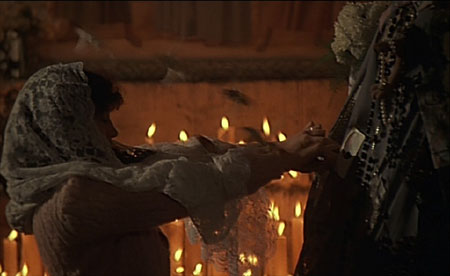
Still from Nostalghia (1983)
BACKGROUND:

  • Tarkovsky was considered one of the finest filmmakers in the Soviet Union; he frequently ran into difficulty with the Soviet censors, however, particularly for his Christian viewpoints.  Although his films won acclaim at international film festivals, they were often shown to limited audiences in edited versions in his own country.  Work on the historical epic Tarkovsky was helming prior to Nostalghia had been halted by the Soviet censorship board because of scenes seen as critical of the state’s policy of official atheism.
  • Nostalghia was the first film Tarkovsky made outside the Soviet Union.  Originally intended to be a Soviet/Italian co-production, the state-owned USSR film production Mosfilm withdrew financial support for the project without comment after filming had already begun.
  • The film competed for the Palme d’Or at Cannes, but was awarded a special jury prize instead.  Tarkovsky claimed that the Soviet contingent applied pressure to assure that the film would not be awarded the grand prize.
  • Tarkovsky defected to the West soon after Nostalghia was completed, leaving his wife and son behind.  They were eventually allowed to leave the country when he was diagnosed with lung cancer in 1986.  Rumors persist that Tarkovsky did not die of natural causes, but was actually poisoned by the KGB in retaliation for his defection.

INDELIBLE IMAGE:  There are many fine candidates.  The scene of Andrei attempting to carry a lit candle cupped in his hand across a drained spa may stick with the viewer, if not for its symbolism, then because it audaciously continues for over eight minutes.  But the final, static, picture postcard-like composition of a Russian homestead nestled inside an Italian cathedral perhaps captures Tarkovsky’s theme the best, and is shockingly beautiful, as well.

WHAT MAKES IT WEIRD:  The fluidity between the conscious and subconscious worlds. Although it’s almost always clear whether the events depicted actually occur or are imagined, Tarkovsky is much more interested in what is going on inside the heads of his alienated Russian poet and the Italian madman than in what is happening in the “real” world. He uses strong, sometimes obscure visual symbolism and dreams to convey an affecting mood of existential loneliness.


Trailer for Nostalghia

COMMENTSNostalghia can’t be approached without a word of warning: this movie is Continue reading 25. NOSTALGHIA (1983)