Tag Archives: Must see

98. IDIOTS AND ANGELS (2008)

“The look of the film is very Eastern European – something like what Jan Svankmayer might make, or David Lynch if he made animation – very dark and surreal.”–Bill Plympton, Idiots and Angels Director’s Statement

Must See

DIRECTED BY: Bill Plympton

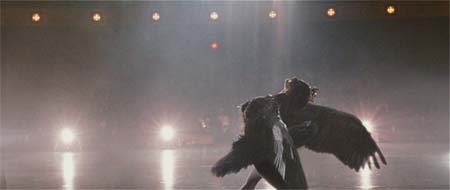
PLOT:  A loathsome man spends his days in a dingy, depressing bar where he lusts after the blonde barmaid, who is also the bartender/owner’s wife.  One day he discovers he is growing wings on his back; initially, he’s thrilled to be able to fly, but comes to hate them when they develop a mind of their own and force him to do charitable acts.  Other, equally venal, men plot to steal the wings to use them for their own selfish purposes.

Still from Idiots and Angels (2008)

BACKGROUND:

  • Bill Plympton has been nominated for Oscars twice for his animated short films.
  • Plympton made Idiots and Angels independently with a small team of four assistant artists for an estimated $125,000.
  • Per Plympton, the film consists of 30,000 drawings.
  • Per Plympton, the film was rejected by thirty distributors.  The animator is self-distributing the movie.
  • Idiots and Angels won the Best Film award at the Fantasporto festival in 2009 (previous Fantasporto winners that were Certified Weird are Toto the Hero and Pan’s Labyrinth).
  • Idiots and Angels is “presented by” Terry Gilliam.
  • The amazing soundtrack, featuring Pink Martini, Nicole Renaud, Tom Waits and others is not available for purchase at this time—and due to licensing issues probably never will be.

INDELIBLE IMAGE:  The obvious choice would have something to do with wings: maybe a manacled butterfly, or a fat stripper showing off her wingspan to a crowd of leering males, or an angel mooning a passing airliner.  More shocking and unforgettable, however, is the moment near the film’s climax when a full-grown man, wrapped in a placenta, emerges from another man’s navel.

WHAT MAKES IT WEIRD: Plympton sets his pitch-black parable about a wicked man who grows angel wings in a dialogue-free barroom Purgatory.  Fantastic daydreams mix with increasingly surreal realities to paint a wordless portrait of the eternal, internal struggle between good and evil. A hip, hypnotic art-pop soundtrack helps sweep the viewer away into Idiots and Angels‘ weird world of bitter cocktails and unexplained appendages.


Scene from Idiots and Angels

COMMENTS: The unnamed antihero of Idiots and Angels (the official plot synopsis calls him Continue reading 98. IDIOTS AND ANGELS (2008)

LIST CANDIDATE: THE SEVENTH SEAL (1957)

366 Weird Movies may earn commissions from purchases made through product links.

Must See

DIRECTED BY:

FEATURING: Max von Sydow, , Nils Poppe, Bengt Ekerot,

PLOT:  A disillusioned knight and his cynical squire return from the Crusades to a 14th century Sweden ravaged by the Black Plague; Death comes for the knight, but he convinces the Reaper to play a game of chess for his soul.

Still from The Seventh Seal (1957)


WHY IT MIGHT MAKE THE LIST: The Seventh Seal is undoubtedly a great movie, but its weirdness is in doubt. In fact, trying to decide if this film is strange enough to make it on the List almost makes me feel like Antonius Block wondering if there’s a God out there.  As an existential allegory, the film has a significant amount of unreality in its corner; although much of the movie is a starkly realistic portrait of medieval life, Bergman often ignores logic in minor ways when necessary to make his larger metaphorical points. He also incorporates the fantastic in one major way, by making Death a literal character in the film, a “living, breathing” character who not only plays chess but also poses as a priest and chops down a tree with his scythe. That’s not much weirdness to go on, though, and the best external support I can find for considering the movie “weird” is the fact that it’s been (inaccurately) tagged with “surrealism” on IMDB. I’m torn; the weird movie community will need to chime in on this one.

COMMENTS: The Seventh Seal has a big, imposing reputation as a masterpiece of world cinema, but if you haven’t seen it yet, you may be surprised to find that most of what you think you know about it is wrong. In the first place, it’s not nearly as gloomy as you may have heard. True, every frame of the film is suffused with the foreknowledge of death—Bergman is very in-your-face with his message that you are going to die, and it’s going to be horrible—but the grim scenes alternate with lighthearted, comic ones. The entire dynamic between the drunken smith Plog, and his unfaithful wife Maria, and her unlucky paramour Scat, for example, has a tone of bawdy Shakespearean comedy. The idyllic scenes where the knight enjoys a meal of milk and wild strawberries with the juggler Jof and his family have a warmth that temporarily drives away the chill—even though there is a skull peering over the Continue reading LIST CANDIDATE: THE SEVENTH SEAL (1957)

CAPSULE: THE TREE OF LIFE (2011)

The Tree of Life has been promoted to the List of the 366 Best Weird Movies.  This initial review is left here for archival purposes.  Please visit the film’s official Certified Weird entry for further discussion of the film.

Must See

DIRECTED BY: Terrence Malick

FEATURING: Brad Pitt, Hunter McCracken, Jessica Chastain, Sean Penn

PLOT: A man recalls his childhood in suburban Waco, Texas, and his difficult relationship with

Still from The Tree of Life (2011)

his father; in the process he also seems to unlock some primal memories of the creation of the universe and the evolution of life.

WHY IT WON’T MAKE THE LIST:  Any movie that tells the story of a suburban Texas boy’s troubled relationship with his father—but uses a dramatic encounter between dinosaurs to illustrate its main point—is at least making a nod towards the bizarre.  But, although there are many strange images and ideas in the stream-of-cosmic-consciousness Tree of Life, surrealism is only used as an occasional accent here; overall, the mood is more accurately described as “poetic” rather than “weird.”

COMMENTS: A boy’s tempestuous relationship with Brad the Father is used as a metaphor for nothing less than the turmoil between man and his Maker in Terrence Malick’s moon shot of a movie.  Told mostly as a series of hazy, almost dreamlike domestic memories, the story frequently drifts from reality to fantasy: at times, the boy imagines his mother as Snow White encased in a glass coffin in the forest, or sees a mysterious tall man looming over him in an arched attic.  In one memorable shot, a child in a flooded, womb-like bedroom swims out the window as a teddy bear floats in the amniotic brine.  But what people remember and talk about most are the amazing sequences of the laying of the foundation of the earth—the formation of nebulae, the birth of stars, molten lava boiling, merging into visions of the dance of cellular mitosis as the Tree of Life begins to form.  This leads to those famous graceful dinos who enact a unlikely primal drama, before a meteor wipes them out and we jump forward to our protagonist’s birth.  The cosmic creation sequences seem to come ex nihilo, and, despite the frequent comparisons to the far-out visuals of 2001: A Space Odyssey, they’re more like watching the “Best of Nova” on fast forward.  As is the rest of the narrative, the scenes of life’s gestation and birth are accompanied by the heavenly choral and symphonic sacred music of Bach, Taverner, Smetana, Mahler, and a host of others; history’s most glorious music written by man to express his wonder at creation.  It is impossible not to be awed by the splendor of the universe Malick lays out before us, and it’s impossible not to be intrigued by his brashness in recreating the cosmos for our benefit.  The middle section of the film, which details young Jack’s inability to comprehend gruff and demanding dad Brad’s harsh plan to toughen him up to face life’s challenges, will prove tough going for many due to the slow pace and lack of narrative flow, but it fits the movie’s meditative themes perfectly and gives the mind a chance to turn over the metaphor Malick molds.  The film’s finale, which may be its weakest (or at least its most divisive) feature, moves from the cosmic to the supercosmic as Sean Penn, the resentful little boy now turned into a doubtful and accusatory adult, walks through a door frame hanging in desert space onto a beach of souls.  You may not agree with Tree of Life‘s ultimate religious message, but you have to admire the sincerity and passionate intensity with which Malick delivers it.  He leaves nothing on the table.  Considering the pandering, preachy crud that passes as “inspirational” cinema these days, it’s a miracle to see a thoughtful spiritual movie that gives doubt its due and isn’t self-servingly made to elicit “hallelujahs!” from the pious choir (though they will likely praise it, too).  Based on the screening I attended, I can say that the reports of audible exhaling when the credits roll and the buzz of excited conversation outside theaters afterwards are not exaggerated.  Like it or not, or agree with the message or not, Tree of Life is a challenging and audacious work of cinema, and you’ll be better for having encountered it.

Beginning with the Charles Starkweather-inspired Badlands in 1973, the perfectionistic and reclusive Terrence Malick has only completed five feature films.  All of them are paced with unfashionable slowness, feature gorgeous natural cinematography, and wrestle with weighty themes (the Harvard-educated director was a Rhodes scholar who briefly taught philosophy at MIT before turning to film).  Now 63 years old, Malick has another project currently in the works, but The Tree of Life has the feeling of a cinematic summation and a swan song.

WHAT THE CRITICS SAY:

“…a beautiful, messy film: at times lyrical, intimate, and uplifting; at others, vast, inscrutable, and maddening.”–Christopher Orr, The Atlantic (contemporaneous)

NOTE: We loved The Tree of Life but didn’t really think it was strange enough to qualify as a “weird” movie (by our elevated standards).  366 readers disagreed, and in the 2nd Reader’s Choice poll they selected The Tree of Life to be placed on the List of Candidates for the 366 Best Weird Movies of All Time.  So it is done.

90. BLACK SWAN (2010)

“It’s a Polanski movie, and then it becomes a Dario Argento movie. And maybe a little bit of David Cronenberg too.”–Vincent Cassell

Must See

DIRECTED BY: Darren Aronofsky

FEATURING: Natalie Portman, Mila Kunis, , Barbara Hershey, Winona Ryder

PLOT: Nina, a goody two-shoes ballerina, wants to dance the lead role in a production of “Swan Lake,” but although she’s perfect for the role of the White Swan, she lacks the seductiveness to portray the Black Swan. Lily, a sexy, irresponsible dancer newly arrived from a San Francisco troupe, becomes her primary competition for the part, but also helps her loosen up by talking her out on the town for a night of drinking and meeting guys. Nina starts physically break down and hallucinate as the stress of preparing for the role takes its toll; by opening night, she can’t distinguish reality from the story she dances of the princess trapped in the body of a swan who takes her own life.

Still from Black Swan (2010)

BACKGROUND:

  • Natalie Portman danced many of her own parts, and actually dislocated a rib while dancing during the shoot. More difficult moves were performed by professional ballerinas, and for two sequences Portman’s face was digitally superimposed on dancer Sarah Lane’s body. There was a minor controversy over how much of the dancing Portman actually did herself and how much was performed by doubles; Aronofsky estimated that the actress executed more than 80% of the dance moves that appear onscreen.
  • Portman won the 2010 Best Actress Oscar for her role as Nina. The film was also nominated for Best Picture, Director, Cinematography and Editing.
  • Aronofsky received “The Understudy,” the original script that became Black Swan, while he was making Requiem for a Dream (2000). He described the script as Dostoevsky’s “The Double” meets All About Eve. Aronofsky combined that script, which was set in an off-Broadway production, with an idea he had to shoot a movie in the New York ballet world to create Black Swan.
  • Aronofsky and Portman had discussed doing a ballet movie together 8 years prior to shooting.
  • Made on a relatively small budget of about $12 million, Black Swan has grossed more than $300 million worldwide as of this writing.

INDELIBLE IMAGE: Nina’s “triumphant” onstage transformation into the Black Swan: as she pirouettes, feathers sprout from her arms, thickening with every swirl, until her limbs have been replaced by wings.

WHAT MAKES IT WEIRD:  Up until opening night, Black Swan is a backstage melodrama about backstabbing ballerinas, with an exaggerated, lurid psychopathology that’s thrust even further over-the-top by lesbian love scenes, hints of horror, and mirrors, mirrors, mirrors.  When the curtain rises on the big night, we experience the performance through the subjective perspective of an overworked, paranoid, demented dancer, whose psychology has been shattered by the film’s sledgehammer symbolism.  No avant-grade choreographer could stage as disorienting a “Swan Lake” as the one she hallucinates for us through her obsessed eyes.

Promotional Music Video for Black Swan

COMMENTS: Black Swan is the weirdest movie ever to win a major Academy Award (Natalie Continue reading 90. BLACK SWAN (2010)

85. BRAZIL (1985)

366 Weird Movies may earn commissions from purchases made through product links.

“Port Talbot is a steel town, where everything is covered with a grey iron ore dust.  Even the beach is completely littered with dust, it’s just black.  The sun was setting, and it was really quite beautiful.  The contrast was extraordinary.  I had this image of a guy sitting there on this dingy beach with a portable radio, tuning in these strange Latin escapist songs like ‘Brazil.’  The music transported him somehow and made his world less grey.”–Terry Gilliam on his inspiration for the title Brazil

Must See

DIRECTED BY: Terry Gilliam

FEATURING: , Kim Greist, Michael Palin, Robert De Niro, Katherine Helmond, Ian Holm, Peter Vaughan, Bob Hoskins, Charles McKeown

PLOT:  Sam Lowry is a lowly, unambitious bureaucrat working in the Records Department in an authoritarian society “somewhere in the Twentieth century” who frequently dreams he is a winged man fighting a giant robotic samurai to save a beautiful woman.  An error results in the government picking up a Mr. Buttle as a suspected terrorist instead of a Mr. Tuttle; Buttle dies during interrogation. Sam visits Buttle’s widow to deliver a refund check for her dead husband, and finds that the upstairs neighbor, Jill, looks exactly like his dream woman; he transfers to the “Information Retrieval” Department to access Jill’s personal files and learn more about her, but ends up running afoul of powerful government interests.

Still from Brazil (1985)

BACKGROUND:

  • Brazil is the second part of Gilliam’s unofficial “Imagination” trilogy, which began with Time Bandits and ended with The Adventures of Baron Munchausen. Time Bandits is told from the perspective of a child, Brazil from that of an adult, and Munchausen from an elderly man. Katherine Helmond, Ian Holm and Monty Python buddy Michael Palin all appeared in Time Banditsas well.
  • Terry Gilliam co-wrote the script for Brazil with Charles McKeown (who also plays Harvey Lime here, and would later collaborate on the scripts for The Adventures of Baron Munchausen and The Imaginarium of Dr. Parnassus) and playwright Tom Stoppard. The three together were nominated for a Best Original Screenplay Oscar. Novelist Charles Alverson also worked on an early version of the script, but he and Gilliam had a falling out and he was not credited for his work, although he was paid.
  • Besides Best Original Screenplay, Brazil was also nominated for a Best Art Direction Oscar.
  • The movie is named after its theme song, Ary Baroso’s 1939 “Aquarela do Brazil” [“Watercolors of Brazil”]. “Brazil” represents the exotic, colorful world (with an amber moon) that Sam dreams of escaping to. According to one story, the film was originally to be titled 1984 1/2, but the title was dropped over worries about lawsuits from George Orwell’s estate (a fine adaptation of 1984 had been released the previous year).
  • Robert De Niro read the script and lobbied to play the part of Jack, but Gilliam turned the star down because he wanted Palin in the role. De Niro accepted the role of Tuttle instead.
  • Brazil has a legendary distribution story. The film was released overseas in Gilliam’s original cut, but in the U.S. Universal Studios did not like the unhappy ending and attempted to recut the film, reducing it from 142 minutes to 94 minutes and editing the ending in an attempt to give it a happy ending. (This studio cut of the film later played on television and has been dubbed the “Love Conquers All” version of Brazil). Gilliam opposed the changes and feuded publicly with Universal Studios head Sid Sheinberg, blaming him personally for holding up the movie’s release, appearing on the television program “Good Morning America” and holding up a picture of Sheinberg, and paying for a full page ad in Variety reading “Dear Sid Sheinberg, when are you going to release my movie?” Against studio orders, Gilliam screened the uncut film for free at the University of Southern California. Curious critics attended the screenings, and before the movie had been released to U.S. theaters, the Los Angeles Film Critics voted Brazil Best Picture of 1985. In a compromise agreed to by Gilliam, Universal cut only 11 minutes from the complete version, left the unhappy ending largely intact, and released the movie soon after (reportedly so as not to jeopardize its chances at winning an Academy Award).
  • Calling its style “retro-futurism,” Marc Caro and Jean-Pierre Jeunet credit Brazil‘s art design with influencing their vision for Delicatessen and The City of Lost ChildrenBrazil’s junkyard of the future look also directly inspired the visual sensibilities of movies such as Dark City, Tim Burton‘s Batman, and 2011’s Sucker Punch.

INDELIBLE IMAGE: Some may nominate Sam’s dream of soaring as a mechanical angel battling a giant robotic samurai, or the torturer posed in his decrepit doll’s mask in the foreground with his tiny victim chained in the center of a massive open-air tower in the distant background, but it’s Katherine Helmond’s personal plastic surgeon gripping and stretching her facial flab impossibly tight that’s the most striking, incisive and unexpected of Brazil‘s many visual non sequiturs.

WHAT MAKES IT WEIRD: Terry Gilliam explained his vision for the milieu he molds in Brazil as one that’s “very much like our world” but “just off by five degrees.” He was shooting for an atmosphere that’s uncannily familiar, something just strange enough to shock the viewer while still highlighting the absurdities of modern existence. Watching Brazil‘s many surreal touches—as when what appears to be a giant boozing tramp peers over a horizon dominated by cooling towers painted sky blue with white clouds—most viewers will conclude Gilliam overshot the five degrees at which he was aiming. But in the unlikely event the rest of the film isn’t strange enough for you, wait for the finale in which Gilliam pulls out reality’s remaining stops, including a scene where a man is literally killed by paperwork.

Original trailer for Brazil

COMMENTS:  Terry Gilliam wasn’t kidding when he located Brazil “somewhere in the

Continue reading 85. BRAZIL (1985)