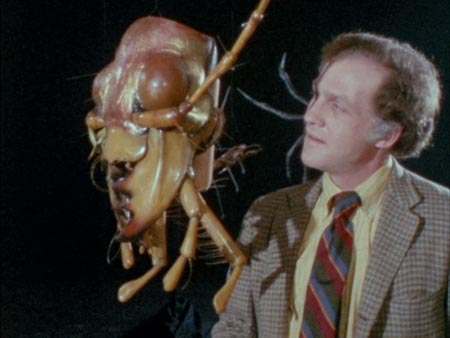
DIRECTED BY: Ed Spiegel (Hellstrom sequences), Walon Green (producer and principal photography), David L. Wolper (executive producer)
FEATURING: Lawrence Pressman
PLOT: The fictional Dr. Nils Hellstrom explains the evolutionary advantages of insects and
concludes they are biologically superior to humans, leading him to predict dire consequences for the future of our species.
WHY IT WON’T MAKE THE LIST: Documentaries don’t come much weirder than this, but even the orgies of insectoid sex and violence and Dr. Hellstrom’s flaky mad scientist rants about the inherent superiority of spiders, termites and centipedes can’t raise this to the level of the truly bizarre. Despite the fact that it doesn’t have the goods to rank among the weirdest movies of all times, however, it’s still a beautiful abnormality that’s well worth your attention.
COMMENTS: The Hellstrom Chronicle contains a lot of curiosities, but the heart of the movie are the amazing images captured through (then miraculous) micro-photography: a caterpillar developing from a fertilized cell to a larva in the space of a minute, a shot of beetles locked in a death struggle that widens and pans to show a human couple cuddling on the lawn, individual brightly-colored butterfly scales glowing in the sunlight like Lite Brites. As that last image suggests, there is a psychedelic character to much of this parade of fantastical bug-tography, one that the filmmakers play up as they segue from those super-closeups of wings to shaky cam scenes of fields of butterflies flying through a forest, as Lalo Schifrin’s electronic free-jazz symphony soars ecstatically. From sequences like this we realize why this documentary was so popular on college campuses in the 1970s; you can almost see the clouds of pot smoke rising up in front of the five-foot tall black beetles with their jutting horns silhouetted against the sunrise, and hear the low murmurs of “far out, man.”
With its dissonant sitars, electric pianos dithering over waves of cymbals, and waveform synthesizers wavering in the background, Schrifin’s remarkable score evokes not only midnight trips but also conventional sci-fi giant insect cues, which is appropriate because much of the Continue reading CAPSULE: THE HELLSTROM CHRONICLE (1971)→
FEATURING: John Cameron Mitchell, Michael Pitt, Miriam Shor, Andrea Martin
PLOT: We first meet Hedwig as she and her band the Angry Inch are performing at a seafood buffet in Kansas City. In flashback, and in music videos, we learn that she was born a boy named Hans in East Berlin, and underwent a (botched) sex change operation so she could marry an American G.I. and leave for the West. Now, she and her band are shadowing the cross-country tour of Tommy Gnosis, Hedwig’s ex-boyfriend turned arena rock star, whom she accuses of having stolen her songs.
BACKGROUND:
John Cameron Mitchell, then a professional stage actor, debuted the character of Hedwig in 1994 at a drag show at a punk nightclub in New York City. With the help of songwriter Stephen Trask, he built an off-Broadway play—originally staged in the ballroom of a fleabag hotel in Manhattan’s meat packing district—around the androgynous chanteuse.
In the early drafts of the play Tommy was the main character and Hedwig a supporting player.
Mitchell’s father was U.S. Army Major General John Mitchell, and the younger Mitchell spent much of his childhood in Berlin where his father was stationed during the later part of the Cold War.
INDELIBLE IMAGE: Is it Hedwig’s androgynous Aryan visage, half-hidden under a pound of glittery makeup and a sculpted blond wig big enough to double the diameter of her head? Or is it the animated retelling of Aristophanes fable in “The Origin of Love,” with a squiggly line drawing of Zeus cutting the legs off whales? Fortunately, thanks to split-screen technology, we don’t have to choose; we can get Hedwig’s glacial glam mug on the left and a severed half-moon face yearning to swallow her up on the right together in one still.
WHAT MAKES IT WEIRD: Well, it does feature a rock star who’s the victim of a botched sex
Original trailer for Hedwig and the Angry Inch
change searching for love and vengeance and telling her life story through song while playing on a tour of discount seafood restaurants with her band of Eastern European refugee musicians, which is a plot you don’t see everyday. If that’s not enough to satisfy your weird desires, however, stick with it until the end, when it drifts into a dreamlike series of music videos that see characters swapping sexes and changing into other characters.
PLOT: Séverine is a wealthy young newlywed who proclaims she loves her husband, but refuses to sleep with him. Her erotic life consists of daydreams in which she is bound, whipped and humiliated. She decides to secretly work as a prostitute during the day, taking the stage name “Belle de Jour”; in the course of her adventures a macho young criminal becomes obsessed with Belle, and he sparks sexual passion in her, as well.
BACKGROUND:
The movie was based on a scandalous (but moralizing) 1928 novel of the same name by Joseph Kessel.
Belle de Jour marked Buñuel’s return to France after his “Mexican exile.” It was the 67-year old director’s most expensive production to date, his first film in color, and his biggest financial success.
The director did not get along with the star, and the feeling was mutual. Buñuel resented Deneuve because she was forced on him by the producers. For her part, the actress felt “used” by the director. Whatever their differences, however, they made up enough to collaborate again three years later on Tristana.
Séverine’s courtesan name, “Belle de Jour” (literally “day beauty”) is the French name for the daylily; it is also play on “belle de nuit,” slang for a prostitute.
Too spicy for critics in 1967, Belle de Jour won only one major award at the time of its release: the Golden Lion at the Venice Film Festival. It now regularly appears on critics top 100 lists (Empire ranked it as the 56th greatest film of world cinema).
Martin Scorsese was behind a 1995 theatrical re-release of the film.
INDELIBLE IMAGE: The ecstatic look on Catherine Deneuve’s face as, tied up and dressed in virginal white, she’s insulted and spattered with shovelfuls of mud (or is it cow dung?).
WHAT MAKES IT WEIRD: Although the movie weaves in and out of dreams and reality until we don’t know which is which, by Luis Buñuel’s standards Belle de Jour is a straightforward dramatic film. Even the dream sequences are relatively rational, unthreatening, and easy to follow, making Belle the favorite “Surrealist” film of people who don’t like Surrealism. But something about the dilemma of Séverine/Belle’s divided personality, and her uncertain denouement, sticks with you long after “Fin” appears. The movie’s weirdness is subtle but persistent, like the scent of a woman’s perfume that lingers in the air long after she’s departed the room.
FEATURING: Gene Wilder, Peter Ostrum, Jack Albertson, Julie Dawn Cole
PLOT: Charlie is a poor boy supporting his mother and four bedridden grandparents with the earnings from his paper route. When eccentric chocolatier Willy Wonka announces he will be awarding a lifetime supply of chocolate and a tour of his mysterious candy factory to the finders of five golden tickets, Charlie wants to win more than anything. When he, along with four bratty companions, finally meets the exceedingly odd Mr. Wonka, Charlie finds the factory, and its owner, far stranger and more magical than anything he could have imagined.
BACKGROUND:
A note for those who believe product placement and corporate tie-ins are a recent phenomenon in movies: although this film was based on Roald Dahl’s bestelling children’s novel “Charlie and the Chocolate Factory,” it was retitled to incorporate the Wonka name in order to promote the release of real-life Wonka candy bars (which were still made up until 2010) by Quaker Oats, who financed the production.
Dahl himself wrote the original script, but it was extensively rewritten by an uncredited David (The Hellstrom Chronicles) Seltzer, reportedly to Dahl’s displeasure. (It’s worth noting that Dahl, like most authors, pretty much hated every adaptation of his work).
This was the only movie Peter Ostrum (Charlie) ever acted in.
The movie just broke even at the box office, but became a cult sensation thanks to television screenings and home video. In 2003, Entertainment Weekly ranked Willy Wonka and the Chocolate Factory as the 25th biggest cult movie of all time.
The score was nominated for a “Best Music, Scoring Adaptation and Original Song Score” Oscar but lost to Fiddler on the Roof.
Despite the fact that he was rejected for the role of the candy shop owner in the film, Sammy Davis, Jr.’s 1972 rendition of the film’s first musical number, “The Candy Man,” became a #1 hit and a staple of his live shows.
Charlie and the Chocolate Factory, Tim Burton‘s 2005 adaptation of the same material with Johnny Depp as Wonka, is somewhat closer to Dahl’s original novel.
INDELIBLE IMAGE: Wonka’s face, bathed in flashing red and green lights, as he shrieks incoherently at the end of his terrifying trip down a psychedelic tunnel of horrors. It’s the capping image of a horrifying scene that’s been scarring unsuspecting children for 40 years now.
WHAT MAKES IT WEIRD: Is it Gene Wilder’s ultra-eccentric performance as the charming but vaguely demonic candyman in a purple velvet jacket and burgundy top hat who suavely arranges for wicked children to hang themselves with the licorice ropes of their own vice? Or the chorus of orange-faced, green haired, dwarf laborers who sing moralizing “Oompah Loompah” tunes after each victim ironically offs him or herself? No, we all know it’s the bad trip boat ride, where Wonka recites Edgar Allan Poe inspired verse (“By the fires of Hell a’ glowing/Is the grisly reaper mowing?”) as the craft careens down a tunnel of horrors while colored strobe lights flash and avant-garde footage plays on the walls that tips this celebration of imagination into the weird column.
Original trailer for Willy Wonka and the Chocolate Factory
“If the cosmic astronaut god-baby at the end of ‘2001’ could come back to Earth and make a movie? It would pretty much be ‘Tree of Life.'”–Film critic Andrew O’Hehir after the Cannes screening of Tree of Life (via Twitter)
“If you didn’t care for Tree of Life then genetically you are not a human being.”–Tim Heidecker (via Twitter)
PLOT: A couple learns about the death of one of their three sons. Then, a flashback covers events from the birth of the universe to the birth of the couple’s first son, Jack. A series of impressionistic scenes show Jack growing up in a small Texas town, afraid of the stern father who wants to toughen him up to face life’s trials.
Producer Grant Hill recalls that when he first saw Terrence Malick’s original script for The Tree of Life, it was “a long document that included photographs, bits of material from his research, paintings, references to pieces of music. It was like something I’d never seen or even heard of before.”
Special photographic effects supervisor Douglas Trumbull had worked on 2001: A Space Odyssey (1968) and Blade Runner (1982). He came out of retirement to work on this film at Malick’s request.
Won the Palme D’or at Cannes in 2011 and was voted “best film” in Sight & Sound‘s 2011 poll.
After some theatergoers asked for their money back after screenings of the movie, the Avon Theater in Stamford, Connecticut put up a poster reading, in part: “We would like to remind patrons that THE TREE OF LIFE is a uniquely visionary and deeply philosophical film from an auteur director. It does not follow a traditional linear narrative approach to storytelling. We encourage patrons to read up on the film before choosing to see it, and for those electing to attend, please go in with an opened mind and know that the Avon has a NO-REFUND policy once you have purchased a ticket to see one of our films.”
A shorter version of the film, featuring expanded versions of the birth of the universe sequences, is planned for a separate release as an IMAX documentary at a later date.
Our original July 5, 2011 review rated The Tree of Life a “Must See,” but demurred that the film was not quite weird enough to merit a place on the List. Readers disagreed, and in the 2nd Reader’s Choice Poll they voted Malick’s masterpiece be promoted to a List Candidate.
INDELIBLE IMAGE: Thanks to its cosmic visuals, The Tree of Life is compared to 2001: A Space Odyssey more often than any other movie. That should tip you off that selecting a single indelible image is no easy task. I could cheat and include the entire twenty minute birth of the universe montage. I could select my personal favorite image: the child in a flooded, womb-like bedroom who swims out the window to be born as a teddy bear floats in the amniotic brine. But I believe we will be forced to anoint the “gracious dinosaur” scene as the film’s most unforgettable gambit. It’s Malick’s “chaos reigns” moment, the juncture at which you either get out of your seat and leave the theater, or experience your first weirdgasm of the evening.
WHAT MAKES IT WEIRD: Sometimes, when you spend your cinematic time immersed in the surrealistic worlds of David Lynch and Alejandro Jodorowsky, it’s easy to forget how uncompromisingly radical and bizarre a film like The Tree of Life appears to someone whose idea of an “out there” movie is Cowboys and Aliens. In our initial assessment of Malick’s grandiose God picture, we concluded that “surrealism is only used as an occasional accent here; overall, the mood is more accurately described as ‘poetic’ rather than ‘weird’” while acknowledging that “[a]ny movie that tells the story of a suburban Texas boy’s troubled relationship with his father—but uses a dramatic encounter between dinosaurs to illustrate its main point—is at least making a nod towards the bizarre.” In the months since that initial review, however, The Tree of Life‘s empyrean strangeness has continued to impress us as 2011’s best weird work. The clincher came when co-star Sean Penn complained to the French press, “A clearer and more conventional narrative would have helped the film without, in my opinion, lessening its beauty and its impact. Frankly, I’m still trying to figure out what I’m doing there and what I was supposed to add in that context! What’s more, Terry himself never managed to explain it to me clearly.” That’s all the endorsement we need: when a movie is too weird for its own Hollywood stars, we have to accept that it’s just weird enough for us.