Tag Archives: Must see

225. ADAPTATION. (2002)

CHARLIE KAUFMAN: I’ve written myself into my screenplay.

DONALD KAUFMAN: That’s kind of weird, huh?

Adaptation.

Must See

DIRECTED BY:

FEATURING: , , Chris Cooper, Brian Cox

PLOT: Screenwriter , fresh off the hit Being John Malkovich, is contractually and mentally trapped as he is forced to plow his way through an impossible project: “writing a movie about flowers.” Things go from bleak to bizarre as he finds himself competing with his endearingly oblivious twin brother, Donald, who also aspires to be a screenwriter. Charlie slips further and further past the deadline, until things come to a head in the film’s swampy denouement where he comes face-to-face with both the writer of and titular character from “The Orchid Thief,” the book he is adapting for the screen.

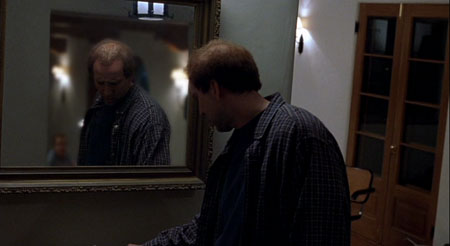
Still from Adaptation. (2002)

BACKGROUND:

  • The screenplay for Adaptation. was on Charlie Kaufman’s to-do list since the late ’90s. Tasked with adapting Susan Orlean’s novel-length essay “The Orchid Thief” and suffering the same problems as his doppelganger, he kept his progress secret from everyone other than Spike Jonze until 2000, when the movie was green-lit for production.
  • Screenwriting guru Robert McKee and his seminars are real. He personally suggested Brian Cox play him in the movie.
  • Adaptation. handily recouped the producers’ investment, with a return of $32.8 million worldwide on a $19 million outlay.
  • Nominated for four Oscars: best actor for Cage, supporting actor for Cooper, supporting actress for Streep, and adapted screenplay for Charlie and Donald Kaufman. Cooper was the only winner.
  • Though “Donald” Kaufman’s serial killer script The 3 was never shot, the idea may have inspired two subsequent movies, 2003’s Identity and 2006’s Thr3e.

INDELIBLE IMAGE: Returning from a misfired date, Charlie finds his twin brother already back home from a writer’s seminar, brimming over with newly adopted wisdom. As Charlie stands in front of his hallway mirror, Donald’s face is captured in the reflection as he expounds upon his own screenplay’s “image system” involving broken mirrors. Charlie’s expression goes from dour to disbelieving at this inanity, and the viewer sees the movie mock both itself and screenplay tricks. A further twist is added by the fact that the blurry reflection in the mirror is the face of the actual Charlie Kaufman talking to Nicolas Cage.

THREE WEIRD THINGS: Film-within-a-film-within-a-screenplay-within-a-screenplay ; Ouroboros; orchid-snorting

WHAT MAKES IT WEIRD: For all its unconventionality, Adaptation is amazingly self-deprecating. Spoilers unravel in opening scenes and are tossed aside, coastal city elites are presented as real people with the petty little problems real people have, and Nicolas Cage gains a bit of weight and loses a bit of hair to provide the compelling double performance as the Kaufman brothers. Events seem scattershot, only to have their purposes later clarified as the tightly structured flow keeps the viewer jumping from moment to moment, always questioning which parts of this convoluted tale are actually true.

COMMENTS: Between its thorough description of the protagonist Continue reading 225. ADAPTATION. (2002)
222. SPIRITED AWAY (2001)

Sen to Chihiro no Kamikakushi

“It was just too bizarre.

“Honestly, when I watched Spirited Away for the first time back in 2008, I didn’t like it for the same reason as you. I just found it too weird.”

–IMDB message board dissenters on Spirited Away

Must See

DIRECTED BY:

FEATURING: Voices of Rumi Hiiragi, Miyu Irino, Mari Natsuki; , Jason Marsden, (English dub)

PLOT: While moving to a new town, ten-year-old Chihiro and her parents take a detour to a seemingly abandoned amusement park in rural Japan. Once the sun sets, the park transforms into an otherworldly resort for spirits and gods overseen by the cruel witch Yubaba. Now separated from her parents, Chihiro must learn to survive among an array of weird creatures as she attempts to reunite her family and return home.

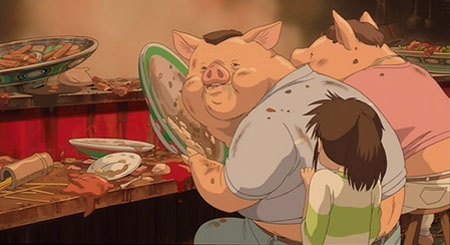
Still from Spirited Away (2001)

BACKGROUND:

  • Hayao Miyazaki had announced his retirement from feature filmmaking in 1998, after completing Princess Mononoke. He came out of retirement in 2001 to make Spirited Away.
  • Disney Studios had distributed Studio Ghibli’s previous film, Princess Mononoke, in the United States, with disappointing results. They put little money into marketing the film, but strong reviews and word of mouth turned it into a hit, and Disney’s partnership with Ghibli was cemented from that point on.
  • Spirited Away won the Academy Award for Best Animated Feature (along with 52 wins granted by other organizations).
  • Spirited Away is the highest-grossing film of all time in Japan.
  • Hayao Miyazaki had announced his retirement from feature filmmaking in 2001, after completing Spirited Away. He came out of retirement in 2004 to make Howl’s Moving Castle.

INDELIBLE IMAGE: Lured into the park by a delicious scent, Chihiro’s parents come upon a vacant restaurant filled with sumptuous, exotic dishes. The two immediately begin to fill their plates, ignoring their daughter’s worries that they’ll be punished for taking the food. After the park begins its transformation, Chihiro returns to find her parents bloated and hunched over piles of scraps. She tries to warn her father about what is happening, but when he looks at her she sees only the sweating, engorged face of a pig. The grunting pig ignores Chihiro and climbs over the restaurant’s counter, only to be swatted away by an unseen figure’s reptilian arm. The pig then crashes to the ground with a primal squeal, frightening Chihiro as she cries out for her parents and runs into a street filled with tall, anonymous ghosts.

THREE WEIRD THINGS: Pig parents; “No Face” eats; three heads and a giant baby

WHAT MAKES IT WEIRD: In Spirited Away, Hayao Miyazaki plays on the normal fears of lost children as the basis for an outlandish, frightening fantasy about a young girl being thrust into the incomprehensible life of an adult. The imagination of the setting is so immense that it seems to dwarf the film itself, suggesting a fully realized universe of magic and monsters with borders that extend far beyond the frame of the story.


Disney Trailer for Spirited Away

COMMENTS: Spirited Away begins with the main character, Chihiro, Continue reading 222. SPIRITED AWAY (2001)

LIST CANDIDATE: COME AND SEE (1985)

Come and See has been promoted to the List of the 366 Best Weird Movies Ever Made. Please visit the official Certified Weird entry.

Idi i Smotri

Must See

DIRECTED BY: Elem Klimov

FEATURING: Aleksey Kravechenko, Olga Mironova, Liubomiras Lauciavicius, Jüri Lumiste

PLOT: A teenage boy loses his innocence when he joins partisans fighting against the Nazis in 1943 Belarus.

Still from Come and See
WHY IT MIGHT MAKE THE LIST: Although in a number of ways Come and See is a conventional war movie, its unremitting bleakness, violent interruptions, and dream-like passages make it transcend the mold.

COMMENTS: The difficulty in writing about this movie is apparent from the title. The sights and sounds of Come and See carry the movie, and much of the narrative is embedded in the grimy and beautiful imagery. Although the string of events is fairly straightforward, our sense of time is thrown to the wind. Everything happens over the course of a few days, but the young protagonist, at the same time, ages decades from his experiences. I have not seen a  more harrowing war movie, nor would I really care to.

Come and See tells the story of a young man who is eager to join the local partisans who are charged with causing havoc with the occupying German forces. The opening shot is of the back of an older man’s head as he looks over a sandy field. “Hey, are you crazy?” he asks an unseen character, “What do you think you’re doing? Playing a game?” Soon after issuing some nebulous warnings, we find the man’s son, Florya, with a friend. They are looking for a rifle, as that is the requirement to join the partisans. They scour filled-in trenches, hoping to find a ticket into the group. An odd shot shows young Florya seemingly making love to the ground, his arms buried deep. He makes a climatic grunt and rises, holding in his hands a muck coated SVT-40 rifle. In this quasi-sexual act, he takes his first step in becoming a man.

Much to his mother’s distress, the partisans take him in. Thus begins a recurring series of close-up faces. Time and again, Klimov relies on the actors’ faces to convey the mood of the scene; sometimes full of wonder, sometimes eager, often tragic. He juxtaposes the mother’s anguished face at the news of her son’s enlistment with the happy grin of the boy who finally feels he has grown up. He meets with the partisans and seems to be accepted, even posing in a large group photo of the squad, taken by an enthusiastic Soviet sporting a jokey Hitler-mustache.

Shortly thereafter, when he is left behind by the militia, he cannot control his tears, until he finds Glasha, a girl around his age. Together they have an innocent encounter, set in a lush wet forest. This invocation of Eden is quickly cut off by a warplane. Bombs soon drop, along with paratroopers. Eden is destroyed—to be found again in a dreamlike sequence that starts off the next morning.

After that point, Come and See allows the viewer no hope of beauty. Continue reading LIST CANDIDATE: COME AND SEE (1985)

205. FANTASIA (1940)

“…action controlled by a musical pattern has great charm in the realm of unreality.”– on Fantasia

Must See

DIRECTED BY: Norman Ferguson, James Algar, Samuel Armstrong, Ford Beebe, Jr. Jim Handley, T. Hee, Wilfred Jackson, Hamilton Luske, Bill Roberts, Paul Satterfield, Ben Sharpsteen

FEATURING: Leopold Stokowksi and the Philadelphia Orchestra, Deems Taylor, Walt Disney (voice of Mickey Mouse)

PLOT: An orchestra files in to a concert hall, followed by classical music critic Deems Taylor, who introduces the film and describes the different purposes of classical music. The first musical selection, Bach’s “Toccata and Fugue in D-minor,” illustrates “absolute” music, and consists of a series of abstract images combined with views of the orchestra in silhouette. The six animated musical sequences that follow compose the bulk of the movie, following the adventures of fairies, Mickey Mouse, dinosaurs, centaurs, hippo ballerinas, and demons set to the music of Tchaikovsky, Dukas, Stravinsky, Beethoven, Ponchielli, Mussorgsky, and Schubert, all introduced by Taylor.

Still from Fantasia (1940)
BACKGROUND:

  • The meeting of conductor Leopold Stokowski and animation god Walt Disney, in 1937 at Chasen’s restaurant, is the stuff of legend. Disney was starstruck with the conductor’s celebrity, mysterious accent, and fierce mane. The seed of an idea for a “concert film” sprang from the meeting. At this time Disney had only produced and released one previous feature: Snow White and The Seven Dwarfs (1937). The idea of an animated feature had seemed risky and radical, with the naysayers predicting bankruptcy. The profits and critical acclaim from Snow White forever silenced those doomsday prophets. Now, Disney was ready to take another risk. 1940 saw the release of Disney’s second and third feature films. Artistically, it paid off as Pinocchio (1940) and Fantasia are, to date, Disney’s two greatest films, released only nine months apart. The former was a critical box office hit. The latter did not make money for nearly twenty years.
  • Fantasia was an expansion of Disney’s “Silly Symphonies” series of musical shorts (which were set to original music commissioned by Disney studios rather than classical masterpieces). The “Sorcerer’s Apprentice” segment, starring Mickey Mouse, was originally made as a Silly Symphony but cost over $100,000 to animate, and Disney realized the only way to recoup that budget was to make it part of a feature.
  • Fantasia was (mostly, despite some notable howls of derision) well-received by critics and audiences on release. It failed to turn a profit because of its enormous budget, difficulties in distribution (new sound systems had to be installed in any theater that wanted to play it, so it was rolled out piecemeal as a roadshow feature), and the fact the the onset of WWII cut off the foreign markets. Disney studios continued to re-release the film every five to ten years up until 1990, however. By the late 1960s, spurred by its discovery and embrace by the psychedelic generation, Fantasia had become both a beloved classic and a cash cow.
  • Bits from the original “Pastoral Symphony” sequence were later erased due to their depictions of black centaurs, who were caricatured and depicted as servants to the white centaurs.
  • Disney had planned more editions of Fantasia (one of which included a collaboration with ), but its initial failure laid such plans to rest until sixty year later, when Walt Disney Productions released Fantasia 2000Fantasia 2000 had fleeting moments of brilliance, but was mostly a disappointing sequel; too clean, too crisp, lacking the risk-taking intensity and provocativeness of the original.

INDELIBLE IMAGE:  In an entire film of indelible images, alligators swooning over and dancing with hippos may have been the “eureka, it’s weird!” moment for the film’s 1960s acidhead crowd. We concur.

THREE WEIRD THINGS: Dancing mushrooms; Stravinsky dinosaurs; alligator/hippo romance

WHAT MAKES IT WEIRD: Pinocchio may have had boys turning into jackasses, and Dumbo (1941) had it’s mind boggling “pink elephants on parade,” but Walt Disney’s Fantasia is chock-full of progressive strangeness and an ardent embrace of art for the sake of art. It’s Walt’s weirdest.


1956 re-release trailer for Fantasia (including part of the scene later deleted from prints due to charges of racism)

COMMENTS: Over a thirty year period I have seen Fantasia (1940) Continue reading 205. FANTASIA (1940)

204. DESTINO (2003)

“A magical display of the problem of life in the labyrinth of time.”– describing Destino

“A simple story about a young girl in search of true love .”– describing Destino

Must SeeWeirdest!

DIRECTED BY: Dominique Monfery

FEATURING: Vocals of Dora Luz

PLOT: Essentially plotless, but the loose narrative involves a nude woman wandering the desert who comes upon a pyramidal statue with a male figure embedded in it. A bird bursts from the statue and it comes to life. The woman and man try to approach each other but walls and other surreal obstacles constantly grow between them, until the woman is transformed into a ballerina with a dandelion head, and then into a bell housed in a tower.

Still from Destino (1946/2003)
BACKGROUND:

  • After making the (flop) Fantasia, was still looking for opportunities to incorporate high culture into his animated projects. In the 1940s visited Hollywood frequently; fascinated by stars and by filmmaking, and constantly promoting himself, the Spanish eccentric struck up friendships with many Tinseltown luminaries, including Disney. The two men hit it off and conceived the idea of a collaboration on a short film (which would be part of an anthology feature film similar to Fantasia). Dalí worked closely with Disney animator John Hench,  who translated many of the Spaniard’s sketches and ideas into ready-to-film animation cels. The project was begun in 1945 and continued for eight months, but only 17 seconds of footage was actually created before it was scrapped.
  • Secondary sources report that the male statue is Chronos (presumably the god of time) while the female character is named “Dahlia” (a feminization of the artist’s name).
  • The official explanation for Disney’s decision to shelve the project was that the wartime vogue for “package pictures” had passed, and Disney’s distributors were requesting full-length features. The documentary Dalí & Disney: A Date with Destino suggests that Walt may have found the film too “bananas,” citing a report that he blew up one afternoon after seeing that Dalí had stopped painting pictures of ballerinas and had begun drawing baseball players instead.
  • Roy E. Disney, Walt Disney’s nephew and a Disney senior executive, was looking for material to provide extras for the DVD release of Fantasia 2000 when he discovered the unused material for Destino in a moldy corporate storeroom. He decided to reconstruct the film from the existing storyboards and leftover concept art, largely so that the Disney Company would gain property rights in the underlying artwork. Fortunately, John Hench was still alive at the time to provide guidance for the reconstruction.
  • This was animator Dominique Monfery’s first work as a director.
  • The short briefly played theaters as an unlikely introduction to the comedy Calendar Girls.
  • Destino was nominated for an Academy Award for best short animated film in 2004, but—incredibly, given its provenance and historical value—it did not win. (‘s excellent Harvie Krumpet got the nod instead).

INDELIBLE IMAGE: The most impressive of many gloriously hallucinatory moments is the seventeen second sequence that John Hench animated to try to convince a faltering Walt Disney to go ahead with the project. Two grotesque faces, with bulging eyeballs and tattered skin pulled taut and held in place by crutches, are perched upon two turtles who slowly bear them together. In the negative space formed when their noses touch, a perfect, pearly ballerina appears.

THREE WEIRD THINGS: Dandelion-headed dancer; baguette-wearing bicyclists; ballerina-head baseball

WHAT MAKES IT WEIRD: Destino is Salvador Dalí’s only moving canvas. A slight breeze from Walt Disney Studios nudges it ever so slightly off its already tilted axis. This dream of a Disney princess trapped in Dalí’s delirious desert is something we will not see the likes of again in our lifetimes.


Promotional clip about Destino from the Dalí Museum (in Spanish and English)

COMMENTS: Salvador Dalí was a genius. This fact may seem Continue reading 204. DESTINO (2003)