Tag Archives: Mental illness

CAPSULE: TITICUT FOLLIES (1967)

DIRECTED BY: Frederick Wiseman

FEATURING: The inmates and staff of Bridgewater State Hospital for the Criminally Insane

PLOT: A documentary chronicling the operations of the Massachusetts Correctional Facility and the lives and treatment of its inmates.

Still from Titicut Follies (1967)

WHY IT WON’T MAKE THE LIST: Titicut Follies is shocking, disturbing, disheartening. It helped usher in cinema verité with a direct approach to documentary filmmaking that had rarely been seen before. But it’s only weird to the extent that man’s inhumanity to man is considered weird. In fact, the most bizarre thing about the film may be that, in half a century, things have changed very little.

COMMENTS: It’s remarkable that Titicut Follies exists at all. The subject matter is not typical fare, even for a documentary, with no protagonist to follow and no banner to carry. The presentation is stark and straightforward, showing routine events with no context or explanation, and refusing to allow uncomfortable moments to end through the artificial escape of cutting away. Watching it fifty years after it was shot, in a society where everyone is painfully aware of the need to manage situations to minimize liability and risk, it is astounding to see how open and guileless the staff is in their attitudes and actions toward their charges. The obvious question is, how did anyone let this get on film?

Credit is due first and foremost to director/producer/editor Frederick Wiseman, who is rightfully famous for his blunt approach to his subjects. Eschewing talking heads, narration, captions, non-diegetic music, or anything that would comment upon the images captured by his camera, Wiseman immerses himself in his chosen setting, fading into the background until the subjects forget the camera is even there. This fly-on-the-wall approach allows him to capture moments of extraordinary intimacy, because the participants fail to notice that they never went off public view. Trained as a lawyer, Titicut Follies was Wiseman’s first film as a director, but it cemented both his style and his subject matter, a warts-and-all look at how people function within institutions. (A recipient of an honorary Oscar this year, none of Wiseman’s films has ever even been nominated for a competitive award).

Some of the responsibility has to be placed at the feet of his willing subjects. Clearly, no one at Bridgewater had any worries about how their methods would be viewed. There can be no doubt that many of these inmates are afflicted with severe mental disease. Some are victim to uncontrollable body spasms, others spew endless paranoid monologues that name-check the president and the pope among their tormentors. Even a quiet, composed patient reveals his true nature as he describes his horrible crimes in a flat, detached tone. Without a doubt, keeping control over hundreds of unpredictable, dangerous men requires an approach that would be frowned on in polite society.

Those methods, though, are delivered in such a cold, unfeeling manner that it is ultimately impossible to view them as anything but torturous. Footage of a man named Jim, who is chided for fouling his cell, is peppered with what initially feels like friendly banter from the guards tasked with cleaning him up. However, as the scene goes on, the suggestion that he try harder morphs into bullying, and their repetition of his name is so condescending and insistent that Jim’s eventual outbursts feel utterly justified. The final shock comes with Jim’s revelation that he used to be a teacher; in this place, no honorable past will protect you from the hellish present.

Which points to one more explanation as to how Titicut Follies slipped through the cracks: there’s no empathy left at the institution to trigger embarrassment. No one thinks twice about the decency or appropriateness of what they are doing any more. Concern for humanity has long since left Bridgewater. In the film’s most notorious scene, an inmate is force-fed via a tube through his nose by doctors who openly smoke and discuss his condition in infantile terms. The delivery of nourishment by decidedly non-nurturing means is the film’s greatest oxymoron, and Wiseman magnifies the horror of the moment by crosscutting with footage of the same patient’s funeral, in which he appears to receive far greater care and affection than he did in life.

The movie is framed by scenes from an amateur variety show put on by the prison, with the awkward-looking patients singing standards in stiff white shirts and milkmen’s bow-ties. They are frequently joined by the warden, who, absurdly, views himself as a delightful showman, telling off-color jokes, breaking into song (he does this offstage as well, while walking through the hospital), and lusting after applause from the audience. Those moments feel strange in counterpoint with the daily horrors of life at Bridgewater. Yet, they’re actually a perfect extension of the interplay between inmates and staff throughout the film. Both groups are trapped in Titicut Follies, some by mental illness, some by the apathy and cruelty brought on by years of detached power. However, one of those groups doesn’t realize it’s trapped. But it soon will…

TRIVIA: …and how. Once they got a look at Wiseman’s film, the Massachusetts Department of Corrections sued to block the movie and managed to get Titicut Follies banned for over two decades, ostensibly to protect the privacy of the inmates. A title card added at the end of the movie curtly throws shade on the true impact of the Department’s efforts.

WHAT THE CRITICS SAY:

“The opening of the film is appropriately surreal, setting the tone for the next hour and a half… It’s almost something you could imagine seeing in a Harmony Korine film… it’s crazy to think it’s actually real.” – Jay Cheel, The Documentary Blog (DVD)

CAPSULE: PERFUME OF THE LADY IN BLACK (1974)

DIRECTED BY: Francesco Barilli

FEATURING: Mimsy Farmer, Maurizio Bonuglia, Mario Scaccia, Jo Jenkins, Daniela Barnes, Orazio Orlando

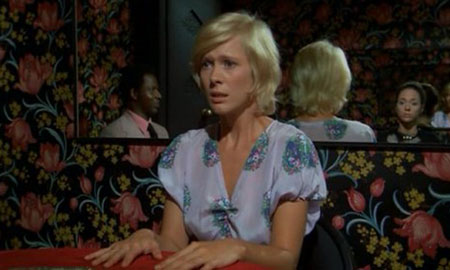
PLOT: A wealthy, workaholic bachelorette chemist begins seeing visions of a lady in black, and a young blond girl; is she going mad or being tricked (or both)?

Still from The Perfume of the Lady in Black (1974)

WHY IT WON’T MAKE THE LIST: With its hysterical hallucinations and hints of witchcraft, plus a grisly surprise ending, a case could be made for certifying this quality offbeat occult giallo; but ultimately, it falls into the category of “you gotta draw the line somewhere.”

COMMENTS: In his interview comments accompanying the Raro Video release, writer/director Francesco Barilli acknowledges The Perfume of the Lady in Black’s debt to , but you’d probably sniff the lingering scent of Repulsion early on even without that admission (not to mention a whiff of Rosemary’s Baby, too). Perfume is part of a line of 60s and 70s horrors playing on the anxieties of young single working women. Thanks to sexual liberation, a class of working women living on their own without a live-in male protector was a relatively new phenomenon, and for all the necessary freedom, the fact is that it can be scary to be a woman in a man’s world. Lone females have more to fear than solo males: they fear all the same things men do, plus, they have to fear men. Silvia is competent enough to manage a chemistry lab, but she can’t trust her surroundings, her neighbors, strangers who stare at her on the street, or her even own senses in the dead of night. Whenever she’s alone, she’s endangered, and returns to sanity only when her boyfriend rushes to her side.

Perfume takes place in that lush giallo world, an existence full of tennis dates, elegant silk robes, and apartment courtyard’s with Roman fountains. The art direction is sumptuous, and at times a little outrageous, such as the jungle mural that hovers above Silvia’s friend’s bedpost. Surely such bourgeois elegance can only be there to cover up the stench of decadence. Mimsy Farmer, while not star material, is a treat in this role, constantly frightened and almost reluctantly sexy. The plot seems to be being made up as it goes along. It turns out that there are really two storylines, one of which involves oblique divulged secrets from Silvia’s childhood. The dual plots are mashed together, which produces extra confusion, but less satisfaction, since there’s not a single resolution, and nothing in particular to tie them together. Highlights include a ghostly little girl, “Alice in Wonderland” references, and a séance with a blind psychic (which may be the most giallo scenario ever). The ending is a genuine shock surprise, leaving a strong enough impression to make you forget the somewhat tedious early moments.

Raro Video upgraded Perfume to Blu-ray in 2016. The disc includes an interview with writer/director Barilli (which might be cut down from a longer one included on the DVD release) and a bonus short film, the 23-minute “The Knight Errant,” a shot-on-video variation on Death Takes a Holiday with a couple of surreal surprises that’s well worth a watch.

WHAT THE CRITICS SAY:

The Perfume of the Lady in Black piles on the weird, somewhat to its detriment.”–Jamie S. Rich, DVD Talk (2011 DVD)

243. VAMPIRE’S KISS (1988)

366 Weird Movies may earn commissions from purchases made through product links.

“Vampire’s Kiss, in which Cage plays a literary agent labouring under the delusion he is a vampire, is a weird film that is kind of great in its weirdness and in which Cage exposes himself fearlessly to ridicule, not least for appearing in a horror movie in the first place.”–from a 2013 Guardian profile on Nicolas Cage

Recommended

DIRECTED BY: Robert Bierman

FEATURING: , Maria Conchita Alonso, , Elizabeth Ashley, Kasi Lemmons

PLOT: Peter Loew is a well-to-do young literary agent with a hedonistic lifestyle, who is also in therapy. One night, he is interrupted while romping with his latest sexual conquest when a bat flies into the bedroom; later, he takes home a one night stand who (maybe) bites him on the neck in the throes of passion. He begins to believe he is becoming a vampire, while at the office he grows increasingly annoyed with and abusive to a junior secretary, Alva, to whom he assigns the task of combing through the agency’s archives looking for a missing contract.

Still from Vampire's Kiss (1988)

BACKGROUND:

  • This was screenwriter Joseph Minion’s second produced script—the first was After Hours (1985).
  • Cage had originally committed to the part before the romantic comedy Moonstruck (1987) ignited his career. He tried to back out of Vampire’s Kiss, and Judd Nelson was tapped to play Peter Loew; thankfully, Cage changed his mind and decided to honor his commitment.
  • According to the commentary, a late scene—where Peter is walks down a Manhattan street talking to himself with blood on his shirt and none of the passersby take any notice of him–was filmed with real New Yorkers who had no idea they were on a movie shoot.

INDELIBLE IMAGE: It’s tempting to select the vision of Cage’s manic face as he mocks poor Alva (an image Dread Central’s Anthony Arrigo brilliantly summarized as “the infamous shot of Cage’s eyebrows attempting to flee the insanity that is his face“), a sight so powerful that it birthed an Internet meme. The notoriety of that shot aside, there are probably a dozen Cage expressions or poses that could vie for the honor of most unforgettable image in Vampire’s Kiss. We ultimately went with the view of Cage’s defeated face as he lies under his couch-cum-coffin, with Jennifer Beals’s hallucinated legs perched above him—an image also used for the film’s original theatrical poster.

THREE WEIRD THINGS: Alphabet-mastering Cage, cockroach-eating Cage, plastic-fang Cage

WHAT MAKES IT WEIRD: Cage, entirely Cage. This is Nicolas Cage’s strangest performance. Let me repeat that. Cage has starred as an Elvis-obsessed lowlife in movie, as the twin alter-egos of in a movie, as a woman-punching detective in the ridiculous Wicker Man remake, as a heroin-addicted New Orleans cop in a movie, and it’s this performance as a literary agent who thinks he’s turning into a bloodsucker that’s his strangest. Without Cage jumping onto desks, eating cockroaches, and posing like Mick Jagger after demonstrating his mastery of the alphabet, this would merely be an oddball tale; with him in the role, it’s a totally bizarre one.


Original trailer for Vampire’s Kiss

COMMENTS: “That mescaline… that’s strange stuff.” Maybe—just Continue reading 243. VAMPIRE’S KISS (1988)

LIST CANDIDATE: THE ATROCITY EXHIBITION (2000)

DIRECTED BY: Jonathan Weiss

FEATURING: Victor Slezak, Anna Juvander, Michael Kirby, Rob Brink, Diane Grotke, Caroline McGee, Robert Morgan, Mariko Takai

PLOTIn a mental institution, a doctor has enticed patients and staff into staging bizarre microdramas and recording them on film. Is he recording his own mental breakdown, or the larger ills of society?

reagan_sex_s7

WHY IT SHOULD MAKE THE LIST: Inasmuch as cult author J.G. Ballard can still be called “weird” nowadays, the film perfectly captures the clinical nature of his themes and uneasy alliances. One scene is a fashion shoot in the midst of a surgical operation. Another memorable sequence has Traven emerging from a 1950s  black sedan on an airport runway shouting “Marilyn Monroe” and breaking into a run with the sound of helicopters on the soundtrack; he inexplicably ends up back at the sedan, vomiting over the front hood.

COMMENTS: The Atrocity Exhibition is another one of the many “unfilmable” novels that some filmmaker, at some point, takes on as a challenge. first took the plunge, being the first to adapt Ballard’s other “unfilmable” novel, Crash, in the mid-90’s, and largely succeeding. “The Atrocity Exhibition“, however, was slightly more challenging for an adapter: there’s no real plot, just linked incidents; the main character is undergoing a mental breakdown affected by mass media; each chapter represents an aspect of the protagonist’s psychosis (his name changes in each segment); and most of the action is psychological. The book is a collection of themes and ideas showing up in Ballard’s work at the time (the mid to late 1960’s), some of which would be fleshed out/explored further in works like “Crash” and “High Rise,” and is much more fragmentary than most novels.

Jonathan Weiss’s approach in adapting Ballard’s work is geared to the experimental film work in the 1960’s and 1970’s. Using stock-film sequences interspersed with new footage, the film is presented as the artifact from Dr. Traven’s project, staged mini-dramas reflecting his obsessions (assassinations, war, celebrity, plastic surgery, the Space Race) which document his—and by extension, society’s—surrender to psychosis. But is it a surrender, or merely an adaptation to the new order?

Exhibition is perhaps the purest adaption of Ballard’s work to date. The low-budget, as well as the unusual nature of the main role, excluded any casting of name stars, and the movie was shot over the period of several years. It’s not as polished or sexy as Cronenberg’s Crash, but it’s even more intellectually rewarding.

the-atrocity-exhibition

DVD INFO: The Atrocity Exhibition had limited festival screenings in the early ’00’s, but no true theatrical release. It seemed it would languish in obscurity until its release on DVD in 2006 by Reel 23, a European company—Region 0, but on the PAL system—now a pricey import, if you do some hard looking. You get a good transfer of the film in picture and sound, highlighting the score by J.G. Thirwell (“The Venture Bros.”, “Foetus”), subtitles in French, Spanish, German and Dutch, and an informative commentary track by the director. But what makes this release special is a second commentary track with the director and J.G. Ballard together. Ballard doesn’t stick around for the last 20 minutes of the film, pretty much having said whatever he needed to.

A contentious interview with Jonathan Weiss can be found on the “Ballardian” website, along with the review that touched things off.

Oswalds Mill Audio (OMA), selling high-quality and high-end audio equipment, is Jonathan Weiss’ current venture.

WHAT THE CRITICS SAY:

“Weiss works superbly with the material here, creating the most Ballard-like visual representation of the author’s work on the screen… They are all meaningfully integrated into the screenplay – if not in any immediately comprehensible way, at least in a way that is true to how Ballard envisioned it in his writing – and thankfully not in any pretentious rapid-fire montage.”–Noel Megahy, The Digital Fix