Tag Archives: Horror

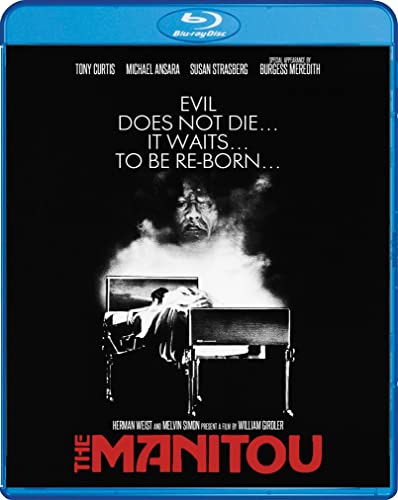
APOCRYPHA CANDIDATE: THE MANITOU (1978)

366 Weird Movies may earn commissions from purchases made through product links.

DIRECTED BY: William Girdler

FEATURING: Tony Curtis, , Michael Ansara,

PLOT: Karen has a problem: there’s a zit on her back which is growing into a tumor that is the manifestation of a 400-year old native American medicine man, which will require the help of psychics, computers, and another medicine man to deal with.

Still from The Manitou (1978)

WHY IT MIGHT MAKE THE LIST: The late Blu-ray release caused a missed connection with the List, now closed. Otherwise, this movie combines the raving premise, bonkers execution, and deadpan seriousness that defines the finest of our so-bad-its-weird curations. The cacophony of an exploding typewriter, an indoor blizzard, a licorice spirit melting out of a table, and a frozen head crashing through a window ensures that everyone will have a favorite indelible scene.

COMMENTS: Today is a very special episode of Pete’s Punishing Picture Show, not the least of which because it touches on one of my favorite perversions side hobbies: collecting bad ripoffs of The Exorcist (1973). From Bollywood to Italian giallo, Exorcist rip-offs form their own genre; you can trace the demon shock wave of 1973 rippling through cinematic history around the world. The Manitou hides behind North American native hoodoo instead of Catholic demonology, but it can’t fool us; it follows the exact same structure act-for-act. Its chief innovation is that by late third act, it gets bored with retrodding Exorcist ground and opts to mix in some Star Wars instead, generously garnished with psychedelic space gloop from 2001: A Space Odyssey for good measure.

Wasting no time in trifling details like character development, The Manitou starts at a hospital as a doctor tries to explain the strange growth on the back of a patient’s neck. The patient is Karen (Susan Strasberg), whose estranged ex-boyfriend Harry (Tony Curtis) is a phony psychic making a living as a freelance Tarot card reader for wealthy widows. Just to nail a pin on how phony he is, he wears a Cookie-Crisp-blue wizard robe and a fake mustache that he peels off and pastes on a pillar en route to his tumbler of scotch at the end of a hard day’s work as a flim-flam artist. But when Karen consults him about her lump problem, he is confronted with real-life black magic, since all attempts to treat the lump with conventional medicine lead to everything going haywire. Harry makes the rounds of his not-fake psychic friends for a séance here and a consultation with a professor of native American studies (a well-cast Burgess Meredith) there, and eventually is led to the conclusion that the lump on Karen’s neck is a reincarnated 400-year old native American medicine man, who is possessing Karen as a parasitic host on his way to being reborn.

The evil influence of the Lump even drives a random client of Harry’s to levitate out of her chair and fly downstairs, killing her, a homicide never to be brought up again. Out of his league when confronted by reincarnated witch doctors, Harry has to drive out to a reservation to recruit John Singing Rock (Michael Ansara), a gruff medicine man who is also the most offensive racial stereotype in film since Mickey Rooney’s buck-toothed Chinaman in Breakfast at Tiffany’s. The whole movie drowns in Disneyfied Injun-Joe buckskin clichés, as Singing Rock executes heap big pow-wow mojo (it involves rattling little leather drums a lot) to contain “Misquamacus,” the name of Karen’s manitou. Misquamacus devoted himself to the dark side of the medicine force, so his coming back is a bad thing. But come back he does, ripping a hole out of Karen’s back as he is birthed into a midget character resembling a slightly chewed cinnamon gummy bear. Misquamacus and Singing Rock spend the rest of the movie in a no-holds-barred Injun magic fight, turning the hospital into a frozen ice cavern straight off the planet Hoth and freezing cheerful nurses into meat popsicles, manifesting lizard spirits, and eventually transforming Karen’s hospital room into an outer space dimension with her bed flying in the middle of it. But Singing Rock marshals the forces of the hospital’s DEC-era computers (“White Man magic!,” he explains) to help in the battle.

As Singing Rock dispenses his medicine-man-wisdom-of-the-day about how the White Man pisses off nature spirits—shame on us!—we soberly realize the consequences of our faithless high-tech lifestyle. Actually, no, not a stinking minute of this movie makes sense, with none of it explained except via Tonto-logic. Nevertheless, it is done with strident deadpan seriousness all the way through; everybody involved seems smugly sure they’d have another Exorcist on their hands. While exteriors are gorgeously shot in San Francisco, the interior sets carries this studio-bound film into made-for-TV funk, feeling like the nuttiest episode of General Hospital ever made. The numerous special effects don’t date themselves to a minute past 1978, giving every “hadouken” laser blast in the medicine-magic battle a distinct early “Doctor Who” flavor. Insult to injury, Tony Curtis has never been so badly miscast. His streetwise Manhattan borough delivery demolishes every line he speaks. The Manitou is one of those movies where nothing works, and yet the entire 104-minute running time is hilarious entertainment that will never bore you for a second. It could be one of the greatest specimens of unintentional camp ever made. Just be sure if you get a zit on your neck, treat it with some Clearasil and take care of it the easy way.

WHAT THE CRITICS SAY:
“The plot can easily be summarized, but first this announcement: If you happen to be drinking hot coffee at the present moment, please set your cup aside, because elements of the scenario might cause you to begin shaking with helpless laughter and you could spill the coffee on your rug, dog, cat, mate or newspaper.”–Roger Ebert, Chicago Sun-Times, contemporaneous

CAPSULE: PIERCING (2018)

DIRECTED BY: Nicolas Pesce

FEATURING: , , Laia Costa

PLOT: Reed has a good job, a loving wife, a cherished newborn daughter, hallucinations, and a (hopefully satiable) lust to kill; he checks into a hotel planning to get his bloodlust out of his system by murdering a call girl, but the woman who arrives may be more than a match for him.

Still from Piercing (2018)

WHY IT WON’T MAKE THE LIST: It’s slick and sick, but plays like a milder version of a film that already made the List.

COMMENTS: Piercing will play better if you’ve never seen Audition, but if you have seen the older film, you may find that the newer one suffers (hee hee) by comparison to its sadistic sister. Piercing is adapted from ‘s 1994 novel of the same name. The author reworked the same general sadomasochistic theme three years later for “Ôdishon.” In doing so, Murakami improved the scenario by making the male protagonist more sympathetic and the female antagonist more mysterious. That’s not to say Piercing is unworthy of your time, or that you will always know exactly where it’s heading, but Audition initiates should prepared for a little bit of a disappointment.

Director Nicolas Pesce explored similarly dark territory in his debut, The Eyes of My Mother, which he shot in rustic and minimalistic grayscale. Here, he goes for a much richer stylistic palette, with a Technicolor style showcasing deep reds and mahogany wood paneling. The opening, in fact, puts us in mind of Rear Window, with the camera panning over an artificial mosaic of skyscrapers, inside whose windows we can imagine individual dramas playing out. Hitchcock, of course, would never have added an infant girl who tells daddy “you know what you have to do” in a creepy baritone.

Pesce creates a genteel atmosphere—a world where men put on ties to meet call girls, hookers wear stocking and fur coats, everyone drinks their spirits on the rocks before getting down to business, and guys use embroidered silk handkerchiefs to douse their dates with chloroform. The soundtrack is a selection of smooth and sophisticated pop, including “The Girl from Impanema” and needle drops from classic gialli like Profondo Rosso; even the most cloying number, the mellow folk-rocker “Bluer than Blue,” is given the best possible treatment. The hotel room and apartment interiors all look like 60s penthouse bachelor pads, with sunken living rooms and dramatic wall-mounted half-moon sconces, very mid-century modern. All the elegant trappings of civilization, of course, only serve to disguise the depravity and barbarism squirming inside the characters’ souls.

Abbott and Wasikowski are perfectly cast. He is superficially suave, but constantly bumbling as he hides his guilty secret; Wasikowski, keeping her natural Australian accent, is a psychotic pixie dream girl who lets on very quickly that she’s not quite all there. They are a perfect match. In terms of gruesomeness, Pesce doesn’t go quite as far as would, but he is willing to go quite a ways, and you should find yourself squirming often. Abbott’s casual hallucinations—he constantly carries on conversations with people who encourage him to carry out his secret murderous plan—keep things interesting, and cast doubt on Wasikowski’s character. Is she really as depraved as he is, or is it just his projection of her as a willing victim/collaborator in his elaborate fantasy? A grotesque dream sequence (scored to the aforementioned soft-rock hit) also mirrors the surrealistic excursion of Audition, and although it is put in service of revealing backstory, there are still some tremendously eerie moments here, with a scorpion-bug monster scurrying from out of a toilet to harass our paralyzed protagonist.

For an evening of dangerous fun, refined sickos could do a lot worse than Piercing. Pesce reaffirms his talent while broadening his range. He’s come close to a breakthrough weird movie with his first two films; his next project is a remake of Ju-on [The Grudge], after which we’re hoping he will be able to come through with something that will really blow our socks off.

WHAT THE CRITICS SAY:

“The movie gains momentum as it indulges in hallucinogenic phantasmagoria.”–Glenn Kenny, The New York Times (contemporaneous)

CAPSULE: TERROR 5 (2016)

Beware

DIRECTED BY: Sebastian Rotstein, Federico Rotstein

FEATURING: Walter Cornás, Lu Grasso, Gastón Cocchiarale, Arias Alban

PLOT: An anthology of horror stories in an Argentinian town told over a single night, involving revenge, zombie-like creatures, and snuff films.

Still from Terror 5 (2016)

WHY IT WON’T MAKE THE LIST: What strangeness is to be found here can mostly be credited to shoddy construction.

COMMENTS: If you’re looking for something nice to say about Terror 5, then the camerawork isn’t bad. There’s a nice shot of a blue neon cross, whose glow becomes reflected in the luminous eyes of the “zombies” who spontaneously appear when the local mayor is cleared of corruption in a construction tragedy. And there’s nothing wrong with the acting; the players do the best they can to inject some life into the dull scenarios.

But the script! Ay! It all plays out in one Argentinian town in a single night, and the five plot strands—each of which is supposedly inspired by an urban legend—connect, somewhat. But none of them are well thought out or interesting in themselves. Nor is the overall architecture sound. While the movie cuts between four of the stories, the worst, a tale of students who take revenge on their teachers at night, plays out in its entirety right up front. Since there isn’t much to it—the characters all buy into the absurd conceit with little resistance, with no explanation of why the teachers don’t fight back and no tension or internal conflict to be found in the new student seduced into the cabal—it lowers expectations for the rest of the tales. One of the remaining plotlines is basically an extended sex scene with a senselessly brutal finale. Another involves two men in their cars, waiting patiently for a plot that never arrives; it’s largely a conversation over walkie-talkies, with another grisly out-of-nowhere ending. It makes almost no sense at all. (At one point one of the men says “I’m super confused,” and that’s before his pal starts talking about “the shower game” and parallel universes.) The introductory and climactic story involves the aforementioned non-zombies and makes a weak stab at a generic satire about political corruption. That leaves one episode of some interest: a booze-and-pot costume party at which a jerk dressed in KISS makeup dares the assembly to watch a snuff film and bullies a heavyset kid until he snaps. Due to some reasonably convincing acting from the greasepainted lout and his victim, it’s the best segment, but it’s still a yawner.

Each of the stories are ridiculous and poorly motivated, but they aren’t executed in a dreamlike or absurd fashion that might engage our interest. Instead, they’re played straight, as if they were really horror shorts. Although there is a mildly surreal aesthetic at work here in the unreal scenarios, what weirdness results is largely by accident rather than design.

The idea of making a hypertext horror is not a bad one, and the filmmakers don’t do anything especially obnoxious, but Terror 5 just plain fails on a storytelling level. With ruthless cutting, they might have salvaged a (still relatively lame) 30 minute short from this material. For sleaze film fans, it offers a smidgen of sex and nudity and a modicum of violence and gore. There’s very little terror, though, and even less sense.

WHAT THE CRITICS SAY:

“Terror 5 is a movie that will turn viewers on and probably trip them out once they realize the almost certainly ominous object of their salacious contemplations…”–Misty Wallace, Cryptic Rock (DVD)

APOCRYPHA CANDIDATE: POSSUM (2018)

Recommended

DIRECTED BY: Matthew Holness

FEATURING: Sean Harris, Alun Armstrong

PLOT: A lonely ex-puppeteer tries to dispose of his demonic spider puppet, but it returns to his room every morning.

Still from Possum (2018)

WHY IT MIGHT MAKE THE LIST: Possum earns a look due to its sheer intensity and commitment to a consistent mood of lingering, suppressed evil.

COMMENTS: You’ll know whether you are into Possum or not from the pre-credits scene. Sean Harris, with a face that can only be described as carved into a permanent frown, gray shirt buttoned to his chin, looking like a guy forced to sign up for the sex-offender registry solely because he looks like a pervert, stands in a field while he reads a corrupted nursery rhyme in voiceover: “…Can you spy him deep within? Little Possum, black as sin…” He places a bag at the base of an odd tree formation with seven trunks. Shot from a dramatic low angle, he stands before it, looking down at the package, pensive, uneasy, shoulders hunched, hands pointed inward toward his crotch; two trunks flank him on either side like splayed limbs. A flute plays a nervous melody, accompanied by the deep strings of the BBC’s Radiophonic Workshop, which explode into a cacophonic drone as the titles play. The atmosphere is already thick and dreadful, filled with a tension suggesting horrible repressed secrets.

Possum is great at suffocating you, making you feel like you’re inside the airless mind of a tormented madman. It fills you with apprehensive suspicion. But, up until the end, the story does not really develop so much as pile on. Every day, the same scenario repeats, with hallucinatory variations. Every day, Philip leaves his brown and dingy house with a large sack containing his puppet, Possum, a spider creature with a human head that looks suspiciously like its owner. He slouches about town, avoiding human contact; he throws the bag in the trash, in the river, burns it, but when he wakes up in the morning Possum is there again at the foot of his bed, or hanging on his wall. Other than a few awkward encounters with locals who shoo him away, Philip only converses with his housemate Maurice, an avuncular older man with a veneer of sarcastic friendliness, who obliquely hints that he knows things from Philip’s past—awful things, it goes without saying. Their daily conversations, though nominally about Philip’s indestructible puppet, are almost entirely subtextual. “You show that to children?,” asks a skeptical Maurice.

Although the movie initially plays as obscure, the symbolism is not difficult to tease out, and becomes fairly explicit by the end. But that hardly lessens Possum‘s effect. Although the repetitive first hour may lose impatient viewers, Possum is unforgivingly rewarding to those who stick with it. It wears away at your sanity drip by malicious drip. Armstrong, primarily known to British audiences for his portrayals of Dickens characters in stage and television plays, makes a wily and terrifying villain. Harris completely crawls inside the shell of his loner puppeteer; he generates sympathy while simultaneously remaining alien and creepy. The camera is bleak and the music oppressive. It’s a great movie for those who like their horror emotionally punishing, and no fun whatsoever.

Believe it or not, writer/director Matthew Holness was previously best known to the British public as a comic actor. I haven’t seen his comedy, but I believe he should stick with horror. Possum is an adaptation of a short story he wrote for an anthology themed on Freud’s notion of the uncanny. The movie did not play in U.S. theaters, but it was released on a DVD with extensive interviews with the director and cast. It’s also currently available free to Amazon Prime subscribers.

WHAT THE CRITICS SAY:

“If you’ve dreamed of ‘Ken Loach’s “The Cabinet of Dr. Caligari,”‘ here is the closest such thing anyone is likely to ever commit to celluloid… Fans of conventional horror will no doubt sigh with boredom over the lack of action, but more adventurous viewers may lend this modest but distinctive enterprise its own eventual cult following.”–Dennis Harvey, Variety (contemporaneous)

CAPSULE: STARFISH (2018)

DIRECTED BY: Al White

FEATURING: Virginia Gardner

PLOT: Aubrey is understandably depressed: her best friend dies, and soon after the end of the world arrives in the form of an invasion of alien monsters.

Still from Starfish (2018)

WHY IT WON’T MAKE THE LIST: Starfish is a weird exercise with interesting ideas and a good performance from Gardner, but its mopey and lingering moments drag it down. Still, it’s a promising, professional-looking debut from Al White.

COMMENTS: Just like Starfish‘s heroine, whenever I get tired of the hassle of dealing with other people, I sometimes fantasize that an apocalypse has hit and wiped out everyone but me. I’m free to roam around grocery store aisles and grab all the bags of Lays Sour Cream Potato Chips I can carry, and eat all the pints of Ben & Jerry’s before they melt.

This is a common solipsistic daydream, even though we all realize that this predicament would be nightmarish in reality. For Aubrey, both the fantasy and the tragedy of this scenario become “real.” I put “real” in quotes, because it’s clear that depopulated world in Starfish is a metaphor for the protagonist’s bereavement and isolation. The death of her best friend and confidant sparks her crisis, but a guilty memory that we glimpse in fragments as Starfish (slowly) progresses fuels her alienation. Starfish does not spell out its underlying story in explicit detail; it’s more impressionistic and often dreamlike. The literal plot is inessential: there’s no attempt to make the end of the world seem reasonable, no serious explanation of where the monsters that roam the streets came from, little backstory on the survivors who occasionally break the silence to speak to Aubrey via walkie-talkie. The “mixtape” she assembles is a roadmap to redemption (it contains seven songs, just like the Seven Stages of Grief), and the “signal” is a pure MacGuffin. And so, given the symbolic nature of the script, the ending may be a bit too ambiguous for the audience’s liking; after everything Aubrey’s been through, it would have been nice to end on a more unconditionally hopeful note. (The ending we got would have been perfect for a different movie.)

Virginia Gardner deserves praise for carrying the film; she’s alone in almost every scene, usually either talking to herself or bouncing ideas off a turtle. Gardner conveys a real sense of loneliness—nothing that she does (or wears) matters, yet she carries on, finding a purpose and dragging herself through the wreckage of the world. The deliberate pacing, which punctuates long pauses with brief, intense bursts of crisis, aids in conveying that sensibility. And yes, while slow at times, the movie is duly weird, with frequent dream sequences—from the dinner settings that suddenly turn weightless to a radical (if brief) stylistic change at the halfway point (I won’t spoil the surprise, but it would have been more of a  shock in a less-strange movie). Underwater, surf and oceanic imagery (including a reading from the opening of “Moby Dick”) flood the film, further reinforcing the sense of loneliness, as if Aubrey is marooned on a desert isle or bobbing alone on a life raft far at sea. Or in the process of slowly drowning.

It’s not a movie for those who value plot, but Starfish earns a recommendation for anyone who appreciates a heavy dose of psychological drama in their genre films.

Debuting director Al White (also known as A.T. White) also heads the U.K. based band Ghostlight. He wrote all the songs heard in the film, from the spooky cello cues to all seven of the indie-pop mixtape songs (a number of which have a silly “They Might be Giants” vibe; others rock). He’s got talent and is still young, and idealistic: he says that all of his profits will be donated to cancer research. Starfish plays at select theaters throughout the U.S. through April. Click here for a list of screenings. Home video/streaming dates have not yet been announced.

WHAT THE CRITICS SAY:

“It’s a beautiful, emotional, weird, and fascinating movie.”–Germaine Lussier, io9.com (festival screening)