Tag Archives: French

CAPSULE: ANATOMY OF HELL (2004)

366 Weird Movies may earn commissions from purchases made through product links.

DIRECTED BY:

FEATURING: Amira Casar, Rocco Siffredi, voice of Catherine Breillat

PLOT: A woman pays a gay man to observe her intimate moments for four nights.

Still from Anatomy of Hell (2004)

COMMENTS: Sartre said Hell is other people. Catherine Breillat says Hell is other people’s bodies; or, more specifically, other genders’ bodies; or, when you get right down to it, women’s bodies.

A Woman goes to a gay disco and slits her wrists in the bathroom. She’s rescued by a gay Man, who takes her to a clinic to be stitched up. The Woman proposes to pay him to “watch her when she’s unwatchable.” He goes to her house for four nights, pours himself a few fingers of Jack Daniels to help him make it through the night, and they talk while she lies naked and exposed. “They fragility of female flesh inspires disgust or brutality,” he muses. “The veils [men] adorn us with anticipate our shrouds,” the Woman proclaims. (The conversation is not intended to be naturalistic; it’s a staged Platonic dialogue with a poetic overlay). While never verbally expressing anything but disgust for the Woman, the Man is drawn to experiment intimately with her body (including scenes involving garden tools, and worse). Then the arrangement ends. He is moved, and, in what may be a fantasy sequence, commits an act of brutality. That’s it; it’s partially successful conversion therapy.

Siffredi, a pornographic actor best known for his recurring “Buttman” character, turns out to be a surprisingly capable actor—although his moods are restricted to disgust and melancholy, both simmering. Casar is beautiful as she lounges around naked, but her role could be played by almost any beautiful nude actress. Although she shows more range than Siffredi, as any actress might, she has trouble putting across dialogue like “in intercourse, the act isn’t what matters, but its meaning.” Casar’s body double is anatomically correct. Breillat herself dubs the thoughts for both parties.  And that’s it for the acting—which is a problem, in what’s basically a character-driven two-hander (explicit though it is, it’s so anti-erotic that could never make the grade as a one-hander).

On release, Anatomy of Hell received a lot of understandable criticism for its overly-simplistic brand of radical gender philosophy. Taken literally, the film argues (explicitly and didactically, despite the poetic trappings) that men are disgusted by women’s bodies and instinctively long to damage them—and that this misogyny is even more pronounced in gay men. That’s not a position I would want to defend in a Ph.D. thesis. But while that literal reading is both ridiculous and offensive, there is another layer to the film that is hopeful. Despite his disgust at The Woman’s body, The Man is eventually seduced by it. And after the job is done, he finds himself changed by the experience: “I experienced total intimacy with her. And I don’t even know her name.” Radical posturing aside, Anatomy of Hell at least partly celebrates the alchemy of shared human bodies: that point when carnal disgust is overcome and physical commingling becomes a spiritual experience. Look past words to the magic of bodies, this wordy picture whispers. Though mercifully short, Anatomy of Hell is a hard watch, composed of dull, pseudo-profound dialogues broken by shock sequences designed to reinforce its putative thesis that female bodies are disgusting. It’s not recommended, but—if you can bypass the untenable literal reading its characters propose—this erotic experiment is more thought-provoking than its detractors suggest.

WHAT THE CRITICS SAY:

“But sometimes [Breillat] is just plain goofy, as in ‘Anatomy of Hell,’ which plays like porn dubbed by bitter deconstructionist theoreticians.”–Roger Ebert, Chicago Sun-Times (contemporaneous)

(This movie was nominated for review by Motyka, who asked for more Breillat reviews and stated that Anatomy of Hell was “especially worth looking at, because of its rejection of a traditional plot.” Suggest a weird movie of your own here.)

24*. KEEP AN EYE OUT (2018)

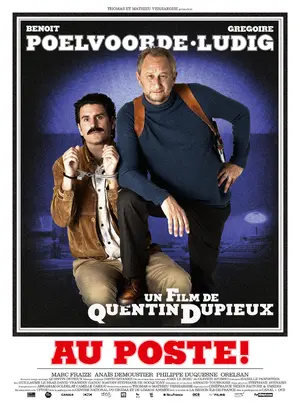
Au Poste!

366 Weird Movies may earn commissions from purchases made through product links.

Recommended

DIRECTED BY: Quentin Dupieux

FEATURING: , , Marc Fraize,

PLOT: Having discovered a dead body under not-very suspicious circumstances, Louis is brought in by the police for questioning. His account of the event arouses the suspicions of police commissioner Buron, but Louis is even more suspicious of the police because of their circular arguments, penchant for distraction, and curious behavior. Louis becomes concerned that he will bear the responsibility for an increasing number of unlucky events, and must recount his actions in fine detail in an effort to affirm his innocence.

Still from Keep an Eye Out [Au Poste!] (2018)

BACKGROUND:

  • This was native Frenchman Dupieux’s first feature actually produced in his home country.
  • The film’s original French title translates as “To the police station!” It can also be translated to mean “at the office.” It can also be interpreted to mean someone who is at their assigned spot (“at one’s post”), in much the way a call of “Places!” summons the actors to their marks at the start of a play.
  • Scenes at the police station were filmed in the headquarters of the French Communist Party, designed by acclaimed architect Oscar Niemeyer.
  • Alain Chabat is credited with providing “screams of pain.” Chabat appeared in Reality as a film director attempting to win an Oscar for the best wail of pain.
  • The film’s poster parodies that of the significantly more action-oriented Jean-Paul Belmondo crime thriller Peur sur la Ville (Fear over the City).

INDELIBLE IMAGE: Philippe, a hapless cop-wannabe, suffers from an unfortunate condition, and its reveal is a genuine shock. It’s not merely that he has only one eye. It’s that the whole upper quadrant of his face is smoothed over, as though the mere idea of an eye socket never existed. And once he begins espousing his hyper-preparedness for even the most surreal of accidents, it is absolutely inevitable that Chekhov’s Plastic Angle Square will fulfill its destiny.

TWO WEIRD THINGS: Near nude conductor; crunchy oyster

WHAT MAKES IT WEIRD: by way of with a healthy layer of Douglas Adams and a final punch of Sartre, Keep an Eye Out is a fantasia of absurdism. Dupieux and his actors seem to be engaged in a contest to see who can be the most deadpan, and the tone never wavers, neither in the face of escalating ridiculousness nor an unexpected and tragic conclusion.

Original trailer for Au Poste!

COMMENTS: We begin with an orchestra in a meadow, accompanying the opening credits under the baton of a mustachioed man clad Continue reading 24*. KEEP AN EYE OUT (2018)

21*. APRIL AND THE EXTRAORDINARY WORLD (2015)

Avril et le monde truqué

366 Weird Movies may earn commissions from purchases made through product links.

Recommended

DIRECTED BY: Christian Desmares,

FEATURING THE VOICES OF: Marion Cotillard,  Philippe Katerine, Marc-André Grondin, Jean Rochefort, Bouli Lanners (French); Angela Galuppo, Tony Hale, Tod Fennell, Tony Robinow, Paul Giamatti (English dub)

PLOT: In 1941, during the reign of French emperor Napoleon V, the world’s scientists have vanished, technology has not progressed for the past six decades, and the environment has been devastated by war, coal consumption, and rampant deforestation. The French Empire hunts the remaining scientists, hoping to enlist them to work on the government’s behalf. After April’s parents are kidnapped by a mysterious electric cloud, the precocious girl teams up with her grandfather, a petty thief with divided loyalties, and her talking cat Darwin to track them down, and possibly find a solution to all that ails the planet.

Still from April and the Extraordinary World (2015)

BACKGROUND:

  • Nominated for the César for Best Animated Feature; it lost to The Little Prince.
  • The most literal translation of “truqué” in the film’s French title is “rigged” or “fake.” The film’s English subtitles translate the title as April and the Twisted World.
  • An alternate history, the film’s point of divergence is the death of Napoleon III, who in our timeline lived to instigate the disastrous Franco-Prussian War. His prosecution of the war was such a failure that he was captured by the enemy, and his subsequent  rule inspired fierce opposition, ending his hopes of founding a dynasty.
  • Among the scientists whose disappearance has arrested the technological progress of this alternate world are Édouard Branly, Albert Einstein, Heinrich Hertz, Guglielmo Marconi, Alfred Nobel, Louis Pasteur, Enrico Fermi, and Sergei Korolev. Also, that may be penicillin discoverer Alexander Fleming giving a large sentient Komodo dragon a massage.
  • The film’s drawing style is modeled after cartoonist Jacques Tardi, who is credited as the creator of the “graphic universe” and gets a shout-out in the credits under an image of a pterodactyl.

INDELIBLE IMAGE: Nothing can quite compare with the first sight of a pair of Eiffel Towers looming over the Paris skyline, eventually revealing themselves as the central station for a fire-powered continental tramway that looms over the coal-stained cityscape. The image is so iconic that it figures prominently in the story, captured in April’s beloved snowglobe and playing a role in the film’s climax.

TWO WEIRD THINGS: Ambulatory meta-mansion, spore rocket

WHAT MAKES IT WEIRD: The film’s individual elements—setting, story, design—are each slightly off-kilter on their own. But combined, they add up to a unified vision of strangeness. With each plot development, the film manages to elevate the already bizarre circumstances to even greater heights.

English-language trailer for April and the Extraordinary World

COMMENTS: Say the word “steampunk” and your first thoughts Continue reading 21*. APRIL AND THE EXTRAORDINARY WORLD (2015)

CAPSULE: LOVE RITES (1987)

Cérémonie d’amour; AKA Queen of the Night

DIRECTED BY: Walerian Borowczyk

FEATURING: ,

PLOT: A man pursues a prostitute he meets on a train into a web of sadomasochistic mystery.

Still from Love Rites (1987)

COMMENTS: If you’re visiting this site, there’s a good chance that you’ve heard of Walerian Borowczyk, the brilliant Polish animator turned art-house pornographer. Much has been made of his infamous fall from grace, which began with 1973’s unsettling and twisted Immoral Tales and hit a spectacular climax with 1975’s  The Beast [La Bête], a Baroque passion play of bestiality that flew in the face of all accepted standards of good taste, and left Borowczyk to wander the wilderness making low-budget schlock for the rest of his days.

Or so the story goes. I can’t speak for the rest of Borowczyk’s work after The Beast, but Love Rites, which turned out to be his last film, finds his eccentric brand of perversion still intact, just a bit mellowed by age. A middle-aged clothing buyer, Hugo (Mathieu Carrière) pursues a clandestine affair with Miriam (Marina Pierro), a mysterious prostitute whom he encounters on a subway. After a game of cat-and-mouse and a lengthy conversation about poetry and acting shouted across opposite sides of a train platform, the two lovers take refuge in a church before making their way to a secret boudoir for an afternoon of sexual domination and submission.

From that description, you might wonder about this movie’s weird credentials. Indeed, on the surface, this is little more than a stereotypical French erotic drama, with the first half of the film’s brief running time devoted to tedious intellectual monologues veering between philosophy, religion, and deadpan tales of past sexual abuse–all of which are apparently intended to be titillating overtures for the real action which is surely lurking just around the corner. After all, don’t forget that The Beast begins in much the same way, with a good 45 minutes devoted to a glorified period soap opera with occasional insinuations of a beastly secret that eventually pays off in a big way.

There’s a troubling development here though, away from the cinematic and towards the literary. Once we enter the boudoir of Miriam’s ominous “friend and mentor,” more and more of the action becomes relegated to a narrator—to the point that most of the juicy stuff that Borowczyk is famous for is hidden off-screen. With sophisticated relish, the narrator relates the sordid events taking place just out of view, as if reading from the works of the Marquis de Sade for an audience of horny aristocrats. The action is hidden from view with compositions designed just as tastefully as the narration is blunt and smutty, with visual motifs evoking cages, butterflies and birds. As the action builds into a fever dream of emasculation and perversion, the narration gradually diminishes, eventually disappearing completely as the film reaches its head-scratching denouement.

But while the film’s muted tone can be both frustrating and boring, there’s no denying that Love Rites is pure Borowczyk. Libertine perversion pervades the film, despite its attempts to hide these qualities from view. If Borowczyk’s intention was to deny the audience’s desire for easy erotic payoffs in lieu of something more esoteric, he succeeded. What’s happening out of view, in the margins, remains perpetually out of our grasp. Who is the unseen madame who demands that games of submission be played in her boudoir? What about the mute Cambodian slave who could appear at any second to carry out some inconceivable orgy of torture?

Alas, Borowczyk is not about to give us the answers to these questions, much like Miriam, who teases her male prey with promises of erotic fulfillment but then confounds her client’s expectations, eventually turning the tables and leaving poor Hugo with more questions than answers. For those who enjoy such esoteric mind games, Love Rites might be just what you’ve been looking for. And for Borowczyk historians, the new Blu-ray release from Kino-Lorber offers the uncut theatrical version as well as a shorter director’s cut that cuts some of the flack from the film’s first half (which is chock full of it). But if you’re new to Borowczyk, you might be better served by checking out his earlier, more infamous films, and then streaming this one as an epilogue.

WHAT THE CRITICS SAY:

“…an object lesson in creating a surrealist work of art. The 1987 film exhibits an exacting preoccupation with the specificities of places and objects, while at the same time remaining open to spontaneity.”–Budd Wilkins, Slant (Blu-ray)