Tag Archives: Found footage

CAPSULE: MURDER DEATH KOREATOWN (2020)

366 Weird Movies may earn commissions from purchases made through product links.

DIRECTED BY: None listed

FEATURING: None listed

PLOT: An unemployed man becomes obsessed with a murder that happened in a nearby apartment complex, but his investigation turns paranoid as he imagines a wide-ranging conspiracy.
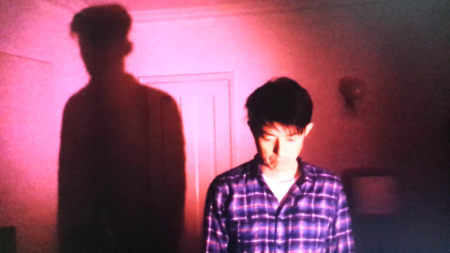
Still from Murder Death Koreatown (2020)

COMMENTS: Though taking its starting cue from a real-life murder, Murder Death Koreatown is, it’s safe to say, fictional, as you will doubtlessly decide for yourself by the time its deranged protagonist starts spouting theories about the Pastors, ghosts, and voices speaking to him from the sewers. It’s like a re-edited version of one of those paranoid YouTube videos that leave you wondering whether the uploader is genuinely crazy or is just stringing you along for the lulz, or like Under the Silver Lake remade on a $100 budget in the style of The Blair Witch Project.

Our unemployed, over-stressed narrator begins by following (real-looking) blood splatters on his sidewalk, and then discovering that one of his neighbors murdered her husband in a neighboring apartment complex in L.A.’s Koreatown. He discovers some minor inconsistencies, and interviews some (real-looking) locals to see if they noticed anything unusual. As his investigation continues, he starts uncovering connections which aren’t really connections—and which sometimes don’t even rise to the level of coincidences—but which are completely obvious and convincing to the protagonist. We ought to be suspicious when we focuses the camera on the blinds in his apartment and marvels, “look at this weird light…” (we have no idea what he’s talking about, but it’s a hint that he takes significance from stuff we wouldn’t even notice). Also, unless you’re Dale Cooper, it’s never a good idea to admit evidence from your dreams into a murder investigation. It’s not really a spoiler to suggest that the movie is a believable study of one man’s descent into delusional paranoia.

Your enjoyment of Murder Death Koreatown will be linked to your tolerance for watching feature-length shot-on-cellphone vlogs. The movie is, by necessity, talky—there are no significant effects or action sequences. Unfortunately, the narrator’s voice isn’t compelling: he delivers most of his lines in a drab “woe is me” tone, and at one point his bleats of terror make him sound like a Muppet startled by a spider. On the plus side, the actor they found to play the shifty-eyed homeless vet in the alley is so convincing that you might believe he’s a real hobo, and that the plot was actually built around his schizophrenic ramblings. The effective horror soundtrack is another element that supersedes the budget; in fact, it’s so well-made that it at times undermines the film’s found footage credibility. Ironically, it’s too professional a touch for a movie that’s trying to make its amateurism into a selling point.

If you’re willing to overlook the budgetary issues, however, Murder Death Koreatown is a solid watch—and if you plot it on a dollars spent to entertainment value curve, it’s off the chart. It holds our interest for just over 70 minutes and does an exceptional job of viral marketing, which is a solid double for a microbudget feature. You can read some of the movie’s promotional gimmickry at the link embedded below.

For more along these lines, Graham Jones’ Fudge 44 (2006) has a similar low-budget, mock-vérité appeal.

https://imgur.com/a/UPnp5U0

WHAT THE CRITICS SAY:

“…in mystifying its own ending, Murder Death Koreatown leaves us, like the investigator, grasping for a transcendent truth that the film itself cannot sustain.”–Anton Bitel, Projected Figures (contemporaneous)


CAPSULE: VHYES (2019)

366 Weird Movies may earn commissions from purchases made through product links.

Recommended

DIRECTED BY: Jack Henry Robbins

FEATURING: Mason McNulty, Christian Drerup, Jake Head, Rahm Braslaw

PLOT: We see the results when 12-year-old Ralph tapes late night 1987 cable television shows, and his own adolescent antics, over his parent’s old wedding tape.

Still from VHYes (2019)

COMMENTS: VHYes had me at the moment when, after brushing in some happy snowcaps for the mountains she’s been crafting, the somnolently friendly Bob Ross-style PBS painting instructor announces “now, let’s get back to the spaceship.” She’s just one of the demented characters you meet as young Ralph experiments in preserving his short-attention span channel surfing for posterity: a kindly cowboy full of inappropriate advice; a couple of shopping channel salesfolk who banter passive-aggressively; an “Antiques Roadshow”-inspired host who appraises some unusual artifacts; the shy hostess of a punk rock public access show (and her supportive parents); and a prescient cultural philosopher who describes the phenomenon of “tape narcissism” and warns that “one day the world will exist only to be filmed.” Naturally, there are also a slew of vintage commercial and infomercial parodies. This smorgasbord of ersatz crapola plays like a found footage 1980s version of The Groove Tube, except that it periodically returns to check in the adventures on Ralph, his best friend Josh, and his mom and dad. Some bits are silly and overdone (there’s more splattered blood than you’d normally see in an alarm company commercial); others are subtle and absurd. The big finale is reminiscent of the kind of short that might play on “” post-midnight: Ralph finds himself surreally transported into a jumbled reality where the layers of the tape all bleed together.

VHYes is a breezy compendium of skewed nostalgia, sometimes hilarious, sometimes weird, and, unexpectedly, sometimes touching. The most substantial complaint to raise against it, in fact, is that it’s too short. There must have been plenty of unused tape, and I would have loved to see even more backstory on young Ralph. His scenes are more than just the gimmick that explains the existence of the artifact we’re watching; his story of coping with childhood fears and disappointments offer a meaningful counterbalance to the goofy comedy sketches, like the commercial for an ointment that grants cubicle workers “freakish flexibility.” On the other hand, maybe it’s best to consider VHYes‘ zippy 70-minute runtime an asset rather than a liability. It’s a “little” film, but in the best sense: short, punchy, homemade, thoughtful in its unassuming way, and—like the ongoing saga of Hot Winter, an ecologically-aware 80s porno with the lesbian orgies edited out—innocent at its heart.

VHYes was shot entirely on vintage VHS and Betacam cameras. The bits with the spooky painter (starring Kerry Kenney, of “Reno 911” fame) are spliced in from Robbins’ 2017 Sundance short “Painting with Joan”; the edited porno scenes from “Hot Winter” were also a standalone short. Director Jack Henry Robbins is the son of and , who executive produced and have eye-blink cameos.

WHAT THE CRITICS SAY:

“…a strange yet sweet film that is one-part coming-of-age dramedy, one-part found-footage comedy, and one part channel surfing.”–Kristy Puchko, Pajiba (festival screening)

CAPSULE: THE CURSE [NOROI] (2005)

DIRECTED BY: Kōji Shiraishi

FEATURING: Jin Muraki, Rio Canno, Tomono Kuga, Marika Matsumoto

PLOT: A paranormal investigator discovers a connection between a succession of mysterious phenomena.

WHY IT WON’T MAKE THE LIST: Though innovative and solidly crafted, the film remains too structurally close to a standard horror to be considered genuinely weird. Noroi stretched for—and, to a great degree, attained—innovation and uniqueness as a work of horror. But there’s little sense that it was ever aiming to be genuinely weird, at least not as this site defines the word. There’s an atmosphere of unreality brought about by the persistent otherworldly presence that wafts throughout the film, but nonetheless, the world in which it manifests is a sane and recognizable one, presented in the plain, organic style that befits the better-crafted sort of found footage film.

COMMENTS: The roots of the found footage style can be traced back as far as 1980’s infamous piece of cannibalsploitation nastiness, Cannibal Holocaust. Found footage, in its early days, represented a promising breath of fresh air for horror. After the genre had spent the last few decades building itself up on a foundation of excess, The Blair Witch Project and its imitators introduced a fresh appreciation for minimalism, implication, and the power of atmosphere in horror—as well as a new way to stretch a budget.

As was inevitable, however, the ugly side-effects of popularity began to kick in; and, as exemplified in the latter films in the Paranormal Activity franchise, the style become an overused parody of itself, completely abandoning the subtleties that gave it its appeal and intrigue for the sake of greater marketability. The “in-universe camera” aspect became little more than an excuse to underpay the cinematographer.

Fortunately for Noroi, it hopped on the found footage bandwagon before Hollywood had fully awoken to its exploitability. Or, put another way, it came out four years before Paranormal Activity, when found footage was still mildly novel.

And, though there’s far more to Noroi than its handheld camera style, this is undeniably a defining aspect of the movie. Noroi is, in short, a horror film that, though distinctly Eastern in general content, is presented in a cinematic style invented and grown almost entirely in the Western world of cinema. Put simply, it’s perhaps one of the most literal cases of J-Horror through a Westernised lens.

Noroi’s director, Kōji Shiraishi, while perhaps not enjoying ‘s levels of cult recognition in the West, has nonetheless solidly established himself as one of Japan’s more prominent 21st century horror directors. Citing both local directors and several of Hollywood’s classic horror masters (, Raimi , et. al.) among his influences, his affinity for experimentation within the genre shows clearly in the broad and diverse body of his work.

Noroi, perhaps his most recognized work in the West, is striking for its slick and effective blend of the familiar and the unexpected. In many ways, his cinematic telling of this particular tale of horror does not shy away from indulging in well-worn genre standards. The J-Horror aficionado will immediately recognize the ominous shrines and the stringy-haired ghost girl in a billowing white gown; the found-footage enthusiast will recognize the journalist protagonist whose relentless drive to document the truth serves as the reason the in-universe camera is always on; and more or less anyone with a taste for horror in any form will recognize the disquieting little girl with the less-than-enviable bonds to the world of the paranormal, or the curse that stubbornly hangs around after centuries.

And yet, in many other ways, Noroi distinguishes itself, particularly in its portrayal of its main horror.

It’s long been established that, in horror, vagueness is often the key to effective chills. From the beginning, it’s clear that Noroi understands this well. It’s not an excessively subtle film, by any stretch of the imagination—the psychic, with his hyperactive paranoia and affinity for tin foil, couldn’t be anything but comedic in any context—but in its presentation of its central threat, Noroi is strikingly effective. The film’s unfortunate protagonists are plagued by a demonic presence that makes itself known in a far more underhanded way that the petty, poltergeist-like antics of the Paranormal Activity ghost and its ilk. At the same time, however, the threat it presents is never undermined; its presence lurks throughout the film, mercilessly persistent, and all the more haunting for its vagueness.

Of course, like any horror scenario built on vagueness, the payoff needs to be meticulously crafted. Personally, I found Noroi‘s conclusion, perfectly functional as it was, to be rather mediocre in comparison with the rest of it. Still, Noroi is a solidly founded work of J-Horror, and, moreover, one of the sadly overlooked examples of the found footage style as it ought to be implemented (most of the others, incidentally, being zero-budget webseries uploaded to YouTube). It is not, however, an example of “weird” cinema to any significant degree. It’s unique, original, and evokes an excellently crafted atmosphere; but pretending that those elements are synonymous with being “weird” only cheapens the art of cinematic absurdity we’re so fond of around here.

WHAT THE CRITICS SAY:

“…overstays its welcome with an unnecessarily complicated and increasingly absurd final act…”–Neil Young, Neil Young’s Film Lodge (festival screening)

SATURDAY SHORT: MEATSACK WORSHIPERS (2015)

are going in an arguably weirder direction with their spinoff YouTube channel, Memory Hole. This newer project features similar editing over footage from home videos. Although the end goal still seems to be laughter, the lead up to the punchline is a lot less comfortable than their work under the EiT! brand… and we’re totally fine with that!

CAPSULE: MR. JONES (2013)

DIRECTED BY: Karl Mueller

FEATURING: Jon Foster, Sarah Jones

PLOT: Deep in the woods, a documentary filmmaker stumbles on the residence of “Mr. Jones”, a legendary builder of scarecrows whose works are rumored to cause madness.

Still from Mr. Jones (2013)
WHY IT WON’T MAKE THE LIST: Mr. Jones isn’t nearly as bad as you might have heard. It took something of a pummeling because its last act is so weird that it confused and alienated many viewers. That said, although the movie may be worth a rental or Netflix stream for weird horror fans on a slow night, it’s not the kind of game-changer it would need to be to make the List of the Best Weird Movies of All Time.

COMMENTS: The filmmaker has stopped taking his meds and has “no idea what this movie is about in the first place.” That’s not a confession from the director’s statement to Mr. Jones; it refers to the nature-doc movie-within-the-movie that would-be auteur Scott has retired to the country to make. Scott and wife Penny decide to change the focus of their unfocused documentary in midstream when it appears they have stumbled upon the hideout of the celebrated reclusive scarecrow-maker (?!) known only as “Mr. Jones.” That setup covers the first half to two-thirds of Mr. Jones, with Scott and Penny’s descent into madness constituting the film’s final act.

As far as horror icons go, the shambling, hooded Mr. Jones doesn’t do much—oh, except for bring insanity in his wake. The movie’s early scenes are effective at creating unease and tension, from the unexpected appearance of a cloaked figure in the background of certain shots to a nerve-wracking moment when Scott gets lost while exploring a strange labyrinth underneath Mr. Jones’ shack. The final act, which traps the couple in what seems to be an eternal midnight filled with nightmares inside of nightmares, is where the movie tends to lose its audience.

Unlikely as it might seem for a guy who’s setting out to make a nature documentary, Scott films himself and his wife sleeping, and having sex. The “found” footage that composes Mr. Jones is also, at times, heavily edited, including addition of a voiceover and soundtrack song, along with one heavily manipulated travel montage. There are even moments (especially late) when the movie appears to shift viewpoints within a scene, or move from a first-person to a conventional third person point of view. The fact that the film we’re watching has clearly been through extensive post-production breaks the Blair Witch vérité spell. Many people point to the movie’s seemingly inconsistent use of the found-footage format as a flaw, and perhaps it is. Perhaps the perspective shifts are less arbitrary than they appear, however. The question, I suppose, is whether Mr. Jones‘ ramshackle construction is the result of sloppy craftsmanship, or a reflection of an unreliable, unstable narrator. Related question: if sloppy craftsmanship inadvertently conveys a psychotic state of mind that is appropriate to the subject matter, is that a bad thing, or a happy accident?

Mr. Jones got a raw deal with both audiences and critics. I think this is a result of difficult market positioning. The film is too thoughtful, ambitious and surreal—and too PG-13—for the average horror fan. At the same time, it’s not polished enough and too genre-y to make much headway in the arthouse press. In other words, it’s too smart to be a popular success, but not smart enough to be a critical hit.

WHAT THE CRITICS SAY:

“You can’t really dip into dream logic if you have nary a single eye-popping visual, and in doing so, Mueller completely wastes a unique, potentially durable concept…”–Gabe Toro, Indiewire (festival screening)