Tag Archives: Flop

295. NO SMOKING (2007)

“Look up the word ‘bizarre’ in the dictionary. It doesn’t mean dark. Was Eternal Sunshine Of The Spotless Mind a dark film? It was bizarre. No dictionary in the world says bizarre means dark or vice versa. This is the problem with Indians; they come with fixed notions. What is the definition of dark? Tell me!”– An exasperated No Smoking writer/director Anrag Kashyap in an interview

Recommended

DIRECTED BY: Anurag Kashyap

FEATURING: John Abraham, Ayesha Takia, Ranvir Shorey, Kiku Sharda, Paresh Rawal

PLOT: K, an arrogant businessman and highly-addicted chain smoker, agrees to enter a smoking-cessation program after his wife threatens to leave him. Going to the address his friend gave him, K is led through a labyrinth and forced to sign a contract which specifies that his loved ones will be harmed in increasingly severe ways every time he smokes a cigarette. Naturally, K relapses into smoking and is caught, eventually winding up trapped in a nightmare world.

Still from No Smoking (2007)

BACKGROUND:

  • The script (at least its early sections) bears some striking similarities to ‘s short story “Quitters, Inc.,” which was previously a segment of the 1985 anthology Cat’s Eye. The writer/director admits the story was an inspiration, although the credits do not mention King.
  • No Smoking was Anurag Kashyap’s third movie, but the first one released in India. His debut, Paanch, was never released outside of international film festivals due to state censorship (for violence and drug use); his second film, Black Friday, a true crime story, was delayed while a court case was pending and released after No Smoking. He later achieved mainstream success with 2009’s Dev D, an adaptation of a popular novel.
  • No Smoking was a colossal flop in its native India, where it baffled audiences with little exposure to psychological thrillers or surreal cinema.

INDELIBLE IMAGE: The bathtub sitting alone on a snowy plain in Siberia, just in sight of what appears to be a Soviet-era gulag, which appears in dream sequences at the beginning and end of the movie.

THREE WEIRD THINGS: Hitler’s Indian buddy; Fosse’s cigarette cabaret; banana peel suicide

WHAT MAKES IT WEIRD: No Smoking isn’t quite what would result if got a wild hair to direct a Bollywood film—but it’s a reasonable approximation. With its theme of bad men forced to forgo their vices against their will, it’s a bit like a Hindi twist on A Clockwork Orange, as well, only with more elaborate musical numbers. With the tropes of Indian popular cinema colliding against a Western-style neo-surrealist narrative, No Smoking is neither fish nor fowl; it totally confounded Indian audiences used to simple stories with happy endings, and it will probably confound you, too.


Hindi trailer for No Smoking

COMMENTS:  Anurag Kashyap’s Advice for How to Stop Smoking in Continue reading 295. NO SMOKING (2007)
294. TITUS (1999)

“Why makest thou it so strange?”–Demetrius, “Titus Andronicus,” II, 1.

Recommended

DIRECTED BY:

FEATURING: , Alan Cumming, Laura Fraser, Jonathan Rhys Meyers, Matthew RhysAngus Macfadyen, Osheen Jones

PLOT: Titus Andronicus, a Roman general, returns from conquering the Goths; he imprisons the queen Tamora and her three sons, killing the eldest boy as a sacrifice to the gods. Back in Rome, the emperor is dead and the popular Titus averts a civil war by supporting Saturninus for emperor against the rival claim of his brother; once on the throne, Saturninus surprises Titus by taking Tamora as his queen. Tamora and her secret lover, the Moor Aaron, then set about plotting revenge against Titus and his entire family.

Still from Titus (1999)

BACKGROUND:

  • Written in the style of the Jacobean revenge tragedy, “Titus Andronicus” is one of Shakespeare’s earliest plays, and perhaps his most disliked by critics; some even went so far as to speculate that the play must be misattributed to him, as Shakespeare could not have written such trash. Harold Bloom scathingly called it “a howler” and “an exploitative parody” and suggested Mel Brooks would be the director most suited to the material.
  • Julie Taymor adapted this film version from her off-Broadway stage production. Titus was her debut film, although she had achieved fame, and won a Tony award, for her 1994 Broadway stage production of “The Lion King.”
  • Taymor chose production designer Dante Ferretti because he had worked on one of her inspirations for Titus‘ look: Fellini Satyricon.
  • An orgy scene had to be edited (reportedly, to excise male genitalia) to earn the film an “R” rating.
  • Reputed auto-fellator Steve Bannon served as one of the executive producers.

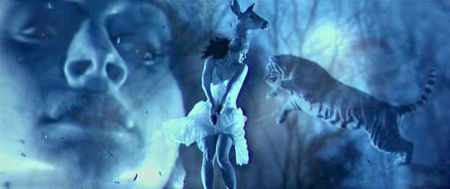
INDELIBLE IMAGE: For this adaptation, Taymor fashioned four short, digitized dream sequences that she calls “penny arcade nightmares.” We selected the one where Lavinia remembers her own rape, imagining herself as a doe (with a deer’s head and hooves) menaced by ravishing tigers. Trip Shakespeare, for sure.

THREE WEIRD THINGS: Paper bag brat; those are twigs that were her hands; Shakespearean video games

WHAT MAKES IT WEIRD: Julie Taymor gives Shakespeare’s least-respected, bloodiest play an anachronistic avant-garde treatment, with fascist emperors riding in convertibles, Roman orgies, “penny arcade nightmares,” and all of the rape, dismemberment, and people-eating that we associate with the Bard’s work.


Original trailer for Titus

COMMENTS: “Shakespeare was a drive-in kind of guy.” I don’t think Continue reading 294. TITUS (1999)

287. L’INHUMAINE [THE INHUMAN WOMAN] (1924)

“At each screening, spectators insulted each other, and there were as many frenzied partisans of the film as there were furious opponents. It was amid genuine uproar that, at every performance, there passed across the screen the multicoloured and syncopated images with which the film ends. Women, with hats askew, demanded their money back; men, with their faces screwed up, tumbled out on to the pavement where sometimes fist-fights continued.”–Jaque Catelain, in his biography of Maurice L’Herbier

Recommended

DIRECTED BY:

FEATURING: Georgette Leblanc, Jaque Catelain, Philippe Hériat

PLOT: Claire Lescot, a celebrity opera singer, hosts a soirée at her modernist mansion for her many male admirers and suitors. Among these is the young engineer Einar, whom she toys with and eventually scorns. When Einar commits suicide, it causes a scandal and Claire is castigated for her callousness; but is there more to his mysterious death than meets the eye?

Still from L'inhumaine (1924)

BACKGROUND:

  • Maurice L’Herbier started his career as a writer; his fascination for cinema partly developed when he was assigned to the French Army’s Cinematographic Service, where it was his job to document the horrors of WWI.
  • Star Georgette Leblanc, an opera singer, put up 50% of the production cost. L’Herbier offered her a script which she deemed too noncommercial, and he had it rewritten according to her suggestions.
  • The production design was divided among several leading international avant-garde artists, each of whom was responsible for creating a different set. These artists were all featured in the influential 1925 Exhibition of Decorative and Industrial Modern Art, for which L’Herbier was also a member of the jury.
  • Extras in the 2,000-strong audience that boos Claire included Pablo Picasso, Erik Satie, James Joyce, and Ezra Pound. To set the mood, dissonant composer George Antheil played piano as the opening act.
  • The original score by Darius Milhaud is lost, although he may have recycled some of the themes for use in later compositions.
  • As was typical for avant-garde performances of the period, fights erupted at the screening.

INDELIBLE IMAGE: There are so many crazed sets to choose from—Claire’s dining room isthmus, her spiky green “winter garden,”  Einar’s disorienting Cubist laboratory—that we were totally confounded at picking just one. Fortunately, we can go with a bizarre costuming choice instead: the masked butlers in short pants with smiles (literally) plastered on their faces.

THREE WEIRD THINGS: Perma-grin waiters; backwards television; riotous resurrection montage

WHAT MAKES IT WEIRD: Too weird for 1924, when screenings prompted fistfights between its few admirers and its many detractors, this interbellum mashup of silent melodrama, heedlessly optimistic science fiction, and bizarre set design is even more singular when viewed through contemporary eyes. This is a case where a film’s advanced age enhances its weirdness—when watching it, you’ll think that it came from not just another time, but another planet.


Blu-ray trailer forL’Inhumaine

COMMENTS: It’s fitting that L’Inhumaine stars an opera star (playing Continue reading 287. L’INHUMAINE [THE INHUMAN WOMAN] (1924)

281. HUGO THE HIPPO (1975)

Hugó, a Víziló

“If you accept a strange story told to you as true,

Then a certain enlightenment comes to you.”

Hugo the Hippo theme “It’s Really True” (as sung by Marie Osmond)

Recommended

DIRECTED BY: Bill Feigenbaum, József Gémes

FEATURING: Voices of , Burl Ives, Ronnie Cox, Robert Morley

PLOT: The Sultan of Zanzibar kidnaps a herd of African hippopotami and relocates them to Arabia to defend his harbor from sharks. After the shark menace is ended and the city prospers, the citizens forget about the hippos, until one day the hungry herds’ excursion to eat local farmers’ crops leads the Sultan’s evil Vizier Aban-Khan to organize a slaughter of the beasts. Only the youngest, Hugo, escapes; he flees to Dar es Salaam and makes friends with the local children, but Aban-Khan continues to hunt him out of pure malice.

Still from Hugo the Hippo (1975)

BACKGROUND:

  • The story is inspired by an actual hippo nicknamed “Hugo”, who ate farmers’ crops before being adopted by the real Tanzanian city of Dar es Salaam.
  • The film was a Hungarian/U.S. co-production. All of the animation was done on the cheap in Hungary. It was released dubbed into both languages.
  • Hugo the Hippo is co-writer/director Bill Feigenbaum’s only film credit. József Gémes went on to direct many Hungarian animated features.
  • Young Marie and Jimmy Osmond perform most of the songs on the soundtrack, along with two songs by Burl Ives and two numbers by jazz/funk session bands.

INDELIBLE IMAGE: It has to be something from the wild vegetable hallucination montage: the apple samurai? Jorma and Hugo climbing onto the space butterfly and sailing through the fruity cosmos? We selected the Dalí-esque shot of three massive monolith potatoes triangulating and transfixing our heroes with the magical beams that shoot from their literal eyes as our take-home image.

THREE WEIRD THINGS: Cigarette-smoking shark; cloud massacre; sliced apple ninja

WHAT MAKES IT WEIRD: Hugo the Hippo was released to widespread indifference. Contemporary reviewers were bored and strangely dismissive, failing to catch the undercurrent of weirdness here, but a generation of youngsters scarred by the hippopotamus massacre kept Hugo‘s underground legend alive. The combination of kitschy songs, psychedelic animation, bizarre plotting, tone shifts, hallucinatory episodes, and the inimitable Paul Lynde as an evil hippo-hating vizier blend to create a children’s film gone awry in all the most delightful ways.


Short clip from Hugo the Hippo

COMMENTS: We might adopt the lyrics from the opening Continue reading 281. HUGO THE HIPPO (1975)

CAPSULE: XANADU (1980)

DIRECTED BY: Robert Greenwald

FEATURING: Olivia Newton-John, Michael Beck, Gene Kelly, Matt Lattanzi, James Sloyan

PLOT: Sonny Malone is a gifted artist reduced to designing album covers, but when he meets former big band leader Danny McGuire, the duo join forces with an Olympian muse open a roller disco club.

Still from Xanadu (1980)

WHY IT WON’T MAKE THE LIST: Xanadu is campy, kitschy and appalling, but it’s not weird. It’s just one of the last death rattles of the disco era.

COMMENTS: La La Land may have revived the movie musical, which has been on life support for decades because of flops like Xanadu. This film spawned a soundtrack album (deliriously overproduced by the Electric Light Orchestra’s Jeff Lynne) that was a monster hit in 1980, spawning five top 20 singles. The movie itself, however, bombed, and rightfully so. It’s inoffensive, embarrassing piffle. Made on a big budget, Xanadu still looks cheap, and director Robert Greenwald , who later made The Burning Bed and several progressive-minded documentaries, doesn’t really seem to know how to stage musical numbers, despite choreography from Kenny Ortega (High School Musical). Michael Beck, fresh off the macho action classic The Warriors, looks embarrassed (he never starred in a movie again), and poor 68-year-old Gene Kelly makes his unfortunate farewell to musicals in this dud. Olivia Newton-John is beautiful but cannot act—although she was much better in Grease—-while director Don Bluth (An American Tail) contributes a weak animated segment.

Practically all memory of the film vanishes right after you’ve seen it. Xanadu is sort of a remake of the indifferently received 1947 Rita Hayworth musical Down to Earth, while Kelly also played a character named Danny McGuire in the 1944’s Cover Girl opposite Hayworth. Either of those films has to better than Xanadu, which only Newton-John may still remember fondly: the young Danny McGuire is played in flashback by dancer-actor Matt Lattanzi, who later became her husband. No amount of fake glitter and flash can salvage this Lattanzi-Newton John family album, however: the climactic musical number involves a series of revolving stages that reminded me of the old Disneyland show “America Sings”. I’d rather sit through “America Sings” again. In fact, those who want to experience Xanadu should listen to the soundtrack album (featuring Newton John, ELO, Cliff Richard, and the Tubes)  instead of slumbering through this decidedly non-weird musical relic of the Studio 54 era.

Someone apparently had pleasant, perhaps drug-induced memories of the picture, because in 2007 Xanadu was adapted into a modestly produced Broadway musical (starring “30 Rock”‘s Cheyenne Jackson) that was nominated  for a few Tony awards. In the end, Xanadu may be recalled chiefly as being part of the “great”—or awful—disco musical trend of 1980, which also gave us the infamous Village People vehicle Can’t Stop the Music. Anecdotally, unfortunate moviegoer John J.B. Wilson saw both films at a 99-cent double feature and came up with the idea of the Razzie awards, “honoring” the year’s worst films, which are still held today. At least Xanadu has better songs than Can’t Stop the Music.

WHAT THE CRITICS SAY:

“To appreciate the madness within, one must take in the blinding neon sights with an open heart and at least one nostril-coating line of cocaine. Surely I hold no certainty that ‘Xanadu’ was fueled by heaping spoonfuls of Bolivian marching powder, but I offer this evidence: it was 1980 and the picture is bonkers.”–Brian Orndoff, Brianorndoff.com (DVD)