Tag Archives: Doppelganger

119. MESHES OF THE AFTERNOON (1943)

“This film is concerned with the interior experiences of an individual. It does not record an event which could be witnessed by other persons. Rather, it reproduces the way in which the subconscious of an individual will develop, interpret and elaborate an apparently simple and casual incident into a critical emotional experience.”–Maya Deren, notes on Meshes of the Afternoon

Recommended

DIRECTED BY: , Alexander Hammid

FEATURING: Maya Deren, Alexander Hammid

PLOT: Approaching her apartment one afternoon, a woman picks up a flower, sees a figure disappearing around a corner down the garden path, then fumbles her key as she tries to unlock the door to her room. She goes upstairs and falls asleep in a chair looking out of the window, where she has a series of dreams that recombine these simple events and objects in unexpected ways. Doubles appear, she floats up the staircase, and the person she briefly glimpsed earlier appears as a figure of menace haunting the corners of her mind.

Still from Meshes of the Afternoon (1943)

BACKGROUND:

  • Deren legally changed her first name from Eleanora to Maya (Sanskrit for “illusion”) just before embarking on her career as a filmmaker with Meshes.
  • Alexander Hammid, Deren’s second husband, co-created and appears in Meshes as “the Man.” The music that now accompanies the film was added in 1957 and was composed by Deren’s third husband, Teijo Ito.
  • Some commentators, including avant-garde director Stan Brakhage (who knew the couple) claim that Meshes was largely the work of Hammid rather than Deren, who went on to have the more noted career.
  • Meshes was made for $275 (which would be about $3,500 today adjusted for inflation). Deren once joked that she made movies for what Hollywood spent on lipstick.
  • Added to the National Film Registry in 1990. The registry began in 1989 with twenty five American films worthy of preservation due to their historical and artistic importance and adds twenty five more films each year since; Meshes was in the second class inducted.
  • Deren, a Ukrainian immigrant, was the first avant-garde filmmaker working outside the studio system of any importance in the United States. She was also a lecturer, wrote articles on film theory, and established the Creative Film Foundation and the Film-Makers Co-op. She unexpectedly died of a brain hemorrhage at 44 while studying and filming Voodoo ceremonies in Haiti.

INDELIBLE IMAGE: The image film critics usually invoke when describing Meshes is Deren with her face and palms pressed up against the windowpane, the reflections of palm trees merging into her curly black hair and an inscrutable expression on her face. The picture has an undeniable metaphorical power: here we see a portrait of the psyche, the plane where reflections from the external world merge into the self. But while there’s an undeniable intellectual appeal to that selection, we’re going to go instead with something freakier and more nightmarishly visceral: the cloaked form with a mirror for a face, a mysterious figure into whom the sleeping protagonist pours her suppressed fears and anxieties.

WHAT MAKES IT WEIRD: Many weird movies are about dreams, or plumb the sleeping mind to exploit dream logic and plunder the unconscious’ mutated symbols, but Meshes of the Afternoon is probably the most psychologically accurate dream movie ever made. From the way it repurposes everyday events and objects, turning keys into knives and passing pedestrians into emissaries of the unknown, to its impossible geometries where windows open onto stairs and distant beaches, Meshes captures the architecture of a dream—and traps us inside it.


Film student analysis of a scene from Meshes of the Afternoon

COMMENTS: A mesh is a net or a web, and this afternoon the strands that trap our nameless Continue reading 119. MESHES OF THE AFTERNOON (1943)

LIST CANDIDATE: SCHIZOPOLIS (1996)

Schizopolis has been promoted onto the List of the 366 Weirdest Movies Ever Made. Comments on this post are closed. Please visit Schizopolis official Certified Weird entry.

DIRECTED BY: Steven Soderbergh

FEATURING: Steven Soderbergh, Betsy Brantley, David Jensen, Mike Malone

PLOT: A series of absurdist sketches and nonsense dialogues linked together by a thin plot

Still from Shcizopolis (1996)

about an office worker struggling with an assignment to write a major speech for a cultlike motivational speaker obviously based on L. Ron Hubbard.

WHY IT MIGHT MAKE THE LIST: Hilarious witticism characterizing film’s oddness. Cautious disclaimer suggesting uneven satire undermines enjoyability, but granting nobility of purpose and peculiar appeal. Self-aggrandizing non sequitur.

COMMENTS: After Schizopolis bombed at Cannes, writer/director/star Steven Soderbergh appended a prologue where he stood on a stage and introduced the film. “In the event that you find certain sequences or ideas confusing, please bear in mind that this is your fault, not ours,” he advised. “You will need to see the picture again and again until you understand everything.” We are then thrown into the story of Fletcher Munson, a chronic office masturbator suffering from writer’s block as he attempts to pen a speech for “Eventualism” founder T. Azimuth Switters. A third of the way through the movie he meets (and sort of becomes) his exact double, an amorous dentist named Korchek who happens to be having an affair with Munson’s wife, but Korchek (or is it Munson inhabiting Korchek’s body?) falls in love with Munson’s wife’s doppelgänger, Attractive Woman #2. Then, in the movies final act we see the same scenes replayed from the perspective of Mrs. Munson. Interspersed with all of this are bits involving a pantsless old man running away from a pair of orderlies, news reports suggesting Rhode Island has been sold to a consortium of investors who want to turn it into a shopping mall, and a shot of a sign posted on a tree reading “idea missing.” Oh, and there’s also an exterminator who speaks gibberish and seduces local housewives. What’s there to possibly be confused about? Sorerbergh, who started his career with Sex, Lies and Videotape, the movie that launched the indie filmmaking revolution, made Schziopolis as a palette-cleanser after his big budget flop Underneath left a bad taste in his mouth (a fan cleverly described this as Soderbergh’s “second first film“). Working with his friends on a budget of only $250,000, it’s a loose, breezy, seemingly Continue reading LIST CANDIDATE: SCHIZOPOLIS (1996)

97. MULHOLLAND DRIVE (2001)

366 Weird Movies may earn commissions from purchases made through product links.

“Do not demystify.  When you know too much, you can never see the film the same way again. It’s ruined for you for good. All the magic leaks out, and it’s putrefied.”–David Lynch, explaining to Terrence Rafferty why he will not record director’s commentaries

Recommended

DIRECTED BY: David Lynch

FEATURING: , ,

PLOT: A woman (Harring) is involved in a nighttime accident on Mulholland Drive and flees into the city of Los Angeles with amnesia; she sneaks into an apartment soon to be occupied by naive young Betty (Watts), who has come to Hollywood hoping to find stardom.  Meanwhile, a film director (Theroux) finds himself pressured by mysterious mobsters to cast an unknown actress in his upcoming project.  Betty helps the amnesiac woman try to recover her identity, but the clues only lead to a strange avant-garde nightclub, a key, a box, and a sudden reality shift that throws everything that came before into confusion.

Still from Mulholland Drive (2001)

BACKGROUND:

  • Lynch originally intended Mulholland Drive as a TV series in the mold of “Twin Peaks.”  When the networks passed on the pilot, the French producer Studio Canal stepped in with additional financing to turn the pilot into a feature film.  In between ABC’s proactive cancellation of the series and the creation of the film version, all of the sets and props were dismantled, forcing Lynch to come up with a different way to complete the story.
  • Monty Montgomery, whose appearance as “The Cowboy” is an uncanny show-stopper, is a Hollywood movie producer (who produced Wild at Heart for Lynch).  Mulholland Drive is his only acting credit (he’s listed as “Lafayette Montgomery” in the credits).
  • Lynch insisted no chapter stops be included on the DVD.
  • The original DVD release included an insert from Lynch containing “10 Keys to Unlocking This Thriller.”
  • Mulholland Drive received significant critical acclaim, nabbing Lynch a Best Director award at Cannes (shared with Joel Coen for The Man Who Wasn’t There) and a Best Director Oscar nomination.  It was voted best picture of the Year by the Boston Film Critics Society, the Chicago Film Critics Association, the new York Film Critics Circle, and the Online Film Critics Society (where it tied with Memento in the voting).  It was also voted best foreign picture by the Academy Award equivalents of Brazil, France, Spain, and Australia.

INDELIBLE IMAGE: The Silencio nightclub, decorated in Lynch’s trademark red velvet drapes and staffed by his trademark subconscious monsters.

WHAT MAKES IT WEIRD: If the massive reality shifts and actresses unexpectedly playing multiple roles is not enough for you, then the monster behind the Winkie’s, a Spanish version of Roy Orbison’s “Crying” delivered by a woman who collapses onstage, and a mafia-style media syndicate run by a deformed dwarf who uses an eyebrowless cowboy as his right-hand man will convince you that we are deep in that subconscious pit of eroticism, kitsch and weirdness that can only go by the name Lynchland.


Original trailer for Mulholland Drive

COMMENTS:  Oddly enough, what may be the most important scene in Mulholland Drive Continue reading 97. MULHOLLAND DRIVE (2001)

90. BLACK SWAN (2010)

“It’s a Polanski movie, and then it becomes a Dario Argento movie. And maybe a little bit of David Cronenberg too.”–Vincent Cassell

Must See

DIRECTED BY: Darren Aronofsky

FEATURING: Natalie Portman, Mila Kunis, , Barbara Hershey, Winona Ryder

PLOT: Nina, a goody two-shoes ballerina, wants to dance the lead role in a production of “Swan Lake,” but although she’s perfect for the role of the White Swan, she lacks the seductiveness to portray the Black Swan. Lily, a sexy, irresponsible dancer newly arrived from a San Francisco troupe, becomes her primary competition for the part, but also helps her loosen up by talking her out on the town for a night of drinking and meeting guys. Nina starts physically break down and hallucinate as the stress of preparing for the role takes its toll; by opening night, she can’t distinguish reality from the story she dances of the princess trapped in the body of a swan who takes her own life.

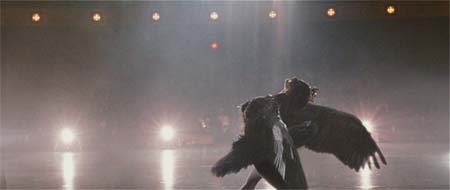
Still from Black Swan (2010)

BACKGROUND:

  • Natalie Portman danced many of her own parts, and actually dislocated a rib while dancing during the shoot. More difficult moves were performed by professional ballerinas, and for two sequences Portman’s face was digitally superimposed on dancer Sarah Lane’s body. There was a minor controversy over how much of the dancing Portman actually did herself and how much was performed by doubles; Aronofsky estimated that the actress executed more than 80% of the dance moves that appear onscreen.
  • Portman won the 2010 Best Actress Oscar for her role as Nina. The film was also nominated for Best Picture, Director, Cinematography and Editing.
  • Aronofsky received “The Understudy,” the original script that became Black Swan, while he was making Requiem for a Dream (2000). He described the script as Dostoevsky’s “The Double” meets All About Eve. Aronofsky combined that script, which was set in an off-Broadway production, with an idea he had to shoot a movie in the New York ballet world to create Black Swan.
  • Aronofsky and Portman had discussed doing a ballet movie together 8 years prior to shooting.
  • Made on a relatively small budget of about $12 million, Black Swan has grossed more than $300 million worldwide as of this writing.

INDELIBLE IMAGE: Nina’s “triumphant” onstage transformation into the Black Swan: as she pirouettes, feathers sprout from her arms, thickening with every swirl, until her limbs have been replaced by wings.

WHAT MAKES IT WEIRD:  Up until opening night, Black Swan is a backstage melodrama about backstabbing ballerinas, with an exaggerated, lurid psychopathology that’s thrust even further over-the-top by lesbian love scenes, hints of horror, and mirrors, mirrors, mirrors.  When the curtain rises on the big night, we experience the performance through the subjective perspective of an overworked, paranoid, demented dancer, whose psychology has been shattered by the film’s sledgehammer symbolism.  No avant-grade choreographer could stage as disorienting a “Swan Lake” as the one she hallucinates for us through her obsessed eyes.

Promotional Music Video for Black Swan

COMMENTS: Black Swan is the weirdest movie ever to win a major Academy Award (Natalie Continue reading 90. BLACK SWAN (2010)

RECOMMENDED AS WEIRD: THE OTHER (1972)

DIRECTED BY: Robert Mulligan

FEATURING: Chris and Martin Udvarnoky, Uta Haen, John Ritter

PLOT: Adapted from his novel by Tom Tryon, two enigmatic twins seem to be connected to a community’s run of misfortune.  Could it have anything to do with a cursed family crest and a dead man’s severed finger?

Still from The Other (1972) with Uta Hagen

WHY IT SHOULD MAKE THE LIST: An unusual story, The Other is unsettling and bizarre, yet it is conventionally produced and is shot by Mulligan (Summer of  ’42) like a mainstream family film. The frank, matter of fact presentation of disturbing imagery is as creepy as a hostess placing a decaying skull in the punchbowl at a débutante’s ball.

COMMENTS: Some horror cinema doesn’t have to rely on the supernatural to be horrifying. The Other is technically a psychological crime thriller, but it projects the distinct feel of a horror movie with occult elements. Set in the 1930’s, The Other is a grim shocker about two cute, apparently wholesome twin boys who would seem to lead an idyllic existence on a picturesque family farm. There’s just one problem—everyone around them begins to have gruesome accidents.

The boys are drawn into a convoluted good-versus-evil struggle that churns within themselves, and they struggle with each other to both exercise and exorcise it. As this conflict manifests itself, the bizarre circumstances surrounding the misfortunes of family and neighbors begin to weave an increasingly twisted and captivating mystery.

The story includes many odd and unsettling elements, such as the fact that the twins’ mother is inexplicably a terrified psychological invalid. Their Russian nanny seems to be able to teach the boys how to fly via astral projection. There is a very odd, cursed family crest ring complete with the severed finger of the corpse from which it was stolen. People and things connected to the twins seem to end up broken, on fire, paralyzed or dead.

The boys covet and revere the ring and finger. They carry it with them constantly in their treasure box, and this morbid memento is somehow the key to all of the strange tragedy that unfolds.  The uncertainty of who is who and what is what creates a surreal tone. The Other is a thoughtfully presented nightmare of indulgence, madness and grotesque murder. The production is enhanced by Robert Surtees’ striking and graceful cinematography which produces memorable visual impressions. Jerry Goldsmith’s low-key, creepy score compliments the film well.

Horror and occult fans should take particular delight in viewing The Other for the following reasons: it has an original story that has not been perpetually copied since it was filmed. This work was shot in 1972 when there were fewer creative constraints on writer-director collaboration. The Other is well constructed, but neither formulaic, nor forced to be “accessible” to the public. There are none of the standard cliches. It withstands the test of time and is not dated. Set during the Great Depression, it looks like it could have been produced yesterday. The subject matter, however, is refreshingly unconventional. Those looking for something fresh and unlike anything they have seen before should be especially pleased—that is, if they can locate a copy.

WHAT THE CRITICS SAY:

“…The Other is a dark, eerie minor masterpiece that is filled with lasting images: a finger wrapped up in a handkerchief, a boy leaping into a pile of hay with a pitchfork in it, the corpse of a baby drowned in a wine barrel… Some horror films leave such a chilling impression that they become impossible to forget.”  -Clarke Fountain, All Movie Guide