A couple tries to choose between titles such as Old Man City (2020) and a 223 minute romantic comedy called The Heart of the Equation (2007).
CONTENT WARNING: This short contains strong language.

A couple tries to choose between titles such as Old Man City (2020) and a 223 minute romantic comedy called The Heart of the Equation (2007).
CONTENT WARNING: This short contains strong language.
366 Weird Movies may earn commissions from purchases made through product links.

DIRECTED BY: Michel Gondry
FEATURING: Tim Robbins, Patricia Arquette, Rhys Ifans, Miranda Otto
PLOT: A scientist and a woman cursed with hirsuitism discover a feral man living in the woods and train him to live in civilized society.
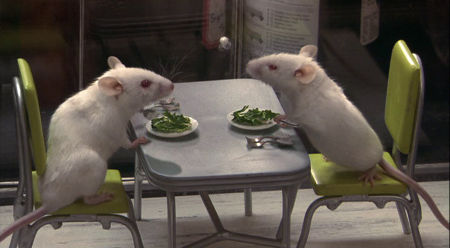
COMMENTS: Human Nature feels a bit like—and was certainly interpreted by contemporaneous critics as—an unpublished Charlie Kaufman script that was dusted off and polished up to capitalize on the unexpected success of Being John Malkovich (1999). In fact, the script had originally been optioned way back in 1996, when it was circulating together with Malkovich, although it’s not clear which screenplay Kaufman completed first. After his 1999 hit, Spike Jonze passed on directing Human Nature; he served as a producer instead, and recommended the already-established music video/commercial director Michel Gondry for the job.
That partnership was also destined to bear fruit in the future, but the team did not immediately meet with success. Human Nature didn’t live up to its immediate predecessor in either the originality of its premise or in its bizarre humor; critics who loved the first movie were generally disappointed, while those who never bought in to Kaufman in the first place relished the opportunity to proclaim that the newly crowned Emperor had scanty clothing. Twenty years later, seen outside of Malkovich‘s immediate shadow, Human Nature looks much better: smart, easy to watch, and wispily Freudian in its depiction of sexual conflict between the superego and id.
Human Nature begins by divulging its three main characters’ eventual fates: Lila is imprisoned, Puff is testifying before a Congressional subcommittee, and Nathan has a conspicuous hole in his head. Flashbacks explain how we got here: Lila, cursed with simian body hair, becomes a famous nature writer but decides she needs a man and so undergoes extensive electrolysis before being introduced to Nathan, an inhibited prude of a psychologist who’s work involves using electrical shocks to train lab rats to use the correct salad fork. They form a desperate, co-dependent relationship until discovering a feral man (later dubbed “Puff”) in the woods, whom Nathan decides would make an even better test subject for his behavioral modification studies than the mice—unlike rodents, he can train the ape man to read “Moby Dick” and discuss Wittgenstein, and to refrain from humping every woman he comes across. Predictably, things go awry, with everything further confused when various competing romantic axes and rivalries start to develop between this threesome and Nathan’s assistant, Gabrielle.
Quirky highlights include an incongruous, Disneyesque strolling-through-nature song where Lila embraces her hairiness (“my new friends, these split-ends…”); early whimsical “Gondryeqsque” sequences of white mice seated at a dinner table (done with a combination of puppetry, stop-motion, and trained animals); and Gabrielle’s contextually inexplicable accent. These bits combine with the oddness of the comic scenario and the movie’s arch approach to sexual repression to create an intelligent and off-key chamber piece effectively poking fun at our civilized foibles (“apes don’t assassinate their Presidents, gentlemen!”), while falling well short of the existential weirdness of Kaufman’s debut. By conventional Hollywood standards, Human Nature is fairly odd; by Gondry/Kaufman standards, it’s an attempt at a completely mainstream movie.
WHAT THE CRITICS SAY:
(This movie was nominated for review by Nick Gatsby, who said it was “perfect for this list. I’m deathly surprised it’s not on here already.” Suggest a weird movie of your own here.)
366 Weird Movies may earn commissions from purchases made through product links.
DIRECTED BY: Bill Benz
FEATURING: Annie Clark (St. Vincent), Carrie Brownstein
PLOT: Annie Clark (who performs as “St. Vincent”) commissions her friend Carrie Brownstein to make a documentary about her; but when Annie’s real personality proves too boring for film, she spices things up acting more like her alter-ego, losing sight of reality in the process.

COMMENTS: About midway through The Nowhere Inn, it occurred to me that I hadn’t really learned anything about Annie Clark that I didn’t know before I hit “play.” Looking up her bio in Wikipedia after watching this fictionalized documentary, I found the following quote from David Byrne: “Despite having toured with her for almost a year, I don’t think I know her much better, at least not on a personal level.”
This made me feel better. Clark uses this faux-confesisonal mockumentary to hide in plain sight. Her alter-ego, St. Vincent, is brash, aggressive, and sexy onstage, shredding her guitar in a skintight red vinyl minidress while an image of her vomiting turquoise paint streams on a giant video board above her. Backstage, though, her friend Brownstein (the real-life riot grrl musician turned “Portlandia” comedienne) finds it hard to assemble meaningful footage for her behind-the-scenes documentary, since all the musician wants to do in her downtime is play Scrabble or video games or sample the local radishes. Even her bandmates and roadies can’t find anything interesting to say about Clark. So, abandoning her original plan capture the artist just being herself, Brownstein prods her subject to project her personality and start acting more like St. Vincent—a challenge the singer-songwriter meets too fervently, turning herself into an insufferable cliche of an image-obsessed rock diva. The pendulum having swung too far, Brownstein falls into an artistic crisis as Clark disappears into her new persona. The movie’s last act takes a hard turn into psychological thriller territory.
So what begins as a sort-of avant garde variation on This Is Spinal Tap segues into a sort-of riff on Mulholland Drive by way of Pink Floyd: the Wall, with hints of 8 1/2 sort-of lingering around the edges. Please observe the deliberate “sort-of”s in that formulation; I don’t mean to oversell The Nowhere Inn. The movie is far more modest and humble than those big comparisons would suggest, and even when it gets existential and meta it always remains grounded in a friendly, pleasant, and lightly satirical comedy. From Clark’s initial encounter with a limo driver who doesn’t recognize her, to a bass player who decides he’ll be Australian on camera, to a hilarious bit part by Dakota Johnson as the tabloid-friendly love interest, The Nowhere Inn undercuts charges of pretentiousness by putting funny first. Even when it’s trending towards its darkest and most unhinged moments, the movie breaks the tension with its most elaborate comic set-piece, a very obviously staged trip to meet Annie’s family in Texas. Brownstein actually carries the film with a sunny confidence that yields to awkwardness, uncertainty, and embarrassment as she realizes that the insightful documentary she has planned is not salvageable. Clark is also very good in her feature debut, essentially playing two characters, neither of whom, we suspect, is all that close to her real personality (whatever that might be). The movie’s themes of artistic integrity and the duality of performers’ public and private personae are not exactly groundbreaking, but they’re handled cleverly and with enough unpredictability and humor to keep even non-fans watching to the end. Presuming, that is, that you have a taste for unconventional presentations. As Clark tells her limo driver, “I’m not for everyone.”
Director Bill Benz is mostly known for his work on “Portlandia” and other TV comedies, which explains why, although it frequently slips into psychedelic music video mode—especially, but not exclusively, during the rock concert numbers—the movie maintains its consistent comic tone.
WHAT THE CRITICS SAY:
Pete needs a cozy crewneck sweatshirt in order to watch the #1 James Taylor impersonator in New England.
Mandibules
366 Weird Movies may earn commissions from purchases made through product links.
DIRECTED BY: Quentin Dupieux
FEATURING: Grégoire Ludig, David Marsais, Adèle Exarchopoulos
PLOT: Two dimwitted thugs think they’ve struck it rich when they find a giant fly in the trunk of their stolen car.
![Still from Mandibles [Mandibules] (2020)](https://i0.wp.com/366weirdmovies.com/wp-content/uploads/2021/09/mandibles.jpg?resize=450%2C204&ssl=1)
COMMENTS: The shaggy-fly comedy Mandibles showcases the more accessible side of Quentin Dupieux; it’s getting the widest American release of any of his film’s since Rubber (2010), and his best notices from mainstream viewers and reviewers. While 2018’s Keep an Eye Out was a nonstop assault of Buñuelian jokes and experiments, Mandibles (like 2019’s Deerskin) restricts itself to only a couple of deadpan absurdist premises (the giant fly being, naturally, the main one). It’s an olive branch for those who believe that, when it comes to weird, less is more.
Mandibles starts when Manu, homeless and sleeping on the beach and looking like a French version of the Dude, gets a hush-hush commission to deliver a mysterious suitcase, no questions asked, for 500 Euros. (As this is a Dupieux film, you can be sure the valise will not contain a kilo of heroin, stolen diamonds, or plans for an Iranian nuclear reactor.) Manu invites buddy Jean-Gab along on the low-key caper, but complications immediately arise when they find that the trunk of their stolen car houses an enormous fly. Jean-Gab, the marginally brighter of the two, hatches the idea to train the flying pest as an assistant for their criminal careers. The suitcase is temporarily forgotten as the two buffoonish thugs seek to enact their plan, overcoming small-scale obstacles (accidentally locked trunks, fires, car problems) as they try to avoid tripping over their own feet. Manu’s efforts go to scrounging up food and lodging, while Jean-Gab spends his time training the fly he’s named Dominique. Through a crazy coincidence, their picaresque adventures eventually land them at a country villa where they meet a suspicious Adèle Exarchopoulos, who threatens to uncover their subterfuge—despite suffering from a novel neurological problem (the movie’s second big surreal joke).
It’s the friendship between Manu and Jean-Gab, rather than the fly’s antics, that carries the movie. These two dopes have a bit of a Bill and Ted dynamic (with their “toro” handshake subbing for the California dudes’ air guitar salutation). Their criminality is opportunistic rather than mean-spirited; in real-life, their poorly conceived scams would quickly land them in prison, but in the movie’s world they’re able to abduct people and steal property without serious repercussions. They never get anywhere; perpetual victims of their own stupidity, they have a tendency accidentally destroy all their ill-gotten gains. Their simplicity and unswerving loyalty to each other leads the audience to root for them despite their boorish behavior, however, and you even see how their insect companion could get attached to them. Meanwhile, their escapades provide just enough unpredictability and amusement to carry the slight narrative through its brisk 75-minute runtime.
Is Grégoire Ludig becoming Dupieux’s leading man of choice? He’s unrecognizable here from his turn in Keep an Eye Out, and he even shows up here briefly in a second role—again unrecognizable. He’s got a chameleonic presence and good comic timing, two things a Dupieux film can always use.
WHAT THE CRITICS SAY: