366 Weird Movies may earn commissions from purchases made through product links.
DIRECTED BY: Petr Zelenka
FEATURING: Pavel Zajicek, Jan Haubert, Seisuke Tsukahara
PLOT: A variety of tales unfold simultaneously during a single night as a radio show attempts a review of the twentieth century.
COMMENTS: Czechoslovakian, and later Czech, cinema has a lot to offer, especially for those interested in the weird. Many are familiar with the legacy of the Czech New Wave (Valerie and Her Week of Wonders, Daisies) or its tradition of stop-motion animation (The Cybernetic Grandma, The Pied Piper). There are a plethora of lesser-known auteurs and visionaries lurking in the shadows, however, awaiting rediscovery. One of them is Petr Zelenka, whose comedies tackle the human condition through an absurdist lens (the distributor’s statement says he “formally combines an American independent movie poetic with Bunuelesque absurdity.”). Buttoners is a perfect example of his style.
Buttoners takes place mostly in the course of one long night and is divided into a series of chapters, each of focusing on different characters and their quirks. It gradually adds layers of meaning by revealing new points of view and multiple intersections between the characters, hidden in the details. In “The Rituals of Civilization,” a neurotic psychiatrist tries to find comfort in the small routines of personal care and hygiene. “The Last Decent Generation” shows how two elderly couples discover each other’s strange yet harmless fetishes. And this is just a sample of the stories included here, building into a complex narrative of humanity at its weirdest and most original.
This is not superficial comedy where the characters eccentricities make them the butt of the joke. “The Rituals of Civilization” is, in fact, a meditation on our relationship with death and chaos. “The Last Decent Generation” tackles human quirks with sympathy, recalling Jan Svankmajer‘s far more bizarre Conspirators of Pleasure (1996). The bombing of Hiroshima is referenced throughout the movie, with a metaphysical twist towards the end, forming a common ground for all these disparate stories. This major event, with all its consequences, couldn’t be absent from a movie that attempts, among other things, to review the twentieth century.
All in all, Buttoners maintains a playful tone while reveling in clever twists. We can trace some formal similarities with the more recent Hungarian title Treasure City (2020), like the constant darkness and slightly surrealistic final segment. This Czech movie is way more light-hearted and comedic in style, however, which makes it the perfect recommendation for anyone looking for a sophisticated comedy unafraid to tackle serious subject matter.
PLOT: A gang of shoplifters develop a vendetta against an arrogant billionaire fashion designer and determine to ruin her. WHY IT MIGHT JOIN THE APOCRYPHA: For his sophomore feature, Boots Riley takes everything that worked in Sorry to Bother You—absurdist comedy that builds until it approaches surrealism, Oakland grit, an insane third act sci-fi twist, and casually shoehorned-in communist propaganda—and piles it on even thicker. It’s arguable that he piles it so high that the story totters by the climax, but then again, that’s not exactly a disqualifier for a weird movie.
COMMENTS: Fashion—which, as Oscar Wilde quipped, is a form of ugliness so intolerable that it must be altered every six months—is an easy subject for satire. Boots Riley uses haute couture as an entry point to criticize the wider world of capitalism, though he doesn’t skimp on the cheap jokes afforded by crazy attention-getting getups and pretentious gits who value high thread counts more than high IQs.
The three (later four) members of the shoplifting consortium known as “the Velvet Gang” are just scraping by financially; Corvette squats in an abandoned chicken shack, and frequently sees herself chased by a giant ball formed from bills and eviction notices. Their crimes aren’t excused so much as minimized compared to the legally-enabled theft practiced by the fashion industry. You root for them like you would for any outsiders fighting against the Man (or, in this case, the Woman). Everyone in the expansive cast pulls their weight, with Demi Moore’s megalomaniacal fashionista and Will Poulter’s aggressively shallow middle-manager emerging as standouts. But best of all is Lakeith Stanfield, a dreamboat male model who isn’t even given a name in the movie. He’s a left-field oddball in a cast that includes skinwalkers, moguls who work in slanted skyscrapers, and pyramid-scheme cult leaders, and he’s so sexy that whenever the camera tries to focus on him it visibly starts to swoon.
Boots has a message, but he wraps it in laughter and awe. When Eiza González gives a lecture on dialectical materialism in the middle of the movie, it’s integrated into the film’s comic fabric so that it doesn’t seems out-of-place or preachy. You don’t have to buy into the ideology to enjoy the unfolding madness, but Boots wouldn’t be Boots if he didn’t take time out to testify. And just give costume designer Shirley Kurata her Oscar right now; from Poulter’s color-matched hair and glasses to the swollen with booty shoplifting sweats to outrageous outfits that André 3000 would pass on for being “too much,” she matches Boots’ mania for satire and spectacle.
It’s entirely fair to argue that the plot completely loses its bearings by the time the climax at Christie Smith’s eyeball-themed runway gala arrives—some of the details of the capacities of the technology at the center of the plot are so rushed through so that you’re not sure what it’s capable of, and it even gets hard to figure out where the characters are in relation to each other during a chase scene—but that’s a small price to pay to enjoy this explosion of creative spleen. I Love Boosters goes over the top early on, then just keeps soaring higher.
PLOT: A Canadian cartoonist interviews his half-Cree brother and his numerous nephews and nieces to make an animated documentary about their shared family history.
COMMENTS: Animator Seth Scriver sets himself a difficult task. He thinks his half-brother, Pete (born to Seth’s father and an indigenous woman of the Cree tribe) is the greatest storyteller he’s ever known, and wants to document those tales. But Pete lives on the Shamattawa reservation in northern Manitoba, a location so remote that there are no roads and visitors must fly in. Pete’s large family has no experience with filmmaking, and the sound quality is so bad Steh frequently has to scrap recordings and start over. He’s excited to get a grant from Telefilm Canada, but his financial backers grow increasingly skeptical with the work-in-progress (“Is this what you’re doing with the money we gave you?” “Tell me, Seth, why is this pizza scene going on so long?”). A project that was supposed to take 7 months to complete stretches out to 9 years. But he crosses the finish line, and he and Pete finally deliver a heartfelt but oddball saga that sometimes approaches outsider art.
Seth’s lack of direction for the project becomes both a thesis and a running joke. His vague but lofty aspiration is to create a documentary that’s “funny, beautiful, spiritual, political, complex, simple, and true.” Easygoing Pete is fine with the plan: “oh, okay.” The original idea is for Pete to tell seven stories, but his first attempt, a tale about the time he got his hand caught in a Conibear trap, is interrupted by the sound of a flushing toilet in the background. (Pete won’t finish this story until the end of the film.) Seth’s briefly-glimpsed flow chart for the movie is composed of irregular scribbled blobs representing scenes and looks like a bulbous, winding intestine instead of a straight arrow. The seven story structure is scrapped in favor of a laid-back method of just recording daily life and squeezing in stories as the come, an approach that better fits the documentarians’ personalities. While sitting around the table at Pete’s house—interrupted by Pete’s daughter Cookie offering to make sound effects for the film—Pete talks to his father on the phone, and Seth’s mother tells a story about a dream Pete told her, which leads the father to reminisce about a fishing trip where he encountered a strange glowing globe in the sky. And so it goes. As they slowly progress through each episode, with digressions aplenty and flashbacks nestled inside of flashbacks, a portrait emerges of Pete’s family and the way First Nations people live today: clinging to some traditions while jettisoning most for modern conveniences. This unforced, as-it-happens methodology allows the movie to touch on social topics like indigenous incarnation rates, lack of access to clean water and hunting lands, and historical injustices without seeming pedantic. Somehow, the movie ends after the apocalypse—although it eventually circles back to the present, because the past is an endless cookie.
The meandering style fits Scriver’s ADD animation style, which can best be described as “cute grotesque.” The brothers are drawn as clowns assembled from Mr. Potato Head parts, with plastic hats perched atop their rotund heads and big floppy noses; they wouldn’t look out of place in Yellow Submarine. Other characters become anthropomorphic trophies, slices of toast, right-angle rulers, or baby onions—not to mention the eponymous Cookie, who’s an actual talking chocolate chip cookie. Scriver puts enormous detail into every deceptively crude Flash animation frame, and indulges in surreal flights of fancy at every opportunity: coffee cups add commentary, real characters intrude on the stories (and vice versa), and a suicidal family member drives an eyeball motorcycle into a desert eternity. Endless Cookie is never visually dull, to say the least, and although some people can’t connect with the meandering storytelling, it resolves into a conversational format: one idea sparks another as stories wind their way through the tapestry of life, indifferent to temporal and physical laws. In the end, Scriver checks off his list of “funny, beautiful, spiritual, political, complex, simple, and true”; he just forgot to add “and kind of weird.”
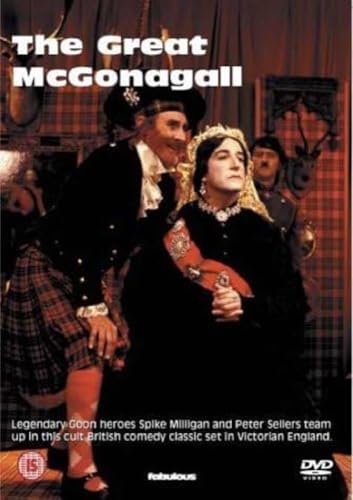
FEATURING:Spike Milligan, Peter Sellers, Julia Foster, John Bluthal, Victor Spinetti, Valentine Dyall, Julian Chagrin, Clifton Jones
PLOT: William Topaz McGonagall, renowned by history as one of the worst-ever practitioners of the art of poetry, recounts his eventful life and demonstrates his inability to distinguish fact from both faulty perception and flights of imagination.
COMMENTS: Scotsman William McGonagall, poet and self-declared “Knight of the White Elephant of Burmah,” has a sterling reputation as a butcher of words without peer. Works such as his bathetic salute to “The Tay Bridge Disaster” have survived over the decades because of their fierce dedication to repetitiveness, disdain for meter, and tendency toward rambling distraction. He is an avatar for the so-bad-it’s-wonderful crowd, on the shelf alongside Florence Foster Jenkins and Plan 9 From Outer Space.
Spike Milligan is also a British hero, although more intentionally, known as a destroyer of comedic conventions. (His spontaneous takedown of an intended tribute from Prince Charles brought down the house in a room full of Britain’s leading comic lights.) His work on “The Goon Show” is deeply influential, with professed fans ranging from the members of Monty Python to Eddie Izzard to all four Beatles. Despite this, Milligan was never a bona fide star on the level of his old pal Peter Sellers, and his ingrained outsider status (born in India to an Irish father) ensured that he could never attain his country’s highest honors. So perhaps it’s not surprising that this serial puncturer of British pomposity would find some affinity with an artist who made the very upper echelons he hoped to enter look foolish .
And that right there is me putting approximately the same amount of effort into researching this review as Spike Milligan did into prepping for the film. It’s not as though anyone would think Milligan was attempting to perpetrate a proper biography on the public; the goal is obviously jokes and nothing but. Nevertheless, The Great McGonagall is a notably slapdash affair, feeling more like someone gave the improv suggestion “William McGonagall” to a troupe at the Edinburgh Fringe, rather than any real attempt to mine the man’s life for material. Most of the acting company takes on multiple roles throughout the film, and Milligan frequently literalizes the staginess of the production like scenes from a music hall revue, complete with an easel advertising the next act. One has to marvel at the laziness of the enterprise, given that this is an actual motion picture featuring two authentic British comedy legends. They could, you know, try a little.
Milligan offers two modes of joke-telling: non sequiturs, and extensive riffs on the trope of the penny-pinching Scotsman. The former gives the film some of its air of oddness; whenever logic dares to show up, it is quickly stomped out. For example, Prince Albert is notably German, but in Milligan’s hands, he becomes a flat-out pastiche of Adolf Hitler, and so naturally a dance scene is accompanied by an orchestra made up entirely of Hitlers. Or consider the curious case of Alfred, Lord Tennyson, who first appears after McGonagall haughtily compares himself to the acclaimed poet; Tennyson pops in to say that he really can’t be bothered right now, as he’s in the middle of a vigorous session of lovemaking. He’ll show up later (initially alongside five Tennyson impostors) to extol the virtues of McGonagall’s poetry while simultaneously stripping down and climbing into the dying Scotsman’s bed alongside a Zulu chieftain. It is unequivocally strange. It’s not especially funny.
Milligan and McGrath’s wandering tale goes furthest off the reservation when appealing to the softcore porn producer who pumped some conditional cash into the film’s budget. Why else would a totally nude dancing woman pop up in McGonagall’s cell in debtors prison? Why intercut McGonagall’s imagined courting of Victoria as a benefactor with a naughty threesome? Of course it doesn’t make sense. The disconnect is the joke. By that standard, it’s a great success, but not an especially edifying viewing experience.
The film has a laudable and unwavering dedication to deadpan performances. Sellers plays it completely straight as Queen Victoria, quietly assuring all who don’t recognize her that “I’m very big in England.” As McGonagall’s long-suffering wife Foster hits all the notes for a sweet, silent, and supportive spouse, even while her husband’s deathbed doctor keeps propositioning her. Perhaps the surest sign of the cast’s commitment is the uproarious mocking laughter that greets McGonagall’s poetry recitals. The sheer cruelty of the response produces the last thing one would expect, and the most dangerous to this kind of comedy: pity for Milligan and his otherwise blissfully ignorant hero.
That points to what gets horribly lost in this ersatz biopic of William McGonagall: McGonagall himself. Milligan uses some of the man’s actual poetry, but it’s so scattered and mixed in with all his other pretensions that you never get a sense of why anyone, McGonagall included, thought he could write, other than blinkered delusion. The most interesting joke–the poetry—was handed to the filmmakers on a silver platter, and they divest themselves of it whenever possible, depriving Milligan of a guaranteed platform for extended silliness. Instead, he’s just a master of ceremonies overseeing a parade of weirdos who are weird for weirdness’ sake. It’s a real waste. No McGonagall. No Milligan. Just a mess.
Socioeconomics journalist Tim Harford examines the life and career of the real William McGonagall on his Cautionary Tales podcast, floating the theory that the poet was in on the bit, and that the terrible poetry was actually an elaborate ruse to keep his career afloat.


![Knoflikari [Buttoners]](https://m.media-amazon.com/images/I/515WzGs7G0L._SL500_.jpg)

![I Love Boosters [4K UHD/Blu-ray]](https://m.media-amazon.com/images/I/41oT9giU69L._SL500_.jpg)