Tag Archives: Children’s Film

CAPSULE: SANTA AND THE ICE CREAM BUNNY (1972)

Santa and the Ice Cream Bunny was promoted onto the List of the 366 Weirdest Movies of all Time. Please make all comments on the official Certified Weird entry.

Beware

DIRECTED BY: R. Winer, Barry Mahon (Thumbelina)

FEATURING: Jay Ripley, Shay Garner

PLOT: Santa’s sleigh is stuck in the Florida sand, so he shows the assembled kids a movie until help arrives in the form of a giant rabbit-man in a fire truck.

Still from Santa and the Ice Cream Bunny (1972)

WHY IT WON’T MAKE THE LISTSanta and the Ice Cream Bunny is weird enough to make the List, but the fact that it can only be endured by injecting Novocaine directly into the part of the brain responsible for processing continuity would make Certifying this movie a public health risk.

COMMENTS: When someone like me, who’s watched They Saved Hitler’s Brain multiple times—voluntarily, not as part of a CIA experiment in breaking interrogee’s wills—tells you that Santa and the Ice Cream Bunny is quite possibly the worst movie they’ve ever seen, you should take notice.  First off, there’s the paradoxical fact that Santa and the Ice Cream Bunny is hardly Santa and the Ice Cream Bunny at all.  It’s actually much more Thumbelina.  Or, maybe it’s primarily an advertisement for a sad-sack, pre-Disneyland southern Florida bemusement park called Pirates [sic] World.  If you’re confused, and not concerned with the prospect of having Ice Cream Bunny‘s plot spoiled, then read on.

The movie begins with what looks like home-movie footage of Santa’s sleigh stuck in the sand on a Florida beach.  The tone-deaf Kris Kringle sings a plaintive (dubbed) tune of lament, then falls asleep, then psychically summons the neighborhood children to help him.  (This sequence of events suggests that the entire movie may be St. Nick’s heat-stroke influenced nightmare).  At any rate, the children flock to his aid, bringing livestock (?) and a man in a gorilla suit (??) to attempt to dislodge the sleigh out of the half-inch of sand it’s buried in (why did the kids think a pig would succeed where eight magical reindeer had failed?)  When this brain-dead plan predictably bears no fruit, Santa decides to tell everyone a story—a story of eternal hope, a story about a magical place called Pirates World.

Actually, the story is the fairy tale “Thumbelina.”  But we can’t simply jump into it.  That would Continue reading CAPSULE: SANTA AND THE ICE CREAM BUNNY (1972)

CAPSULE: THE DARK CRYSTAL (1982)

DIRECTED BY: , Frank Oz

FEATURING: , Frank Oz (puppeteering); Stephen Garlick, Lisa Maxwell, Billie Whitelaw (voice acting)

PLOT: A meek Gelfling sets out on a journey to fulfill the prophecy that he will heal the Dark

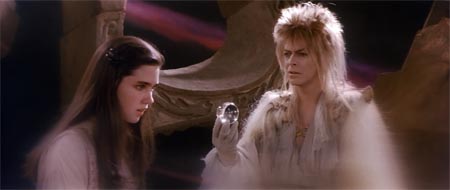
Still from The Dark Crystal (1982)

Crystal.

WHY IT WON’T MAKE THE LIST:  With its advanced puppetry and dazzling color, The Dark Crystal is a visually spectacular movie.  The standard-issue quest story, however, is nothing unusual; just recycled Tolkien, watered down for kids.

COMMENTSThe Dark Crystal may be the most elaborate puppet show ever staged.  There are no human actors in the film, and the sets—from the spiny castle rising from a bleak landscape to the twisted interior corridors of the Skeksis’ lair to the forests of walking plants—are all fairy tale artifice, storybook illustrations adapted into three-dimensional scenery.  A menagerie of imaginatively designed creatures parade in front of these beautifully textured backdrops.  Most impressive are the evil Skeksis, hunched bipeds who simultaneously resemble reptiles, dinosaurs and birds of prey.  They are opposed by the gentle Mystics, four armed, droning sloths with kind wizardly faces, and Gelflings, the “human” characters, who look like an experiment in breeding J.R.R. Tolkien’s elves with chimpanzees from The Planet of the Apes.  The meticulously molded puppets–each turkey-faced Skeksis’ beak is individually gnarled—have expressive eyes, and their jaws move when they speak.  The rest of the puppet faces, however, are immobile; so despite the minute detailing, the mix of animatronics with static features makes the creatures overall appearance unreal and somewhat uncanny—maybe even “weird.”  (The fact that the puppets move at about three-quarters the speed of a human actor, while seriously hampering the action sequences, also adds to the movie’s artificial reality).  The simplistic, muted emotions conveyed by the creatures’ features aren’t terribly jarring, however, because their puppet shells are inhabited by one-dimensional characters.  Lack of character depth isn’t a problem for the villainous Continue reading CAPSULE: THE DARK CRYSTAL (1982)

GUEST REVIEW: ALICE IN WONDERLAND (1933)

366 Weird Movies may earn commissions from purchases made through product links.

Guest review by Scott Sentinella, a freelance writer whose work has appeared in “The Carson News”, “The Gardena Valley News”, “Animato”, “Videomania Newspaper”, “Cashiers du Cinemart”, Dugpa.com and ALivingDog.com.

DIRECTOR: Norman Z. McLeod

FEATURING: Charlotte Henry, Gary Cooper, , Cary Grant, Mae Marsh, , Alison Skipworth, Charlie Ruggles, Edward Everett Horton, Sterling Holloway, and many others.

PLOT: A teenage girl named Alice travels through a mirror into a nonsensical fantasy world where animals talk, mad tea parties are held and queens threaten beheadings.

Still from Alice in Wonderland (1933)

WHY IT MIGHT MAKE THE LIST: Because of the source material, and because of this version’s especially creepy use of bizarre, grotesque masks on many members of its all-star cast.

COMMENTS: Before Tim Burton’s 2010 Alice in Wonderland, every big-screen adaptation of Lewis Carroll’s classic book had flopped at the box office, and this early 1930’s curio was no exception.  Directed by Norman Z. McLeod (known for the Marx Brothers’ Monkey Business and Horse Feathers), and with a screenplay by Joseph L, Mankiewicz (All About Eve) and William Cameron Menzies (better known as the art director on Gone With the Wind), this primitive-looking extravaganza rounded up some 22 stars from the Paramount lot and immediately hid most of them behind very unpleasant-looking masks and bulky costumes.  This Alice was made only five-and-a-half years before The Wizard of Oz, but some of the technology on display here looks like it was left over from the Victorian era.  (Incidentally, Alice’s then-starry cast now consists of three legends—Cooper, Fields, Grant; a lot of character actors familiar to viewers of Turner Classic Movies—Horton, Holloway, Ruggles; and then a host of performers unknown to even the most die-hard classic film buffs—-Jackie Searle? Raymond Hatton?) The results are a bit too disturbing, even for Lewis Carroll, but at least it captures the madness of the novel(s) in a way that Burton’s neutered, watered-down disappointment never really does.  Like most films based on Alice, this one liberally combines elements of both “Alice’s Adventures in Wonderland” and “Through the Looking Glass.”  This time, Alice (Babes in Toyland’s Charlotte Henry) first finds her way through a mirror and then tumbles down a rabbit hole, where she meets the usual Continue reading GUEST REVIEW: ALICE IN WONDERLAND (1933)

CAPSULE: THE PEANUT BUTTER SOLUTION (1985)

366 Weird Movies may earn commissions from purchases made through product links.

The Peanut Butter Solution has been promoted onto the List of Apocryphally Weird movies. Please read and comment on that entry. Comments here are closed.

DIRECTED BY: Michael Rubbo

FEATURING: Mathew Mackay, Michel Maillot, Siluck Saysanasy, Alison Darcy, Michael Hogan

PLOT: A boy loses his hair from a fright, but some grateful ghosts give him a secret recipe for regrowing it; complications ensure when he doesn’t follow the formula exactly.

Still from The Peanut Butter Solution

WHY IT WON’T MAKE THE LIST: It’s weird—scarringly weird—to kids, but this follicular fairy tale is unlikely to have the same effect on grown-ups.

COMMENTS: The most noteworthy thing about The Peanut Butter Solution isn’t any of the weird stuff that happens onscreen; it’s the amazingly consistent reflections of adults who recall seeing it as a child. Anytime this movie is mentioned anywhere on the Net, you will see some variation of the same response: “I saw this as a kid!  I tried describing the plot to someone who hadn’t seen it and they thought I was making it up! I was beginning to think I dreamed it!”

Almost uniformly, these adult survivors of The Peanut Butter Solution mention that the movie gave them nightmares. I don’t think many adults will find this film that creepy when seeing it for the first time, but it’s easy to see why it freaked out so many kids. Leaving the weird and the scary moments to one side, just consider the number of childhood anxieties this film touches on: fear of being made fun of by other kids for being different. First encounters with death. A scary neighborhood house (where a couple of local winos burnt to death). An absent parent. Fear of oncoming puberty. The suspicion that authority figures aren’t just criticizing you for your own good; they really do have it out for you. Abduction. Even the Brothers Grimm were never this macabre. (There is a real modern fairy tale quality to the story, which we’re reminded of when the resourceful kids try to use a trail of sugar to track down the bad guys.)

A movie that dealt with these themes in a straightforward way would likely upset tykes, but Peanut Butter Solution adds nightmarish imagery: a kid who’s gone totally bald (particularly frightening to a youngster who’s vaguely aware of childhood leukemia and chemotherapy). A nameless horror in an attic of an old house. Hobo ghosts. A boy smearing a mixture of peanut butter, rotten eggs and dead flies on his head. Hair that grows so fast it gets snagged in trees as he walks to school. Fur flowing out of a kid’s pants leg. A child imprisoned in an elevated box with his hair hooked up to a loom. Paintings that you can walk into.

All of these strange sights are delivered with the matter-of-factness of a dream. When young Micheal’s hair starts growing centimeters per minute, his father and sister are amazed, but not alarmed by this violation of the laws of nature. Despite the fact that his tresses lengthen visibly as he sits in class, a teacher implies Michael’s lying: hair only grows a half an inch per month, it’s a scientific fact. When Michael and dozens of schoolmates are abducted, the boy’s family is concerned, but not terrified or bereaved. Even children have to realize that there’s something off and unnatural about people’s reactions in the movie; young Micheal is terrified and depressed by the fact that his body is in revolt against him, but none of his adult protectors share his alarm or identify with his sadness.

Kids won’t pick up on the pedestrian acting and the flubbed attempts at comedy, though these factors will likely annoy adults. But even for a grown-up, the script is interesting and unpredictable enough to overcome the workmanlike thesping (and even to make you overlook the vapid, oh-so-80s synth-pop score). With its deep imagination and grasp of childhood psychology, I could imagine The Peanut Butter Solution working more effectively as a picture book than as a movie; the Signor would be a far scarier villain in the mind’s eye than he is onscreen, and the surreal situations would make illustrators salivate.

Despite the legions of adults who remember The Peanut Butter Solution from their youth, the film has never been available on DVD. (VHS copies are not hard to come by). I have a theory as to why this is: a pre-fame Celine Dion sings two (frankly lame) songs on the soundtrack, and I suspect her camp is unwilling to clear their rights without a hefty down payment first. Whenever a film is unavailable due to rights squabbles, it’s a tragedy, but there may be a silver lining here: at least the movie won’t give a whole new generation of kids nightmares.

WHAT THE CRITICS SAY:

“Imagine a weird low-budget variant on The Boy with Green Hair (1948) and the Dr Seuss film The 5000 Fingers of Dr T (1953)… some people have strange memories of The Peanut Butter Solution from growing up in the 1980s but the film sounds much more wacky in description than the pedestrian way it is directed on screen.”–Richard Scheib, Moria: The Science-Fiction, Fantasy and Horror Review (video)

(This movie was nominated for review by “James,” who said “I saw it as a child and was freaked out and I’ve seen it recently and it’s just as weird…check it out!” Suggest a weird movie of your own here.)

LIST CANDIDATE: ALICE IN WONDERLAND (1951)

366 Weird Movies may earn commissions from purchases made through product links.

Recommended

DIRECTOR: Clyde Geronimi, Wilfred Jackson, Hamilton Luske

FEATURING: Voices of Kathryn Beaumont, Ed Wynn, Sterling Holloway, Verna Felton, J. Pat O’Malley, Bill Thompson

PLOT: A young girl named Alice follows a talking white hare down his rabbit hole and into a world of talking animals, smoking insects, walking playing cards, and other nonsense creatures.

Still from Alice in Wonderland (1951)

WHY IT MIGHT MAKE THE LIST: Because of the source material.  Disney animator Eric Goldberg explains Alice‘s appeal: “I think the book ‘Alice in Wonderland’ is popular because it’s completely absurd… The book, in its kind of weirdness, persists because people like weird.”  The question becomes, does Disneyfication destroy the story’s weirdness?

COMMENTS: Though it doesn’t reach the level of the classic-era Disney animated masterpieces Snow White and the Seven Dwarfs (1937) or Pinocchio (1940), Alice in Wonderland is certainly in the next tier—notwithstanding the fact that it didn’t fare well on its initial release. The animation, obviously, is glowing and superlative, and the anything-can-happen-here surrealism of the story gave the Disney artists the license to let their imaginations run wild without being fettered even by cartoon realism. As might be expected, the result is worlds away from the staid, quaintly absurd black and white line drawings of Sir John Tenniel (the standard vision of Alice and Wonderland up until that time). The rabbit hole, with its grandfather clocks and rocking chairs floating at different rates, doesn’t follow the rules of gravity; the flexibility of the playing card royal guards allows the animators to arrange them into pickets or to spontaneously form roller coasters to take Alice for a ride. Scarcity of spectacle is not an issue in Wonderland.

As an adaptation, this Alice is surprisingly smooth.  Episodes from the book have been shuffled around and mixed with characters and events from “Through the Looking Glass,” an example that future Alices would follow (since no one wants to leave out Tweedledee and Tweedledum). Even digressions like the “The Walrus and the Carpenter” interlude, which plays like a self-standing Looney Continue reading LIST CANDIDATE: ALICE IN WONDERLAND (1951)