Tag Archives: 2020

CAPSULE: POSSESSOR (2020)

AKA Possessor Uncut

366 Weird Movies may earn commissions from purchases made through product links.

Recommended

DIRECTED BY:

FEATURING: , , , ,

PLOT: In the near future, secret elite assassins carry out their work by possessing the bodies of innocent parties through a neural implant; Taysa, a top Possessor, has trouble on her latest assignment when the subject proves capable of sporadically suppressing her control.

Still from Possessor (2020)

COMMENTS: “This film has not been modified from its original version” is an odd notice to see on a movie in its first run. Releasing Possessor as Possessor Uncut is meant to play on the fact that Brandon Cronenberg’s second feature was refused an “R” rating, and the director declined to make the cuts (involving both sex and violence) required for the “restricted” rating. Thirty years ago that would have been a big deal, meaning no advertising in newspapers and boycotts by mainstream theaters (and Blockbuster Video). Nowadays, unrated movies—especially provocative art-house pictures and sordid genre films (Possessor fits both categories)—get theatrical releases all the time with little hoo-ha. Still, after watching a possessed hostess plunge and twist a knife repeatedly into her privileged white male target in Possessor‘s opening sequence, you will understand why they are making a big deal out of the “uncut” nature of this project. Possessor‘s violence is graphic, well-done, and fits the film’s disturbingly sociopathic tone.

Specifics of the technology that allows Possessor‘s assassins to ply their gruesome trade are left largely to our imagination. Some details are plot-important, however: possessors are psychologically tested to make sure their individual memories remain intact after a job, and technicians warn that it’s safe to inhabit the host bodies for only about 72 hours. Storywise, there is actually not a lot to follow: top hitwoman Taysa Vos (Risenborough, looking like she’s inhabiting the body of a young ) is feeling the stress of her lifestyle, spontaneously recalling scenes from her work life as she’s trying to re-establish her bond with her estranged husband and son. Her chillingly businesslike boss (Jason Leigh) calls her in for a lucrative job that involves possessing a man to murder his CEO father-in-law-to be as part of an extremely hostile takeover scheme. Things go badly, naturally, as Taysa finds that her neural connection with target Colin (Abbot) isn’t as steadfast as usual. The subject regains some measure of free will, complicating the job.

Like his father, Cronenberg fils knows when to ratchet up the unease with subtle touches (an establishing shot of skyscraper slowly spinning along the frame’s axis) and when to unleash the hounds. One of the odd features of this film is that our putative protagonist is, by necessity, off screen for most of the action. Her psychological motivations are equally absent; we don’t get any overt explanation as to why she does what she does, what makes her good at it, and why she’s willing to risk her family—and her sanity—for her distasteful job. This blankness makes her seem all the more of a monster, a perfect psychological parasite. The trippy sequences where she and her target battle for control of the body’s will feature images of molded mannequin heads melting and reassembling, and of Risenborough trapped in an ill-fitting mask. The imagery suggests not so much a Persona-styled existential crisis as it does a metaphor for a character battling for her own humanity. While not as aggressively weird as his unsettling debut film Antiviral (no celebrity steaks on offer here), Possessor is dark in the best/worst way, and will satisfy your desire for soul-freezing chills.

WHAT THE CRITICS SAY:

“This Cronenberg’s work is just as odd, bloody and twisted as that of his old man, but he’s not imitating the twistedness… whatever else it is, ‘Possessor’ feels authentically weird.”–Mick La Salle, San Francisco Chronicle (contemporaneous)

APOCRYPHA CANDIDATE: I’M THINKING OF ENDING THINGS (2020)

I’m Thinking of Ending Things has been promoted to the Apocryphally Weird List. Please read the official entry.

366 Weird Movies may earn commissions from purchases made through product links.

DIRECTED BY:

FEATURING: , , , , Guy Boyd

PLOT: A young woman goes on a trip to meet her new boyfriend’s parents at their farmhouse on a night when a blizzard is brewing; the night grows increasingly strange and unsettling as it becomes unclear what is real and what is imaginary.

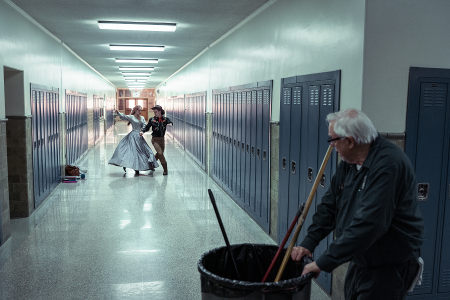
Still from I'm Thinking of Ending Things
I’m Thinking of Ending Things. Guy Boyd as Janitor in I’m Thinking of Ending Things. Cr. Mary Cybulski/NETFLIX © 2020

WHY IT MIGHT JOIN THE APOCRYPHA: By the time the pig shows up at Jake’s old high school, it becomes apparent that this maze of awkward interactions, faulty memories, and uncertain identities may just be Charlie Kaufman’s most surreal film.

COMMENTS: The first inkling that something is not quite right in I’m Thinking of Ending Things comes when the young woman (who is first introduced as “Lucy,” although it turns out that may not be her real name) thinks to herself, “I’m thinking of ending things.” “Huh?,” says Jake (that is his real name), from the driver’s seat. Can he hear her thoughts? She denies speaking. “Weird,” says Jake. “Yeah,” she answers.

Things will get weirder. She’s unsure why she wants to break up with him. Her backstory doesn’t add up. And she’s getting a lot of phone calls, which she’s not answering. When they arrive to meet Jake’s parents at their remote farmhouse, things get even stranger. As it turns out, Jake’s parents would creep out Henry Spencer‘s in-laws. Dinner is uncomfortable, full of small talk that often sounds like hidden accusations, and—once more—competing backstories that contradict each other. Jake’s parents age, almost before her eyes… Nothing explicitly supernatural or menacing happens, but the creaky farmhouse emanates a horror movie vibe, intensified by Jake’s passive-aggressive insistence that his girlfriend stay out of the basement. Meanwhile, Lucy—or whatever her name is—anxiously suggests that Jake take her home before the coming blizzard snows them in and traps her there.

Charlie Kaufman‘s latest mind-massager is another intensely subjective and literate tour of the lonely corridors of the mind, where nothing is as it seems. It’s one of his strangest offerings— particularly when it reaches an irrational finale that departs from the source novel—but perhaps what distinguishes it the most is the exceptional ensemble acting, best seen in the four-way sparring at the dinner table. Their expressions are priceless: Collette smiling to herself at private jokes only she can hear, Thewlis aggressively incredulous at the idea that a landscape could appear sad, Plemmons understandably embarrassed by his parent’s odd behavior, and trying to coax his girlfriend into revealing the correct details about how they met. We expect accomplished performances from those three celebrated actors, but relative newcomer Jessie Buckley is a revelation. She mutates throughout the film, portraying everything from a nervous recalcitrant girlfriend to an angry feminist to an apparent victim of very early-onset Alzheimer’s. She even slips into a Pauline Kael impression. Remarkable.

As with all the best trips, it’s the journey that’s most memorable, not the destination. There is a reveal at the end, but the twist, while satisfying, is hardly the point. Each scene is structured as an individually confounding moment: on the long ride there and back, Jake and his girlfriend discuss everything from the human experience of time, bad movies as viruses, with citations to Wordsworth, David Foster Wallace, Guy Debord, and musical theater (familiarity with “Oklahoma!” will enrich your experience). Jake says he like road trips because “it’s good to remind yourself that the world’s larger than the inside of your own head”—but does the movie believe this thesis? As they travel, the couple learn less about each other, and more about the slipperiness of human memory, fantasy, and identity.  It’s Kaufman’s favorite theme: the loneliness of our inherent interiority. The paradox is that our inescapable subjectivity is the one thing we all share and bond over.

WHAT THE CRITICS SAY:

“If that sounds confusing, or even downright hostile to the audience, well, that describes the Charlie Kaufman experience… There’s a weird thrill to getting lost inside this movie, only so you can study every odd detail from new angles, over and over again.”–David Sims, The Atlantic (contemporaneous)

FANTASIA FESTIVAL 2020: HANGOVER CAPSULE: DINNER IN AMERICA (2020)

366 Weird Movies may earn commissions from purchases made through product links.

Recommended

DIRECTED BY: Adam Rehmeier

FEATURING: , Emily Skeggs

PLOT: Simon, the incognito frontman of the hyper-underground punk group “Psy-Ops”, is low on cash and on the run for arson charges when he has a meet-cute with a hyper-medicated superfan named Patty.

COMMENTSDinner in America is about as quirky a movie as I’d ever dare to recommend on this website. It’s a romantic comedy at heart, with strangely sweet romance and often savage comedy. It’s apt, also, that I write this review while hungover (or as hungover as a teetotaler can hope to be). The driving force and fury behind Dinner in America is one of the most punk of rockers ever to emerge from upper-class suburbia.

Don’t tell Victor (Kyle Gallner, with the mien of a latter day Thomas Howard) that I know his secret background, otherwise he’d smack me upside the head with a metal bat and then light fire to my house. We follow his journey from being a drug tester (where we see his first dinner, on which he loses his lunch) to a smitten jail-bird as he escapes from one scrape after another, spouting enough rage to power a small abattoir. The leading lady, Patty (a truly fascinating Emily Skeggs), is so far down the rabbit-hole of “manic pixie dream girl” that she’s on five different medications to have the merest veneer of normal. She is obsessed with “John Q. Public,” the lead singer of a punk band that’s so underground that their front man is on the run both from the law and from his privileged background.

The simmering rage in Dinner in America is hard to process: every character we encounter comes from a comfortable suburban background. However, as the story progresses, we learn that life’s edges are only smoothed over by money, ranch homes, and pre-fab gourmet dinners. There’s more than a hint of Teorema to be found, as Victor enters the lives of several strangers and immediately takes an axe to their civilized pretenses. In his first visit, he manages to seduce the mother, unhinge the daughter, and absolutely infuriate the racist father before smashing through their bay window and setting fire to their lawn. At dinner with Patty’s family, he adopts the guise of the son of missionaries and in the process liberates a household so weighed down by cyclical tedium that its patriarch is overwhelmed by the “heat” of unspiced beef.

Dinner In America‘s tone is best explained by the presence of Ben Stiller as the first-credited producer. (There’s even a nod to his Royal Tenenbaums character: of the long menu of jerks in this movie, the two worst are these upper-class track and field prats who are only seen out of their pristine track suits when Victor gets one up on them with a metal bat and a dead cat.) And the spirit of Syd Vicious lives on in the fractured singer, who only finds purpose in the form of hyper-weird, hyper-innocent Patty. Like the line from the track those two cut in his folks’ (mansion’s) basement, this is a sweet film in the “Fuck ’em all but us” vein.

WHAT THE CRITICS SAY:

“…the best, and weirdest, rom-com in years.”–Joey Keough, Vague Visages (festival screening) [link requires subscription]

FANTASIA FILM FESTIVAL 2020 APOCRYPHA CANDIDATE: UNDERGODS (2020)

366 Weird Movies may earn commissions from purchases made through product links.

Recommended

DIRECTED BY: Chino Moya

FEATURING: Johann Myers, Géza Röhrig, and ensemble cast

PLOT: “K” and “Z” drive their van around a clapped-out shell of a city collecting dead bodies and telling each other about their dreams.

Still from Undergods (2020)

WHY IT MIGHT MAKE THE APOCRYPHA LIST: The various stories in Undergods interlock with a dreamy (at times, literally) logic worthy of Luis Buñuel. The various future-creepy scenarios are haunting, unsettling, and puzzling, but anchored by two of the most pleasant corpse-haulers one could hope to meet.

COMMENTS: Only the most fragile of barriers protect civilization as we know it today form the looming dystopia of tomorrow. Undergods two guides, body collectors “K” and “Z,” illustrate this point through their narrative dreams, which occasionally bump into reality and each other. Our affable van drivers share a camaraderie forged by their grisly work and offset by their friendly banter and shared can of rum. Moya’s stories unfold and unsteady us in the finest tradition of H.G. Wells, George Orwell, Phillip K. Dick, and the Black Mirror television series.

Undergods opens with an ill-boding narrative about a mysterious 11th-floor neighbor, Harry, who is locked out of his apartment and crashes with Ron and Ruth for the weekend, distressing the former and romancing the latter. After a bender, Ron encounters the apartment’s superintendent and learns that he and Ruth are presently the building’s only occupants. Harry is a charlatan. Ron and Harry scuffle in the elevator. The superintendent begins a tour, opening the door to a father and daughter prospective tenants with Ron’s corpse on the floor.

And so it goes in Undergods. That segment segues into a bedtime story being told by that father to his daughter, a story that itself segues back into the world of van-men K and Z. Like a game of “Sammy the Snake,” the chain of narratives grows and twists until, Ouroboros-style, it feeds back into to the conversation about dreams. The vignettes are invariably sad. Perhaps the happiest event is Dominic’s promotion to “head engineer”–which is small comfort, seeing as his wife’s first husband, presumed dead fifteen years prior, has just been released from a prison facility (found in K’s and Z’s milieu) and now she wants to leave him (Dominic, that is, not her recently returned husband). Undergods‘ plot is just begging for a diagram; but unfortunately I don’t make art, I review it.

Even before the first fully-fleshed story unfolds, the dystopia is firmly established. I don’t know what wreck of an old Soviet town Moya filmed in, but it is beautifully run-down and oozing with creepy grandeur. Ashy snow (or snowy ash) falls continually over the nearly-abandoned streets. The film score feels lifted from an early John Carpenter movie, providing further alienation whenever the electro-pop tones sound off. Undergods never seems to stop moving forward, until we find we never left the van. That’s all right: it’s scary outside, and K and Z have rum to share.

WHAT THE CRITICS SAY:

“Chino Moya’s feature debut is a haunting, almost impenetrable film, one billed as a dark fantasy but that in reality resists categorization. It will leave you with more questions than answers, but if you let it suck you into its strange world, you might not end up minding that.” –Thomas O’Connor, Tilt Magazine (festival screening)