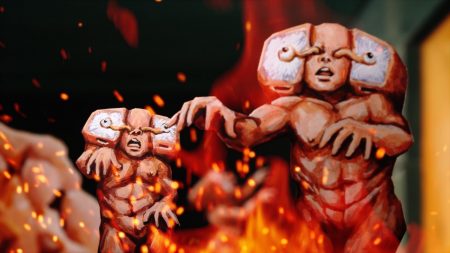
Named after the John Donne poem, this short portrays the madness of isolation.
Tag Archives: 2018
LIST CANDIDATE: VIOLENCE VOYAGER (2018)

DIRECTED BY: Ujicha
FEATURING: Voices of Saki Fujita, Shigeo Takahashi, Naoki Tanaka, Naoki, Aoi Yûki
PLOT: Two young friends investigate a mysterious adventure park only to find that the friendly owner wants them for some particularly icky science.

WHY IT MIGHT MAKE THE LIST: The cartoon style alone, though not new, is singularly discombobulating. Unlike more typical examples (whether drawn or computer generated), the whole movie’s “animation” is more akin to a picture book with pop-ups and pull-tabs, with occasional doses of squirted liquids and couple of fiery scenes. Then there’s the story, pulled out from some terrible organic-horror closet, in which the young “park” visitors face violence and mutations that were made somehow more distressing by the color picture cardboard cut-outs that they’re made up of.
COMMENTS: My right-hand neighbor was at a loss for words after the screening; my left-hand neighbor immediately wanted to confirm just what it was he had seen. Me, I spent the better part of Violence Voyager with what might have appeared to be a quirky-quizzical expression. Ujicha’s “cartoon” is something that, somewhere inside my mind, I enjoyed, while at the same time leaving me at a total loss as to whom I might possibly recommend it. Before the screening I had had the forethought to write the review out-line. Now, stuck with the Comments to flesh out, I shall try to muddle on.
Bobby and Akkun are school chums who have a penchant for adventuring in the woods and mountains near their small Japanese village. Bobby, whose father is American, is out-going, eager to help, and always curious; Akkun is a local lad who might otherwise be a loner, and is quite loyal to Bobby. When the two come across a theme park—the titular “Violence Voyager”—Bobby is keen and Akkun is apprehensive. They are given an orientation video and suit up for what is pitched as a harmless adventure. But some way into their escapade, they encounter an unconscious girl, who upon awakening tells them she’s been stuck in the park for days. Further exploration leads them to a “Robot Graveyard” and other children. Eventually, a bird-beaked cyborg (?) creature subdues them and they are dragged to a subterranean lab.
It took some getting used to, but eventually the moving cardboard pseudo-animation seemed somehow real. It’s akin to how an imaginative child looking at story-book pictures might see them move. So there’s this simplicity and innocence established at the beginning, but then things start going Horribly Wrong. Disintegrating paper kids, icky ooze guns, and perhaps the most disgusting “mother” character I’ve ever seen utterly warp the naïve sentiments embodied in the visual style. Further hitting the viewer upside the head is the never-say-die chirpiness of Bobby, who is unflinching when faced with the array of mad scientist evil, robot-boy creepiness, and, again, whatever the heck that “mother” thing is supposed to be. As a bonus, the narrator intones at the end that Bobby’s struggles are just beginning, before assuring him, “Be strong, Bobby! You can do it, Bobby!”
Then the credits began to roll and I took at peek at my neighbors. Ultimately, the question has to be asked, did this work as a movie? Somehow, it did. However, the follow-up question is a tougher one: is this a movie that deserves to be seen? For that, I’m at a loss. Obviously I’ve seen it, others at Fantasia have. There was even laughter at the numerous, strangely comical bits. And it’s apparent a lot of work, thought, and artistry went into it. I mentioned earlier that I couldn’t think of anyone that I might recommend Violence Voyager to; there is one fellow, but he’s an odd one. So to anyone who feels that she or he might be an odd one, I dedicate this review and say: “Go ahead. Give it a look. (I practically dare you.)”
WHAT THE CRITICS SAY:
LIST CANDIDATE: RONDO (2018)

DIRECTED BY: Drew Barnhardt
FEATURING: Luke Sorge, Brenna Otts, Reggie De Morton,Gena Shaw, Steve Van Beckum
PLOT: Paul has been dishonorably discharged from the military and relies on his sister’s hospitality for a couch to crash on; when she recommends a therapist to help him with PTSD and alcohol addiction, he encounters a sordid world where revenge and unhealthy fantasy experiences can be bought for the right price.

WHY IT SHOULD MAKE THE LIST: Rondo un-apologetically wrings the viewer through a stylized world of manneristic camera, Edward Hopper-esque lighting, gratuitous violence, and a purposely intrusive soundtrack. It plays like a bare bones revenge murder fest spiked with dubstep Greenaway.
COMMENTS: Even before its international premiere, Rondo was creating mumblings among reviewers who had seen it in the screening room. At the debut, the normally raucous Friday night crowd was uncharacteristically quiet in the theater. Then Rondo unleashed its singular form of magic. Having decided on a whim to catch this, I was impressed at not only its vitality, violence, and humor, but also its incredible audacity. The director, Drew Barnhardt, started this project with the intention of making, without compromise, the movie he wanted to make. He succeeded spectacularly.
Rondo begins as the story of Paul (Luke Sorge), a young man dishonorably discharged from the army and shattered by PTSD. His daily life consists of drinking whiskey and lying on his sister’s couch. Troubled by her brother’s depression, his sister Jill (Brenna Otts) recommends a therapist who herself recommends that Paul should explore Denver’s fetish scene. Provided with an address and a password, Paul visits an opulent apartment building in which he encounters two others who have been solicited for having intercourse with a doped-up businessman’s wife. But don’t worry, the role-playing and strange demands are all “part of the fun,” insists Lurdell (Reggie De Morton), in a speech teaming with ominous guide-lines (“keep it on the plastic.”) Paul has a cigarette out on the balcony while waiting his turn, looking inside at where the action is taking place. His bad habit ends up saving his life.
Rondo relies heavily on two nondiegetic sound techniques to keep the viewer detached from the goings-on. The first is an advertently intrusive hardcore electro-trance soundtrack that acts as a dissonant counterpoint to much of the on-screen action. Brooding scenes are imbued with a strange, unsettling energy with each musical cue; I could easily imagine Rondo slipping into melodrama otherwise. Narration also spikes the proceedings. With an officiousness of tone to compete with Colin Cantlie in The Falls, Steve Van Beckum simultaneously clarifies and undercuts the narrative flow, adding another barrier between the audience and the action. Whenever his radio-style voice courses from the speakers, it purposely reminds us that Rondo is a movie, while at the same time anchoring us to the movie’s world.
And that’s just the sound. Stylistically, much of Rondo works like Peter Greenaway at his most ZOO-ily formalistic. Scenes are designed more like paintings than real life. That’s not to say that the action is missing, but more that Barnhardt knows what he wants us to look at, and goes to great lengths to make us do so. I mentioned Hopper earlier, and the candy-noir of his paintings springs up again and again. Then there’s the story itself. Narrative twists are a convention for many of the movies we review; Rondo‘s take is more of a narrative convulsion. Ultimately, the finale is the one that we necessarily had to reach, but the path there is like having our arm twisted behind our back (but, paradoxically, pleasantly so). In Rondo, baroque verbiage and baroque violence come together in a celebration of blood-sodden deadpan.
WHAT THE CRITICS SAY:
SATURDAY SHORT: UGLY (2018)
In a computer generated world with Styrofoam physics, a mystic Native American shows concern for an unfortunate and ugly cat.
LIST CANDIDATE: UNDER THE SILVER LAKE (2018)
Under the Silver Lake has been promoted to Apocryphally Weird status. Please read the official entry. Comments are closed on this post.
DIRECTED BY: David Robert Mitchell
FEATURING: Andrew Garfield, Riley Keough, Patrick Fischler, Jimmi Simpson, David Yow, Jeremy Bobb
PLOT: Doc Sportello‘s grand-son, Sam, is going to be — wait, no. Disheveled loafer Sam is going to be kicked out of his apartment in five days for (criminally overdue) back-rent. Instead of fixing his domestic problem, he becomes embroiled in perhaps the biggest cover-up that has ever bamboozled the Golden State.

WHY IT MIGHT MAKE THE LIST: A serial dog murderer, a conspiracist ‘zine drawn to life, a map in a box of “Space Nuggets,” Jesus and the Brides of Dracula, palatial tombs, the Owl Woman, symbolic Chess moves, the Homeless King, and a mysterious Songwriter all come crashing down on a shiftless 30-something loser with a knack for crypticism. Barking women, Purgatory parties, and one bad cookie lock Under the Silver Lake into a realm of supreme strangeness reminiscent of that beach dream you had after reading Pynchon.
COMMENTS: Call it poor form of me, but I felt obliged to skip a second screening to hustle back and write about David Mitchell’s newest film. During the movie, variations on what to call it skipped around my brain, but ultimately I reckoned that Inherent Goonies best encapsulates the mood. This bizarre crime drama on barbiturates; this ambling post-Slacker comedy; this magnificent quest—somehow the director weds the listless protagonist with the adolescent adventure-stylings of “The Hardy Boys.” Jammed throughout are enough threads to sew yourself a nice cardigan to protect you from the sun while you’re strolling through the over-baked landscape of sorta-now-ish California.
Perched on his apartment’s balcony, Sam (Andrew Garfield) has a good view of his attractive older neighbor—a constantly topless bird fancier. Suddenly, a young beauty (Riley Keough) with a dog and a boombox catches his eye. They meet, they get high together, and then she disappears mysteriously in the middle of the night. Quietly curious and uncannily focused, Sam pursues the mystery at his own ambling pace, encountering an underground ‘zine artist (Patrick Fischler) who sets him on the right path and a coterie of über-hipster musicians whose songs are encoded with secret messages, before meeting the benevolent Homeless King (David Yow) by the grave of James Dean. What follows is an odyssey of unpleasant discovery as Sam finds that, for the rich, the world is a very different kind of place than it is for everyone else.
I’ve already mentioned the Inherent Vice connection, and even if it were only Andrew Garfield’s Joaquin Phoenix-channeling performance, Under the Silver Lake would still be an odd duck. But David Mitchell keeps shoveling on more ducks at every turn. I don’t know where else I’d find cryptography and Hollywood history so intertwined. I don’t know where else I’d find the Purgatory club—the kind of place you might hang out between the Black and White Lodges. And I don’t know where else California’s bright lights and beautiful people could find themselves crashing so violently into luxuriant subterranean twilight. Mitchell even drops some suggestions that Sam could be a burnt-out, alternate time-line Peter Parker.
Fortunately for us, our knight-errant keeps it together on his perilous mission seeking the maiden fair. The movie is epic in length and epic in scope, unveiling new side roads for Sam to shuffle along: sometimes in jeans, sometimes in pajamas. When an ultimate truth is discovered, Mitchell isn’t satisfied, and somehow manages to unveil an even ultimater truth. For reasons beyond my understanding, Under the Silver Lake was poorly received at Cannes. Perhaps it’s just not their kind of movie. Thank the heavens above for Fantasia: Mitchell’s latest effort found just the right kind of people there. With Under the Silver Lake, we fly very close to the sun; but unlike Icarus, we manage to crash comfortably on to our hot neighbor’s bed.
WHAT THE CRITICS SAY: