Tag Archives: 2014

220. REALITY (2014)

Réalité

“It is sometimes an appropriate response to reality to go insane.”–Philip K. Dick

Recommended

DIRECTED BY:

FEATURING: , Kyla Kenedy, Jon Heder, Jonathan Lambert, Élodie Bouchez, , John Glover

PLOT: A young girl (improbably named “Reality”) spies a videotape inside the entrails of a wild hog her father shoots. Meanwhile, Jason, a French-speaking novice director, gets the green light for a screenplay he is working on about killer television sets, but only if he can find an Oscar-caliber scream of pain to insert in the film. Jason’s producer is also funding a fiction film from a former documentary director who, coincidentally, is using Reality as his lead actress, while the stressed would-be filmmaker finds he is having nightmares that are increasingly difficult to wake from.

Still from Reality (2014)
BACKGROUND:

  • Réalité, Quentin Duepieux’s fifth film, was a French/Belgian co-production. The story is set in southern California, although many of the characters primarily speak French.
  • Although Duepieux usually scores his own films, the only music in this film is a repeated phrase from Philip Glass’s “Music with Changing Parts.”
  • The male Award Presenter in Jason’s dream is Michel Hazanavicius, Academy Award-winning director of The Artist (the female Presenter is Rubber‘s ).

INDELIBLE IMAGE: Jason’s recurring dream where he is at an awards ceremony, awaiting announcement of the award for best groan in movie cinema history. He’s the lone human in a sea of blank-faced mannequins in tuxes.

THREE WEIRD THINGS: Viscera video; eczema on the inside; this film doesn’t exist yet

WHAT MAKES IT WEIRD: In his short five film career, Quentin Dupieux has established a distinctive—and divisive—comic vision. His absurd sense of humor takes killer tires, dog-turd detectives, and electronica-snob cops and tosses them into twisted, self-aware scenarios. Reality sees him take a darker turn, venturing deeper into his subconscious, foraging for nightmares.


U.S. theatrical trailer for Reality

COMMENTS: In Reality, a mother reads a bedtime story to her Continue reading 220. REALITY (2014)

CAPSULE: STARRY EYES (2014)

DIRECTED BY:  Kevin Kolsch, Dennis Widmyer

FEATURING: Alexandra Essoe, Lou Deszeran

PLOT: A struggling young L.A. actress finally gets a callback, but the auditions are increasingly humiliating, and the casting director wears a pentagram…

Still from Starry Eyes (2014)

WHY IT WON’T MAKE THE LIST: It’s got a little bit of backloaded weirdness in its final act, but mostly, it’s just a clever but minor indie horror whose primary impact will be as a calling card for lead actress Alexandra Essoe.

COMMENTS: Starry Eyes‘ script was obviously written by people who have stood up and read lines from an unfamiliar script in an attempt to impress poker-faced executives who silently assess their appearance, talent and general suitability as a human being. The movie makes auditioning feel (at times literally) nightmarish. Starry Eyes really makes you feel Sarah’s objectification as a struggling L.A. actress, and not only in the obvious ways. In fact, her daytime stint in hot pants and cutoff t-shirt at “Big Taters Family Restaurant” is less humiliating than the auditions she attends. The “Big Taters” subplot is interesting, because breastaurant waitressing is presented as a more honest and, in a way, honorable line of work than acting; her boss may ogle her, but he actually gives her good advice, whereas the casting agents are arrogant procurers who shamelessly leverage her starlet ambitions. Food service just wants her for body, but the movie industry wants her soul.

Astraeus Pictures not only makes B-movies, but they are staffed entirely by renegades from a low budget horror set. The bow-tied assistant casting director is fey and over-enunciates; his female superior is severe and androgynous, like a patrician riding instructor or a warden at a women’s prison. The producer himself has the studied smile, raised eyebrows and smarmy positivity of an overeager motivational speaker, or a hammy horror movie villain. Essoe’s performance, by contrast, is totally naturalistic, and extremely intense when anxiety attacks make her tear the hair out of her head in bloody clumps. The campiness of the moguls’ portrayals is a deliberate attempt to make them seem strange and artificial (and even hypocritical, since they demand authenticity from the auditionees they torment).

Sill, reasonable aesthetic choice though it may be, I think the hammy performances from the Hollywood phonies are a bit overplayed. The other major detractor from a generally solid horror outing is the weak second act, where Sarah spends too much time hanging out with her indie filmmaking friends. These digressions set up a necessary contrast between the creative freedom of the poor artsy types and the corporate bondage offered by Astraeus, but they don’t do favors for the pacing. Fortunately, the final act takes a turn into ian body horror, as Sarah transforms from a nobody wannabe into one of  Hollywood’s merciless bloodthirsty elites. “Dreams require sacrifice,” taunts the producer. The idea of selling your soul for a starring role isn’t a new or original one, but Starry Eyes is effective because it’s made by people who understand the agony and temptation of the quest for stardom from the inside.

WHAT THE CRITICS SAY:

a mumblegore Mulholland Dr., following a would-be startlet’s (self-)destructive fugue through the dreamworld of Tinsel Town.”–Anton Bitel, Grolsch Film Works (contemporaneous)

CAPSULE: JAUJA (2014)

DIRECTED BY: Lisandro Alonso

FEATURING: Viilbjørk Malling Agger

PLOT: A Danish surveyor tracks his missing daughter into the wilderness.

Still from Jauja (2104)
WHY IT WON’T MAKE THE LIST: This slow-paced movie turns weird by the end, but strangeness doesn’t even put in a cameo appearance until the last twenty minutes.

COMMENTS: While Jauja is set in a specific time and place, no one in the movie ever says what that time and place is; they simply inhabit it as their reality. The film’s “meaning,” similarly, is left vague. An explanation for the film’s title, on the other hand, is given in a text prologue: “Jauja” is a mythical paradise, the equivalent of El Dorado, a place ambitious explorers seek and never find. This, along with the colonial dress and a campfire tale about a soldier who was wandered into the wilderness and went mad, immediately brings to mind similar themes from Aguirre, the Wrath of God; although ultimately Alonso’s movie is more oblique and far more restrained than ‘s Amazonian fever dream classic.

Although never specified, Jauja was actually shot in Argentina, and the film could serve as an advertisement for the Pampas Tourist Board. In its ability to capture the country’s strange landscapes— the standing pools of water flanked by mossy rocks, the fields of boulders, the mighty horizons—the film is an undisputed triumph. Jauja is shot in a boxy 4:3 aspect ratio rather than the expected widescreen, with the corners quaintly rounded so that the screen recalls a picture frame. The natural color schemes, particularly the blue midnights and glowing dawns, look brilliantly unreal. Jauja may be too small and peculiar to compete for any major awards, but I doubt we will see superior cinematography in any film this year.

As desolate as Jauja‘s landscapes can be, for most of the running time the film’s plot is even more so. A scene that kicks off the movie’s second act illustrates how unnaturally deliberate the pacing is. Viggo Mortensen’s Danish captain discovers that his teenage daughter is  missing from her tent; instead of immediately rushing off after her, he returns to his own tent and spends several minutes calmly examining his weapons and dressing in his formal military uniform. Although not much time is actually lost in the formal procedure, the scene conveys the exact opposite of urgency. In the movie’s middle section, minute after minute goes by with no words spoken; we simply watch Mortensen stumble across the craggy landscape, growing increasingly weaker. (We also watch him sleep). Eventually, he encounters a shaggy dog and follows it back to a cave where he has a very strange encounter with an old woman (which I will not spoil). Things get even weirder for the ending epilogue, a time-bending journey to another world where the film’s earlier motifs—dogs, a toy solider—are recast in a dreamlike fashion.

Many critics compare Alonso’s latest film to the work of  , for obvious reasons. Although Jauja shares Tarkovsky’s meticulous use of time and strangeness, the Russian master’s films always win out because they end on profound emotional resonances; the Stalker weeping in despair, Kris Kelvin’s decision to play along with Solaris’ delusion. As well-made and thoughtful as it is, Jauga‘s heart is simple—the love of a father for his daughter—and does not approach the emotional intricacies of Tarkovsky. Of course, few do; but Jauja shows you what Tarkovsky may have looked like without his complex understanding of the human soul.

WHAT THE CRITICS SAY:

“…this hallucinatory head-trip Western remains unmistakably Alonso’s film from first frame to last — a metaphysical road movie in which origin and destination are markedly less important than the journey itself…  Alonso saves his most dazzling trick for last: a sudden plunge down a Lynchian rabbit hole that should, by all means, rupture the film’s hypnotizing atmosphere, but instead pulls the viewer in even deeper.“–Scott Foundas, Variety (contemporaneous)

CAPSULE: DA SWEET BLOOD OF JESUS (2014)

DIRECTED BY: Spike Lee

FEATURING: Stephen Williams, Zaraah Abrahams, Rami Malek, Elvis Nolasco, Thomas Jefferson Byrd

PLOT: A well-to-do doctor of anthropology gets stabbed with an ancient Ashanti dagger and becomes immortal but addicted to blood.

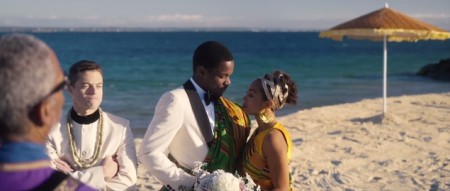
Still from Da Sweet Blood of Jesus (2014)

WHY IT WON’T MAKE THE LIST: The movie’s vampire-origin premise is an uncommon one, but the movie is weighed down by a cold—bordering on somnolent—lead performance, a scattershot tone, and the fact that the most compelling scenes are largely uninvolved with the main action.

COMMENTS: The opening credits of Spike Lee’s latest movie are fully alive. Across the acting and production shout-outs, Lee shows off a very skilled street dancer (Charles “Lil Buck” Riley) performing a number of smooth, impressive moves in various Brooklyn street spots. The momentum continues with the opening scene proper, a lively gospel shout ceremony at “Lil’ Piece of Heaven” church. During the full-blooded, upbeat sermonizing, we see Dr. Hess Green (Stephen Williams) sitting alone in the back, noticeably separate from the rapt congregants. After this introduction, however, it seems that all the blood drains from the movie.

What follows is a sometimes dreamy, sometimes intellectual, and consistently tedious affair involving the realities of a modern, bookish vampire. Dr. Greene hosts big parties for intelligentsia at his large estate in Martha’s Vineyard (with grounds spanning 40 acres, no less). He chats amiably, but briefly, with the various educated bourgeoisie, before having to hightail it to his basement for some blood packs from the refrigerator. He emerges with a wine glass of blood; when an insistent guest tries it and spits it out, he glibly explains, “It’s organic.” And so comes and goes one of the few breaks from the largely unremitting monotony of the film.

Between his unfortunate conversion to vampirism and a personal spiritual revelation, he murders and drinks blood of various poor women of color. His traces of hyper-shy charm are smudged over by his callous and guileless manner. For reasons not entirely clear, he immediately falls in love with Ganja Hightower (Zaraah Abrahams), who was once married to his erstwhile assistant. She seems to hate everything and everyone, and has adopted the unfortunate habit of being 100% honest 100% of the time. She has a backstory to explain her current hostility to the world, but I found myself utterly incapable of seeing how that justifies her sheer unpleasantness. Throughout the movie, Spike Lee (who co-wrote the screenplay) dribbles in bits and pieces of mumblecore exchanges; where he should have focused on creating an atmosphere of angst and ambiguity, instead he makes each character no more than a projection of a type. Even the hammy characters from Blacula have more nuance and relatability.

There are some scenes of vitality and beauty. Whenever the action shuffles over to the church (all too infrequently), the movie  immediately gets a shot in the arm. And while I am not one to generally marvel at the visual splendor of a scene, the marriage on the private beach that takes place in the second half was a sheer joy just to look at. Unfortunately, I can only come to the conclusion that while the movie toyed with greatness, it came short in a number of ways. It may have been a worthy recommendation if it had been: more atmospheric, more puzzling, livelier, wittier, and so on. Had it thoroughly pursued any one of those directions, it may have been on to something. Instead, Spike Lee seems to want it all, and it ends up falling flat.

WHAT THE CRITICS SAY:

“…with no one breathing down [Lee’s] neck, it’s free to zoom all over the place — from seriousness to high comedy to weird comedy to quietly anxious set pieces…  For better and sometimes worse, ‘Jesus’ is undiluted Lee — a half-committed attempt at a twisted genre film that freely gets lost down unexplored alleyways.”–Matt Prigge, Metro (contemporaneous)

214. DER SAMURAI (2014)

“…there seems to be some sort of secret anarchic urge within me to see the monsters set loose and rampantly reclaim what’s theirs, to witness them bringing back some wonder and excitement into a world so controlled by order and reason that it at times threatens to suffocate all sense of joy and opportunity.”–Till Kleinert

DIRECTED BY: Till Kleinert

FEATURING: Michel Diercks

PLOT: Young policeman Jakob deals with a wolf menacing his rural east German village by placing bags of butcher scraps in the woods, hoping to lure the predator away from inhabited areas. One night he receives a mysterious package which he is instructed to deliver to an abandoned house; inside the home is a man in a dress who unwraps the package to reveal a samurai’s katana. The transvestite then runs into the night, where he embarks on a campaign of murder and mayhem which Jakob must put to an end.

Still from Der Samurai (2014)

BACKGROUND:

  • Der Samurai is Till Kleinert’s directorial debut, and his graduation project for the German Film and Television Academy.
  • The film was denied a government funding grant because it was deemed “incompatible with the taste guidelines of German public television.” Much of the budget was instead raised through a crowdfunding campaign.

INDELIBLE IMAGE: When your movie stars a blond-haired samurai in a floor length backless white party dress, you have a good idea what the indelible image is going to be.

THREE WEIRD THINGS: Transvestite samurai; flamingo punch; explosive decapitation

WHAT MAKES IT WEIRD: Exploring the weirdness in queerness, Der Samurai is a primal confrontation with the Other, embodied in the person of a wolf man come to life as a dress-wearing, sword-wielding maniac who taunts a repressed country policeman into a confrontation with his own desires.


Original trailer for Der Samurai

COMMENTS: Jakob’s long duel with a mysterious cross-dressing Continue reading 214. DER SAMURAI (2014)