Tag Archives: 1981

CAPSULE: MY DINNER WITH ANDRE (1981)

Recommended

DIRECTED BY:

FEATURING: , Andre Gregory

PLOT: Struggling playwright Wallace Shawn has dinner with his old friend, theater director Andre Gregory, who describes the mystical experiences he’s had visiting experimental theater workshops and communes around the world.

Still from My Dinner with Andre (1981)
WHY IT WON’T MAKE THE LIST: It’s not weird enough. The concept of a movie that is almost entirely a single dinner conversation is successfully experimental, and some of Gregory’s theories approach the bizarre, but Louis Malle has a couple of better candidates for the List of the weirdest movies of all time out there.

COMMENTS: Based on the description—there’s no plot per se, just two intellectuals sitting down for dinner at a swank restaurant having a conversation–you probably have no interest in seeing My Dinner with Andre, no matter how many times cinephiles tell you it’s a classic. I admit, the synopsis held no great attraction for me; I like Wallace Shawn and Louis Malle, but I never would have sought this movie out on my own, and I approached the prospect of viewing it more with trepidation than anticipation. Frankly, I was hoping it would not be as boring as it sounds—I mean, I like a good chat about life when I’m a participant, but I don’t see talking as a spectator sport. I needn’t have worried; although My Dinner with Andre assumes that you are reasonably intelligent and have a basic liberal education, it’s more accessible than it sounds. And, if you engage with it, it’s also more dramatic than it sounds.

The movie stars playwright/actor Wallace Shawn as a struggling playwright/actor, and avant-garde theater director Andre Gregory as an avant-garde theater director. The conversation is scripted, but it is based on actual discussions between the two men, who play exaggerated, fictionalized versions of themselves. The story begins with a dissatisfied Shawn complaining about his life: his career as a playwright isn’t putting food on the table and all he ever thinks about are his money problems. He is going to dinner with Andre, the theater director who produced his first play but who had recently dropped out of the New York theater scene to travel around the world, returning with strange tales of his adventures. Wally has heard Andre has been acting erratic and is nervous to meet him again. The first part of the dinner is almost a monologue by Gregory, who details his adventures in an experimental theater group in Poland where he directed a group of women who did not speak English; tells tales about his time in the Sahara with a Japanese monk who could balance on his fingertips; and relates a story about a ceremony where he was ritually killed and resurrected. Andre explains that he has been searching for experiences that allow him to be truly human, because he believes that modern man is fatally disconnected from reality. He also explains that, during this period in his life, he would spontaneously hallucinate, seeing birds flying out of his mouth when he looked in the rear-view mirror and a blue minotaur with flowers growing out of its body at midnight Mass. Although Andre is charasmatic, enthusiastic and lucid, these confessions cast him in a strange light. Is he really a mystic? Or does he have a touch of madness? Or is he just a man with an amazing imagination?

Wally listens with increasing interest as Andre relates his exploits, until, in the second half of the conversation, he starts to raise objections and fire back at Andre, whose vision of life he finds intoxicating but impractical. Wally says Andre’s lifestyle is too elitist: not everyone can have these experiences, and there is meaning to be found in reading good books and enjoying a cup of coffee. Neither Wally nor Andre gets the upper hand. Ultimately, Andre doesn’t convince Wally that it’s necessary to take extreme measures to find meaning in life. Yet, Wally still has a sense of epiphany. As he’s leaving dinner, he thinks with wonder of ordinary experiences he’s had: buying a suit, eating an ice cream… Wally comes away from dinner invigorated, not because Andre convinces him to change his life and start “really living,” but because he’s refreshed himself by an encounter with another mind, with another way of thinking about life. The reason My Dinner with Andre works is not because we take sides with either Wally or Andre, but because it reminds us of discussions we’ve had with our own dear friends, where we lose track of time and talk deep into the night. It recalls those treasured times we shared our deepest thoughts, and someone else thought enough of them to challenge us. It’s the conversation that matters, not the words spoken.

WHAT THE CRITICS SAY:

“…one of the few entrancingly esoteric, radically raw dialectics ever filmed.”–Joseph Jon Lanthier, Slant (DVD)

(This movie was nominated for review by nicolas, who simply called it “an amazing film.” Suggest a weird movie of your own here.)

CAPSULE: NIGHTDREAMS (1981)

DIRECTED BY: F.X. Pope

FEATURING: Dorothy LeMay, Jennifer West, Andy Nichols

PLOT: Two scientists observe a woman’s erotic dreams.

Still from Nightdreams (1981)
WHY IT WON’T MAKE THE LIST: As the first, and very nearly the only, movie to mix hardcore XXX action with dream logic, Nightdreams is a unique beast. As a curiosity piece it’s something to add to your bucket list, but once the novelty of surrealist porn wears off, Nightdreams is not really a great movie—and it’s worse erotica.

COMMENTS: There’s a reason plotted porn movies never took off. Narrative and intense titillation work against each other; each one is a distraction from the other. Even today, directors like who toy with adding explicit sex to their movies make sure that actual acts of penetration and gynecological detail last only for a few seconds, to keep their stories from drifting into a fap-fest. Surrealism and porn don’t really go well together, either; the weird feeling inspired when a cigarette-smoking fish head pops up in bed next to a lovely lady throws cold water on those sexytime cravings. Written by a young “Hustler” copy writer named Jerry Stahl and that magazine’s “Creative Director” (the two would continue their partnership on the XXX cult film Cafe Flesh and the softcore midnight movie Dr. Caligari), Nightdreams was made by smart people slumming in the gutter, anxious to do something erotically different for two reasons: a), to get themselves noticed, and b) to keep from getting bored in the repetitive and formulaic world of porno. Of course, porn is repetitive and formulaic for a reason—its function is to expand viewers’ pants, not their intellectual horizons—so, while Nightdreams got some favorable notice as some sort of prestige sleaze piece, it didn’t exactly found a subgenre of art-house smut.

Nightdreams stars Dorothy LeMay as the woman whose sexual imagination is so outlandish it’s the subject of a research project by a pair of scientists in lab coats. Strawberry blond LeMay has a real-world, girl-next-door sexiness that’s refreshing compared to the plasticized glamor of today’s porn starlets, but, based on her line readings, an actress she is not. That’s okay, because she appears to enjoy the weird sex (so maybe she is a great actress, after all). Her fantasies involve sex with a Jack-in-the-box (accompanied by creepy anti-erotic laughter), a campfire threesome with two lithe cowgirls (while Wall of Voodoo sings a cool New Wave rendition of “Ring of Fire”), servicing a couple of hookah-smoking sheiks, meeting a man with a fetus in his pants, a pseudo-rape scene over a toilet, and rutting with the Devil in Hell, followed by a romantic coupling with an angelic stud in Paradise. The movie’s most memorable sequence, no doubt, is when Dorothy fellates a living rendition of a Cream of Wheat box while serenaded by a jazz version of “Old Man River.” Her head bobs back and forth to the music, and a piece of toast shows up to accompany the couple on sax. It’s an unusual sight, to say the least. Like most of Nightdreams‘ scenes, it’s too weird to be erotic, but too porn-y to work as an art installation.

The Cream of Wheat scene is a trademark infringement that the Nabisco company would never condone, and I seriously doubt Johnny Cash would license the rights to “Ring of Fire” for a lesbian threesome scene, either. I suspect Nightdreams got away with these infringements because, in 1981, porn was still relatively taboo, and none of the copyright holders would admit to having seen the film.

The IMDB credits “F.X. Pope”  as Nightdreams‘ director, and lists this as an alias for TV and music video director Francis Delia (who has no other porn connections). However, IMDB also lists “F.X. Pope” as one of Sayadian’s pseudonyms—I had always assumed Sayadian was the director because of the style, and also because he indisputably directed the sequel Nightdreams 2.

Others who worked on Nightdreams include Fast Steppin’ Freddie, Zoot Suit and Pez D. Spencer.

WHAT THE CRITICS SAY:

“…definitely the most unusual and unique porn flick I’ve ever seen… a series of weird, funny, sexy, surreal and twisted dreams.”–Goregirl, Goregirl’s Dungeon (DVD)

(This movie was nominated for review by “Andrew.” Suggest a weird movie of your own here.)

PENNIES FROM HEAVEN (1981)

Steve Martin burst onto the national radar with his comedy album “A Wild and Crazy Guy” (1978). He followed that success by starring in his first feature film, the box office bonanza The Jerk (1979) directed by Carl Reiner and co-starring his then-current flame, Bernadette Peters. Although The Jerk was merely crass instead of authentically humorous, Martin and Peters re-teamed for Herbert Ross’ winningly experimental Pennies From Heaven (1981). Predictably, American audiences smelled something new with the film, and stayed away. Many critics were more astute and praised the film, which prompted Martin and Reiner to briefly follow that attempted path of originality in Dead Men Don’t Wear Plaid (1982) and Man With Two Brains (1983). Alas, like the rest of that decade, what started in a burst of creative energy petered out midway through and succumbed to formula.

Martin’s work as an interesting artist paralleled the rise and fall of the 1980s. He simply ceased to take chances after his role as the dentist in Little Shop of Horrors (1986) and rendered himself irrelevant. In contrast, Peters continued to challenge herself, instead of taking the safe route. It is her post Pennies career, rather than Martin’s, which is more consistently satisfying.

Pennies from Heaven is an idiosyncratic and delightfully grim film, and it separates authentic critics from the weak-kneed boys by defying the rules of filmmaking and confounding those who expect dogmatic adherence to genre expectations (with due apologies to Mr. Ebert). It startles us even today and seems as fresh and innovative as it did thirty years ago.

 wrote the screenplay, which sprang from his 1978 BBC mini-series of the same name. As in his later script for Dreamchild (1985), Potter achieves a level of unsettling emotional intensity rarely achieved in the medium. Potter and Ross recreate a mythological Depression era, lifted straight from the haunting canvases of Edward Hopper, giving the film its unique texture.

Arthur (Martin) is a down on his luck sheet music salesman trying to ply his wares in a corrupt world. Compounding his frustration is his downright Victorian marriage to Joan (). When Arthur encounters the uninhibited Eileen (Peters), he is not above lying about his marital status.

Still from Pennies from HeavenThe characters lip-synch to songs from 1930s musicals and, surprisingly, it works. Often, Pennies From Heaven supersedes its source material because—let’s be frank—do any of us ever watch period musicals for their emotional depth or narrative substance?
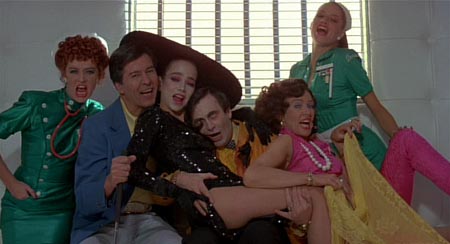
A web of lies, back alley abortions, and the rape and the murder of a blind girl are not going to add up to an Astaire/Rogers happy ending. (Arthur and Eileen even take the place of that famous duo by literally stepping into a scene from 1936’s Follow the Fleet).  has an all too brief scene, doing a slimy striptease as only he can. Martin is refreshingly subdued. We root for him and Eileen, despite his manipulations. Harper is equally good, and it’s a revelation of some kind that her character in 1981 is not the one we are asked to identify with or root for, as we would have fifty years earlier.

Pennies From Heaven was a gutsy movie in 1981. It still is, never once succumbing to bland and pretentious realism, while at the same time never alienating us emotionally. Ross, Potter, Martin, Peters, Harper, and Walken all proved that the good and original musical had not gone the way of the dinosaur. Alas, it took European audiences to respond to them.

CAPSULE: SHOCK TREATMENT (1981)

DIRECTED BY:

FEATURING: , Cliff De Young, Barry Humphries, , Charles Gray, Ruby Wax,

PLOT: A young married couple end up in a town that’s actually a giant television network; Janet is groomed as a celebrity, while Brad becomes a mental patient in a hospital show.

Still from Shock Treatment (1981)

WHY IT WON’T MAKE THE LIST: Shock Treatment is a cult film even among the tiny subset of cult film enthusiasts. This “sequel” was rejected as a confounding disappointment by most fans of The Rocky Horror Picture Show, but is still vehemently defended by a segment of that fan base. It’s a peculiar exercise in wacky musical satire, for sure, but it lacks the kind of résumé necessary to place it among the most significantly weird movies of all time.

COMMENTS: What would you get if you took The Rocky Horror Picture Show and stripped out Tim Curry‘s domineering performance as the mad scientist transvestite dominatrix, leaving behind only the theater-rock musical numbers and campy supporting players? (On the off-chance you don’t see where I’m going yet, the answer is Shock Treatment). Whereas Rocky Horror was a theatrical flop that organically grew into a cult movie, Shock Treatment was pitched as a deliberate cult movie, but became an instant flop. This delayed follow-up is full of amped-up ideas and energy, but it comes off as cocksure; it’s so convinced its madness is entrancing that it forgets to ground us in its quirky universe. The (confusingly executed) idea is that the entire town of Denton, U.S.A. is a TV studio, with the audience as regular citizens, the stars and staff as sorts of metro officials, and the sponsors as big-money villains manipulating studio politics behind the scenes. The movie throws so many colorful eccentrics at us that every character turns into a minor character, even the leads. Janet (not necessarily the Janet Susan Sarandon played in the previous movie) and Brad (again, a character with the same name but little connection to the original) enter the town’s audience, for unclear reasons, and wind up on a marriage counseling show run by a blind Austrian in an orange thrift-store tuxedo. He hands Brad off to a brother/sister pair of psychiatrists (writer Richard O’Brien, wearing uncomfortable- Continue reading CAPSULE: SHOCK TREATMENT (1981) →

102. LUCIFER RISING (1981)

366 Weird Movies may earn commissions from purchases made through product links.

“The montage of hermetic symbols becomes first dreamlike, then menacing; centuries of mystical thought are distilled into a series of voyeuristic fantasies, a kinky psychodrama backed by the carnival strains of a maleficent calliope.  Anger intended Lucifer Rising to stand as a form of ritual marking the death of the old religions like Judaism and Christianity, and the ascension of the more nihilistic age of Lucifer.”–Mikita Brottman in “Moonchild: The Films of Kenneth Anger”

RecommendedWeirdest!

DIRECTED BY:

FEATURING: Myriam Gibril, , , Leslie Huggins,

PLOT: Lava erupts and the goddess Isis awakens, calling to her husband Osiris. In a room far away a man wakes up, sits on a throne in his apartment and somehow spears a woman in a forest far away, then climbs into a bathtub to wash off the blood. Later, the moon awakens the goddess Lilith, a magick ritual summons Lucifer, and flying saucers appear over Luxor, Egypt.

Still from Lucifer Rising (1981)

BACKGROUND:

  • Anger originally shot a film called Lucifer Rising (A Love Vision) in 1966, which starred Bobby Beausoleil as Lucifer. Anger claimed that Beausoleil stole most of the completed footage and hid it; the star contended that Anger merely ran out of money to complete the movie.  Anger then took out an obituary-style ad in The Village Voice announcing his retirement from filmmaking.  Whatever the case, Anger incorporated some of the surviving footage from the original Lucifer into Invocation of My Demon Brother (1969).
  • Anger began working on the project again in 1970 and completed the first cut of Lucifer Rising in 1973, with a score by Jimmy Page.  After a falling out with Page he had the movie re-scored by Bobby Beausoleil.
  • Beausoleil was a Haight-Ashbury musician who came under Anger’s influence during the Summer of Love.  After his falling out with Anger the musician joined Charles Manson’s “Family.” He murdered music teacher Gary Hinman in 1969 over a drug deal gone wrong, and was convicted and sentenced to life imprisonment.  Anger contacted him to create the music for Lucifer Rising, and he wrote and recorded the score from prison.  The band heard on the soundtrack is comprised of his fellow inmates.
  • Lucifer Rising was completed with funds from the National Film Finance Corporation of Great Britain, prompting some controversy about state funding of a “devil film.”  Anger also received financial assistance from the Germany’s Hamburg Television and the U.S.’s National Endowment for the Arts.
  • Anger did not complete the editing on the final cut until 1981, a decade after work was begun.
  • In one of the film’s final scenes there is a long shot of the Colossi of Memnon in Upper Egypt. If you look hard you can see a puff of smoke rising in the distant background. According to Anger, this came from him ceremonially burning the film’s script because the work was now complete.

INDELIBLE IMAGE: The orange UFO flying over the crumbling columns of the Temple of Luxor, then peeking over the shoulder of the colossal ancient statue of Ramses II.

WHAT MAKES IT WEIRD: Egyptian gods and goddesses frolicking through a magickal psychedelic landscape, summoning Lucifer and flying saucers.


Trailer for “The Films of Kenneth Anger, Vol. 2 (including clips and music from Lucifer Rising)

COMMENTS:  A shaggy-haired man in a robe of many colors caresses a stone column. A Continue reading 102. LUCIFER RISING (1981) →