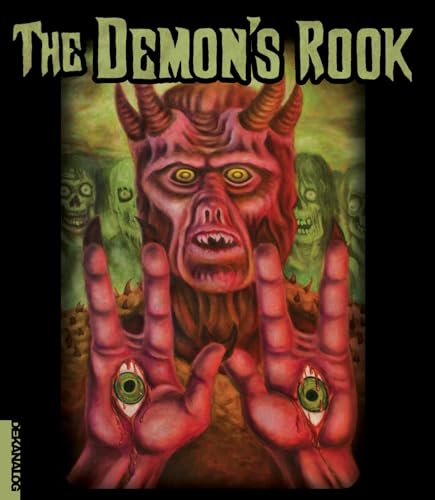
CAPSULE: THE DEMON’S ROOK (2013)

366 Weird Movies may earn commissions from purchases made through product links.

DIRECTED BY: James Sizemore

FEATURING: James Sizemore, Ashleigh Jo Sizemore, John Chatham, Josh Gould

PLOT: After disappearing into the Earth as a young boy, Roscoe returns from the Dark Womb years later to thwart a demonic invasion.

Still from The Demon's Rook (2013)

COMMENTS: Well, that was ridiculous.

Mind you, it is a glorious piece of ridiculousness—and a testament to the can-do attitude of filmmaker James Sizemore and his pals. The Demon’s Rook looks like a professional piece from a career special-effects artisan, though apparently all the costumes, violence, and prosthetics were whipped up by Sizemore after he watched some YouTube tutorials. The whole thing exhibits extreme enthusiasm, as supernatural set-pieces unspool (typically toward a gristly climax) while Roscoe and Eva do their darnedest to dodge death as a trio of dastardly demons reign havoc upon a rural corner of Georgia.

The story functions almost exclusively as a framework for the atmosphere and artistry (beyond the top-notch bloodwork, there’s a ubiquitous moody synth score whipped up—you guessed it—by Sizemore’s pals). The filmmakers provide just enough personality, pathos, and peril to give the viewer an emotional “in,” and a more enterprising reviewer might consider the symbolic ramifications of the title: in chess, the rook is a powerhouse enforcer, though one typically fated for doom.

I am not that enterprising. I am, however, someone who’s seen enough micro-budget DIY outings to recommend this movie to anyone who’s remotely hooked by the gory trailer, or has a yen for ’70s and ’80s splatter features—particularly if they like them spiked with mysticism. The Demon’s Rook is a joyous celebration of classic splatter, and proof positive that anyone with enough gumption (and tolerance for YouTube tutorials) can make an entertaining violence picture.

WHAT THE CRITICS SAY:

“Like a midnight movie from the 80s, its focus is on showing as much blood as possible, while acting, plotting and coherence all deliberately take a backseat… the nostalgic bunch of you out there, who remember staying up to watch cheap horror flicks on VHS or late-night cable, will probably find themselves entertained by THE DEMON’S ROOK’s cheesy, ridiculous charm.” — Eric Walkuski, JoBlo (contemporaneous)

POD 366, EP. 145: THANKFUL FOR ANGEL’S EGGS AND OTHER WEIRDNESS, WITH A LOOK AHEAD TO BLACK FRIDAY

366 Weird Movies may earn commissions from purchases made through product links.

Audio link (Spotify)

YouTube direct link

Discussed in this episode:

Angel’s Egg (1985): Read Simon Hyslop’s original List Candidate review! In a desolate city, an angelic young girl cherishes an egg. We have been waiting for this one to be re-issued since the day this site first came into existence; that day is finally here. In theaters, physical media to follow soon. Angel’s Egg official site and check for locations.

The Carpenter’s Son (2025): plays “Joseph” in this teenage “Jesus” horror movie inspired by the apocryphal (not apocryphally weird) Infancy Gospel of Thomas. It’s understandably getting review bombed by angry Christians on IMDb, but mainstream critics aren’t exactly loving it, either; we’ll check it out anyway. The Carpenter’s Son official site.

Dark City (1998): Read the Canonically Weird review! The standard version of the Arrow limited edition set of the Canonically Weird sci-fi psychothriller we discussed on a previous episode; choose either the Blu-ray or the 4K UHD version (not both).  Buy Dark City.

Él (1953): An older man grows insanely jealous of his beautiful, entirely faithful younger wife. An early-to-mid Mexican period film from , so not as weird as his early and late outings, but still historically fascinating to watch his development as a filmmaker. The adds this one to their expansive Buñuel offerings in a new restoration with archival interviews and so forth. Buy Él.

Hundreds of Beavers (2022): Read the Apocryphally Weird review! With the arrival of cold weather, Beavers is (are) back on tour, in select theaters throughout December.  Hundreds of Beavers Northwoods 2025 tour list.

Reflection in a Dead Diamond (2025): Read Giles Edwards’ Apocrypha Candidate review. and fracture the Eurospy genre into bizarro shards like fragments of an exploding metallic dress. Now in limited release, then to be a Shudder exclusive for some time. No official site located.

Slide (2024): Read Giles Edwards’ Apocrypha Candidate review. Bill Plympton‘s animated musical Western gets a one week run at Cinema Village in Manhattan; wouldn’t be surprised to see it show up on Blu-ray in 2026. Bill Plympton’s linktree for links.

Universal Language (2024): Read Gregory J. Smalley’s Apocrypha Candidate review. ‘s Canadian/Iranian postmodern comedy mashup should speak to everyone. Now on Blu-ray or DVD. Buy Universal Language.

WHAT’S IN THE PIPELINE: 

Pod 366 will be off next week for Thanksgiving. In written content, however, Shane Wilson celebrates Fun in Balloon Land (1965), Giles Edwards takes The Demon’s Rook (check above), and Gregory J. Smalley amps himself up for the animated time travel of Arco (2025). Onward and weirdward!

CAPSULE: DANIELA FOREVER (2024)

366 Weird Movies may earn commissions from purchases made through product links.

DIRECTED BY:

FEATURING: Henry Golding, Beatrice Grannò, , Nathalie Poza

PLOT: A man enters a secret trial for a drug that exponentially enhances lucid dreaming, but instead of following instructions, he brings his dead girlfriend to life in a dream world.

Still from DANIELA FOREVER (2024)

COMMENTS: Modern mystic Alan Watts once delivered a lecture (which became the basis for an indie movie reviewed here) that suggested that if we could achieve our every desire through lucid dreaming, we would eventually become bored with omnipotence and return to the exact waking reality we once fled. Daniela Forever‘s Nicolás is determined to test that theory. After his girlfriend dies in a freak accident (for which he irrationally blames himself), all he wants is to live a simple life with Daniela alive and back in his apartment, forever. A lucid dreaming clinical trial gives him the opportunity to create that fantasy in a simulated world where he has almost total control over every aspect of reality, from the position of the sun to Daniela’s every mood, along with the ability to pause, rewind, and restart the flow of time. As he gains more and more facility with the process, he finds himself able to expand his dream-world from his cozy apartment to encompass most of Madrid (although he can’t create areas he’s never seen in waking reality, which show up in the dream as undulating grey walls). But he becomes surprised when Daniela suddenly appears to be developing free will and having thoughts of her own he didn’t place there. Meanwhile, the story moves forward in the waking world, where Nicolás deceives his clinical overseers about his real intentions, creating fake reports about assignments he is ignoring. How long can he keep it up?

While the dream-world is vibrant widescreen, Nicolás‘ everyday reality is shot in dingy, washed-out color (filmed in Betamax, to wit), and presented in a cramped, perfectly square aspect ratio. Distinguishing dreams from reality is thus not an issue for the viewer, at least not in the movie’s first two acts. While the film features some visual experimentation—mostly glitches like improper lighting schemes and stuttering, which are explicitly pointed out by the characters—there is no dream logic to the story. It all plays out instead with speculative realism. There is an interesting motif that shows up in Daniela’s artwork, however, where shadows skew in impossible directions: perhaps a nod to Last Year at Marienbad, that dreamlike smudge of a story in which a man and a woman’s memories of their relationship never match up. That suggestion may point towards the film’s weirder aspirations, and in the third act, Nicolás finds a way to boostrap the dream world, leading to unpredictable results, dreams bleeding into reality, and flirtation with meatier psychological thriller territory.

The creative scenario is rife with intellectual implications. Ethical questions proliferate in both the real and dream worlds. Nicolás‘ godlike abilities create one set of conflicts; his romantic fixation creates another. His dreambuilding also mirrors the evolution of a relationship, beginning in an infatuation stage where the lovers seem mystically simpatico in their mutual desires, but gradually revealing a frustrating separateness that undermines the utopian illusion.

What’s good about Daniela Forever is its thought-provoking premise. The execution, however, does not always match the conception. The pacing is a bit off; although it gets to the point quickly, it may spend a bit too much time locked in that apartment in repetitive scenarios of self-indulgent domestic bliss. I was surprised to read critical praise for Henry Golding’s performance; I found him almost unbearably bland and difficult to sympathize with—or to figure out what Daniela saw in him in the first place. The ending also feels emotionally forced, for reasons that unfortunately can’t be disclosed without spoilers. Of course, none of these small complaints kill Daniela Forever; they just hold it back from rising to the heights of such forebears as Open Your Eyes and Eternal Sunshine of the Spotless Mind, which would be lofty company indeed.

WHAT THE CRITICS SAY:

“Vigalondo never really taps into the full potential for whimsy or surrealism that the lucid dream scenario offers, while also keeping the film’s principal characters frustratingly one-dimensional.”–Josh Goller, Spectrum Culture (contemporaneous)

CAPSULE: FINALLY DAWN (2023)

Finalmente l’alba

366 Weird Movies may earn commissions from purchases made through product links.

Recommended

DIRECTED BY: Saverio Costanzo

FEATURING: Rebecca Antonaci, Lily James, Joe Keery, Willem Dafoe

PLOT: After losing track of her sister during a casting call in 1950s Rome, Mimosa ends up spending a long night with a Hollywood actress and her hangers-on.

Still from Finally Dawn (2023)

COMMENTS: Mimosa’s mother appreciated the actors’ performance in The Sacrifice—the black and white film which opens Finally Dawn—but is annoyed that all the movies these days obsess over war tragedies. Mimosa’s striking sister thought the film lovely; though perhaps not quite so lovely as a studio swain finds the sister. And Mimosa herself? She loves movies, and probably doesn’t love the quiet police official she’s engaged to. She joins her sister at Cinecittà the following day for an extras casting call for a new sword and sandal epic; though not selected (Mimosa’s modesty does her no favors with the film crew), she accidentally meets Josephine Esperanto, a star she greatly admires. When she’s hand-picked by the leading lady for a small cameo, so begins Mimosa’s long night of drinks, drugs, and rumors of a tiger escaped in the Eternal City.

Finally Dawn is slick, with the atmosphere of a period-period-epic. But the general malaise of the grand actors confounds Mimosa, and her lack of fluency in English does her no favors. (This is allayed when an affable bilingual American gallery owner played by a quietly charming Willem Dafoe smooths over the proceedings.) She’s brought to a fine restaurant, whisked to an opulent palazzo party, and otherwise has luxury and intrigue thrust upon her as her various hosts curry favor with this quiet Roman girl who has escaped the jadedness which weighs them down.

Saverio Costanzo’s film unwraps with an easy-awkward charm: easy on the eyes, as these are the beautiful people; awkwardness emerging from the unkindness found amongst those beautiful people, foisted upon an everywoman who is torn between wonderment, confusion, and a desire to just get home. Even with their flaws, the characters are all likable, to one degree or another—although Josephine Esperanto’s shenanigans with her human toy make for at least one uneasy scene—and Rebecca Antonaci’s turn as Mimosa evolves from endearing deer-in-headlights into compelling mistress of her fate. Finally Dawn concludes with a low growl, as Mimosa’s maturation arc lands with a soft, barefoot walk alongside a soft, toothful companion.

WHAT THE CRITICS SAY:

“…chronicles the dreamlike quality of a night that eventually descends into a nightmare… a surreal vision of coming-in-age via cinema, and James fully sells the movie star mayhem at its center. But it can’t overcome its meandering script and hollow depiction of the era.”–Maureen Lee Lenker, Entertainment Weekly (contemporaneous)

Celebrating the cinematically surreal, bizarre, cult, oddball, fantastique, strange, psychedelic, and the just plain WEIRD!