25. NOSTALGHIA (1983)

366 Weird Movies may earn commissions from purchases made through product links.

“I wanted the film to be about the fatal attachment of Russians to their national roots, an attachment which they will carry with them for their entire lives, regardless of where destiny may fling them.  How could I have imagined as I was making Nostalghia that the stifling sense of longing that fills the screen space of that film was to become my lot for the rest of my life; that from now until the end of my days I would bear the painful malady within myself?” –Andrei Tarkovsky, Sculpting in Time

Recommended

DIRECTED BY: Andrei Tarkovsky

FEATURING: Oleg Yankovskiy, Domiziana Giordano, Erland Josephson

PLOT: Andrei is a Russian poet is traveling around Italy in the company of a fetching translator, researching a biography of a Russian composer who studied in Italy before returning to Russia only to drink and kill himself.  Andrei becomes homesick and bored with the project, and with life in general, until he becomes fascinated by a insane man living in a small town famous for its natural mineral baths.  The madman gives him a simple symbolic task to perform—which Andrei procrastinates in completing— then leaves for Rome on a mission of his own.
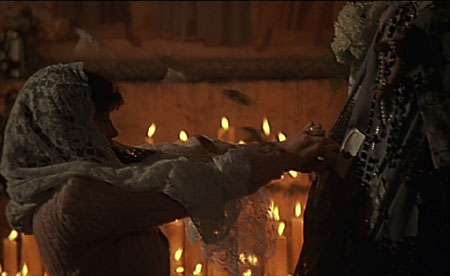
Still from Nostalghia (1983)
BACKGROUND:

  • Tarkovsky was considered one of the finest filmmakers in the Soviet Union; he frequently ran into difficulty with the Soviet censors, however, particularly for his Christian viewpoints.  Although his films won acclaim at international film festivals, they were often shown to limited audiences in edited versions in his own country.  Work on the historical epic Tarkovsky was helming prior to Nostalghia had been halted by the Soviet censorship board because of scenes seen as critical of the state’s policy of official atheism.
  • Nostalghia was the first film Tarkovsky made outside the Soviet Union.  Originally intended to be a Soviet/Italian co-production, the state-owned USSR film production Mosfilm withdrew financial support for the project without comment after filming had already begun.
  • The film competed for the Palme d’Or at Cannes, but was awarded a special jury prize instead.  Tarkovsky claimed that the Soviet contingent applied pressure to assure that the film would not be awarded the grand prize.
  • Tarkovsky defected to the West soon after Nostalghia was completed, leaving his wife and son behind.  They were eventually allowed to leave the country when he was diagnosed with lung cancer in 1986.  Rumors persist that Tarkovsky did not die of natural causes, but was actually poisoned by the KGB in retaliation for his defection.

INDELIBLE IMAGE:  There are many fine candidates.  The scene of Andrei attempting to carry a lit candle cupped in his hand across a drained spa may stick with the viewer, if not for its symbolism, then because it audaciously continues for over eight minutes.  But the final, static, picture postcard-like composition of a Russian homestead nestled inside an Italian cathedral perhaps captures Tarkovsky’s theme the best, and is shockingly beautiful, as well.

WHAT MAKES IT WEIRD:  The fluidity between the conscious and subconscious worlds. Although it’s almost always clear whether the events depicted actually occur or are imagined, Tarkovsky is much more interested in what is going on inside the heads of his alienated Russian poet and the Italian madman than in what is happening in the “real” world. He uses strong, sometimes obscure visual symbolism and dreams to convey an affecting mood of existential loneliness.


Trailer for Nostalghia

COMMENTS:  Nostalghia can’t be approached without a word of warning: this movie is Continue reading 25. NOSTALGHIA (1983) →

WEIRD HORIZON FOR THE WEEK OF 6/26/09

A look at what’s weird in theaters, on hot-off-the-presses DVDs, and on more distant horizons…

Trailers of new release movies are generally available on the official site links.

IN THEATERS (LIMITED RELEASE):

Surveillance (2008):  Psychological thriller from Jennifer (Boxing Helena, daughter of David) Lynch in which FBI agents try to solve a string of grisly killings with the help of three witnesses who tell conflicting stories.  Has divided critics over its brutality and perversity, as well as its twist ending.  With Bill Pullman and Julia Ormand.  Playing New York and L.A. only, with future dates throughout California and Denver, Co. Surveillance Official Site.

NEW ON DVD:

Diary of a Suicide [Le journal d’un suicidé] (1973): There’s little information available on this (perhaps justifiably) overlooked French anthology movie about a man on a cruise challenged to tell tall tales by a mysterious translator. It’s likely being released now to coincide with Last Year at Marienbad (see below), because Suicide also stars Delphine Seyrig.  Buy from Amazon.

Karl May (1974): Hans-Jürgen Syberberg picture with an intriguing Kafkaesque premise: in Nazi Germany, Karl May (a real-life writer of potboiler Westerns for German audiences) is put on trial on suspicion that he is a character from one of his novels.  Seldom seen.   Buy from Amazon.

Last Year at Marienbad [L’année dernière à Marienbad] (1961):  Alain Resnais dreamlike classic (written with Alain Robbe-Grillet) about a nameless Man who waits for a year to run away with a nameless Woman–only to find out that she does not remember meeting him when the time comes to reunite–has been shamefully out of print for what seems like forever.  The Criterion collection again rides to the rescue with a two disc edition.  A major, major event in weirdness.   Buy from Amazon.  Also available on Blu-Ray.

Phoebe in Wonderland (2008): This well-acted, tearjerking indie drama about an obsessive/compulsive little girl isn’t exactly weird, although it does contain a several fantasy sequences inspired by Alice in Wonderland.  Most importantly, it’s been reviewed in these pages.   Buy from Amazon.

Waltz with Bashir (2008):  Genre-crossing, partially fictionalized Israeli animated documentary on the 1982 Shabra and Shatila massacres and the amnesia of states contains some wonderfully surreal passages on the absurdity of war.  This was one of the best films of 2008, and damn weird to boot; it should be reviewed on these pages in the future. Buy from Amazon.

What are you looking forward to? If you have any weird movie leads that I have overlooked, feel free to leave them in the COMMENTS section.

AVANT OPERA ON FILM, PART TWO

Daniel Barenboim and Harry Kupfer followed their acclaimed “Ring” cycle (discussed in last week’s column) with Richard Wagner’s final opera, Parsifal, which, if anything, was even more successful.   Alas, the film of this version has been long unavailable.

Scene from Syberberg's Parsifal (1982)
Scene from Syberberg’s Parsifal (1982)

Comparing their geometric, sparse Parsifal to that of Neues Kino director Hans-Jürgen Syberberg’s controversial 1982 multi-layered collage film would be a pointless task.  Syberberg’s famous film is a case of a director with so much to say, that it literally becomes a truly rare kitchen sink moment in which repeated viewings reap priceless rewards.

Syberberg’s Jungian references abound with fascist symbolism, Nietzsche, Christian mythology, Post World War II Euro culture in a narcotic texture unlike anything before or since.  Entire books could be written about this one of a kind film.

In 1993, long before Titus, Frida, or her most recent (and amazing) work, Across the Universe, Julie Taymor was known to modern opera buffs as the director of Stravinsky’s Oedipus Rex. Taymor filtered Stravinsky’s opera through her own undeniably powerful, highly individualistic voice.

Undoubtedly, Stravinsky (who, like Picasso, went through numerous phases, from neo-classicism to post Webern serialism and yet made everything  he touched sound like his own) would have approved of Taymor’s kindred aesthetic spirit.

When Taymor’s production first became available on the video market, word spread quickly, with many proclaiming it to be one of the very best, if not the best, opera yet filmed.

The sets (by George Tsypin), masks, sculptures, puppets, costumes ( Ei Wade), make-up (Reiko Kruk), Japanese dance and narration (the libretto by Jean Cocteau, originally in Latin, allowed for translation to the native language), Ozawa’s incisive conducting, add up to one of the most extraordinarily stylized and emotionally draining operatic Continue reading AVANT OPERA ON FILM, PART TWO →

CAPSULE: THE LAND OF THE LOST (2009)

DIRECTED BY:

FEATURING: , , Danny McBride

PLOT:  Obnoxious scientist Rick Marshall discovers a way to go “sideways” in time to a world of dinosaurs, ape men, and lizard-like sleestaks in this science fantasy comedy.

landofthelost
WHY IT WON’T MAKE THE LIST:  It’s quite a challenge to adapt a 1970s television show about a family lost in a world of dinosaurs and alien creatures and not make it come off as too weird for mainstream audiences, but Brad Siberling managed this feat.  Other than a narcotic-induced group hallucination involving an exploding crab, the only truly weird thing about this critical flop is that the producers chose to reimagine a crazy cult kids’ show as a standard comedy to accommodate the talents of star Will Ferrell, thereby thumbing their noses at the potentially lucrative nostalgia market.

COMMENTS:  The Land of the Lost is a sloppily crafted piece of Hollywood entertainment.  The jokes, frequently involving dinosaur pee and poop, are unimaginative and clearly aimed at middle school boys.  The plot is too episodic, with the stranded travelers wandering from set piece to set piece instead of creating tension and forward momentum in their quest to find the lost “tachyon amplifier” and return to their own world.  The script is awful, with minimal regard for logic or internal consistency: we get a doctoral candidate who is inexplicably able to translate alien ape tongues simply because it’s easier than thinking up a clever way to communicate by pantomime.  Antagonists disappear, without being dispatched, when they’re no longer needed.  It’s lazy screenwriting that screams “Will Ferrell’s signed, we’ve already made a fortune off this thing.  Let’s just grind out five acceptable punchlines for the trailer, knock off early and get this check deposited.”  The supporting characters are bland, but the biggest problem with the movie is with Will Ferrell’s Dr. Marshall.  He’s arrogant, dim, easily annoyed, weak-willed and vindictive, and there’s no reason for the audience to root for him.  Of course, by the middle of the film he undergoes standard-issue “character growth,” consisting of a speech on how he’s decided to mend his ways.  Now, we are now supposed to approve when he gets the girl, even though he’s still the same jerk he always was.  Yet, despite all these faults, Land of the Lost is actually not an irredeemably terrible movie.  It’s tolerable, in that insidious way Hollywood has of taking mediocre ingredients and making them palatable by pumping up the pace, throwing in a little spectacle, and focusing on pretty faces roaming around in pretty places.  The sets are imaginative and interesting, often consisting of stray junk (like an ice cream truck and a filled motel pool) that’s been sucked through a wormhole and plopped into the wilderness.  The action sequences are kinetic, if nonsensical at times.  Ferrell’s character and the script’s disregard for logic are annoying—the movie seems to taunt you with its lack of craftsmanship—but Land of the Lost is never boring, and it will play fine for its intended audience of tween boys.

Going in to the movie, I knew it would be bad; I was hoping it would be a delightfully huge bomb, which can make for a fun time, rather than the forgettable attempt it turned out to be.  By design, summer blockbusters marketed to mass audiences have little weird potential, but I felt obliged to check it out due to sprinkled quotes like the one from Eric Snider (below) and these others: “surprisingly bizarre” (N.V. Cooper, “E” Online), “[a]lways weird” (Todd Maurstad, The Dallas Morning News), “[t]his is one very weird movie” (Joanna Langfield),  “aggressively weird” (Brian Juergens), “incredibly strange experience” (Edward Douglas),  “too damn bizarre to hate” (Luke Thompson).  That sounds like a lot of votes for weird, but to put things in perspective, out of dozens and dozens of reviews, about the same number of critics thought the film was “funny.”

WHAT THE CRITICS SAY:

“Oh, what a weird movie this is… a wildly bizarre and frequently hilarious adventure that appears to be whacked-out by design, not out of sloppiness.”–Eric D. Snider, Film.com

366 WEIRD MOVIES ON FACEBOOK

Sorry there’s no new review today… sometimes regular ordinary life interferes with our enjoyment of weird movies.

In other news, 366 Weird Movies now has its own Facebook page.  What does this mean to you?  We have no idea.  We’re not even sure what it means for us.  Nonetheless, there it is.

Also note our new, totally public domain, updated logo:

366logo-copy

We’re working on a review of Tarkovsky’s excellent and very beautiful Nostalghia; it will probably be added to the List on Monday of next week. There will be a capsule review tomorrow, and the second part of Alfred Eaker’s report on “Avant Opera” is scheduled for Thursday.  Stay tuned!

Celebrating the cinematically surreal, bizarre, cult, oddball, fantastique, strange, psychedelic, and the just plain WEIRD!