This review is a follow-up to last week’s “Fringe Cinema” column on Damon Zex. Read last week’s column here.
Along with Yoga, Damon Zex’s other passion is chess. He had begun playing the game at the age of five and renounced it after winning a state championship years later. After emerging from a creative hiatus, Zex returned with his 27 minute film Checkmate.
Checkmate represents a return on many faceted levels. Zex labored long on Checkmate and that labor paid off brilliantly. Checkmate is Damon Zex’s diaphanous train wreck that one simply cannot look or turn away from. It is horrifying, perversely amusing, unbearably intense, highly contrarian, and Damon Zex at his most quintessentially bizarre. Even knowing Zex’s previous work will not prepare the viewer for for this, despite it’s being that seemingly inevitable bookend to what came before.
When making Checkmate Zex knew fully well that he risked propelling even his most ardent admirers into that incessant squirming, uncomfortable plateau. But then, Damon Zex is hardly one to rest on laurels, nor is he one to cave into conservative, expectant formulas to appease a fan base. The Checkmate that emerged after Zex’s self-imposed silence is the equivalent of an artist clearing out his own mothballs.
The first 2:50 of Checkmate
Everyone involved with Checkmate knew Zex was onto something special and different, even though a videographer friend, frustrated with the film’s static qualities, wanted to change it and chastised the artist for breaking the “101 basic cinematic principles.” Indeed, Damon Zex is breaking even his own orthodoxy in Checkmate, but with an overwhelming sense of clarity. The long, sustained enveloping pauses are sharply cut with richly complex compositions which could almost be described as inducing cubist headaches.
The bulk of Checkmate is juxtaposed to Mahler’s 9th Symphony, and Zex is one of those artists determined to take Mahler back from the music fundamentalist who have claimed the composer as solely their own. Alban Berg proclaimed the first movement of the Mahler 9th as the greatest in all of music. Arnold Schoenberg gave an impassioned
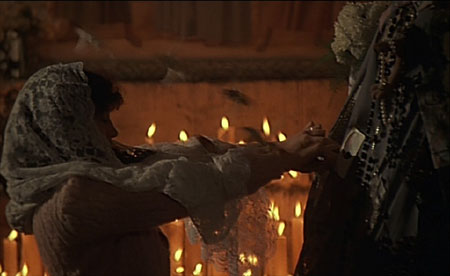
PLOT: Over-imaginative young Seth, growing up in post-World War II rural USA, comes to believe that his widowed neighbor is actually a vampire. After his father dies in unexpected fashion, the older brother he adores returns from his military tour of the Pacific. When the brother falls in love with the vampire widow, Seth tries to find a away to save him.
BACKGROUND:
This was Philip Ridley’s first directorial effort, after breaking into the movie business by writing the script for The Krays. He is also an author of children’s books.
A top-billed, pre-fame Viggo Mortensen had just come off playing the role of the cannibal “Tex” in Leatherface: Texas Chainsaw Massacre III.
The production company for the film (Bialystock & Bloom Limited) is jokingly named after Zero Mostel and Gene Hackman’s characters in The Producers.
This film, with its hyper-imaginative child protagonist roaming among golden fields of wheat, was an obvious inspiration for Terry Gilliam‘s 2005 film Tideland, which has a slightly different atmosphere but can be seen as a companion piece.
INDELIBLE IMAGE: Seth cradling and asking advice from the petrified baby (which he believes to be an angel) that he found hidden in an egg-like box in a hayloft chapel.
WHAT MAKES IT WEIRD: Nothing that happens in The Reflecting Skin is literally impossible. Much of the film’s bizarre effect comes from the characters, especially the weird widow Dolphin who is obsessed with decay and destruction and whose husband hanged himself after a week of marriage. Other characters who form the background of young Seth Dove’s weird world are his perpetually on the verge of tears, creatively abusive mother; a father who reeks of gasoline and hides a secret past; a drunken neighbor obsessed with his own sinful thoughts who dresses like a Puritan; the world’s unluckiest town sheriff, who has lost three body parts to animal attacks and who wears a slice of a colander for an eyepatch; and a hot-rod hearse full of juvenile delinquents that haunts the back roads of this Midwestern farm community. Altogether, it’s a such an odd concoction of unlikely ingredients, told in a straightforward dramatic manner, that might earn the label “improbable realism” (as well as “Midwestern Gothic”).
Every Friday, we take a look at what’s weird in theaters, on hot-off-the-presses DVDs, and on more distant horizons…
Trailers of new release movies are generally available on the official site links.
NEW ON DVD:
Dante 01 (2008): This sci-fi penal colony film with messianic overtones slipped well under the radar, which is somewhat surprising since it’s directed by Marc Caro, who together with Jean-Pierre Jeunet was one half of the directing team behind the classic weirdfilms Delicatessen (1991) and City of Lost Children (1995). Poorly reviewed. Buy from Amazon.
The House of the Sleeping Beauties (2006): Allegorical German adult fairy tale about a brothel where men pay to spend the night with beautiful women who are trapped in a permanent slumber. From the Japanese story “Nemureru bijo” by novelist Yasunari Kawabata, which has been adapted on film three times in Japan (1968, 1995, 2007). Buy from Amazon.
NEW ON BLU-RAY:
Sin City (2005): The Robert Rodriguez-directed, Frank Miller-penned, noirish comic-book-come-to-life receives a 2-disc Blu-ray special edition, with the original theatrical release on disc 1 and a “recut” version (actually, it sounds like it’s four new versions, since each of four separate storylines is edited into it’s own mini-movies). Contains 20 minutes of extra footage and abundant extras. Buy from Amazon.
What are you looking forward to? If you have any weird movie leads that I have overlooked, feel free to leave them in the COMMENTS section.
“Alfred Eaker’s Fringe Cinema” is a column published on Thursdays covering truly independent cinema: the stuff that’s so far under the public radar it may as well be underground. The folks making these films may be starving artists today, but they may be recognized as geniuses tomorrow. We hope to look like geniuses ourselves by being the first to cover them.
While there might still be quality, dramatic television, there is little doubt the medium has lost it’s imaginative powers and any penchant for innovative, experimental, provocative, quirky aesthetics. Ernie Kovacs and Andy Kauffman are long dead. In addition to Kauffman, the 80’s did see Pee Wee’s Playhouse and Bakshi’s “New Adventures of Mighty Mouse”, but they have been relegated to distant memories. Then, in the 1990’s came Damon Zex; the underground cult icon from Columbus, Ohio’s short-lived public access television.
One writer speculated that Charlie Chaplin was nearly the sole silent super star to have survived sound because he alone understood it was a different art form. There is a reason that Chaplin, Keaton, Harry Langdon, Charlie Bowers, Theda Bara, etc. were inspirational fodder to later surrealist luminaries such as Samuel Beckett and Andre Breton. Those provocateurs understood and connected with elements from the silent art form which had it’s origins in vaudeville and can be seen in today’s performance artists such as Diamanda Galas and Damon Zex.
Much in early film, by today’s standard, was experimental because the rules had not yet been set as to what constituted ‘film’ and what did not. Luis Buñuel once said, “Moving pictures merely repeat what we have been told for centuries by novels and plays. Thus, a marvelous instrument for the expression of poetry and dreams (the subconscious world) is reduced to the role of simple REPEATER of stories expressed by other art forms.”
Damon Zex’s “Asana Assassin” (discussed below)
In lieu of today’s obsession for squeaky clean, hypernarrative Hollywood realism, reactions to expressionism, experiment, rough improvisation range from red flag dismissals such as “artsy” and “pretentious” to downright hostility. Audiences can numbly sit through porn fests such as Hostel or Passion of the Christ, but will react quite differently when aesthetically provoked.
Author Scott MacDonald nails it in his introduction to avant-garde film studies:
Mainstream cinema is so fundamental a part of our public and private experiences, that even when filmmakers produce and exhibit alternative cinematic forms, that dominant cinema is implied by the alternatives. If one considers what has come to be called avant-garde film from the point of view of the audience, one confronts an obvious fact. No one–or certainly, almost no one–sees avant garde films without first having seen mass-market commercial films. In fact, by the time most people see their first avant-garde film, they have already seen hundreds of films in commercial theaters, and their sense of what a movie IS has been almost indelibly imprinted in their conscious and unconscious minds by their training as children and by the continual reconfirmation of this training during adolescence and adulthood. The earliest most people come in contact with an avant-garde film of any type is probably mid to late teens (for many people the experience comes later, if at all). The result is that whatever particular manipulations of imagery, sound, and time define these first avant-garde film experiences as alternatives to the commercial cinema are recognizable only because of the conventionalized context viewers have already developed. Generally, the first response generated by an avant-garde film is, ‘This isn’t a movie,’ or the more combative, ‘ You call this a movie?’ Even the rare, responsive viewer almost inevitably finds the film–whatever its actual length in minutes–‘too long .’ By the time we see our first avant-garde film we think we know what movies are, we recognize what ‘ everyone’ agrees they should be; and we see the new cinematic failures-to-conform as presumptuous refusals to use the cinematic space (theater, VCR, viewing room) ‘correctly.’ If we look carefully at this response, however, we recognize that the obvious anger and frustration are a function of the fact that those films confront us with the necessity of redefining an experience we were sure we understood. We may feel we KNOW that these avant-garde films are not movies, but what are they? We see them in a theater; they’re projected by movie projectors,just as conventional movies are… we can see that they ARE movies, even if we KNOW they’re not. The experience provides us with the opportunity to come to a clearer, more complete understanding of what the cinematic experience actually can be, and what–for all the pleasure and inspiration it may give us–the conventional movie experience is NOT.
“It’s impossible to make a movie out of ‘Naked Lunch.’ A literal translation just wouldn’t work. It would cost $400 million to make and would be banned in every country of the world.” –David Cronenberg
DIRECTED BY: David Cronenberg
FEATURING: Peter Weller, Judy Davis, Julian Sands
PLOT: Bill Lee is a writer/exterminator in New York City whose wife begins mainlining the bug powder he uses to kill roaches, and convinces him to try it as well. He becomes addicted to the powder, and one night shoots his wife dead while playing “William Tell.” Lee goes on the lam and lands in Interzone, an exotic free zone reminiscent of Tangier or Casablanca (but which may exist only in his mind), where he begins taking ever more powerful drugs and typing out “reports” partially dictated to him by his living, insectoid typewriter.
The novel was held not to be obscene by the Massachusetts Supreme Court in 1966. This was the final obscenity prosecution of a literary work in the United States; there would be no subsequent censorship of the written word (standing alone).
Several directors had considered filming the novel before David Cronenberg got the project. Avant-garde director Anthony Balch wanted to adapt it as a musical (with Burroughs’s blessing), and actually got as far as storyboarding the project and getting a commitment from Mick Jagger (who later backed out) to star. Among others briefly interested in adapting the novel in some form were Terry Southern, John Huston, Frank Zappa, and Terry Gilliam.
Because the novel was essentially a plotless series of hallucinatory vignettes (what Burroughs called “routines’), David Cronenberg chose to make the movie a thinly veiled tale about Burroughs’s writing of the novel, incorporating only a few of the actual characters and incidents from the book. Actors in the film portray real-life writers and Burroughs associates Jack Kerouac, Allen Ginsberg, and Paul and Jane Bowles.
The episode in the film where Lee accidentally shoots his wife while performing the “William Tell routine” is taken from Burroughs real life: he actually shot his common law wife while performing a similar trick in a Mexican bar. Burroughs felt tremendous guilt through his life for the accident and has said “I would have never become a writer but for Joan’s death.”
Naked Lunch won seven awards at the Genie Awards (the Canadian equivalent of the Oscars), including Best Movie and Best Director.
Producer Jeremy Thomas has somewhat specialized in bringing weird and unusual fare to the largest possible audience, producing not only Naked Lunch but also Cronenberg’s Crash (1996) and Tideland (2005).
Following a definite theme for the year, Judy Davis also played an author’s muse and lover in another surrealistic 1991 movie about a tortured writer, Barton Fink.
INDELIBLE IMAGE: Clark Nova, Lee’s territorial, talking typewriter, who alternately guides and torments the writer. He’s a beetle who has somehow evolved a QWERTY keyboard as an organ. When he speaks, he lifts his wings to reveal a sphincter through which he dictates his directives.
WHAT MAKES IT WEIRD: It begins with an exterminator who does his rounds wearing a three piece suit and fedora. His philosophy is to “exterminate all rational thought.” His wife steals his insecticide and injects it into her breast to get high, and gets him hooked on the bug power, too. A pair of cops question him on suspicion of possessing dangerous narcotics, and leave him alone in the interrogation room with a huge talking “caseworker” bug who explains that his wife is an agent of Interzone, Incorporated, and is not even human. And this is just the setup, before the film turns really weird.