Category Archives: Canonically Weird (The List)

296. DOG STAR MAN (1964)

“One thing I knew for sure (from my own dreaming) was that what one dreams just before waking structures the following day. That dream material is gathered from the previous day, and therefore is a gathering of all previous days, ergo contains the structure of all history, of all Man… I wanted PRELUDE to be a created dream for the work that follows rather than Surrealism which takes its inspiration from dream; I stayed close to practical usage of dream material, in terms of learning and studying, for a while before editing. At this time I left strict myth considerations out of my study process as much as possible..”–Stan Brakhage speaking on Dog Star Man in “Metaphors on Vision”

DIRECTED BY:

FEATURING: Stan Brakhage, Jane Brakhage

PLOT: This silent non-narrative film is presented in four parts: a 20-minute “Prelude” introduces many of the visual motifs that will show up in later installments, followed by “Part One,” which focuses on a man  climbing a mountain with his dog. The man continues his climb in the seven-minute “Part Two,” but the picture now focuses on a baby boy, with abstract figures superimposed directly on the film. “Part Three” is a “sexual daydream” of a nude woman, with even more layered images, and “Part Four” is an even more abstract culmination of all that has come before.

Still from Dog Star Man (1964)

BACKGROUND:

  • Experimental filmmaker Stan Brakhage completed almost 400 films during his life (some of which run for less than a minute).
  • Dog Star Man is the final compilation of five short films Brakhage produced between 1961 and 1964. They are almost never screened separately, although the Prelude could stand alone.
  • While making Dog Star Man, Brakhage was unemployed and living with his wife and her parents in their Colorado cabin; to earn his keep, he chopped wood for the family.
  • Brakhage named his movie after a pulp novel he picked up as a boy, because he thought it a shame that such a great title would be forever wasted on a tawdry paperback.
  • The film is structured with increasing visual complexity. Brakhage shot one layer of film for part one, two for part 2 (and also for the prelude), three for part 3, and four for part 4. The layers of film were then superimposed on top of each other.
  • Brakhage later produced a four-and-a-half hour cut of this material called The Art of Vision, which rearranged every layer of film Brakhage shot for the project into every possible combination of superimpositions (within each part).
  • Chosen for preservation in the Library of Congress’ National Film Registry in 1992.

INDELIBLE IMAGE: Most of the amazing visual effects Brakhage achieves with his complex superimpositions fly by too quickly for us to consciously register—some can be seen for only a single frame or two. The most important repeated symbol in the film, however, may be the most mundane: the woodcutter struggling up the snowy mountain with his axe, stumbling and falling, while his dog happily bounds at his side.

THREE WEIRD THINGS: Phosphenes on film; baby with snowflakes; sex and beating hearts

WHAT MAKES IT WEIRD: Meticulous and intentionally unentertaining, Dog Star Man is a masterwork of consciously constructed dream cinema.


Excerpt from Dog Star Man (Prelude)

COMMENTS: When ordinary people think about experimental Continue reading 296. DOG STAR MAN (1964) →

295. NO SMOKING (2007)

“Look up the word ‘bizarre’ in the dictionary. It doesn’t mean dark. Was Eternal Sunshine Of The Spotless Mind a dark film? It was bizarre. No dictionary in the world says bizarre means dark or vice versa. This is the problem with Indians; they come with fixed notions. What is the definition of dark? Tell me!”– An exasperated No Smoking writer/director Anrag Kashyap in an interview

Recommended

DIRECTED BY: Anurag Kashyap

FEATURING: John Abraham, Ayesha Takia, Ranvir Shorey, Kiku Sharda, Paresh Rawal

PLOT: K, an arrogant businessman and highly-addicted chain smoker, agrees to enter a smoking-cessation program after his wife threatens to leave him. Going to the address his friend gave him, K is led through a labyrinth and forced to sign a contract which specifies that his loved ones will be harmed in increasingly severe ways every time he smokes a cigarette. Naturally, K relapses into smoking and is caught, eventually winding up trapped in a nightmare world.

Still from No Smoking (2007)

BACKGROUND:

  • The script (at least its early sections) bears some striking similarities to ‘s short story “Quitters, Inc.,” which was previously a segment of the 1985 anthology Cat’s Eye. The writer/director admits the story was an inspiration, although the credits do not mention King.
  • No Smoking was Anurag Kashyap’s third movie, but the first one released in India. His debut, Paanch, was never released outside of international film festivals due to state censorship (for violence and drug use); his second film, Black Friday, a true crime story, was delayed while a court case was pending and released after No Smoking. He later achieved mainstream success with 2009’s Dev D, an adaptation of a popular novel.
  • No Smoking was a colossal flop in its native India, where it baffled audiences with little exposure to psychological thrillers or surreal cinema.

INDELIBLE IMAGE: The bathtub sitting alone on a snowy plain in Siberia, just in sight of what appears to be a Soviet-era gulag, which appears in dream sequences at the beginning and end of the movie.

THREE WEIRD THINGS: Hitler’s Indian buddy; Fosse’s cigarette cabaret; banana peel suicide

WHAT MAKES IT WEIRD: No Smoking isn’t quite what would result if got a wild hair to direct a Bollywood film—but it’s a reasonable approximation. With its theme of bad men forced to forgo their vices against their will, it’s a bit like a Hindi twist on A Clockwork Orange, as well, only with more elaborate musical numbers. With the tropes of Indian popular cinema colliding against a Western-style neo-surrealist narrative, No Smoking is neither fish nor fowl; it totally confounded Indian audiences used to simple stories with happy endings, and it will probably confound you, too.


Hindi trailer for No Smoking

COMMENTS:  Anurag Kashyap’s Advice for How to Stop Smoking in Continue reading 295. NO SMOKING (2007) →

294. TITUS (1999)

“Why makest thou it so strange?”–Demetrius, “Titus Andronicus,” II, 1.

Recommended

DIRECTED BY:

FEATURING: , , , Alan Cumming, Laura Fraser, Jonathan Rhys Meyers, Matthew Rhys, Angus Macfadyen, Osheen Jones

PLOT: Titus Andronicus, a Roman general, returns from conquering the Goths; he imprisons the queen Tamora and her three sons, killing the eldest boy as a sacrifice to the gods. Back in Rome, the emperor is dead and the popular Titus averts a civil war by supporting Saturninus for emperor against the rival claim of his brother; once on the throne, Saturninus surprises Titus by taking Tamora as his queen. Tamora and her secret lover, the Moor Aaron, then set about plotting revenge against Titus and his entire family.

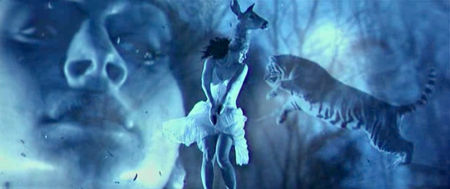
Still from Titus (1999)

BACKGROUND:

  • Written in the style of the Jacobean revenge tragedy, “Titus Andronicus” is one of Shakespeare’s earliest plays, and perhaps his most disliked by critics; some even went so far as to speculate that the play must be misattributed to him, as Shakespeare could not have written such trash. Harold Bloom scathingly called it “a howler” and “an exploitative parody” and suggested Mel Brooks would be the director most suited to the material.
  • Julie Taymor adapted this film version from her off-Broadway stage production. Titus was her debut film, although she had achieved fame, and won a Tony award, for her 1994 Broadway stage production of “The Lion King.”
  • Taymor chose production designer Dante Ferretti because he had worked on one of her inspirations for Titus‘ look: Fellini Satyricon.
  • An orgy scene had to be edited (reportedly, to excise male genitalia) to earn the film an “R” rating.
  • Reputed auto-fellator Steve Bannon served as one of the executive producers.

INDELIBLE IMAGE: For this adaptation, Taymor fashioned four short, digitized dream sequences that she calls “penny arcade nightmares.” We selected the one where Lavinia remembers her own rape, imagining herself as a doe (with a deer’s head and hooves) menaced by ravishing tigers. Trip Shakespeare, for sure.

THREE WEIRD THINGS: Paper bag brat; those are twigs that were her hands; Shakespearean video games

WHAT MAKES IT WEIRD: Julie Taymor gives Shakespeare’s least-respected, bloodiest play an anachronistic avant-garde treatment, with fascist emperors riding in convertibles, Roman orgies, “penny arcade nightmares,” and all of the rape, dismemberment, and people-eating that we associate with the Bard’s work.


Original trailer for Titus

COMMENTS: “Shakespeare was a drive-in kind of guy.” I don’t think Continue reading 294. TITUS (1999) →

293. SWEET SWEETBACK’S BAADASSSSS SONG (1971)

“From the very beginning, back in 1957, people were always commenting on my films being a little weird in subject matter, and the angles I used, and the superimpositions and things like that.  Me, I figured that it came from the fact that I was self-taught and missed the technological colonization of the white aesthetic. Anyhow, back then everybody just thought I was crazy.”–Melvin Van Peebles, “The Real Deal: What It Was... Is”

DIRECTED BY: Melvin Van Peebles

FEATURING: Melvin Van Peebles, Simon Chuckster, John Gallaghan

PLOT: An African American boy grows to manhood in a brothel, where he is nicknamed “Sweetback” for his sexual prowess and taught to perform in live sex shows when he reaches adulthood. One night two detectives perform a fake arrest on Sweetback as part of a political scheme; but when they beat a black activist while Sweetback watches, he beats the two policemen into a coma in a fit a righteous rage. The bulk of the film follows the fugitive as he makes his way toward the Mexican border on foot, staying one step ahead of the cops as his legend grows within the black community.

Stillfrom Sweet Sweetback's Baadasssss Song (1971)

BACKGROUND:

  • Melvin Van Peebles’ personal history is colorful, to say the least. He began his career making short films, and one feature, in France. On the strength of these Columbia Pictures invited him to direct a feature film. His first Hollywood feature, the racial satire Watermelon Man, was a small hit. Columbia offered him a three picture deal, but he chose to make Sweet Sweetback’s Baadassss Song instead.
  • Van Peebles says that he played the role himself because he couldn’t find an established black actor willing to take it due to the fact that they pay was so low and Sweetback only has six lines of dialogue in the film.
  • Van Peebles says he actually had sex with the actresses while shooting film’s sex scenes, and contracted gonorrhea from one. He says he applied to the director’s guild for compensation and that they were so surprised by the claim that they paid him. He then used the money to buy more film.
  • The soundtrack was written by Van Peebles and performed by a pre-fame Earth, Wind and Fire, the same year their debut album. The check bounced.
  • Van Peebles ran out of money while filming Sweetback and begged investors to help him finish the movie. Finally, Bill Cosby loaned him $50,000, interest-free, to finish the movie. The film went on to gross $4.1 million at the box office and eventually earning more than $10 million. Van Peebles was able to keep all the profits himself.
  • Sweetback was rated X by the MPAA and prints were often screened with up to 9 minutes of sex removed, inspiring Van Peebles to promote the movie with the sensational (but technically accurate) tagline, “Rated X by an all-white jury!”
  • The remarkable story behind the making of Sweetback is told in the fictionalized 2003 film Baadasssss!, written, directed by and starring Van Peebles’ son Mario. Mario had also played Sweetback as a boy in Baadassss Song, where he was pressured into performing a sex scene with an adult actress.

INDELIBLE IMAGE: Sweetback running. Runner-up: Sweetback sprinting. We also considered Sweetback loping, Sweetback jogging, and Sweetback trotting.

THREE WEIRD THINGS: Sex will make you a man; the Good Dyke Fairy Godmother; lizard lunch

WHAT MAKES IT WEIRD Take a radical experimental filmmaker with narcissistic tendencies, give him $150,000 dollars (in 1971 money) and an amateur cast and crew, give him carte blanche to make a Black Power film with lots of sex scenes, and Sweet Sweetback’s Baadasssss Song is the result. You’d think it was a deconstructionist version of a blaxploitation film, except that it was made before the blaxploitation formula existed.

Original trailer for Sweet Sweetback’s Baadassss Song

COMMENTS: In 1971 the Civil Rights movement was almost two Continue reading 293. SWEET SWEETBACK’S BAADASSSSS SONG (1971) →

292. VIVA LA MUERTE [LONG LIVE DEATH] (1971)

“I have heard this insensible and necrophilous oath, ‘¡Viva la Muerte!’, and I, having spent my life writing paradoxes that have provoked the ire of those who do not understand what I have written, and being an expert in this matter, find this ridiculous paradox repellent.”–Miguel de Unamuno

DIRECTED BY:

FEATURING: Madhi Chaouch, Núria Espert, Ivan Henriques

PLOT: Fando is a boy growing up in Spain in the early days of the Franco regime, raised by his mother, about whom he has sexual fantasies. One day he discovers that his mother turned his father in to the authorities because of his “dangerous progressive” political views. In between fantasies, Fando decides to go searching for his father, but his quest is interrupted when he contracts tuberculosis.

Still from Viva la Muerte (1971)

BACKGROUND:

  • Like the father in Viva la Muerte, Arrabal’s own father was imprisoned by the Fascists during the Spanish Civil War (one report claims it was for an assassination attempt). After five years he escaped from custody and was never seen again.
  • The title refers to a quote from the Fascist General Millan Astray: “Down with intelligence! Long live death!,” a line barked during a political debate with philosopher Miguel de Unamuno.
  • The movie is an adaptation of Arrabal’s 1959 novel “Baal Babylone” (which does not appear to have been translated out of the original French).
  • The sadomasochistic torture sketches first seen in the opening credits are by Arrabal’s fellow Panic movement member (for more on the Panic movement, see the background information section of I Will Walk Like a Crazy Horse).

INDELIBLE IMAGE: Fando’s papa, buried in the sand with only his head showing, and a quartet of riders fast approaching.

THREE WEIRD THINGS: Incestuous S&M mourning; priest’s tasty balls; slaughterhouse frolic

WHAT MAKES IT WEIRD: A howl of protest at the horrors of the Franco regime, as well as an autobiographical attempt to exorcise some serious mommy issues, Viva la Muerte uses surreal vignettes as a savage expression of personal outrage.


Original trailer for Viva le Muerte

COMMENTS: Fernando Arrabal’s Viva la Muerte is the kind of movie Continue reading 292. VIVA LA MUERTE [LONG LIVE DEATH] (1971) →