Category Archives: Capsules

CAPSULE: SUCK [2009]

DIRECTED BY: Rob Stefaniuk

FEATURING: Rob Stefaniuk, Jessica Pare, Malcolm McDowell, Dave Foley, Alice Cooper

PLOT: A struggling Canadian rock band finds sudden success when their female
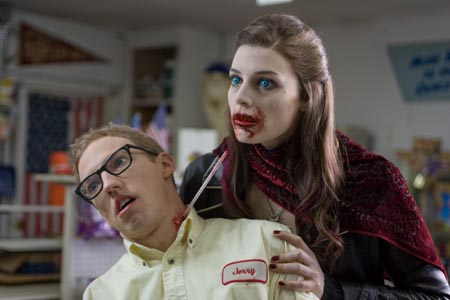
Still from Suck (2009)

bassist becomes a vampire.

WHY IT WON’T MAKE THE LIST: It’s a campy, tongue-in-cheek music movie with a horror/comedy flavor, but doesn’t do much we haven’t seen before.  It draws from other films and music videos to create a light parody of the music industry that’s enjoyable but ultimately forgettable.

COMMENTS:  The plot of Suck is oddly (and I assume unintentionally) reminiscent of Zombie Strippers: both feature a group of performers who willingly become a monstrous entity in order to boost their own popularity, and then climatically reap the consequences of their selfishness.  It gives a satirical bent to the overdone “fledgling musical group hits the big time but get more than they bargained for” premise, substituting blood addiction for drug addiction and topically tapping into society’s sudden Twilight-fueled obsession with vampires.  The concept of vampirism is handled in a very matter-of-fact way, resulting in a lot of unexpected jokes and straightforward humor.

Writer/director Rob Stefaniuk stars as Joey, the lead singer of “The Winners”, playing the straight man surrounded by ridiculous figures for most of the film.  Jessica Pare holds her own as the only female lead, funny and sexy as the hot bassist Jennifer, while Malcolm McDowell (always ready to bring the camp) is awesomely over-the-top as vampire hunter “Eddie” Van Helsing.  Appearances from an impressive bevy of old timer rock stars lend Suck an air of credibility as a rumination on modern-day rock and roll.  Iggy Pop is a wise rocker-turned-recording engineer, Alice Cooper is a creepy mind-reader who spouts unwanted advice, Henry Rollins is a goofy rock DJ, and Moby is a meat-loving frontman.  The highlight for any Kids in the Hall fan will of course be Dave Foley’s few scenes as the Winners’ incompetent manager, delivering the film’s best deadpan lines.

Suck incorporates a lot of different visual techniques that give it more variety than one might expect of a low-budget horror-comedy.  The use of stop-motion miniatures and blood-stained maps for transitions were a neat touch, and the frenetic cuts and dramatic lighting during many of the vampire-centric scenes cleverly reference contemporary music videos.  The music itself is catchy and fun, but doesn’t do much to set itself apart from any generic indie rock band’s output.  It’s not a true musical, saving most of its songs for stage performances except for one unexpected impromptu goth music video set at a vampire’s really pale party.

As a movie, this sits somewhere in the middle of funny and boring, smart and stupid, bold and underachieving, rocker and poser.  It’s got a good concept that blends several genres, but isn’t as effective as it could have been.  It needed to be funnier, scarier, more rockin’, or all three.  As it stands, it’s a cute film with some really enjoyable comedic bits and a few great performances, but not nearly humorous or weird enough to be memorably entertaining.

WHAT THE CRITICS SAY:

“…Stefaniuk bites off more than he can chew in this star-studded rock ‘n’ roll fantasy vampire flick. Juggling conventions, skewering clichés and referencing genre cues, Stefaniuk packs the film with so many insider jokes that what could have been a wild ride simply isn’t.”–Barbara Goslawski, Box Office Magazine (festival screening)

CAPSULE: SAINT JOHN OF LAS VEGAS (2009)

DIRECTED BY:  Hue Rhodes

FEATURING: Steve Buscemi, Romany Malco, Sarah Silverman,

PLOT: An insurance fraud investigator with a secret gambling addiction is assigned to investigate a wheelchair-bound stripper’s accident claim in Las Vegas.

Still from Saint John of Las Vegas (2009)
WHY IT WON’T MAKE THE LIST:  Saint John lands the dreaded double whammy: it’s not very weird, and not that good.

COMMENTS:  In blackjack, a player sometimes gets a decent hand but pushes his luck, takes another hit and end up going bust.  Saint John of Las Vegas starts with good cards: quirky indie icon Steve Buscemi, a plot hook about fate leading a problem gambler to the worst place in the world for him, and good supporting performances by Sarah Silverman as the new girlfriend whose sunniness and clinginess besmirch her sexiness and Peter Dinklage as the smarmy, fast-talking boss.  There are a couple of nearly brilliant, ironically absurd individual ideas: a wheelchair lapdance and a carnival sideshow attraction trapped in a malfunctioning flame suit.  But every good scene is undone by at least two corresponding clunkers: sleepyheads un-comically freaking out when awakened by the glare from a nearby glass building, a sequence involving a clique of nude men in the desert that works too hard for its single joke, a slowly revealed recurring dream that explains nothing, and a nonsensical, bungled twist ending that explains even less.  Apprentice fraud investigator Buscemi hits the road with vet adjuster Malco, an unflappable, cocky black dude whose too-cool-for-school glare gets him past strip club bouncers without paying the cover.  The mismatched pair never develop a chemistry to drive the movie; though he’s just doing what the script tells him to, Malco remains more of a constant annoyance than a worthy antagonist for Buscemi.   The final card that makes the movie go bust, however, is the half-hearted attempt to base the story on Dante’s “Inferno.”  English majors’ ears will perk up when they hear that Buscemi’s guide to the City of Sin is named Virgil, but anyone hoping to pick out correspondences to the epic poem will be frustrated, and anyone not familiar with Dante will be confused by the digressions.  The script stretches for circles.  Lust works, but where’s gluttony, who are the naked guys supposed to represent, and is there a new mortal sin—nicotine addiction—sandwiched somewhere in between wrath and heresy?  Writer/director Rhodes prominently gives Dante Alighieri a “based on a story by” credit, which is borderline unethical; the guy’s been dead for almost 700 years, so he’s not likely to have his agent call to get his name taken off the credits.  Still, with all its script problems and its chronic lack of laughs, Buscemi’s shaggy charisma keeps the project from being a total waste.  The rat-faced actor was born to play strung-out losers seeking redemption; a middle-aged desk-slave addicted to scratch off lottery cards is a role he can’t completely whiff on.

First time feature writer/director Hue Rhodes, who made a mid-life career change from software engineer to filmmaker, obviously charmed a lot of people into believing in him.   Not only did he lure Buscemi on board, but Spike Lee and Stanley Tucci show up in the credits as executive producers.  Their confidence wasn’t completely misplaced, as Rhodes does prove competent: although Saint John‘s parts don’t fit together into a bigger picture, the individual pieces are technically polished, making for a salable trailer.

WHAT THE CRITICS SAY:

“…Rhodes buries his would-be comic tale of desert losers in a welter of quirkiness and lousy surrealism, largely wasting an alluring cast brimming with humorous potential.”–David Noh, Film Journal International (contemporaneous)

CAPSULE: NEVER LET ME GO (2010)

DIRECTED BY: Mark Romanek

FEATURING: Carey Mulligan, , Keira Knightley,

PLOT: Kathy,Tommy and Ruth grow up at the pleasant but isolated Hallisham Academy in a fictional Britain that never was; they fall in and out of love with each other and grow up to discover that the purpose of their lives has already been set for them.

Still from Never Let Me Go (2010)

WHY IT WON’T MAKE THE LIST:  It’s not weird, though the mix of genres is unprecedented.  The premise is speculative—it would be science fiction had it been set in the future instead of an alternate past—but the execution is conventional, laid down with a Merchant-Ivory-ish gravitas.

COMMENTS: I’ll respect convention and won’t give away the “spoiler” for Never Let Me Go, despite the facts that 1). the trailer reveals it to the observant viewer who has seen a couple of key B-movies from which the premise is derived, and 2). the mystery surrounding the children of Hallisham Academy is divulged about twenty minutes into the film. Point 2) is key, because this movie works not by slowly revealing twists and secrets, but by keeping us watching in horror at the ironic inevitability of the children’s unfolding fate. Locked away from the outside world in the comfortable but disquietingly totalitarian Academy, the kids make up horrible stories about what happens to disobedient children who leave the grounds (dismemberment and starvation); their myths about their own fates persist into adulthood, but the audience always understands that they are doomed even as they cling to desperate hopes.  One of the biggest problems with the film is that it lacks background detail; viewing things entirely from the perspective of the trapped children, we never get enough of a sense of the larger society and its skewed politics and ethics, and are left to raise a lot of issues for ourselves. Too many questions about this Brave Alternate World are left unanswered (primarily, why our protagonists go so gently into that good night, hardly struggling against their fate). The love story is predictable, but that doesn’t make it any the less emotionally affecting, thanks to some great performances. Carey Mulligan, a rising star, carries the film with an often heartbreaking performance: smarter and less prone to illusion than her companions, the despair starts to register in her eyes just a few moments before it reaches Garfield or Knightley’s.  She also cries on cue, including a doozy that rolls down her face and ends up hanging off her chin for a second or two.  Garfield, currently being groomed to be the next Spider-Man, is acceptable as the awkward and occasionally unbalanced male love interest, and Knightley is pro as the seethingly jealous and gently vindictive third point of the love triangle. Kudos go out to the casting director for signing a trio of child actors that are not only fine thespians, but are also almost perfect genetic models for their grown-up counterparts. The cinematography is pleasing, sometimes poetic, with lonely fields and deserted beaches lit by soft golden glows. Despite its effective mood of melancholy, however, the film never really takes off. Director Romanek seems self-conscious in adapting the famed literary property. He’s so careful to be respectful, restrained and tastefully subtle so that the film will come off as “serious” and “important” that the tale fails to live and breathe.  (Having the lead character deliver the obvious moral in a closing monologue—just in case viewers missed the script’s Oscar-caliber metaphors—was a bad decision).  The end result is a story that sends the viewer out mildly depressed, rather than existentially shattered. Despite not quite achieving its full potential, Never Let Me Go still a good choice for the arthouse patron jonesing for a flick with Brit accents, teardrops, and no car chases.

The film was adapted, with the author’s blessing and oversight, from Kazuo Ishiguro’s acclaimed novel.  Ishiguro’s main weird movie connection is that he wrote the original screenplay for The Saddest Music in the World, although director Guy Maddin and his writing partner George Toles significantly surrealized the British writer’s scenario.  Director Mark Romanek’s previous feature was One Hour Photo (2002), an offbeat psychological thriller that cast Robin Williams way against type as a creepy, delusional photo developer.  His first, hard to find feature Static (1985), about a worker in a crucifix factory who thinks he has found a way to take pictures of Heaven, is reputedly quite weird (thanks to L. Robb Hubbard for reminding us of that last point).

WHAT THE CRITICS SAY:

“…an alternate universe that exudes some of the creepy calm of Wolf Rilla’s great English science-fiction flick Village of the Damned, but also the gloomy romanticism of Keats and Shelley.”–Steven Rea, Philadelphia Inquirer (contemporaneous)

CAPSULE: EVANGELION 1.11: YOU ARE (NOT) ALONE (2007/2010)

366 Weird Movies may earn commissions from purchases made through product links.

DIRECTED BY: Masayuki, Kazuya Tsurumaki, Hideaki Anno

FEATURING: Voice actors

PLOT: Tokyo-3 is under assault by mysterious robot-like creatures known as “Angels”; two teenagers pilot the mechanical Evangelions that are the only things that can defeat the invaders and save humanity, while simultaneously dealing with pop quizzes and high school bullies.

Still from Evangelion1.11: You Are (Not) Alone (2010)

WHY IT WON’T MAKE THE LIST:  How do you assess the weirdness of anime, a fantastical genre in which underage nude sexpots with powder blue hair and blood red eyes don’t raise an eyebrow?  An average anime is pretty damn weird to the uninitiated, but like other specialized subgenres (such as the kung fu film) anime follows its own conventions.  Once the seasoned viewer internalizes those rules, the resulting films don’t look quite so strange.  That means that, to be considered as a candidate for the List of the 366 Best Weird Movies of All Time, an anime needs to be weird even by Japanimation’s exalted standards of oddness.  By reimagining stock giant robots as avenging angels in a mystical scenario worthy of a pop-art Book of Revelations, but embedding the messianic tale within the ordinary travails of an extremely wimpy high school freshman, Evangelion 1.11 nearly vaults over this raised weirdness bar.  The hurdle this particular film can’t quite overcome, however, is the fact that it’s incomplete, only part I of a planned “rebuild” series of four movies—and that there’s already a previous entry in the franchise it’s remaking that reputedly blows 1.11 away with its bizarreness.

COMMENTS:   Forget the plentiful, and plenty spectacular, duels between giant robots.  (Obsessive fans of the series may stress to you that neither the Angels nor the Evas are technically giant robots, but don’t be fooled: if it looks like a giant robot, clatters like a giant robot, and shoots death rays from its fingertips, it’s a giant robot).  Set aside the fantastic visions like the giant mutating cube that drops a diamond drill bit into downtown Tokyo-3.  Even overlook portentous (pretentious?) lines of dialogue like, “The Apocrypha of the Dead Continue reading CAPSULE: EVANGELION 1.11: YOU ARE (NOT) ALONE (2007/2010) →

CAPSULE: NECROMENTIA (2009)

DIRECTED BY: Pearry Reginald Teo

FEATURING: Layton Matthews, Chad Grimes, Santiago Craig

PLOT:Various characters lives entangle when the gateways to Hell open.  They seek lost loved ones or retribution, which can be granted by learning the mysteries of a Ouija board… carved into human flesh.  Of course there is a price to pay, and it isn’t pretty.

Still from Necromentia (2009)

WHY IT WON’T MAKE THE LIST: It is an unoriginal and ho-hum horror movie. Once you get past the human Ouija board, all you are left with are uninteresting characters and standard “torture porn” clichés. Almost nothing is overtly weird, and nothing is exactly new either.

COMMENTS:  I keep waiting for a new horror movie that is going to knock me for a loop. “Torture porn” and the recent resurgence of vampire lore has overstayed its welcome.   For a genre that seemingly has unlimited weirdness potential, horror usually churns out the same old recycled thing.  I caught the trailers for Necromentia a year ago and it looked dark, exciting and new.  It should come as no surprise, but in fact, it was a huge let down.

The box cover declares this movie to be a cross between Saw and Hellraiser, but “better than both.”  Um, no.  During my younger years, I ate up Clive Barker’s twisted visions.  Barker was the more dangerous Stephen King, focusing on horrors of the flesh and demons straight from Hell.  Necromentia borrows heavily from Barker’s “Hellbound Heart” which eventually was adapted into Hellraiser (instead of using a puzzle box, the filmmakers decide to open up Hell by carving a Ouija board onto someone’s back).  The iconic villain Pinhead is poorly replaced by a dude wearing a gas mask and cranial-halo headgear screwed into place. Even a summoned demon is an updated Hellraiser Cenobite… it’s the Chatterer, on steroids!  Necromentia is a blatant rip-off in many regards.

We have four central characters: Hagen, who longs to bring his lover back from the dead; Travis, who wants to join his handicapped brother in the afterlife; Morbius, who is bent on revenge against those who have betrayed him; and Mr. Skinny, the mysterious figure who holds the secrets to the Ouija board.  Their stories come together by the end, but by that time I couldn’t have cared less about any of them.

There were obvious budgetary limitations.  The gateway to Hell is seen as a long corridor that could be any old building’s underground tunnel leading to the boiler room.  The props for torture are the usual mutilation tools:  hooks, chains, and primitive (but admittedly cool-looking) multi-bladed medical equipment.  It gets gory for sure.  Precise cuts penetrate skin.  There’s a realistic severed pinky.  At one point, we are supposed to be shocked that a female character is not being tortured against her will, but is actually paying for this pain.  Those crazy sadomasochists!  One character, who tortures while striking Christ-like poses, is trying to kick heroin (because that’s obviously worse than torturing people).  And you have scenes of disemboweling and intestines being paraded around.  Are you starting to get the idea?

If this movie has anything that remotely flirts with weirdness, it comes in the form of a character wearing a pig mask manically playing a piano while reciting a song to entice a handicapped boy to commit suicide.  It’s a weird little scene thrown in the mix with a hallucinatory atmosphere captured by warped camerawork.  But as far as suicide ditties go, it doesn’t hold a candle to the catchiness of Big Fun’s “Teenage Suicide (Don’t Do It)” in Heathers.

As much as I kind of liked this scene, I couldn’t help thinking how cool it would be if Pinhead came into the picture and began tearing this pigman apart, or maybe just dismembered the generic gas mask man.  I quote from Hellraiser: “The suffering…the sweet suffering.”  I suffered watching Necromentia, but it sure as hell wasn’t sweet.

WHAT THE CRITICS SAY:

“…wastes no time in becoming very weird… Teo’s latest dark and twisted foray into the mad and macabre is a competent thinking man’s horror.”–Lee Griffiths, Total Sci-Fi Online (DVD)

(This movie was nominated for review by reader “dclxvi” [we’re pretty sure, although he called it “Necromania“]. Suggest a weird movie of your own here.)