Category Archives: Capsules

CAPSULE: DEATH RACE 2000 (1975)

DIRECTED BY: Paul Bartel

FEATURING: , Simone Griffeth, Sylvester Stallone,

PLOT: In the year 2000, five racers competing in the annual Transcontinental Road Race must reckon with terrorists, government cover-ups, and each other in their rush to New Los Angeles.

Still from Death Race 2000 (1975)

WHY IT WON’T MAKE THE LIST: Although it has some moments of intense weirdness, they’re too few and far between; most of the film is just clever futuristic sci-fi whose bizarreness is restrained by its light sense of humor.

COMMENTS: Although, on the surface, Death Race 2000 may look like another dumb ’70s B-movie, trust me: it’s not.  It is pretty schlocky, and occasionally raunchy, but it’s also imbued with the satirical humor and the eye for low-budget artistry that has been a hallmark of Roger Corman productions since the days of The Little Shop of Horror.  Director Paul Bartel (he of the cult classic Eating Raoul) foregrounds the film’s funny streak, so that it plays more like a series of double entendres and anti-authoritarian jokes set against a futuristic backdrop than any kind of straightforward action movie.

The film’s pleasantly dark sense of humor is clear from its absurd central conflict: a band of anti-Death Race terrorists called the Army of the Resistance is sabotaging the racers, but the propaganda-spewing media-industrial complex blames it on the French.  Amidst coverage of the ongoing race (where hitting pedestrians scores points), the film occasionally cuts to the overzealous newscaster Junior Bruce, who’s basically a mouthpiece for Mr. President’s totalitarian government, and to Grace Pander, a proto-Oprah talk show host who describes every racer as “a dear friend of mine.”  Every twist and turn of the race is mythologized by these TV personalities, especially when it regards the film’s hero, Frankenstein (David Carradine).

In Death Race‘s vision of America, Frankenstein is the object of unending hero worship; he’s literally “bigger than Jesus.”  This is the source of extensive satire, as when Junior Bruce enthuses about Frankenstein’s “half a face and half a chest and all the guts in the world,” but it also leads to a surprisingly poignant scene when a girl named Laurie, a member of the St. Louis Frankenstein fan club, sacrifices her life to give him some extra points.  Tucked inside this cheap little dystopian sci-fi-comedy, we’ve got an eerily dead-on allegory about the nature of fandom and celebrity.  Similar treats await the patient viewer, especially in the film’s ideologically over-the-top finale.

Death Race 2000 is what happens when very smart, talented people set out to make a ridiculous movie.  It’s got a hammy Sylvester Stallone as Frankenstein’s arch-nemesis, Machine Gun Joe, but it also has expansive vistas shot by Badlands cinematographer Tak Fujimoto.  It has plenty of bad puns and topless women, but it also comments on the role of violence American society.  Complete with hand-illustrated backdrops and opening credits, this is 1970s cult cinema at its trashy, funny best.

WHAT THE CRITICS SAY:

“The action setpieces work well, the blood smears look great in high definition, and most of the jokes land. It’s not like the news suddenly stopped caring about sexy, sexy violence in the 35 years since this first hit theaters. What really makes Race such a classic, though, is that Bartel manages to mix ruthless satire, absurdism, and sincerity without ever softening or compromising any of them.”–Zack Handlen, The A.V. Club

This is a condensed version of a longer review entitled “Satire, Americana and the Death Race.” The complete text can be found at Pussy Goes Grrr.
CAPSULE: MEGA PIRANHA (2010)

DIRECTED BY: Eric Forsberg

FEATURING: Paul Logan, , Barry Williams

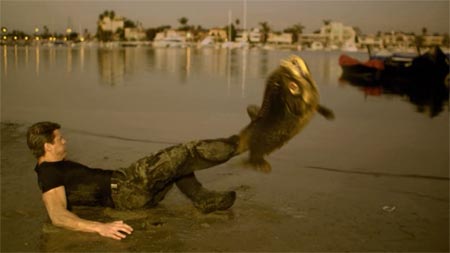
PLOT: After genetic experiments get out of hand, the US government must battle giant, flying,

Still from Mega Piranha (2010)

exploding, cannibalistic, hermaphroditic, mutant piranhas.

WHY IT WON’T MAKE THE LIST:  Mega Piranha is absurd and ridiculous enough for a few giggles over a beer or two (or six), but nothing more.

COMMENTS: Juts a small sampling of things I learned from watching Mega Piranha:

  • The State Department doesn’t consider knowledge of Spanish to be a prerequisite for a investigative mission to Venezuela.
  • Knowledge of kickboxing is a prerequisite.
  • People remember who Tiffany was.
  • There are coral reefs along the bottom of South American rivers.
  • Piranhas explode when they contact building materials.
  • Genetic mutations are always favorable.
  • In the navy, you can wear whatever hairstyle you like.
  • Steering a helicopter makes the veins in your neck stand out.
  • Nuclear weapons have no effect on large fish.
  • Piranhas will attack boats, submarines and helicopters because they know there’s meat inside.
  • There’s nothing to eat in the ocean, so sea predators need to attack settlements on the coast.
  • Fat girls can be love interests, but not until the very last scene.

This list could go on indefinitely (feel free to add more observations in the comments).  The point is, Mega Piranha is a self-esteem movie.  No matter your age, intelligence, social status, or education, you can feel superior to the folks involved in this production.  Not that, for a moment, I believe the filmmakers could possibly be as dumb as the script makes them seem.  It’s just that they would obviously rather spend their limited funds on bargain bin piranha CGI and washed-up stars with names that might ring a bell with someone, somewhere, than to waste it on meaningless extras like second drafts and continuity.  Writer/director Eric Forsberg has no illusions (I hope) that he’s creating great art here; he understands it’s not plot but mega piranhas that are the draw, and keeps things moving quickly so he can get to scenes like Special Agent Fitch lying on his back booting away the fish that fly directly into his feet, while in the South American riverside village other (much larger) piranhas are jumping into buildings, either exploding or simply sitting there halfway through the roof, with their dorsal fins wagging in the breeze.  Forsberg does at least one thing smartly: he keeps the camp tone correctly deadpan, resisting the urge to have the players break character and laugh at their own shenanigans.  The lack of winks makes it a much more effective parody: this seriously looks like a script that Michael Bay might have considered, with a few minor script rewrites and a lot more explosions.  So, it’s dumb, but is it dumb fun?  I’ll put it this way: if you’d ever entertain the idea of watching a movie titled Mega Piranha, you’ll probably be satisfied with this offering.  This is the most entertaining movie about mega piranhas, and quite possibly about mega aquatic creatures as a genus, it would be possible to make.

Mega Piranha was a co-production of sorts between The Asylum (makers of microbudget “mockbusters” like Transmorphers intended to rip off box office successes like Transformers) and the SyFy channel (which airs so many made-for-TV losers like Mansquito and Dinsoshark that they probably should rebrand themselves “the Sigh-fi Channel”).  The version that aired on television (also the version available on Netflix streaming as of this date) is PG-rated, at worst.  The “special edition” DVD adds some gratuitous topless shots and naughty words for an R-rated product.

WHAT THE CRITICS SAY:

“…wilfully preposterous cod B-movie… initially amusing but swiftly outstays its welcome as the piranhas develop the ability to fly like fanged double decker buses and the whole caboodle tries just a bit too hard to be knowing.”–Tim Evans, Sky Movies (contemporaneous)

CAPSULE: MARTYRS (2008)

DIRECTED BY: Pascal Laugier

FEATURING:  Morjana Alaoui, Mylène  Jampanoï, Catherine Bégin, Robert Toupin, Patricia Tulasne

PLOT: A girl ventures into unknown territory when she helps her lover, a former torture victim, seek revenge on her one-time captors, in this bloody tale of madness and sadism.

Still

WHY IT  WON’T MAKE THE LIST: You may have heard incomplete descriptions of Martyrs in the media or by word of mouth.  Hushed references and whispered gossip might make it sound like a snuff movie, a sado-masochistic tableau, or a scandalous exploration of taboos. It is none of these things. While Martyrs is a heavy, very violent film with a grim story, it is not a snuff movie or a sensational expose of torture. It is an offbeat, horrifying thriller, and nothing more.

COMMENTS: When Anna (Alaoui) and her lover Lucie (Jampanoï) embark on a mission of revenge against Lucie’s childhood torturers, the situation quickly spirals out of control.  The couple locates Lucie’s alleged abductors, but did they find the right people?  Lucie is stalked and victimized by the spectre of the mutilated sister she had to leave behind, and Anna is not so sure where the truth lies.  In the process of exacting retribution the landscape changes dramatically and Anna is swept into an incomprehensible morass of hell on earth.

I’m so underwhelmed!  I was expecting a real stick of dynamite, but instead, I got one of those Fourth of July smoldering snake novelties.  Movie site rumors and an ongoing debate over whether or not Martyrs amounts to little more than “torture porn” made me expect a wild ride.  I had hoped to see the ultimate horror movie, or at least something mindlessly vulgar and sensational, but no dice.

What I got was an extremely well-shot, conventionally produced, offbeat story.  Unfortunately, it consists of two loosely linked plot sequences which, once combined, don’t amount to a sum greater than their parts.  Nor do they deliver any sort of soul stirring revelation.  Ho hum.

I found Martyrs to be intriguing, but, well, kinda boring.  Maybe even a little tedious in places.  Continue reading CAPSULE: MARTYRS (2008) →

CAPSULE: HOME (2008)

DIRECTED BY: Ursula Meier

FEATURING: , Olivier Gourmet, Madeleine Budd, , Adélaïde Leroux

PLOT:  The idyllic existence of an isolated family is shattered by the re-opening of an abandoned highway that runs through their front yard.

Still from Home (2008)

WHY IT WON’T MAKE THE LIST:  Despite the absurd rot at its core, Home is structurally sound; but it’s too low-key and lacking in zing to be counted among the weirdest movies of all time.

COMMENTS:  There’s not much plot to Home—a highway opens in a family’s front yard, the fumes and endless noise bug them, and they eventually put cinder blocks and cement over their windows to keep the outside world out. The idea could have packed a compact wallop in a short; but here, there’s ninety minutes to fill up. Promising first time director Ursula Meier saturates the empty spaces with acting; thankfully, she has Isabelle Huppert and a pro cast on her side.

Home will work best for those who find the carefully observed intimate details of other people’s family lives fascinating, but the leisurely pacing will make this thin allegory something of a grind for others. Early scenes establish the bucolic Eden that’s about to be paved over: the family plays hockey in the abandoned highway, watches TV on a couch outdoors, and bathes together. (Meier makes a major point of the family’s unselfconscious, unsexual nudity; Huppert is the only one in the film who keeps her clothes on). External pressure on the happy family arrives when the highway reopens (allowing Meier the opportunity for a nicely absurd parody of the “incredibly specific news broadcast” movie cliché: the only radio station the family receives focuses exclusively and obsessively on the new thoroughfare, tracking the progress of the first motorist as if he were a national celebrity). Amusingly, at first the brood attempts to go about its normal routines despite the intrusion of the motorway; college-age Judith continues her full-time bikini sunbathing career (to the delight of passing truckers), and the two younger kids dodge cars as they cross the highway on their way to school each morning. Eventually the pressure starts to get to the family unit; the incessant freeway noise causes sleepless nights, and fatalistic middle child Marion takes to wearing a homemade gas mask and filling her younger brother’s head with tales of how the gasoline fumes will stunt his growth. Father Michel (Gourmet) reasonably suggests relocation, but mother Marthe (Huppert) digs in to preserve the homestead.

Under stress, the family’s behavior takes a turn for the bizarre (especially Mom’s). When they decide to wall up the house, the heat inside becomes stifling and the air stale; they spend most of their time sleeping, lacking the strength to do more. The film’s symbolism is open-ended, which can be a very good thing, but which works better when coupled with a stronger narrative. Critics seem to be focusing on the happy pastoral family vs. poisonous industrial society theme and the environmentalist subtext, but there’s also a metaphor about growing up at work here. At each stage of the story, the tone reflects one of the three children’s perceptions of family life. At first there is a childish innocence and fun to the home, with nothing of too much importance existing outside it. The outside world (represented by the highway) begins to encroach on the family sanctuary and penetrate its four walls, reflecting the anxiety and disillusionment of the early teen years. Finally, the home becomes a stifling prison run by madmen whose walls must be torn down in order to become an adult.

This Home is often confused with Home (2008), a mother-daughter cancer drama, and Home (2009), an environmental documentary narrated by Glenn Close. I have no theory to offer as to why the filmmakers gave their French language film shot in Bulgaria an English title.

WHAT THE CRITICS SAY:

“…the engaging, darkly funny, surreal story of what happens when people who have thrived by keeping civilization at a safe distance suddenly find themselves pushed right back into its headlights… an absurdist pit stop on the order of ‘Bagdad Café,’ but with more edge and less charm.”–Janice Page, The Boston Globe (contemporaneous)

CAPSULE: SEA OF DUST (2008)

DIRECTED BY: Scott Bunt

FEATURING: Troy Holland, Sarah Dauber, , Ingrid Pitt

PLOT: Prester John, a mythological crusader king, possesses the bodies of 19th century

Still from Sea of Dust

Germans to manifest his sadistic religious ideology in this world.

WHY IT WON’T MAKE THE LIST:  Sea of Dust is a tough case: it’s definitely weird, but at the same time it’s neither polished enough to be counted as one of the best weird movies of all time, nor bad enough to earn the so bad it’s weird designation that could get it on to the List through the back door.  The movie is worth a cautious recommendation for those who can overlook its ample flaws—bad acting, stilted dialogue, and an anti-religion message delivered with just a tad more subtlety than Religulous—and just want to soak in the b-movie weirdness of the “WTF?” third act.

COMMENTS:  Much of the time, Sea of Dust is like a Hammer Studios period movie acted by community theater thespians, with the addition of spurting gore effects supplied by exploding-head maestro Tom Savini.  As you watch the introduction where a rich landowner rejects a young medical student’s pleas for the hand of his daughter, your first thought will probably be “poorly acted and scripted.” That’s a shame, because the film gets better as the weirdness builds in later reels, and you may find yourself drawn into the movie if you can overlook the acting and dialogue and make it through the first half.  In the actors’ defense, it’s hard to sound convincing when you’re asked to deliver lines like “I really do apologize, I’ve never tried to kill someone before.  It’s very unlike me, I wouldn’t want you to think I behave like this all the time” just the way a 19th century German peasant girl who just been possessed by the spirit of a mythological crusader king would.  (An even more challenging line delivery comes when the hero is washed up unconscious on a beach and awakened by a fisherman who inserts a wicked hook attached to a staff through his chin and drags him a few feet through the surf: mildly perturbed, he whines, “Was that really necessary? You poked a hole in me!”)  If these descriptions make it sound like Sea of Dust is the work of incompetents, the look of the film belies that impression: the photography, lighting, costuming (lots of waistcoats and bodices), believable period sets, and editing are all strictly pro.  Even the special effects, while obviously cheap, are effective: there are multiple gore effects (an exploding head, a pitchfork through the head), and there’s a fluid sequence where a steadicam rushes through forests and into other dimensions where a beautiful siren awaits, and another one where the camera enters a maggot-ridden brain through a puncture wound in the head.  Even more importantly, for our purposes, there’s a lot of imaginative weirdness in the movie’s second half to recommend it.  We get multiple flagellations, two finger-sucking scenes, a crucified Tom Savini with dilated pupils, surgery on a hollow Ingrid Pitt, a cat-woman “harpy” in a black latex bodysuit who urinates on torture victims, and an ending that involves dreams inside of dreams and should leave the viewer well confused about who has triumphed.  At any rate, you have to give Sea of Dust credit: the film is overambitious, which is almost always a better thing than being underambitious.  A movie’s reach should exceed its grasp.

The film’s villain, Prester John, was a “real” legendary king during the Crusades; he was said to rule a Christian kingdom to the east of the Holy Land.  In writer/director Bunt’s vision he is a blatantly fictional creation of the kings of Europe during the crusades to lure volunteers into the wars.  In the film, people’s belief in Prester John causes him to take on a real existence, though he can only effect this world by possessing the souls of others.  Belief in Prester acts like a zombie virus in the affected villagers, but what’s unexplained is why the king would have a Sadean worldview, proclaiming pain is “the most delicious sensation” and perverting the Christian message into one that seeks to maximize suffering and therefore views inflicting cruelty as a holy act.  No orthodox Christians appear to oppose the evil; the good guys are rational Enlightenment scientists, men of medicine.  It’s not exactly what you would call a subtle or fair-minded allegory.

WHAT THE CRITICS SAY:

“…the film’s budgetary drawbacks and Bunt’s inexperience actually work in SEA OF DUST’s favor. The quick shifts in tone and occasional awkward transitions contribute to the movie’s dream-logic quality, adding a surface layer of Lovecraftian surrealism.”–Mike Watt, Fangoria (DVD)