Category Archives: Capsules

CAPSULE: SOMEBODY UP THERE LIKES ME (2012)

DIRECTED BY: Bob Byington

FEATURING: Keith Poulson, Nick Offerman, , Stephanie Hunt,

PLOT: Thirty-five years in the life of a waiter who goes through three lovers and one friend while not visibly aging, possibly thanks to a magical suitcase.

Still from Somebody Up There Likes Me (2012)

WHY IT WON’T MAKE THE LIST: Somebody Up There Likes Me is an experiment that dares to ask the question: just how deadpan can you make your comedy before the funny completely evaporates? It comes perilously close to finding the answer.

COMMENTS: Struggling valiantly to fashion the listless happenings that occur during the running time of Somebody Up There Likes Me into some kind of plot synopsis, the distributor’s copywriter came up with a notion that the movie involves two men named Sal and Max and “a love triangle with Lyla, the woman they both adore.” This is blatantly incorrect. The characters in Somebody simply don’t “adore”; that’s far too strong an emotion for the universe in which this movie takes place. This is a world where a woman cries out “OK!” rather than “yes!” during sex, while another confesses to “kind of liking” intercourse. This extreme understatement and emotional flatness is the movie’s joke; I suspect it may all be an arch, meta-ironic comment on fashionable hipster detachment. For long stretches, the movie won’t even attempt a real gag, skating by on its incongruously nonchalant tone: everyone is bored and inexpressive during sex, weddings, and funerals, except for Nick Offerman’s Sal, who is mildly irritated by everything, and therefore is the script’s most alive character. Although the two pals do sleep with the same woman, there is no adoration and, consequently, no love triangle (because there is no love). It’s hard not to sympathize with the poor synopsizer trying to explain what happens in the shambolic Somebody. Besides the inaccurate suggestion that the film is some sort of romantic comedy, the other potential hook the writer seizes upon is the notion that the movie contains “a magic suitcase [that] prevents Max from getting older.” This is a reasonable supposition, although there are significant problems with this description as well. Max only peers into the suitcase, whose origin or function is never explained, a couple of times. And although it’s true, and notable, that he doesn’t visibly age as the movie covers three and a half decades, what’s even odder is that some of the supporting cast age normally (a child grows to an adult), others sort of age, but don’t really look much older (Offerman develops a slight touch of grey in his beard and Jess Weixler acquires thick-rimmed glasses), while at least one other character remains as eternally youthful as Max. It’s reasonable to conclude the baggage keeps Max from visibly aging, but it’s hard to make any definitive statements about anything in this movie. The magical realist conceit enclosed in the suitcase is a surreal joke a would have taken and run with, but here, it’s sidelined and almost forgotten. Somebody‘s poker-faced twee aesthetic is strange and distinctive, but not particularly endearing. It’s like something Wes Anderson might direct while under heavy sedation.

Utilizing some of the cast from his hit TV show “Parks and Recreation” Nick Offerman co-directed a very strange (and not-safe-for-work) “virile video” for Somebody Up There Likes Me, in a style that’s nothing at all like the movie (it’s much funnier).

WHAT THE CRITICS SAY:

“…nihilistic, misanthropic, and weirdly relaxing. I’ve never seen anything like it.”–Leah Churner, Austin Chronicle (contemporaneous)

CAPSULE: THE EXTRAORDINARY ADVENTURES OF ADELE BLANC-SEC (2010)

Les Aventures Extraordinaires d’Adèle Blanc-Sec

366 Weird Movies may earn commissions from purchases made through product links.

DIRECTED BY:

FEATURING: Louise Bourgoin, Nicolas Giraud, Jacky Nercessian, Gilles Lellouche, Laure de Clermont-Tonnerre,

PLOT: In 1911, novelist and adventuress Adele Blanc-Sec seeks an ancient Egyptian cure to bring her twin sister out of a coma; her plans are interrupted when she must deal with a pterodactyl who is terrorizing Paris.

Still from The Extraordinary Adventures of Adele Blanc-Sec
WHY IT WON’T MAKE THE LIST: It’s more Spielberg-on-the-Seine than a weird movie per se.

COMMENTS: Adèle Blanc-Sec will probably remind you of those fantasy/adventure hybrids from the mid-1980s, movies like Big Trouble in Little China and Young Sherlock Holmes that mixed swashbuckling with the supernatural in an attempt to cash in on the cachet of Raiders of the Lost Ark. If you imagine Audrey Tautou’s Amelie Poulain cast in the role of Indiana Jones, you wouldn’t be too far off the style here. Assaying the title character from a popular series of French graphic novels, newcomer Louise Bourgoin (previously a weather girl) stars as a proto-feminist novelist/adventurer at the dawn of the 20th century, the era just before the myths and legends of the ancient past were scoured away by the mustard gas blast of World War I. Interestingly, although all of her foils are male, no one in the French patriarchy comments on Blanc-Sec’s gender. She’s so confident and forceful in her actions—always seizing the initiative and never giving anyone else the opportunity to object—that we really believe her sex is not an issue. Adele bumbles around like an absent-minded professor, blind to everything that is alien to her goal of resurrecting her sister from her coma, including the clumsy advances of a young scientist who’s smitten by her. Yet, she’s also incredibly composed under pressure, not even breaking a sweat when she’s captured by an oily nemesis in the middle of raiding a pharaoh’s tomb.

Bourgoin is excellent in the role, and what success the movie achieves is largely due to her performance. Visually, the movie is a mixed bag. The cinematography is great, the set design (from desert tombs to Adele’s apartment, cluttered with relics from her adventures) is fantastic, and director Luc Besson’s eye for composition is as imaginative as always. Unfortunately, when it comes to effects and makeup, Blanc-Sec is not up to contemporary standards, giving the movie a cheap, ersatz Hollywood sheen that detracts from the sense of wonder the movie is desperate to instill. The pterodactyl is fine in closeups, but when it’s animated in clumsy CGI, it looks about a decade or more behind current technology. The grotesque Halloween makeup is unnecessary; it’s purpose, it seems, is to transform the onscreen characters into the exact duplicates of the characters from the graphic novel. One character has ridiculous eyebrows, another has unnatural dark spots surrounding his eye sockets, and the nutty professor of parapsychology wears a liver-spotted latex mask that just looks wrong. The makeup all looks slightly uncanny rather than whimsically cartoonish, as intended. The comic plot tries very hard to entertain, with telepathic connections to dinosaurs, a Clouseau-esque investigator who accidentally talks into his shoe, and reanimated Egyptians who speak perfect French and are fond of pranks. In fact, if anything Adele Blanc Sec may try a little too hard to impress, coming off as desperate; but any movie that manages to fit both pterodactyls and mummies into its running time has something to recommend it.

France just doesn’t have the funds to compete with Hollywood when it comes to blockbuster international entertainment; even in its dubbed version, Adele Blanc-Sec barely played American theaters (although the film did well in the Far East, surprisingly, and managed to break even on its budget). The movie arrived unceremoniously on Region 1 DVD three years late, without fanfare, from specialty distributor Shout! Factory. In a small controversy, a brief and apparently inconsequential scene of Bourgoin bathing in the nude was not included in Shout!’s initial release (as it had been snipped from the U.S. theatrical print). Three weeks later, however, Shout! issued a “director’s cut” with the topless footage included, forcing early-bird cinephiles to double dip if they wanted to catch the double nips.

WHAT THE CRITICS SAY:

“Matching lavish period sets to surreal visual effects, Besson has crafted a feast for the eyes – but while there is absurdity aplenty on display here, the film also requires a very high tolerance for the broadest of humour and the slightest of whimsy.”–Anton Bitel, Eye for Film (contemporaneous)

CAPSULE: THE PAINTING (2011)

Le Tableau

DIRECTED BY: Jean-François Laguionie

FEATURING: Voices of Jessica Monceau, Adrien Larmande

PLOT: Figures leave the painting in which they reside and go searching for the Painter to find out why he left some of them incomplete.

Still from The Painting [Le Tableau] (2011)

WHY IT WON’T MAKE THE LIST: It’s visually imaginative and ambitious, with a few hallucinatory moments, but the morally naïve allegory adds a kitschy feel that’s incompatible with the high art graphics. If the story had been sketched out with as much loving detail as the beautiful Impressionist-styled artwork, this might have been a masterpiece, rather than something that’s just nice to look at.

COMMENTS: True to its post-Impressionist inspirations, The Painting is visually stunning. Taking its cues from early Picasso, Gauguin, and (especially) the crazy geometries and color schemes of Matisse, this movie always looks like a canvas come to life. Standout scenes include a dreamlike sequence of a magical flower observing a captive figure with its glowing eye-like stigma, a raucous animated romp across the bridges of Venice during Carnivale, and moments where the characters push through the permeable burlap canvas to emerge in the “real” world. Storywise, however, there isn’t much to The Painting. There are three classes of painted figures in the movie; the fully colored-in Allduns (who consider themselves superior and oppress the “lesser” figures), the incomplete Halfies (who may be lacking nothing more than a corner of the hem of a dress to be complete), and the Sketchies (black and white figures whose shape has only been suggested). A forbidden Romeo n’ Juliet relationship between an aristocratic Alldun and a Halfie leads the characters to leave the painting in search of answers (and hopefully a dye job) from the Painter; they move across other canvases and eventually into the Painter’s studio (where animation mixes with live action). The plot is basic, with the scarcely developing characters simply moving from one CG environment to another. Allegorically, however, The Painting has grand ambitions. It wants to be both an existentialist take on the search for the Creator and a class parable about bigotry and oppression (it also reserves a few minutes to declare its basic anti-war sentiments). By tackling two huge themes, however, director Laguionie ensures that each only gets half-sketched. The idea of the creations searching for God is an appealing conceit, but ultimately the movie has nothing to say about that ultimate reality beyond “be responsible for your own fulfillment.” We’re not convinced that the Almighty Creator is very much like a mortal painter, and so the analogy can’t satisfy our own sense of the mystery of existence. As far as the class parable goes, it’s never clear what the divisions are supposed to represent. Are the differences between the Allduns, Halfies and Sketchies racial, economic, or cognitive? Maybe the Sketchies represent the physically or mentally handicapped, who are, in some offensive sense, “incomplete” creations? At any rate, the movie’s position that the Halfies and Sketchies should “complete” themselves strikes many commentators as ironic and unsatisfactory. Shouldn’t the Allduns learn, or be forced, to tolerate those who are different, rather than the inferior classes accepting that they are defective, and figuring out how to fix themselves? These questions won’t bother youngsters, who will absorb the valuable (if insipid) lessons about tolerance and self-reliance well enough. But the movie’s failure to complete the grand philosophical goals it sets for itself makes it much like a partially unfinished artwork. Still, the part that is painted looks awfully good, and that’s enough to make it worth looking at, if not thinking about.

The French animation studio Blue Spirit produces mostly children’s television programming, but they also worked on the brilliant The Secret of Kells.

WHAT THE CRITICS SAY:

“The animated film’s aesthetic employs expressionism, realism, and cubism, but the morality plays are layered on as thickly and haphazardly as a toddler’s finger painting.”–Caroline McKenzie, Slant (contemporaneous)

CAPSULE: SECONDS (1966)

DIRECTED BY: John Frankenheimer

FEATURING: Rock Hudson, John Randolph, Will Geer, Jeff Corey, Murray Hamilton, Frank Campanella, Salome Jens

PLOT:  A middle-aged businessman in midlife crisis gets a second chance at life—but it comes at a steep price, and there’s a morbid catch.

SECONDS-2


WHY IT WON’T MAKE THE LIST: Seconds offers us a unique, unusual plot, one that will really stick in your memory. You’ll carry the story and its lesson for the rest of your life because it directly treats concepts that nearly everybody can, or knows they eventually will relate to:  growing old, midlife crisis, looking back and wondering if we made the right choices, and ruefully contemplating the what-might-have-beens. What can we be doing now to make sure we don’t have regrets? Despite the dramatic, hard-hitting effect the writers and director bring to these concepts, however, Seconds is a straightforward, conventional film. The story is offbeat as hell, but the movie isn’t weird.

COMMENTS:  Dramatic and disturbing, Seconds is a dark, brooding predecessor to middle-class America mid-life crisis films such as the blackly-comic Middle Age Crazy (1980) or the light-hearted and less substantial This Is 40 (2012). Yet, while those films allow us to laugh off the grim prospects of getting older, Seconds grinds on us and strikes a nerve.

Wealthy banker Arthur Hamilton (John Randolph) has it all. He went to the right Ivy League school, joined all the right fraternal organizations, and married the right woman. Yet, at middle-age, something’s missing.

In Sinclair Lewis’s classic novel “Babbitt,” the book’s namesake awakens each morning from a blissful dream of being a carefree youth cozying up to an enigmatic and beautiful girl to greet the dread of reality: a frumpy wife, his own greying countenance, and the unsatisfying banality of another tedious workday. Like Babbitt, Arthur Hamilton feels frustrated and empty. Maybe it’s because Arthur looks like an aging John Randolph. Or could it be because at middle age, Arthur isn’t so sure that the life he toiled away for is the one he really wants?

It’s hard to imagine that it is. Arthur is clearly bored and bothered. Even more telling, Arthur and his wife don’t sleep together anymore. The Hayes code hold-over separate beds don’t help the romance.

And Hamilton is beyond staunch; he’s gosh-darned uptight. Racked with tension, beaded with sweat, coiled up, we want to hand him a Hawaiian shirt, a Mai-Tai, and tell him to loosen up.

We’re not alone. Someone from Arthur’s past also has him sized up as a walking time-bomb of seething non-fulfillment.

A mysterious phone call from a dead school chum (Murray Hamilton) breaks the routine. After the phone call Hamilton receives a mysterious address, at which he arrives after following a chain of clues. Arthur Hamilton’s life is about to change.

In return for his life insurance payout and a hefty chunk of his sizable estate, Hamilton joins a secret society—one which, after months of super-nutrition, exercise, hair restoration, testosterone therapy, and state of the art plastic surgery, transforms him into—wait for it … wait for it …  young, virile, ROCK HUDSON!

And that’s not all. Under hypnosis, Arthur learns that what he really wanted to do in life was to be an artist. The organization he’s joined has that Continue reading CAPSULE: SECONDS (1966) →

CAPSULE: MAGIC MAGIC (2013)

DIRECTED BY: Sebastián Silva

FEATURING: , , Agustín Silva, Catalina Sandino Moreno,

PLOT: An emotionally fragile American girl is trapped with four strangers in a vacation home in Chile when her friend ditches her to deal with personal issues.

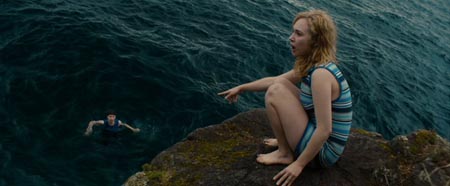
Still from Magic Magic (2013)

WHY IT WON’T MAKE THE LIST: The movie is good at creating a subtly unnerving atmosphere, but it doesn’t quite push far enough into eldritch realms earn a single Magic in its title, much less two.

COMMENTS: Magic Magic‘s scenario is a little like Repulsion-lite. Juno Temple plays the repressed girl with the disintegrating mind, with the major difference being that it is other people, not solitude, that makes her crack up. It’s also not clear that Temple’s Alicia fears men in general, although she certainly shudders at the touch of Michael Cera’s Brink (which is actually pretty rational behavior, given Brink’s awkwardly sleazy passes at her). Abandoned among strangers in a foreign country, Alicia comes off as merely shy, at first; but, she seems to be having difficulty sleeping, as well as relating to her fellows. She loves animals, but they don’t reciprocate, unless it’s to hump her leg. As the vacation goes on her paranoid behavior gets worse. She begins recalling conversations others don’t remember. The camera sometimes inhabits her subjectivity; when out of focus, her companions’ faces seem to be staring at her, studying her, but a more objective view shows them to be minding their own business. Most of the movie consists of a string of scenes that are very good at creating a subtle, unsettling atmosphere of social and sexual anxiety. The individual pieces are carefully detailed and observed, but the movie as a whole lacks the narrative hooks to draw you into the story, either emotionally, or as a psychological mystery play. The roots of Alicia’s problems, even her basic backstory, are barely hinted at, leaving this unsatisfying as a character study. The movie’s climax invokes Chilean voodoo, a left-field gambit that’s fairly intense and spooky on its own; but, like a potentially interesting and emotionally resonant subplot involving Browning’s character, it doesn’t seem to belong to the main narrative in a meaningful way. The overall result is a slightly unsatisfying movie with parts that are better than the whole. On the plus side, the performances by Temple and Cera are very good. Cera’s character is the socially inept inversion of Temple; overcompensating for his inadequacies with obnoxiousness, he talks a big game, but he may be even more repressed than Alicia.

Michael Cera made two movies back-to-back with director Silva while on a visit to Chile. In Crystal Fairy and the Magical Cactus, the somewhat better of the two films, he plays a neurotic American drug tourist foiled by a free-spirited hippie girl.

WHAT THE CRITICS SAY:

“To be sure, the movie isn’t much more than its atmosphere of clammy discomfort and a gonzo performance from Juno Temple, but those open to the experience will enjoy its gleeful strangeness.”–Tim Grierson, Screen Daily (contemporaneous)