Tag Archives: Jean-François Laguionie

CAPSULE: GWEN AND THE BOOK OF SAND (1985)

Gwen Et Le Livre De Sable

366 Weird Movies may earn commissions from purchases made through product links.

DIRECTED BY:

FEATURING: Voices of Michel Robin, Lorella DiCicco, Armand Babel, Raymond Jourdan, Jacques Ruisseau

PLOT: Sometime “After the gods have left…”, what remains is a desert landscape in which a few animals and nomads make their home; the only danger being the Makou, something that drops objects of various size onto the desert floor, forcing the nomads to live underground. Gwen, an orphan, falls in love with a strange boy, Nokmoon, who is taken away one night by the Makou. She and Roseline (a 173 year old woman) set off on a journey to retrieve him; in doing so, they encounter a mysterious cult.

Still from gwen and the book of sand (1985)

COMMENTS: The post-apocalyptic tale is a genre of its own, but when you take post-apocalypse and desert and put them together, you get The Road Warrior. It’s practically the template followed by its own sequels and countless homages/ripoffs. And when it comes to non-apocalyptic sci-fi/fantasy, the template is Dune. These stories are usually heavily plot-driven, with a relentless forward momentum.

Gwen is desert post-apocalypse in a poetic mode. The title might make one surmise that the title character will undergo a series of adventures and challenges for the next hour or so, but it’s not so. The movie is gentler than that. It’s paced leisurely; there is a plot, but it drives lightly. Instead, the film focuses on visuals: characters walking across the sands on stilts, landscapes littered with objects such as oversized utensils and eyeglasses, close-ups of the pincipals. And it’s all the more striking for being animated with a gouache paint palette, which softens things, giving the impression of a dream. (One visual reference that I twigged was Henri Rousseau’s “The Sleeping Gypsy.”)

Gwen is about mood and atmosphere: the surreality of the landscape, how the nomads live in this world, how they hunt, how they travel. There’s little explanation of how this desert came to exist, other than the oblique “the gods have left,” or of the Makou. And that’s to the film’s advantage, especially as things get more surreal and the introduction of the Makou Cult (which includes pointed satire of religion). Although there are what could be referred to as “antagonists,” there’s no outright villain, as there would be in a more standard treatment. The music of Pierre Alrand, a longtime collaborator of Laguione’s, adds to the moody atmosphere.

Fantastic Planet, another French animation with a similar mood and adult approach, is Gwen‘s closest relative. Planet, however, is much more brutal in approach. Gwen is made for adults, but it’s family-friendly—although it’s probably way too slow and not antic enough for young children (although the visuals may attract them). Older kids could get more out of it, though again it’s paced much slower than current animated films. Fans of , and especially of Nausicaa of the Valley of the Wind, might also get into the film’s rhythm and mood.

Gwen‘s first ever U.S. release on 4K and Blu-ray comes from Deaf Crocodile, in a limited or standard edition. The movie has a commentary by Samm Deighan, along with an interview with director Laguionie by Dennis Bartok and an intriguing video essay by Dr. Will Dodson and Ryan Verrill. The Limited Edition includes a 60 page booklet with essays by Laguionie, film historian Jennifer Barker, and critic/DC house writer Walter Chaw, as well as a slipcase with new art by Beth Morris.

(This movie was noimated for review by Russa03, who said it was “a surrealist, post-apocalypse animation and it’s beautiful to boot.” Suggest a weird movie of your own here.)
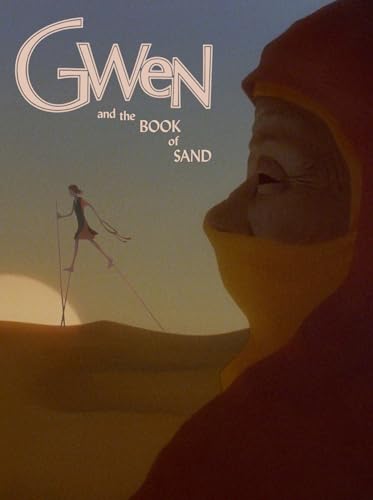
Gwen And The Book Of Sand (4k UHD + Blu-ray)
  • A teenage girl and her 173 year old companion take an epic journey in French director Jean-François Laguionie's hauntingly poetic animated classic.

CAPSULE: THE PAINTING (2011)

Le Tableau

DIRECTED BY: Jean-François Laguionie

FEATURING: Voices of Jessica Monceau, Adrien Larmande

PLOT: Figures leave the painting in which they reside and go searching for the Painter to find out why he left some of them incomplete.

Still from The Painting [Le Tableau] (2011)

WHY IT WON’T MAKE THE LIST: It’s visually imaginative and ambitious, with a few hallucinatory moments, but the morally naïve allegory adds a kitschy feel that’s incompatible with the high art graphics. If the story had been sketched out with as much loving detail as the beautiful Impressionist-styled artwork, this might have been a masterpiece, rather than something that’s just nice to look at.

COMMENTS: True to its post-Impressionist inspirations, The Painting is visually stunning. Taking its cues from early Picasso, Gauguin, and (especially) the crazy geometries and color schemes of Matisse, this movie always looks like a canvas come to life. Standout scenes include a dreamlike sequence of a magical flower observing a captive figure with its glowing eye-like stigma, a raucous animated romp across the bridges of Venice during Carnivale, and moments where the characters push through the permeable burlap canvas to emerge in the “real” world. Storywise, however, there isn’t much to The Painting. There are three classes of painted figures in the movie; the fully colored-in Allduns (who consider themselves superior and oppress the “lesser” figures), the incomplete Halfies (who may be lacking nothing more than a corner of the hem of a dress to be complete), and the Sketchies (black and white figures whose shape has only been suggested). A forbidden Romeo n’ Juliet relationship between an aristocratic Alldun and a Halfie leads the characters to leave the painting in search of answers (and hopefully a dye job) from the Painter; they move across other canvases and eventually into the Painter’s studio (where animation mixes with live action). The plot is basic, with the scarcely developing characters simply moving from one CG environment to another. Allegorically, however, The Painting has grand ambitions. It wants to be both an existentialist take on the search for the Creator and a class parable about bigotry and oppression (it also reserves a few minutes to declare its basic anti-war sentiments). By tackling two huge themes, however, director Laguionie ensures that each only gets half-sketched. The idea of the creations searching for God is an appealing conceit, but ultimately the movie has nothing to say about that ultimate reality beyond “be responsible for your own fulfillment.” We’re not convinced that the Almighty Creator is very much like a mortal painter, and so the analogy can’t satisfy our own sense of the mystery of existence. As far as the class parable goes, it’s never clear what the divisions are supposed to represent. Are the differences between the Allduns, Halfies and Sketchies racial, economic, or cognitive? Maybe the Sketchies represent the physically or mentally handicapped, who are, in some offensive sense, “incomplete” creations? At any rate, the movie’s position that the Halfies and Sketchies should “complete” themselves strikes many commentators as ironic and unsatisfactory. Shouldn’t the Allduns learn, or be forced, to tolerate those who are different, rather than the inferior classes accepting that they are defective, and figuring out how to fix themselves? These questions won’t bother youngsters, who will absorb the valuable (if insipid) lessons about tolerance and self-reliance well enough. But the movie’s failure to complete the grand philosophical goals it sets for itself makes it much like a partially unfinished artwork. Still, the part that is painted looks awfully good, and that’s enough to make it worth looking at, if not thinking about.

The French animation studio Blue Spirit produces mostly children’s television programming, but they also worked on the brilliant The Secret of Kells.

WHAT THE CRITICS SAY:

“The animated film’s aesthetic employs expressionism, realism, and cubism, but the morality plays are layered on as thickly and haphazardly as a toddler’s finger painting.”–Caroline McKenzie, Slant (contemporaneous)