Category Archives: Capsules

CAPSULE: RADIO FREE ALBEMUTH (2010)

DIRECTED BY: John Alan Simon

FEATURING: Jonathan Scarfe, Shea Wigham, Katheryn Winnick, Alanis Morisette, Hanna Hall

PLOT: In an alternate-reality America, a music producer receives psychic dream transmissions from a mysterious entity known as VALIS (“Vast Active Living Intelligence System”), who provides advice for overthrowing the President of the United States, a crypto-Communist dictator.

Still from Radio Free Albemuth (2010)
WHY IT WON’T MAKE THE LIST: The paranoid plot is pretty damn peculiar, but the presentation isn’t unhinged enough for weird immortality.

COMMENTS: A tale of pink, pro-rock n’ roll aliens beaming hallucinatory political advice to subversives from a satellite orbiting earth, Radio Free Albemuth is totally baffling if you don’t know the backstory behind it. It may be even stranger if you do. If you want to be confused and astounded by a weird little story (and don’t demand the highest production values), you might skip this review and just take a chance on Albemuth. But if you want context, here it is. Philip K. Dick (1928-1982) was a counterculture science fiction author, the man responsible for the stories that were adapted into movies like Blade Runner, Total Recall, Minority Report, A Scanner Darkly, and others. He was also a heavy user of amphetamines and LSD in his youth; in his later years he became paranoid, and may in fact have been living with some form of mental illness. In 1974, after taking sodium pentothal for an impacted wisdom tooth, Dick began seeing visions involving pink beams of light, the sense of having lived a previous life as a persecuted Christian in the Roman era, and communication from a super-rational intelligence he dubbed “VALIS.” He described these experiences in a semi-autobiographical novel set in an alternate history timeline titled—you guessed it—“Radio Free Albemuth.” To Dick’s credit, he never surrendered to delusions altogether; he remained rational enough to suspect that the alien epiphanies he experienced may have been hallucinations. The novel, on the other hand, present VALIS’ revelations as gospel. To confuse matters, “Alebmuth” included a science-fiction writer character named Philip K. Dick, but the ecstatic pseudo-religious experiences were attributed to a different protagonist, a music producer who schemes to promulgate VALIS’ revolutionary message through subliminal messages hidden in rock records. Dick’s publishers rejected the novel, and he reworked it into a more palatable story titled “VALIS” (which became the first book in a trilogy). Dick’s original novel, of which this movie is a faithful adaptation, was posthumously published in 1985.

The insane origins of this story may help the uninitiated reader understand why the movie Radio Free Albemuth feels a bit—off. It is, almost literally, the work of a mad genius. This adaptation, made for about three-and-a-half million dollars, has production values comparable to a TV miniseries. The acting is uniformly competent—Shea Wigham’s stoic Dick probably comes off the best, and (ironically) singer-songwriter Morisette isn’t as bad as you might fear. The CGI hallucinations—wormholes, alien cathedrals, angels made of pink electricity—definitely betray their budget, but are acceptable. There is little stylistic zing to the production; the novice director lets Dick’s ideas speak for themselves, in all their delusional grandeur, and what keeps the movie watchable is waiting for the appearance of the crazy, delivered in the voice of one apparently sane. Albemuth is, at the same time, one of those goofy hypotheses that posit a sci-fi explanation for ancient religious ecstatic experiences (a step more sophisticated than UFO cults) as well as an anti-authority allegory (rock n’ roll as carrier of the torch which will incinerate American conformity). It is a weird, though not wholly satisfying, artifact from a unique mind.

None of this will mean much to the hardcore Dick aficionados (I fully realize that some of our less mature readers will titter at the preceding phrase) who are the movie’s target audience. They likely have their minds already made up, and either unconditionally support a faithful adaptation, or believe it’s sacrilege to even try to realize the author’s vision on this meager budget. Casual Dick fans (more titters) may find this either a fascinating introduction to the reality-bending postmodern wormhole of the author’s late works, or an oddity to gape at askance.

WHAT THE CRITICS SAY:

“…resembles a weird artifact from the early days of science-fiction television… this lifeless adaptation only proves that making entertaining movies out of hard-to-swallow ideas is as challenging as you might think.”–Jeanette Catsoulis, The New York Times (contemporaneous)

CAPSULE: CRAVE (2012)

366 Weird Movies may earn commissions from purchases made through product links.

DIRECTED BY: Charles de Lauzirika

FEATURING: Josh Lawson, Emma Lung, ,

PLOT: A freelance crime-scene photographer romances a younger woman in his apartment building, while suffering delusions and fantasizing about becoming a vigilante.

Still from Crave (2012)
WHY IT WON’T MAKE THE LIST: This movie is trying so hard to be like its big brother Taxi Driver that it’s embarrassing to watch at times; it has a certain grotty charm and good performances, but needs a huge wallop of subtlety. Its hallucinations are so clearly marked off as fantasies that they never threaten to swallow up the viewer, leaving its weird effect highly attenuated.

COMMENTS: An internal monologue of a disaffected white guy who’s convinced that humanity is rotten. The antihero drives aimlessly through the city at night, searching for scenes of depravity to reinforce his misanthropic vision. He awkwardly romances a beautiful woman who’s out of his league. He plans a crime, practices the exact words he will say to his victim. The delusional self-appointed vigilante eventually wreaks a gruesome vengeance on an absuer of women. Stop me if you’ve heard this before.

Taxi Driver was the deconstructed, arthouse revision of puerile crime-anxiety thrillers like Death Wish; Crave is an unneeded, on-the-nose reconstruction of Taxi Driver for the modern age. Crave‘s chief problem, for a movie whose promotional material promises that its photographer protagonist Aiden will be a hero whose “dark imagination starts to leak into reality,” is that the line between fantasy and reality isn’t blurry for the viewer—when redheads tear off their blouses and fall to their knees and Bill Gates shows up offering Aiden bags of cash, it’s fantasy. The clarity of that line and the lack of a radical subjective perspective removes a lot of potential tension that might result if we are wondering if what is happening is really inside Aiden’s head. Nor is Aiden delusional enough to create suspense via the gap between the dangers the audience recognizes and what our protagonist comprehends; he not only realizes his grip on his emotional throttle is slipping, he agonizes about it endlessly in voiceovers and heart-to-hearts with his tough-but-wise stereotype cop buddy. And some of the stuff that clearly is intended to happen in reality doesn’t make a lot of sense, like his hot neighbor’s spur-of-the-moment decision to screw Aiden senseless one afternoon just because he’s not terrible-looking and not obviously a psychopath. That’s bad writing, though, not dark imagination.

The script’s lack of originality and subtlety is a shame, because there is a lot of talent here. Josh Lawson is not bad as Aiden, although he lacks the scruffy anti-charisma necessary to take the role over the top. The supporting players fare better. Adorable Emma Lung somehow comes across as a real person, despite the fact that the only character trait the script gives her to work with is a baffling bad taste in men. Edward Furlong, who we last saw in the miserable This Is Not a Movie, redeems himself here as a hipster cad who nonetheless doesn’t deserve his torturous fate. Ron Perlman’s square mug is, as always, a welcome sight; inhabiting his character with ease, he lends instant credibility to any project. The movie’s technical qualities are pro throughout. The neon-noir vistas of Chicago streets at night are memorable, as is the shot of spinning pinwheels reflected in Aiden’s eye. De Lauzirika, who has previously specialized in directing special features for major DVD releases (including Alien, Blade Runner, and three of the extras on the “Twin Peaks” Gold Box set), is a talented director who shoots a good-looking film and elicits fine performances from his actors. But, he may better serve his career in the future by directing scripts written by someone else.

WHAT THE CRITICS SAY:

“[The performances are] undermined by not just the clichéd story but director/co-writer Charles de Lauzirika’s misguided tone, which veers from straight-up impotent fury to a clunky humor that’s just not funny in the story’s overall context.”–Maitland McDonagh, Film Journal International (contemporaneous)

CAPSULE: WRONG COPS (2013)

366 Weird Movies may earn commissions from purchases made through product links.

DIRECTED BY:

FEATURING: Mark Burnham, , Arden Myrin, , , Marilyn Manson

PLOT: Los Angeles cops sell weed (hidden in dead rats), harass aerobics dancers, blackmail each other, and compose electronica; anything but fight crime.

Still from Wrong Cops (2013)
WHY IT WON’T MAKE THE LIST: With a few exceptions (like a fatally wounded music aficionado who refuses to kick the bucket), this black comedy is missing the unique conceptual meta-humor of Quentin Dupieux’s first two movies. It plays more like mildly edgy sketch comedy—it’s almost mainstream.

COMMENTS: One strange lesson you’ll take out of Wrong Cops is that American peace officers love European-style techno music. The other lesson is that, although Quentin Dupieux does surreal comedy well, his general outlook is too bemusedly sunny (a la genial absurdists like ) to create a truly biting satire about policemen behaving badly. True nastiness doesn’t seem to be in Dupieux’s makeup, so Wrong Cops ends up being more like Bad Grandpa than Bad Lieutenant. Although the movie’s cops are intended to be morally corrupt, only Mark Burnham‘s Officer Duke comes off as totally depraved; Eric Wareheim’s breast-obsessed patrolman, for example, is far too teddy-bearish to disturb, even when he’s forcing women to disrobe at gunpoint. The desire to make a black comedy about cops behaving badly mixes poorly with this director’s basic lack of cynicism. (The unexpected sweetness of Dolph’s search for his missing dog in Wrong was a better fit for his sensibilities.) The not-quite-dead body that is never disposed of is one dark moment that works, as is Officer Duke’s spontaneous, pot-fueled eulogy about Hell on Earth that closes the film, but in general the somewhat flat comedy routines are more mild than wild.

With five cops to follow (plus a pair of gay officers who show up occasionally but don’t have a plotline of their own), there’s a lot going on, and Dupieux makes the movie into something of a L.A. block party by inviting a number of recognizable bit players. Eric Roberts stops by as a movie director, and is in there for a few minutes, while her “Twin Peaks” hubby has a slightly larger role as a police chief presiding at a funeral. Marilyn Manson (out of makeup) plays a hassled teenager; despite the fact that he’s in his forties, he is actually surprisingly convincing as a misfit kid. Unobtrusive but obvious references to Rubber and Wrong are also placed in the movie for Dupieux fans. The sprawling cast adds to the sketch-comedy feel, although the overarching plot (which is partly told out of sequence) is more carefully constructed than most viewers give it credit for: if Officer Duke never harasses David Delores Frank about his taste in electronica, the movie’s big tragedy never occurs. Dupieux’s core fan base will probably be pleased with this entry—and it does have its weirdly funny moments—but personally, I’m getting diminishing returns on his unique sense of humor with each subsequent film. The abstract meta-comedy that seemed rule-rewriting in Rubber has become expected and merely entertaining by the time we reach Wrong Cops.

WHAT THE CRITICS SAY:

“…tonally weird and totally forgettable.”–Marc Savlov, The Austin Chronicle

CAPSULE: TWISTER (1989)

366 Weird Movies may earn commissions from purchases made through product links.

DIRECTED BY:

FEATURING: , Suzy Amis, ,

PLOT: A man seeks to reconnect with his daughter and her alcoholic mother, who rarely leave the mansion they share with the family patriarch and a weirdo artist brother/uncle.Twister (1989)

WHY IT WON’T MAKE THE LIST: This shambolic mass of quivering quirk is for fans of the cast only—specifically, for fans of Crispin Glover, who, bullwhip in hand, is acting somewhere near the acme of his Crispin Glover-ishness here as a fey would-be artist.

COMMENTS: Harry Dean Stanton is mini-golf mogul and patriarch of the crumbling Cleveland clan in Twister, Michael Almereyda’s odd but mostly unsuccessful debut film. Stanton, who is romancing a local Christian kids’ show host (Lois Chiles), is mildly eccentric, but his children have gone around the bend. Howdy (Crispin Glover) is an effete, sensitive artist in a shaggy Prince Valiant haircut. He plays guitar and sings (badly) and looks constipated most of the time. Sister Maureen (Suzy Amis) is a mess: constantly drinking beer, passing out on the lawn, and imagining helicopters are watching her. According to the story’s plan she’s supposed to be quirky and charming, but her behavior is too unpredictable and dangerously immature to be endearing. She’s an unfit mother, guilty of child endangerment just by being herself. Observing all the crazy are a trio of somewhat normal outsiders: live-in nanny Lola (Charlaine Woodard), whose underdeveloped part seems to be on back-order; victim kid Violet (Lindsay Christman), who is currently normal (against all odds) but in desperate need of rescue; and decent-guy protagonist Chris (Dylan McDermott), who just wants to put his family back together and get his daughter out of the Cleveland’s madhouse.

The title implies a cataclysmic upheaval that never comes. The Cleveland men get and lose girlfriends, the maturity-challenged siblings make plans to visit their absentee mother that don’t get very far, and Chris tries to woo the mother of his child despite increasing evidence that she’s too far gone into alcoholism and mental illness to make a commitment that lasts more than five minutes. By the end, despite the script’s hopeful protestations, we don’t believe that anyone has learned anything, or that anything is going to change for the core family, no matter what new living arrangements they propose. Twister is a character-driven story without genuine character development; things continue to happen, it keeps teasing us that it’s about to turn interesting, and then suddenly it ends, in a light breeze rather than a tornado.

Twister‘s main asset is its cast, and one of its coups was getting beat novelist to show up and deliver a few lines of dialogue. Watching Glover’s performance alongside Burroughs, you sense that the actor based his laborious, over-enunciating schtick on the junkie icon’s odd cadence. Seeing these two cult figures exchange carefully-crafted but halting lines of dialogue is one of Twister’s only small pleasures.

WHAT THE CRITICS SAY:

“Almereyda finds exactly the right tone: a loopy, understated deadpan that invites empathy rather than ridicule.”–Nathan Rabin, The A.V. Club (DVD)

(This movie was nominated for review by dthoren, who said it “stars Harry Dean Stanton as patriarch of an insane family, including a bullwhip-wielding Crispin Glover in one of his trademark terrible wigs. I love it, and I hope you will too.” Suggest a weird movie of your own here.)

CAPSULE: MYSTERIOUS SKIN (2004)

Must See

DIRECTED BY:

FEATURING: , Brady Corbet, Michelle Trachtenberg, Jeffrey Licon, Elizabeth Shue, Mary-Lynn Rajskub, Bill Sage, Chase Ellison, George Webster

PLOT: Brian, who is missing memories from part of his childhood, believes that he was abducted by aliens; his investigations lead him to Neal, a street hustler who may have had a similar experience.

Still from Mysterious Skin (2004)
WHY IT WON’T MAKE THE LIST: This searing and graphic drama about two damaged boys and their opposite approaches to dealing with trauma is Gregg Araki’s masterpiece, his best movie by a wide margin. Ironically, however, it’s also his least weird film, with only a few dreamlike moments thrown in to relieve the harsh reality.

COMMENTS: Alternating stories in the lives of two former Little League teammates, one now a teenage hustler and the other a UFO-abduction fanatic, Mysterious Skin plays something like Midnight Cowboy with a touch of “The X-Files.”

The performances of both young leads are astounding, and it’s actually a little unfortunate that Brady Corbet’s turn as nerdy, asexual Brian is overshadowed by Joseph Gordon-Levitt’s sexier performance as a prematurely dissipated teenage prostitute. Gordon-Levitt’s role interacting with the various johns, from lonely middle-aged businessmen to touchingly pathetic AIDS sufferers to the inevitable angry sadist, is simply meatier than Corbet’s, who only spars sexually with a frumpy fellow alien-abduction enthusiast. Gordon-Levitt, in his first major part after concluding his run as an alien inhabiting the body of a precocious kid in the sitcom “Third Rock from the Sun,” announces himself here as one of the great upcoming actors of his generation in his dark performance as a cocky boy-stud who isn’t nearly as in control of his life as he believes himself to be.

Each kid has a very different character arc, but they have more in common than it seems. The story’s big “secret” will probably become obvious very quickly, but the drama doesn’t come in the mystery of the big reveal. This is more of a dual character study depicting opposite but equally dysfunctional strategies for dealing with the unthinkable. It’s difficult to watch at times, but it’s played with exceptional compassion and insight that steers well away from survivor clichés—the hustler’s story, in particular, reveals a disturbing but credibly sick psychology. Scenes with cornfed Kansas grotesques finding mutilated cattle with their genitals removed make the Midwest look a little Lynchian; but, other than a misty shot of a Fruit Loop shower and hallucinatory glimpses of an actual UFO, Akari makes very few departures from raw reality here. The supporting performances are all excellent, as is the unobtrusive shoegaze score. This is filmmaking at its most humanistic.

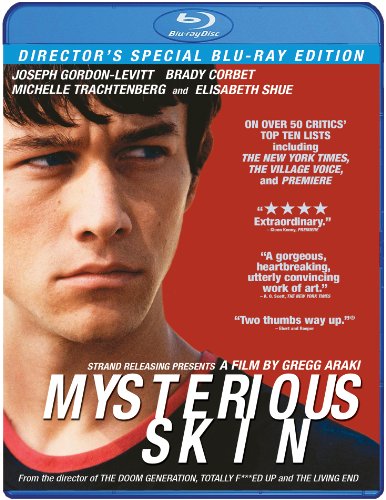
Araki wrote the Mysterious Skin screenplay from Scott Heim’s novel. According to a Heim interview included on the Blu-Ray edition, the director consulted the original author on the adaptation, although Heim decided to get out of the way and not meddle unless asked after the contract was signed. Heim was then invited to tour with the cast and crew as they took the film on the festival circuit. The dynamic between the original author and the adapter here appears to be a model working relationship.
WHAT THE CRITICS SAY:

“The film has a weird buoyancy…”–Stephanie Zacharek, Salon.com

(This movie was nominated for review by “Tori.” Suggest a weird movie of your own here.)

Mysterious Skin (Director's Special Blu-Ray Edition)

  • Factory sealed DVD

New starting from: 100.00 $

Go to Amazon