Category Archives: Capsules

CAPSULE: STARRY EYES (2014)

DIRECTED BY:  Kevin Kolsch, Dennis Widmyer

FEATURING: Alexandra Essoe, Lou Deszeran

PLOT: A struggling young L.A. actress finally gets a callback, but the auditions are increasingly humiliating, and the casting director wears a pentagram…

Still from Starry Eyes (2014)

WHY IT WON’T MAKE THE LIST: It’s got a little bit of backloaded weirdness in its final act, but mostly, it’s just a clever but minor indie horror whose primary impact will be as a calling card for lead actress Alexandra Essoe.

COMMENTS: Starry Eyes‘ script was obviously written by people who have stood up and read lines from an unfamiliar script in an attempt to impress poker-faced executives who silently assess their appearance, talent and general suitability as a human being. The movie makes auditioning feel (at times literally) nightmarish. Starry Eyes really makes you feel Sarah’s objectification as a struggling L.A. actress, and not only in the obvious ways. In fact, her daytime stint in hot pants and cutoff t-shirt at “Big Taters Family Restaurant” is less humiliating than the auditions she attends. The “Big Taters” subplot is interesting, because breastaurant waitressing is presented as a more honest and, in a way, honorable line of work than acting; her boss may ogle her, but he actually gives her good advice, whereas the casting agents are arrogant procurers who shamelessly leverage her starlet ambitions. Food service just wants her for body, but the movie industry wants her soul.

Astraeus Pictures not only makes B-movies, but they are staffed entirely by renegades from a low budget horror set. The bow-tied assistant casting director is fey and over-enunciates; his female superior is severe and androgynous, like a patrician riding instructor or a warden at a women’s prison. The producer himself has the studied smile, raised eyebrows and smarmy positivity of an overeager motivational speaker, or a hammy horror movie villain. Essoe’s performance, by contrast, is totally naturalistic, and extremely intense when anxiety attacks make her tear the hair out of her head in bloody clumps. The campiness of the moguls’ portrayals is a deliberate attempt to make them seem strange and artificial (and even hypocritical, since they demand authenticity from the auditionees they torment).

Sill, reasonable aesthetic choice though it may be, I think the hammy performances from the Hollywood phonies are a bit overplayed. The other major detractor from a generally solid horror outing is the weak second act, where Sarah spends too much time hanging out with her indie filmmaking friends. These digressions set up a necessary contrast between the creative freedom of the poor artsy types and the corporate bondage offered by Astraeus, but they don’t do favors for the pacing. Fortunately, the final act takes a turn into ian body horror, as Sarah transforms from a nobody wannabe into one of  Hollywood’s merciless bloodthirsty elites. “Dreams require sacrifice,” taunts the producer. The idea of selling your soul for a starring role isn’t a new or original one, but Starry Eyes is effective because it’s made by people who understand the agony and temptation of the quest for stardom from the inside.

WHAT THE CRITICS SAY:

“…a mumblegore Mulholland Dr., following a would-be startlet’s (self-)destructive fugue through the dreamworld of Tinsel Town.”–Anton Bitel, Grolsch Film Works (contemporaneous)

CAPSULE: TROMA’S WAR (1988)

DIRECTED BY: , 

FEATURING: Sean Bowen, Carolyn Beauchamp, Patrick Weathers, Rick Washburn

PLOT: After a plane crash on a Caribbean island, stranded citizens of Tromaville organize to defeat an army of terrorists.

Still from Troma's War (1988)

WHY IT WON’T MAKE THE LIST: Working with their largest budget ever, the Troma team loses focus on their signature brand of transgressive comedy with War. Between firing thousands of blank rounds and bursting hundreds of blood squibs, blowing up watchtowers and lighting up stuntmen in flame-retardant suits, War occasionally fools itself into thinking it’s a real action movie rather than an absurd spoof.

COMMENTS: Survivors of the Tromaville flight that crashes onto a not-so-deserted Caribbean island include a lisping flight attendant, a used-car salesman/Vietnam war vet, a busty feminist, an optimistic priest, a sleazy Wall Street financier, a British guy who appears to be a secret agent (he carries curare darts, at least), and the three girl/one guy punk band “The Bearded Clams,” among many others. Their antagonists are “the cream of the crap”: Cubans, the IRA, the PLO, a squad of HIV-positive rapists, a snorting pig-faced colonel, and military-industrial Siamese twins. With a cast like that, just wind them up and let the carnage begin, right?

It’s not quite that easy, it turns out. While War never lags, it never really heats up, either. Troma conceived of War as their opportunity to break into the (relative) mainstream after scoring low budget cult hits with iconic titles like The Toxic Avenger (1984) and Class of Nuke ‘Em High (1986). The resulting project seems to want to be too many things to too many different audiences: it’s a spoof of Rambo and other anti-Communist 1980s action flicks, while at the same time it tries to put together legitimately thrilling, bullet-riddled action scenes. It takes a stab at serious anti-authority satire with the claims that the political left and right are two sides of the same greedy coin, and that the powers-that-be have an interest in cultivating public hysteria, whether it be over Communists, terrorists, or AIDS. But that serious message is undermined when it panders to its horny male teen demographic, with gratuitous female nudity and dirty diaper jokes. The film has ludicrous surreal touches, like the literal Fascist pig and the twins conjoined at the face. (There’s also a strange bit where a hysterical woman looks out from the wreckage and sees crash victims running about on fire, their flaming bodies lit up against the night sky; the problem is, her scenes are shot in the daytime. It’s not clear whether it’s supposed to be a flashback, a joke, or if it’s one of the worst continuity errors of all time, but it appears to be a low-budget first: night-for-day photography). Still, for most of its running time it’s the most “realistic” (relatively speaking) movie Kaufman and Herz ever shot. Other than the farcical firefights where our heroes mow down dozens of terrorists per Uzi burst while the bad guys return fire with Stormtrooper aim, the oddest thing in the film may be its deadpan camp dialogue.  “I have just about had it with you terrorists!” screams a mom-turned-commando as she stuffs a baby’s jumpsuit into a guerrilla’s mouth. War actually does what I’ve been saying Troma should do for years—play it straighter, not indulging in the “we’re deliberately making a bad movie, it’s funny!” jokiness—yet it doesn’t really work this time out. Making bad movies is harder than it sounds.

Troma’s 2015 Blu-ray release is nothing special visually or sonically (not a big surprise given the source material), but as usual the studio packs on the extra features. Several featurettes are ported over from the 2010 “Tromasterpiece” DVD, but there is a new introduction and about 30 minutes of new interviews. In the included commentary, Kaufmann comes across as extremely bitter about the cuts demanded by the MPAA before they would grant the film an “R” rating. He seems to legitimately believe that War was his masterpiece, torpedoed by censorship. Nonsense. Tromeo & Juliet was his masterpiece, and has the Certified Weird laurel to prove it. Even in its uncut state, War is not the glorious adventure it’s made out to be.

WHAT THE CRITICS SAY:

“Military movies just don’t get any more deranged that Troma’s War. All mega-munitions claims aside, this is one completely crazy entertainment.“–Bill Gibron, Pop Matters (Director’s Cut DVD)

CAPSULE: STROSZEK (1977)

DIRECTED BY:

FEATURING: , Eva Mattes, Clemens Scheitz

PLOT: When his elderly landlord suggests that he, recently-released prisoner Bruno, and their mutual friend Eva escape to America, the trio head to Railroad Flats, Wisconsin; there, they start living the American Dream, only to have it reposessed.

Still from Stroszek (1977)

WHY IT WON’T MAKE THE LIST: The unlikely plot, combined with the unlikely locales (Berlin and the fictional “Railroad Flats”), further combined with unlikely leads (mostly non-actors) results in a strange story—but not-so-strange a movie. The tale being told is a weird one; the movie itself is a (commendably) straightforward telling of it.

COMMENTS: As road movies go, this one is quite the odd duck. This is, of course, to be expected from one of the great oddball directors of the ’70s and ’80s (the reliably offbeat Werner Herzog) who concocted this film specifically for one of the great eccentrics of the last century, the vagrant/street-performer/poet/musician/non-actor known as Bruno S. Like the lead, most of the characters are played by people who did not act for a living, and as such they give their story a layer of truthfulness.

In fact, much of the movie has a documentary vibe. Straight-forward mise-en-scène, realistic lighting, medium shots, and even occasional glances at the camera from Bruno all combine to provide a sensation one is watching, as it were, a “movie-movie” as it flows in and out of a “documentary movie”. Various avenues are explored by this non-documentary: alienation, family, emotional and physical survival, but most of all, the American Dream. The simple joys of this dream, however, quickly give way to the grinding vexations of bleak reality. Toward the end of the movie, Bruno makes a telling remark as he listens to an English conversation he doesn’t understand. He mutters, “I’m really pessimistic about all this.” But I’m getting ahead of myself.

As a man seemingly transplanted from another time (if not another world), Bruno S. copes with his surroundings as ably as his innocence allows. The audience first meets him when he’s being released from jail, imprisoned for unspecified “alcohol-related crimes.” He has only two friends: his landlord, Clemens Scheitz, who not only kept Bruno’s room as he left it but also watched after his Myna bird; and Eva, a much-abused prostitute who may or may not be Bruno’s lover. In Berlin, their lives are semi-tragic but comfortingly mundane. Once in America, Bruno doesn’t so much eventually “lose it” as much as he realizes as there isn’t really any place for him to quietly exist. As events unfold, his American experiences become increasingly strange, until everything unravels. His home is repossessed by the world’s friendliest banker, his old friend goes around the bend and gets arrested, and he himself ends up being hunted by the police. His escape through the most crudely conceived tourist attraction imaginable—which includes not only a “Fire Chief” rabbit but also two (2!) musical chickens—stands as one of Herzog’s stranger set-pieces.

Both location and society seem out to get our endearing protagonist. In the film’s first half, his environment conspires to force him to flee his home; in the film’s second half, it conspires to take away the only people he cares about. Somehow, Herzog makes great swaths of the movie either hilarious or just plain delightful to watch. While a happier trajectory for the film would have been enjoyable, Herzog’s nuanced cynicism makes the film, for all its eccentricity, feel very real.

WHAT THE CRITICS SAY:

“…one of the oddest films ever made.”–Roger Ebert, Great Movies series

CAPSULE: JAUJA (2014)

DIRECTED BY: Lisandro Alonso

FEATURING: Viilbjørk Malling Agger

PLOT: A Danish surveyor tracks his missing daughter into the wilderness.

Still from Jauja (2104)
WHY IT WON’T MAKE THE LIST: This slow-paced movie turns weird by the end, but strangeness doesn’t even put in a cameo appearance until the last twenty minutes.

COMMENTS: While Jauja is set in a specific time and place, no one in the movie ever says what that time and place is; they simply inhabit it as their reality. The film’s “meaning,” similarly, is left vague. An explanation for the film’s title, on the other hand, is given in a text prologue: “Jauja” is a mythical paradise, the equivalent of El Dorado, a place ambitious explorers seek and never find. This, along with the colonial dress and a campfire tale about a soldier who was wandered into the wilderness and went mad, immediately brings to mind similar themes from Aguirre, the Wrath of God; although ultimately Alonso’s movie is more oblique and far more restrained than ‘s Amazonian fever dream classic.

Although never specified, Jauja was actually shot in Argentina, and the film could serve as an advertisement for the Pampas Tourist Board. In its ability to capture the country’s strange landscapes— the standing pools of water flanked by mossy rocks, the fields of boulders, the mighty horizons—the film is an undisputed triumph. Jauja is shot in a boxy 4:3 aspect ratio rather than the expected widescreen, with the corners quaintly rounded so that the screen recalls a picture frame. The natural color schemes, particularly the blue midnights and glowing dawns, look brilliantly unreal. Jauja may be too small and peculiar to compete for any major awards, but I doubt we will see superior cinematography in any film this year.

As desolate as Jauja‘s landscapes can be, for most of the running time the film’s plot is even more so. A scene that kicks off the movie’s second act illustrates how unnaturally deliberate the pacing is. Viggo Mortensen’s Danish captain discovers that his teenage daughter is  missing from her tent; instead of immediately rushing off after her, he returns to his own tent and spends several minutes calmly examining his weapons and dressing in his formal military uniform. Although not much time is actually lost in the formal procedure, the scene conveys the exact opposite of urgency. In the movie’s middle section, minute after minute goes by with no words spoken; we simply watch Mortensen stumble across the craggy landscape, growing increasingly weaker. (We also watch him sleep). Eventually, he encounters a shaggy dog and follows it back to a cave where he has a very strange encounter with an old woman (which I will not spoil). Things get even weirder for the ending epilogue, a time-bending journey to another world where the film’s earlier motifs—dogs, a toy solider—are recast in a dreamlike fashion.

Many critics compare Alonso’s latest film to the work of  , for obvious reasons. Although Jauja shares Tarkovsky’s meticulous use of time and strangeness, the Russian master’s films always win out because they end on profound emotional resonances; the Stalker weeping in despair, Kris Kelvin’s decision to play along with Solaris’ delusion. As well-made and thoughtful as it is, Jauga‘s heart is simple—the love of a father for his daughter—and does not approach the emotional intricacies of Tarkovsky. Of course, few do; but Jauja shows you what Tarkovsky may have looked like without his complex understanding of the human soul.

WHAT THE CRITICS SAY:

“…this hallucinatory head-trip Western remains unmistakably Alonso’s film from first frame to last — a metaphysical road movie in which origin and destination are markedly less important than the journey itself…  Alonso saves his most dazzling trick for last: a sudden plunge down a Lynchian rabbit hole that should, by all means, rupture the film’s hypnotizing atmosphere, but instead pulls the viewer in even deeper.“–Scott Foundas, Variety (contemporaneous)

CAPSULE: DA SWEET BLOOD OF JESUS (2014)

DIRECTED BY: Spike Lee

FEATURING: Stephen Williams, Zaraah Abrahams, Rami Malek, Elvis Nolasco, Thomas Jefferson Byrd

PLOT: A well-to-do doctor of anthropology gets stabbed with an ancient Ashanti dagger and becomes immortal but addicted to blood.

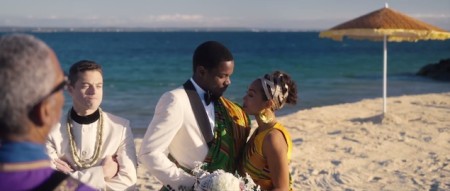
Still from Da Sweet Blood of Jesus (2014)

WHY IT WON’T MAKE THE LIST: The movie’s vampire-origin premise is an uncommon one, but the movie is weighed down by a cold—bordering on somnolent—lead performance, a scattershot tone, and the fact that the most compelling scenes are largely uninvolved with the main action.

COMMENTS: The opening credits of Spike Lee’s latest movie are fully alive. Across the acting and production shout-outs, Lee shows off a very skilled street dancer (Charles “Lil Buck” Riley) performing a number of smooth, impressive moves in various Brooklyn street spots. The momentum continues with the opening scene proper, a lively gospel shout ceremony at “Lil’ Piece of Heaven” church. During the full-blooded, upbeat sermonizing, we see Dr. Hess Green (Stephen Williams) sitting alone in the back, noticeably separate from the rapt congregants. After this introduction, however, it seems that all the blood drains from the movie.

What follows is a sometimes dreamy, sometimes intellectual, and consistently tedious affair involving the realities of a modern, bookish vampire. Dr. Greene hosts big parties for intelligentsia at his large estate in Martha’s Vineyard (with grounds spanning 40 acres, no less). He chats amiably, but briefly, with the various educated bourgeoisie, before having to hightail it to his basement for some blood packs from the refrigerator. He emerges with a wine glass of blood; when an insistent guest tries it and spits it out, he glibly explains, “It’s organic.” And so comes and goes one of the few breaks from the largely unremitting monotony of the film.

Between his unfortunate conversion to vampirism and a personal spiritual revelation, he murders and drinks blood of various poor women of color. His traces of hyper-shy charm are smudged over by his callous and guileless manner. For reasons not entirely clear, he immediately falls in love with Ganja Hightower (Zaraah Abrahams), who was once married to his erstwhile assistant. She seems to hate everything and everyone, and has adopted the unfortunate habit of being 100% honest 100% of the time. She has a backstory to explain her current hostility to the world, but I found myself utterly incapable of seeing how that justifies her sheer unpleasantness. Throughout the movie, Spike Lee (who co-wrote the screenplay) dribbles in bits and pieces of mumblecore exchanges; where he should have focused on creating an atmosphere of angst and ambiguity, instead he makes each character no more than a projection of a type. Even the hammy characters from Blacula have more nuance and relatability.

There are some scenes of vitality and beauty. Whenever the action shuffles over to the church (all too infrequently), the movie  immediately gets a shot in the arm. And while I am not one to generally marvel at the visual splendor of a scene, the marriage on the private beach that takes place in the second half was a sheer joy just to look at. Unfortunately, I can only come to the conclusion that while the movie toyed with greatness, it came short in a number of ways. It may have been a worthy recommendation if it had been: more atmospheric, more puzzling, livelier, wittier, and so on. Had it thoroughly pursued any one of those directions, it may have been on to something. Instead, Spike Lee seems to want it all, and it ends up falling flat.

WHAT THE CRITICS SAY:

“…with no one breathing down [Lee’s] neck, it’s free to zoom all over the place — from seriousness to high comedy to weird comedy to quietly anxious set pieces…  For better and sometimes worse, ‘Jesus’ is undiluted Lee — a half-committed attempt at a twisted genre film that freely gets lost down unexplored alleyways.”–Matt Prigge, Metro (contemporaneous)