Category Archives: List Candidates

APOCRYPHA CANDIDATE: BERLIN ALEXANDERPLATZ (1980)

DIRECTED BY:

FEATURING: Günter Lamprecht, , ,

PLOT: After four years in prison, wife-murderer Franz Bieberkopf is released into Weimar Germany; he tries to go straight, but with no means of employment, he soon returns to the criminal underworld, with tragic results.
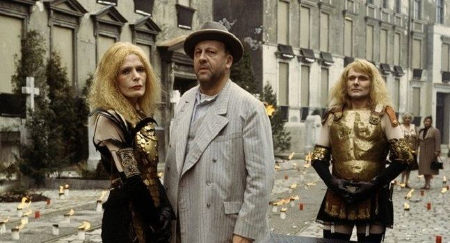
Still from Berlin Alexanderplatz (epilogue) (1980)

WHY IT MIGHT MAKE THE LIST: We’ve toyed with the idea of considering self-contained TV miniseries as “movies” for classification purposes before; Berlin Alexanderplatz, a celebrated masterpiece of world cinema from an auteur with eccentric tendencies but nothing on the List, makes perhaps the best case for loosening our criteria—especially since the result would be classified as “apocrypha” rather than canon. A miniseries adapting Alfred Döblin’s modernist novel, first broadcast on German television, Alexanderplatz is a fifteen hour dive into an enigmatic character told through a fluid mix of straight drama, melodrama, poetic monologue, and surrealism. The two-hour capstone installment, a frenzied passage dubbed “My Dream of the Dream of Franz Biberkopf by Alfred Döblin, An Epilogue,” could well stand alone as a weird movie classic—but it can’t be appreciated without first seeing the thirteen hours that came before.

COMMENTS: Oddly, it was the second episode that sold me on Berlin Alexanderplatz. The first introduced our protagonist, Franz, newly released from prison after a four year stay, briefly suffering from disabling agoraphobia until a friendly Jew tells him an obscure parable, visiting—and raping—an old acquaintance, and finally swearing an oath to go strait. It was strange stuff, setting up intriguing possibilities, but I was not all-in just yet.

That second episode was, in a way, comparatively ordinary. Desperate for a job, with legitimate employment in 1920s Berlin rare in even for non-felons, Franz agrees to put on a swastika armband—reluctantly—and sell newspapers for the newly-formed Nazi party. This decision causes him trouble when a fellow vendor, who happens to be Jewish, confronts him, followed by an old friend who’s now a dedicated Marxist. Franz, who is proud to be German but has nothing against the Jews (or anyone), eventually quits the job, but not before the gang of Communists accost him in a bar. He almost smooth talks his way out of the confrontation, but can’t resist responding to their taunts by singing a Nationalist song as a response to their chorus of the “Internationale.” Angered, they back him into a corner. In a frightened fury, one man against a gang, he is forced to raise a chair to defend himself.

It was at this point that I realized that I’d gone from simply following Franz’s story to rooting for the poor reprobate. Fassbinder brought me, slowly, to sympathize with a killer, a rapist, a pimp, and a Nazi Continue reading APOCRYPHA CANDIDATE: BERLIN ALEXANDERPLATZ (1980) →

APOCRYPHA CANDIDATE: 9 LIVES OF A WET PUSSY (1976)

Nothing Sacred

DIRECTED BY: Abel Ferrara (as “Jimmy Boy L”)

FEATURING: Dominique Santos, Pauline LaMonde, Joy Silver,  Abel Ferrara (as Jimmy Laine)

PLOT: Gypsy reminisces about her relationship with Pauline while working out how to keep her wild lover faithful to her alone.

WHY IT SHOULD MAKE THE LIST: 9 Lives is a porno, but Abel Ferrara’s artistic direction coupled with the epistolary and dreamy nature of the narrative make this an odd porno.

COMMENTS: A piece of trivia: the review for Blue Movie has gotten about fifteen hits a day since it was first posted. That’s not because it’s particularly insightful,[efn_note]Although I say so myself.[/efn_note] but because 366 gets a bit of overseas traffic for “blue movies“—and few I’ve seen come “bluer” than Abel Ferrara’s 9 Lives of a Wet Pussy. Any systematic discussion of movies (weird or otherwise) would be remiss not to include cinema’s less respected peer, pornography. Since mankind could sculpt, then paint, then photograph, there has been a healthy inclusion of carnality in art. Film is no exception, and so it was without trepidation that I dove headfirst into 9 Lives.

The tone is set immediately, with the opening credits intercut with a graphic scene that flirts with abstraction via novel camera focus and expressionistic lighting. The story proper begins with a narration playing over a steamy encounter with “the French stable boy”, which we quickly learn is being read from a letter to Gypsy (Dominique Santos) from her on-again, off-again lover, Pauline (Pauline LaMonde, Ferrara’s girlfriend at the time). Through Gypsy’s emotional lens, we witness Pauline’s insatiable sexual appetite, her transcendent approach to pleasure, and her unbridled freedom. Various segments illustrate Pauline’s character: an encounter with a gas station attendant while her husband waits in the car; her upbringing—and its Lot-ian results—under a strict, Catholic father; and a long-term affair with her Nigerian lover, Nacala (Joy Silver). All the while, we return to Gypsy talking directly to us as she maneuvers to retrieve Pauline and keep her to herself.

What could have been a mindless framework for an anthology of loosely related set-pieces becomes something considerably more under Abel Ferrara’s oversight. Gypsy’s mysticism appears throughout; her name indicates her archetype. Ferrara himself plays another archetype—the religious, domineering father—in one of the episodes, breaking the incest taboo in his very first film. 9 Lives‘ rape scene, however, suggests Ferrara’s future. Ms. 45, Bad Lieutenant, and even New Rose Hotel all explore sexual violence and guilt. We expect that from gritty dramas; much less-so from dirty movies. The movie climaxes with a nebulous scene that underlines the film’s contrast between dreaminess and physicality while mirroring the opening: Pauline with Nacala, together, intercut with shots of Gypsy wandering with aimless purpose through a forest.

It works well enough as a story (I was interested in the development of Gypsy’s and Pauline’s relationship), and Abel Ferrara gets the job done, as it were, as a straight-up pornographer. However, I highly recommend watching the Vinegar Syndrome Blu-ray with Samm Deighan’s commentary. She provides the film’s context and a thorough sketch of the director as a young man (he was 25 at the time). Beginning as he did in hardcore film, I’m not surprised that Ferrara remained on cinema’s fringes throughout his career; the passion that robbed him of mainstream success, however, is the key to his oeuvre’s staying power.

WHAT THE CRITICS SAY:

“…an opium-stoned hostess introduces several sexual vignettes, and though slightly classier than the usual cum pageants, it’s impossible to achieve a Lady Chatterley-like decadence when you’re saddled with an Al Adamson-like cast… a must-see embarrassment!” –Steven Puchalski, Shock Cinema

APOCRYPHA CANDIDATE: SON OF THE WHITE MARE (1981)

Fehérlófia

366 Weird Movies may earn commissions from purchases made through product links.

Son of the White Mare has been officially added to the Apocryphally Weird list. Please visit the official entry.

DIRECTED BY: Marcell Jankovics

FEATURING: Voices of György Cserhalmi, Vera Pap, Gyula Szabó, Ferenc Szalma, Mari Szemes, Szabolcs Tóth

PLOT: A divine white mare gives birth to a son, the Tree-Shaker, who is destined to destroy three dragons in the Underworld who are holding captive three mythical princesses.

WHY IT SHOULD MAKE THE LIST: Marcell Jankovics puts the limitless possibilities of animation on display for this mythic tale. Abstraction and form combine to move the story along in a way that would be stylistically impossible with any other medium, all infused with the most vibrant palette I’ve ever seen in a movie. Son of the White Mare‘s epic nature and ancient roots are perfectly represented by the timeless feel of the nonstop delights to the eyes.

COMMENTS: This movie, I’ve been told, has been hovering around the site’s periphery for quite a while now, with us forebearing discussion until we could watch a high-quality, non-YouTube posting of Jankovics’ iconic masterpiece. With the 4K, re-mastered version from Arbelos Film which screened at the tail-end of this year’s Fantasia Festival, that time has come. Some quick research suggests that a disc release has not yet been determined, but considering the three years of work put into the project by a dedicated multi-national team (under the guidance of Marcell Jankovics himself), it’s bound to made available. Some day soon. Like in early 2020. Hopefully.

In the meantime, let me try to regale you with my poor words what Jankovics and his crew put together almost forty years ago. The film begins with a flash, as a pregnant white horse flees across the screen from a horde of nasty, jagged pursuers. Finding protection in the Earth Tree, she bears a human son, an eager boy who grows to become known as “Tree-Shaker.” He is told the story of his father’s downfall and, after finding his brothers (“Stone-Crumbler” and “Iron Temperer”), he looks for the entrance to the Underworld after outsmarting the Seven Colored Gnome by stealing his beard. With his brothers’ help he forges the beard into a mighty weapon that aids him as he seeks to free the kingdom’s princesses trapped in castles, guarded jealously by twisted versions of their former beaus.

It would be next to impossible to describe how magnificent the animation is. Much of its motion defies Euclidean geometry. To get the vibe, I recommend an image search. But even beyond its presentation, its narrative is well worth a mention. The time-tested methods of storytelling—tasks and goals in groups of three; heroes of impossible skill and origins; ultimate good fighting ultimate evil—are all present. This is not surprising; what took me aback (in a good way) was the fusion of this ancient technique with the interwoven warnings against modernity. Of the three multi-headed dragons fought by Tree-Shaker, two are manifestations of modern man: a seven-headed, dozen-gunned tank beast and a truly menacing, twelve-headed, ever-shifting skyscraper monster. Obviously there is a message here, one that slipped passed the well-practiced Communist censors of the day.

If you’ve patiently waited to watch this movie, please continue to do so. The impending release will be of a print that doesn’t look like it has aged at all. I know that I can get very excited about movies that others find ho-hum (or worse); but, for those of you who’ve seen some version of Son of the White Mare, and to those many others who have doubtless heard its praises sung on high, it lives up to whatever expectations of wonderment you could possibly harbor. Whoever gets the task of certifying this gem, I hope they’re up to it.

WHAT THE CRITICS SAY:

“The art style is incredible: pastel and clashing colours are everywhere and are used to paint very trippy and beautiful art. The animation is fluid, with shapes morphing into others and back seamlessly – a road becomes a snake, the gap between two faces changes into a goblet – but these must be seen to grant them their full justice.”–Simon Brand, PopOptiq

APOCRYPHA CANDIDATE: WHY DON’T YOU JUST DIE! (2018)

Papa, Sdokhni

Recommended

DIRECTED BY: Kirill Sokolov

FEATURING: Aleksandr Kuznetsov, Vitaliy Khaev, Evgeniya Kregzhde, Michael Gor, Elena Shevchenko

PLOT: Matvey intends on doing in Olya’s father with a hammer, but complications—and Matvey’s uncanny indisposition to dying from his wounds—derail his straightforward plan.

WHY IT SHOULD MAKE THE LIST: At a certain point I figured this was merely an extreme case of Guy Ritchie violence and mayhem. By the third act, though, I discovered that the movie still had a bloody mile to go.

COMMENTS: To paraphrase one of my peers who attended the screening, this movie has “Chekhov’s shotgun, Chekhov’s hammer, Chekhov’s power drill, Chekhov’s handgun…” I managed to slip in, “also Chekhov’s ceiling light.” Considering the crowd, I’m not sure if you’d not be surprised to hear it also had the most consistent laughs of any Fantasia “comedy” so far. Perhaps all of us are just terrible people, but I lay the blame squarely on directing neophyte Kirill Sokolov (who also wrote the film) for creating such a side-splitting violence chamber play.

During his brief introduction, Matvey (Aleksandr Kuznetsov) seems like a regular fellow, albeit a regular fellow furtively hiding a hammer behind his back as he rings an apartment doorbell. He intones “One, two, three, evil can’t touch me” as he buzzes and is greeted by Andrey (Vitaliy Khaev), an intimidating, hefty man in his fifties, who reluctantly invites him in. Andrey’s wife Tasha (Elena Shevchenko) offers the boy something to drink. When Matvey and Andrey sit down, so begins a very awkward conversation after Matvey’s hammer slips out of his pants and clammers to the ground. “Is that your hammer?” “Yes. A friend wanted to borrow it.” And soon a room-busting melee between the father and Matvey ensues.

This battle of violence and wills continues throughout the run-time of the movie, interrupted on only three occasions by vignettes that explain the pertinent back stories. All very “Guy Ritchie,” as I mention above, but much like Come To Daddy, there is a point at which the whole affair careens over an edge and becomes ludicrous. No more hemming-and-hawing in the theater seat for me, but a quick flash of realization that this movie had just entered the world of crazy-go-nuts. Within its tiny setting (I’d say over 80% of the action takes place in a three room apartment), nearly everything becomes saturated with someone’s blood as TVs bludgeon, shotguns blast, drill bits spin, and kitchen knives cleave.

Near the end, when all the facts are on display and poor Matvey is sitting in a sorry state on the tattered couch (middle finger still flipped up in defiance), Andrey muses aloud to his daughter, “How is this guy still alive?” What, indeed, is this bloodshed for? Part of me suspects it’s allegorical: Matvey, the Russian everyman, enduring and outlasting every abuse from a government system that’s against him. A slightly larger part of me suspects that that would be thinking too much. This red-spewing fountain of black comedy needn’t be approached with any lens, political or otherwise. Just make sure you can stomach ninety straight minutes of top gore .

WHAT THE CRITICS ARE SAYING:

“Building a crazed Looney Tunes mood with cartoon-bright colors, kinetic camera moves and zippy fast cuts, Sokolov keeps ramping up the savagery to absurdly excessive levels, his protagonists somehow struggling on despite skull-cracking, stomach-bursting injuries. Gore levels are high, but the overall effect is more sicko comedy than torture porn.”–Stephen Dalton, Hollywood Reporter (festival screening)

APOCRYPHA CANDIDATE: LAKE MICHIGAN MONSTER (2019)

Recommended

DIRECTED BY:

FEATURING: Ryland Brickson Cole Tews, Beulah Peters, Erick West, Daniel Long

PLOT: Having lost his father to the claws of the terrible “Lake Michigan Monster,” Captain Seafield assembles a crew of specialists to exact his revenge.

WHY IT SHOULD MAKE THE LIST: This movie is very dumb, in a good way, and very derivative, in a good way. Tews creates a scratchy, black and white world à la Guy Maddin in a clever, mindless romp where every rule of narrative is bent as the story crescendos to a dizzying municipal-political climax.

COMMENTS: In the spirit of the movie, this is a DIY review. Feel free to cut and paste the sections below however suits your mood.

Disclaimer: In no way have I been remunerated for the views expressed herein. Fact is, they’d have to more than double the film’s budget to buy my good graces.

Good: There is a jokesy doppelgänger of Guy Maddin at work in Lake Michigan Monster. Ryland Tews captures the Canadian auteur’s aesthetic—grainy black and white, mythic proportions, and the idolization of a city (though not Winnipeg for this go-around)—and puts it to work for an episodic comedy that would seem ramshackle if it weren’t so charming and also somehow pinned to what just about passes as a story arc for the good Captain Seafielding.

Plot: Assembling a mercenary crew comprising a weapons expert, a N.A.V.Y. drop-out, and a “sonar individual”, Captain Seafielding (Ryland Tews) hopes to hunt and destroy the titular monster that he blames for the murder of his father. With half-baked schemes (à la “Nauty Lady” and other pun-driven titles), he fails again and again until he is abandoned by his hirelings and is forced to summon a ghost army (found, incidentally, in an Episcopal cathedral). After losing all his henchman, worldly and otherwise, he must complete his quest mano-a-beasto.

Weird: Lake Michigan Monster is merely 78 minutes long, but a whole world and mythology is haphazardly crammed into each and every nook. Seafielding begins each outing with a magical, animated map of the action, on which designations for each crew member zip around according to his mad whim. The fourth wall is battered to dust as Seafielding, in character, begins to dismantle the narrative shell that keeps the audience separate from his machinations; we become very much the accomplice in his silly work as the movie goes on. To boot, there are the kind of quips and asides that we’d expect more from popular television.

Opening or Closing: So what is it like to watch this movie? Unless you have some very creative film buddies, it’d be hard to get closer to the core of the crafting experience. Mind you, this isn’t just some dumb evolution of a movie into a movie about movies. This is just some dumb s̶e̶a̶ lake-faring yarn that feels like it’s being told to you live over a glass of bourbon, or whatever that type of whiskey it is you find in Scotland. But there is a gloriousness to its apparent idiocy. No real actors, no fabricated sets, but one heckuva a closing sea shanty await you in this wild and whimsical outing.

You can also listen to our interview with some of the gang responsible for Lake Michigan Monster.

WHAT THE CRITICS SAY:

“Tews and company have crafted something unique here, an absurdist fever-dream that looks (and sounds) like little else.” -Matt Wild, Milwaukee Record (contemporaneous)