
Novelist Ransom Riggs and Tim Burton should have been an ideal match, but Miss Peregrine’s Home For Peculiar Children (2016) is yet another verification that this director is at the end of his tether.
Burton can’t take the sole blame. He shares that honor with screenwriter Jane Goldman, who previously scripted two of the better X-Men sagas. This is part of the problem: they treat the material as if it’s the initial entry in a new and potentially profitable X-Men-styled franchise. For a director who has long made claims to specializing in films for the peculiar, Burton shows no genuine enthusiasm for his newest project and, with Goldman, sucks all the peculiarity out of its source material. This has been Tim Burton’s modus operandi for a long time, apparent to almost everyone (the director’s zealous, in-denial cult excepted). Burton likewise neutered all the surrealism of Lewis Carroll’s Alice and Disneyfied Barnabas Collins, Sweeney Todd, and Willy Wonka. Even Disney itself, teamed with Bing Crosby, was more adept at interpreting Washington Irvin’s Ichabod Crane. There’s a problem when two paragons of artistic conservatism have a better feel for the kooky-souled than a self-proclaimed specialist.
Burton came closest to a return to form with The Corpse Bride (2005), which he co-directed with Mike Johnson, along with Big Eyes (2014), the story of Margaret Keane. Despite being a personal project, the latter film eventually faltered in focusing on a kitsch suburban artist who simply wasn’t as interesting as the working relationship between the world’s worst director and one the worst ham actors of all time in Ed Wood. Still, this is the director who took a pre-existing pulp character (Batman) and managed to produce two comic book-inspired masterpieces stamped with highly personalized weirdness (especially Batman Returns, which really should be one for the List). He probably would have done the same for Superman, or at least that appears to be the case from the fascinating documentary Death of Superman Lives: What Happened? (2015).
With his latest misfire, however, Burton is yet again crippled by his own brand crutch, producing a caricature of himself that imitates imitator’s imitations of Tim Burton, with Riggs’s narrative ending up a casualty. In addition to borrowing from his own past “hits,” Burton throws in a sink-full of other sources, including Groundhog Day, Back to the Future, X-Men, and Harry Potter, but this Burton is not the Burton of the Eighties and Nineties, nor is he a Robert Zemeckis, Harold Ramis, Bryan Singer, or even journeyman David Yates. By now, Burton heading a project is an almost as guaranteed a recipe for disaster as is hiring Zack Snyder.
There are a few plusses, including a campy Eva Green in the title role. As the shape shifting matriarch of her orphanage for misfits, adorned in Coleen Atwood’s goth costuming, Green demands our attention (and gets it). Samuel L. Jackson also has fun hamming it up as the antagonist Barron. However, despite some good moments amidst impressive set pieces, Jackson’s Barron is a vague character. Supporting actors Chris O’ Dowd, Judi Dench, Rupert Everett, and Allison Janney are virtually wasted. Asa Butterfly, as Jake, turns in an off-colored and ultimately two-dimensional performance, which can be blamed on Burton, since the actor has done good work for others (i.e. Boy in the Striped Pajamas, Hugo). Best is Ella Purnell as Emma, who embodies an atmospheric sense of nostalgia in a star-making performance.
 As expected, there is CGI aplenty (including a floating ghost ship, an ode to Ray Harryhausen’s stop-motion work, and post-production botox for actor Terence Stamp, something like to a roughly sketched version of Big Fish‘s Ed Bloom). Additionally, the physical space is well-utilized, even more so than in his previous few films. Even at his most fatigued, Burton still manages to produce a pretty package.
Unfortunately, the package is an empty box. Over-written, Miss Peregrine’s Home For Peculiar Children is woefully complicated, cram-packed, emotionally bankrupt, poorly-paced, and far too narcissistic in its mythology-building and exposition, feeling at times like lost footage from alternative production of David Lynch‘s Dune. Perhaps he and Goldman should have watched Rankin and Bass to learn how to convey a world of misfits more simply, or rewatch his own Batman (1989), which was comparatively underwritten (and it didn’t matter one damn bit). With Riggs’s array of misfits, one can easily imagine the appeal, but Burton’s (undeniable) strengths are slurped up by executive production demands as wholly as the Barron devours his eyeballs, which can be summed in a finale that has to be his most painfully obvious and dumbest since Burton’s 2001 Planet of the Apes.
 ,” featured two additional “lost” episodes. “The Veil” has also been referred to as a precursor to “Thriller,” although it’s not quite as good and the flavor is different. Hopefully, we’ll get around to reviewing the earlier series by next Halloween.
 As we watch, Karloff informs us that this a tale of watching and being watched, assuring that a shattering effect lies within the “Twisted Image.” Nielsen, as Patterson, a married, successful business man, is watched by four psychotic eyes belonging to Lily (Trundy) and Merle (George Gizzard). Lily lusts after him and, at least on the surface, Merle is insanely jealous. Although director Hiller denied it, as it was written (by James P. Cavanagh adapting William O’ Farrell’s novel) and played by Grizzard, there is sexual longing in Merle’s voyeurism as well. Still, we’re not entirely convinced he deserves all the attention, as the very young Nielsen has none of his later charisma. Grizzard walks away with the episode playing a scheming, destructive looney tune coworker. Competent, but unimaginative with no surprises, this debut waddles its way to a lackluster finale.
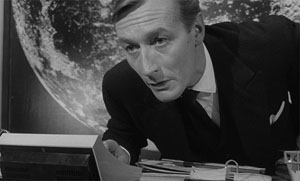 Shortly after the mysterious murder of fellow researcher Dr. Munro (Warren Mitchell), Davidson and Professor Lancaster (Phillip Stone) resume work on their government funded project, one which enables people to telepathically travel to other planets and potentially contact alien life. In addition to investigating Munro’s death, project supervisor Major Clark (Patrick Newell) has taken an abnormal interest in Davidson’s new Swiss wife, Julie (Gabriella Licudi). Lancaster, a close friend of Davidson’s, is also curious and surprised that he has not been introduced to the new bride.
 Although Mondo Cane has been accused of having a xenophobic perspective, its hard to make that point when the filmmakers (Paolo Cavara,