All posts by Gregory J. Smalley (366weirdmovies)

Gregory J. Smalley founded 366 Weird Movies in 2008 and has served as editor-in-chief since that time. He is a member of the Online Film Critics Society, and his film writing has appeared online in Pop Matters and The Spool.

CAPSULE: THE COW WHO SANG A SONG INTO THE FUTURE (2022)

La vaca que cantó una canción hacia el futuro

366 Weird Movies may earn commissions from purchases made through product links.

DIRECTED BY: Francisca Alegria

FEATURING: Leonor Varela, Mía Maestro, , Enzo Ferrada

PLOT: When her father is hospitalized from shock after her long-dead mother appears to him, Cecilia returns to her family’s dairy farm to care for him.

Still from The Cow Who Sang a Song into the Future (2022)

COMMENTS: Fans of cows singing songs will surely be satisfied with The Cow Who Sang a Song Into the Future; the bovines croon quite well, although it is up for debate just how far into the future their tunes echo. The rest of us will at least be willing to hear the movie out: it contains much intriguing strangeness, while also held back a bit by a tangled thicket of themes and the sometimes underwhelming familial drama.

The film begins with a shot of a mouse corpse that leads to a long pan over a forest floor to a riverbank where a carpet of beached fishes sing a song about death. This is followed by the appearance of Magdalena, who arises from the water wearing a motorcycle helmet and walks silently into town. We then turn our attention to Cecilia, a single mom doctor raising two children. We meet the elder, Tomás, trying on women’s clothes and discussing a vintage newspaper article about a woman who committed suicide by riding her motorcycle into the river. Cecilia rushes to her father’s side after he collapses from shock after catching a glimpse of what he believes to be his long-dead wife, looking just as she did the day she died. Cecilia and her children settle in at the family’s dairy farm, where her brother Bernardo attempts to revive the herd’s failing fortunes while the patriarch complains about his effort. Also on site is superstitious stepmom Felicia, the first to directly interact with silent revenant Magdalena, who gradually reveals herself to the others. Meanwhile, the cows get loose at night, while back in town people stage protests, blaming a local pulp plant’s pollution for the plague of dead fish.

I’ve tagged this movie as magical realism—it’s a rule that we must do so for any moderately strange movie hailing from south of the U.S. border—but at times, Cow feints towards actual surrealism. If Magdalena’s strange and unexplained return from the dead was the only thing going on here, Cow probably could be confined to the realm of magical realism; but the magic here extends beyond the realistic. There are, of course, the choirs of singing fish and cattle. There is Magdalena’s strange relationship with technology: she’s obsessed with cellphones and her mere presence turns on microwaves. A mysterious wound appears on Cecilia’s head, quickly healed and never explained. The zombie mom briefly takes up with a lesbian motorcycle gang. So, despite a primary focus on drama, things do get weird.

But The Cow Who Sang a Song Into the Future arguably attempts to deal with too many themes at once. The family dynamics are the primary focus, with the mystery of Magdalena’s death and return illuminating and catalyzing the interplay between the others. Ecological collapse forms the background: the deaths of fish, the disappearance of bee colonies, a sickness affecting the cattle herd.  There’s a nod to issues of how conservative Latino societies deal with LGBTQ members, and even a critique of industrial dairy farming practices. But, although everything connects, to a large extent, spreading all of these concerns over the course of a 90 minute movie means that each one gets short shrift: we never uncover the source of the river’s pollution, Tomás’ transgenderism subplot feels imported from a different movie, etc. Furthermore, the big family secret is not weighty or surprising enough to justify its delayed reveal; it’s delivered in a single sentence. Still, Cow works out well in the end, generating an optimistic feeling of rejuvenation and resurrection. The postmortem resolution of Cecila and Magdalena’s relationship loosely parallels the notion that there is still time for us to atone for our sins against the environment.

WHAT THE CRITICS SAY:
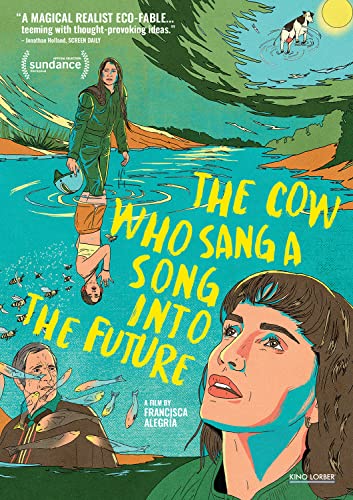
“Rife with evocative symbolism, Chilean director Francisca Alegria’s feature debut is an audacious, surrealistic expression of acute ecological distress and various ideas pertaining to contemporary agita.”–Kat Sachs, Chicago Reader (contemporaneous)

The Cow Who Sang a Song Into the Future [DVD]
  • Family drama meets magic realism in this compelling environmental fable about family, nature, renewal, and resurrection

POD 366: REFLECTIONS OF DAMON PACKARD

366 Weird Movies may earn commissions from purchases made through product links.

Audio only link (Soundcloud download)

Quick links/Discussed in this episode:

Angel’s Egg New York City screening: Discussion begins. Read Simon Hyslop’s review of Angel’s Egg. ‘s surreal, almost wordless anime fantasia gets a rare screening on September 10, with two sessions, lead artist Yoshitaka Amano in attendance (as part of a Amano retrospective) at both.  Normally, we would speculate that a rare revival like this might herald an upcoming re-release of this fondly-remembered OVA, but the Japan Society also screened this in 2022, and there is no mention of a new remastered source or anything of the kind to suggest a new edition upcoming. At least they are keeping the legend alive, which may suggest to someone somewhere that the demand is there. Unfortunately, these two screenings will be sold out by the time you read this, but chances are you’re not reading this from New York City anyway. Angel’s Egg at Japan Society, Sep. 10.

Hello Dankness (2022): Discussion begins. The first film from the Tik Tok generation? Hello Dankness re-imagines America’s 2016 presidential election with a collection of re-edited (and unauthorized) pop culture clips. Writing for “The Beast,” Nick Schager called it “as bizarre as it is brilliant” (point of reference: he thought it was brilliant.) Hello Dankness official site.

Reflections of Evil screening: Damon Packard interview begins. Read the Canonically Weird entry! A rare screening of ‘s underground classic in Los Angeles Saturday evening, September 16. Reflections of Evil screening at Los Feliz Theater (Los Angeles).

Damon Packard YouTube

Reflections of Evil on Tubi

WHAT’S IN THE PIPELINE:

No guest scheduled for Pod 366 next week—we’ll just chat about new releases. In written reviews, Giles Edwards and Shane Wilson investigate Cosmic Disco Detective Rene (2023) and Little Murders (1971), respectively, while Gregory J. Smalley listens to The Cow Who Sang a Song into the Future (2022). Onward and weirdward!

CAPSULE: WILL-O’-THE-WISP (2022)

366 Weird Movies may earn commissions from purchases made through product links.

DIRECTED BY:

FEATURING: Mauro da Costa, André Cabral

PLOT: Concerned about the environment, the prince of Portugal chooses to become a volunteer fireman and falls in love with a co-worker.

Still from Will-o'-the-wisp (2022)

COMMENTS: There was a 1974 softcore sex spoof called 2069: A Sex Odyssey. Pretty hilarious title, huh? Will-o’-the-Wisp opens on almost the same joke, conspicuously setting its flash-forward prologue in 2069. This is not a promising opening for a supposedly serious art film.

A lot of the insubstantial Will-o’-the-Wisp comes off exactly as on-the-nose as that opening joke. Among the film’s incompatible parts is a general dedication to environmentalism (which motivates its protagonist to semi-abdicate his royal commission to volunteer as a firefighter). We know of Alfredo’s convictions because he interrupts family dinner to read Greta Thunberg’s 2019 U.N. speech off his phone, speaking directly to the camera. So when it comes time for a sex scene, it shouldn’t be too much of a surprise that it goes unambiguously explicit. The film contains a lot of hoses, and some actual hosing, but almost no firefighting—although Rodrigues shows, in a CPR-training scene, that he is perfectly capable of conveying eroticism indirectly. The finale features a singer substituting the word “falo” (phallus) for “fado” (folk song) in her dirge. Subtlety isn’t always a virtue, but with a project as wispy as this—even at 67 minutes, its plot feels stretched-out—a little could have gone a long way.

Will-o’-the-Wisp flits as lightly over its surrealism as it does every other element (with the exception of male full-frontal nudity, which, honestly, is the film’s major theme and raison d’être). Muscly, nude firemen re-enact various classical paintings (humorously), and the final funeral scene is suitably strange, with a pair of female mourners played by gossipy, ambiguously-gendered ladies. Perhaps most notably, the film is proffered as a “musical fantasia,” with pauses in the action for song-and-dances. The slim runtime only accomodates three numbers, however: an a capella ode to trees sung by schoolchildren, the closing funeral fado, and the centerpiece, an athletically choreographed fireman’s techno-ballet where the protagonist gets spun around like one of those twirling signs by his future lover.

The musical element makes Will-o’-the-Wisp resemble the queer absurdity of Rodrigues’ To Die Like a Man (2009) more than the ambitious surrealism of his Ornithologist. Wisp lacks the emotional heft of that 2009 effort, however, because it doesn’t spend enough time developing Alfredo and Alfonso’s characters into much more than romantic pawns playing their assigned roles. This phantasm of a film feels dashed-off, an under-budgeted pandemic-era project made to keep busy while waiting for something bigger to come down the pike. That said, other critics were more forgiving: 97% positive on Rotten Tomatoes at the time of publication, in fact. One would presume Wisp would also play well with a niche gay art-house audience, while lacking crossover potential. (I will point out that gay-friendly art-house patrons are the only ones likely to pick it for a screening, however; and, returning to the Tomatoes numbers, the paltry 32% audience score suggests that even they weren’t impressed. I suppose this is more of a critics’ movie: other critics, that is.)

WHAT THE CRITICS SAY:

“…hilarious and yet still heartfelt, extremely weird but wonderful…”–Lee Jutton, Film Inquiry (festival screening)