Tag Archives: Recommended

APOCRYPHA CANDIDATE: MEMORIA (2021)

366 Weird Movies may earn commissions from purchases made through product links.

Recommended

DIRECTED BY:

FEATURING:

PLOT: A Scottish woman traveling in Colombia thinks she’s losing her mind when she intermittently hears a mysterious thumping sound.

Still from Memoria (2021)

WHY IT MIGHT JOIN THE APOCRYPHA: Memoria is a deliberately-paced accumulation of subtly odd incidents, with one big weird reveal.

COMMENTS: Memoria has a lot on its mind, but Weerasethakul’s philosophy, if not his film’s purpose, is summed up in a discussion in a doctor’s office (a conversation that Pfizer might not appreciate). Jessica has come to see a physician in a small Amazonian town seeking relief from her increasing auditory hallucinations and concomitant insomnia. She hints about pills. Tranquilizers, the non-prescribing physician advises, “will make you lose empathy. You will no longer be moved by the beauty of this world. Or the sadness of this world. Do you know Salvador Dalí? Salvador Dalí understood the beauty of this world.”

With all of the potential themes weaving their way through this movie, and through all of Weerasethakul’s oeuvre, the simple directive of not overlooking the beauty of this world is a constant. As with other minimalist filmmakers, Weerasethakul pauses on scenes like a shot of a woman silhouetted in the silvery night, or an quietly teeming Amazonian jungle seen from a balcony, long enough so that you can absorb all the detail, all the beauty. Though she seeks a brief relief from the pressures of her world with Xanax, Jessica is not alien to this insight: on an errand at a music studio, she stops in a doorway to listen to a spirited jam session from a jazz quartet. Not many movies take time out in the middle of the story for a brief and totally superfluous recital—but for Weerasethakul, beauty pops up unexpectedly, and we must take time to savor it when it arrives.

It should be noted that much of the beauty he arranges for us is strange beauty, the beauty of the inexplicable and the supernatural. The movie’s second scene is a symphony arranged for car alarms, whose various honks and sirens, set off by some poltergeist, perform an aleatory rhythmic concert. Another early scene involves Jessica talking to sound engineer Hernán, who takes time out of his schedule to help her recreate the sound she’s hearing in her head in the studio, working from a library of movie effects, sculpting waveforms to create a “more earthy,” “rounder” sound at Jessica’s direction. This is an unusual scenario, to say the least. From this meeting Hernán takes a strong and peculiar interest in the older woman—that is, until he suddenly disappears from the story. Then, oddly enough, in a remote village Jessica meets a fish-scaler and mystic who just happens to also be named Hernán. This second Hernán understands the language of howler monkeys, does not dream, and holds the answer to the source of the thumping sound Jessica has been hearing… a rather astounding answer, it turns out.

Swinton is reserved here. She is quietly lost in the world, never raising her voice, reacting with widening eyes and tightening lips to the alarming noises echoing in her head. She is the perfect  Weerasethakul heroine, reacting just enough to these beautiful mysteries to guide us towards absorbing and savoring them. Memoria is a wispy piece of poetry that rewards concentration, but doesn’t demand it. If your mind drifts, you won’t miss anything. You see what is there to be seen, and hear what is there to be heard.

The screener copy I received on DVD was preceded by an short apologia from Weerasethakul and Swinton reminding us to “respect that this film was intended for a very, very much larger screen than the one you’re probably viewing it on now, and to keep that sacrosanct.” I didn’t get it at the time–I thought it was an unnecessary plea to not pirate the film, or simply to take into account that this was a sub-optimal presentation. But it turns out that these critics’ screener copies are reluctantly granted exceptions to the film’s rule: Weerasethakul intends for the movie to be shown only in theaters, with no home video or streaming release. (I imagine they will relent on that restriction after a few years pass, but then again, never has.) In the U.S., it begins its release on December 26, traveling from town to town, one engagement at a time. We’ll post a schedule when we can. If you want to see Memoria, you’ll have to make a point to seek it out; it won’t come to you.

WHAT THE CRITICS SAY:

“…watching Memoria is like sleepwalking through an unfamiliar territory. It’s like a lucid dream; you are not quite sure if you are awake or dreaming… Memoria, with languid long takes and tranquil setting, is a deeply contemplative film that offers you to experience a dreamscape in a place strange yet familiar, where you can embrace the mysteries of life.”–Dustin Chang, Screen Anarchy (festival screening)

APOCRYPHA CANDIDATE: I MARRIED A STRANGE PERSON! (1997)

366 Weird Movies may earn commissions from purchases made through product links.

Recommended

DIRECTED BY:

FEATURING: Voices of Tom Larson, Charis Michelsen, Richard Spore

PLOT: Mid-orgasm, two birds crash into Grant’s satellite receiver, whose redirected beam gives him super powers.

WHY IT MIGHT MAKE THE APOCRYPHA: When the line, “Have you ever tried to tell a 50-ton tank to stop having sex?” makes perfect sense in context, it stands to reason the surrounding film is peculiar. Plympton’s surrealist animated comedy is fit to burst with caterpillar daydreams, organ juggling, and boobs big enough to fill the house.

COMMENTS: The word “strange” is right in the title, along with an appropriate exclamation mark. The film opens with a bit of duck sex, replete with tongue-chomping, teeth-shattering lust (literally, figuratively speaking). And as a flight-of-fantasy indictment of network television’s pervasive malignancy, it’s somewhat ironic that the hero—Grant, the “strange person” of the title—received his phenomenal powers from that very danger. But perhaps it’s not ironic so much as appropriate. If this movie is at all suggestive of Bill Plympton’s views, he finds the human mind far more nonsensical than any invention yet made manifest.

On the topic of manifesting, that is just the power our hero develops. After the amorous anatidaean opener, we meet Grant, an accountant (or something) with the squarest jaw and doublest chin this side of Hollywood’s heroic age. With a pulsating boil on the back of his neck, his day-dreamy outlook changes his reality: the insects his mother-in-law fears appear from her clothes and swarm into her mouth; his chirpy, lawn-mowing neighbor ends up pursued by a giant, psychotic blade of grass with a vendetta; and mid-coitus his wife’s boobs grow to ginormous size, crashing through rooms and smashing through windows. All this does not go unnoticed, neither by the witnesses of his visions-made-real, nor by SmileCorp studio’s Machiavellian overlord, Larson P. Giles.

But back to the sex. It is with a modicum of surprise that I found this film to be R-rated. Granted, it’s animation: a medium in which one can get away with a lot more than any live action equivalent. Bodily explosions, a man hog-tied with another’s intestines, and so on: these are kinds of things that could not get a live action theatrical release, R-rated or otherwise. And there are plenty of “these kinds of things” in Strange Person. In one long-form example, Grant’s friend Solly, a comedian on the cusp of failure, saves his act through sheer force of showmanship by self-dismantling in front of a live studio audience.

But back to the sex. I have seen few non-pornographic films with more sex than I found in I Married a Strange Person! That is not to say any of it was erotic. Plympton’s style doesn’t bend that way; instead, it bends as far away as possible from mundane concerns—like sex. It’s there, but presented on the very edges of acceptable taste (much less “good taste”, a concept decried in an opening quotation from Picasso), smashing like a pastel hammer into the viewer’s consciousness. What truly tips the scale, with weirdo-violent aplomb, is the film’s sweetness. The musical interludes (“Would You Love Me If…?” and “How’d You Get So Cute?” among them) and the overarching theme of love and forgiveness add a saccharine spike of whimsy to the absurd and violent reverie. Rest assured, I Married a Strange Person! ends on a happy note… of sex.

WHAT THE CRITICS SAY:

“[Plympton] is head and shoulders above Spumco, Spike and Mike, and yes, even hometown boy Mike Judge when it comes to creating the weirdest, wildest, most sublimely outré cartoons in the world… Absurdist comedy of this sort is rarely seen these days…”–Marc Savlov, The Austin Chronicle (contemporaneous)

I Married A Strange Person! [Blu-ray]
  • Legendary animator Bill Plympton's delirious, demented feature with a nonstop stream of surreal nonsequiturs and visual puns about a pair of newlyweds

APOCRYPHA CANDIDATE: THE SHOW (2020)

366 Weird Movies may earn commissions from purchases made through product links.

Recommended

DIRECTED BY: Mitch Jenkins

FEATURING: Tom Burke, , Ellie Bamber, Christopher Fairbank, Alan Moore

PLOT: Fletcher Dennis is a hitman an “exit technician” posing as a private detective posing as an antiques dealer in search of a stolen Rosicrucian necklace.

WHY IT MIGHT MAKE THE APOCRYPHA LIST: Sometimes “weird” leaves you overthinking; in this case, I suffered the reverse. While watching The Show, it occurred to me that perhaps it wasn’t weird, because it’s exactly the kind of movie Alan Moore would make. Having pondered a few minutes following the spectacle’s completion, it became apparent that this was indeed something weird. Jenkins’ and Moore’s movie blends reality and dreams, and life and death, in a manner that would make 366’s poster-boy Dave Lynch smirk in satisfaction.

COMMENTS: Please forgive this reviewer’s gushing, but in the hopes of getting it out of my system let me begin with, “This… this is the Alan Moore film I’ve been waiting for!” Mr. Moore, as some of you may know, has had a long history of disappointment with studio executives when it comes to his innumerable works and their adaptations. Some of this is warranted (League of Extraordinary Gentlemen), some of it not (Watchmen). Regardless, The Show pulls off a very-Moore experience—more so than any other adaptation of his oeuvre.

Because it immediately pulls the viewer into a cryptic facsimile of Northampton UK, it’s helpful that the film pulls its protagonists from the “straight man” bucket. Steven Lipman (later, and earlier, Fletcher Dennis, ever-clad in black and red striped shirt, presumably with sling-shot) has been hired by Patsy Bleaker to retrieve a family heirloom that went missing after his daughter (not quite) was murdered (definitely). Faith Harrington, a briefly comatose journalist, arrives at the local hospital the same night the murderer is carted in following a tragic accident involving a pineapple and a nightclub stairwell. Faith begins suffering from carnivalesque nightmares featuring Matchbright & Metterton, a comedy duo who perished in a 1970s fire. While the plot thickens reality-side (Bleaker’s daughter was not his daughter), it positively coagulates in the subconscious world, as both Dennis and Harrington confront an agenda hatched within dreams and beyond the grave.

Those familiar with Alan Moore’s world(s) know that no detail is to be ignored, whether from the perspective of plot or to appreciate an erudite slight-of-hand. When subcontracting his search to the “Michelson & Morley Detective Agency”, Dennis finds himself in front of a backyard clubhouse whose entrance opens up into an improbably large office, where he converses with two Tims around the age of ten. (“We don’t handle messy divorces, and we have to be in bed at 9:30.”) They speak in a ’40s film noir narration style, and take payment in either cash or energy drinks.

The paragraphs I could burn with such regalement could take up an entire movie, surprise surprise, so consider that just a taste of the fun-time genre stroking herein. Stylistically, it is apparent that The Show was created by a comics man. Every shot and sequence will be familiar to readers of that medium, and it stands as a stark reminder that for whatever reason, virtually no filmmaker seems to fully embrace the aesthetic: an aesthetic you’d think would make the cinematographer’s job that much simpler. Just. Follow. The. Storyboards.

But I’m in fan-boy mode again; I didn’t think I’d be able to shake it. This acts as a companion piece to Under the Silver Lake, another film that got me gushing. Alan Moore’s hometown of Northampton is deeply unreal and fully realized; his characters are unreasonably eccentric individuals who interlock seamlessly with their peers and milieu; and his film has enough smoke and mirrors for a late night cocaine and dance party at the Black Lodge.

WHAT THE CRITICS SAY:

“Jenkins’ surreal city symphony transforms Little England into an overlooked site of invention, resistance and revenge, while the erudite poetic wit of Moore’s script is a dizzying blend of high and low, the profane and the occult, funny-haha and funny-weird.”–Anton Bitel, VODzilla (VOD)

CAPSULE: HUMAN NATURE (2001)

366 Weird Movies may earn commissions from purchases made through product links.

Recommended

DIRECTED BY:

FEATURING: , , , Miranda Otto

PLOT: A scientist and a woman cursed with hirsuitism discover a feral man living in the woods and train him to live in civilized society.

Still from Human Nature (2001)

COMMENTS: Human Nature feels a bit like—and was certainly interpreted by contemporaneous critics as—an unpublished script that was dusted off and polished up to capitalize on the unexpected success of Being John Malkovich (1999). In fact, the script had originally been optioned way back in 1996, when it was circulating together with Malkovich, although it’s not clear which screenplay Kaufman completed first. After his 1999 hit, passed on directing Human Nature; he served as a producer instead, and recommended the already-established music video/commercial director Michel Gondry for the job.

That partnership was also destined to bear fruit in the future, but the team did not immediately meet with success. Human Nature didn’t live up to its immediate predecessor in either the originality of its premise or in its bizarre humor; critics who loved the first movie were generally disappointed, while those who never bought in to Kaufman in the first place relished the opportunity to proclaim that the newly crowned Emperor had scanty clothing. Twenty years later, seen outside of Malkovich‘s immediate shadow, Human Nature looks much better: smart, easy to watch, and wispily Freudian in its depiction of sexual conflict between the superego and id.

Human Nature begins by divulging its three main characters’ eventual fates: Lila is imprisoned, Puff is testifying before a Congressional subcommittee, and Nathan has a conspicuous hole in his head. Flashbacks explain how we got here: Lila, cursed with simian body hair, becomes a famous nature writer but decides she needs a man and so undergoes extensive electrolysis before being introduced to Nathan, an inhibited prude of a psychologist who’s work involves using electrical shocks to train lab rats to use the correct salad fork. They form a desperate, co-dependent relationship until discovering a feral man (later dubbed “Puff”) in the woods, whom Nathan decides would make an even better test subject for his behavioral modification studies than the mice—unlike rodents, he can train the ape man to read “Moby Dick” and discuss Wittgenstein, and to refrain from humping every woman he comes across. Predictably, things go awry, with everything further confused when various competing romantic axes and rivalries start to develop between this threesome and Nathan’s assistant, Gabrielle.

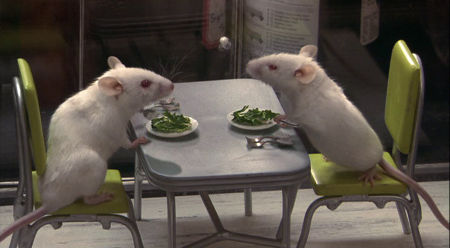
Quirky highlights include an incongruous, Disneyesque strolling-through-nature song where Lila embraces her hairiness (“my new friends, these split-ends…”); early whimsical “Gondryeqsque” sequences of white mice seated at a dinner table (done with a combination of puppetry, stop-motion, and trained animals); and Gabrielle’s contextually inexplicable accent. These bits combine with the oddness of the comic scenario and the movie’s arch approach to sexual repression to create an intelligent and off-key chamber piece effectively poking fun at our civilized foibles (“apes don’t assassinate their Presidents, gentlemen!”), while falling well short of the existential weirdness of Kaufman’s debut. By conventional Hollywood standards, Human Nature is fairly odd; by Gondry/Kaufman standards, it’s an attempt at a completely mainstream movie.

WHAT THE CRITICS SAY:

“Written by Charlie Kaufman (BEING JOHN MALKOVICH), this superficially surreal film is in fact a surprisingly straightforward fable… overall the film feels forced and awkward, as though it’s trying too hard to be weird, culty and profound..”–Maitland McDonagh, TV Guide

(This movie was nominated for review by Nick Gatsby, who said it was “perfect for this list. I’m deathly surprised it’s not on here already.” Suggest a weird movie of your own here.)

CAPSULE: THE NOWHERE INN (2021)

366 Weird Movies may earn commissions from purchases made through product links.

Recommended

DIRECTED BY: Bill Benz

FEATURING: Annie Clark (St. Vincent), Carrie Brownstein

PLOT: Annie Clark (who performs as “St. Vincent”) commissions her friend Carrie Brownstein to make a documentary about her; but when Annie’s real personality proves too boring for film, she spices things up acting more like her alter-ego, losing sight of reality in the process.

Syill from The Nowhere Inn (2021)

COMMENTS: About midway through The Nowhere Inn, it occurred to me that I hadn’t really learned anything about Annie Clark that I didn’t know before I hit “play.” Looking up her bio in Wikipedia after watching this fictionalized documentary, I found the following quote from : “Despite having toured with her for almost a year, I don’t think I know her much better, at least not on a personal level.”

This made me feel better. Clark uses this faux-confesisonal mockumentary to hide in plain sight. Her alter-ego, St. Vincent, is brash, aggressive, and sexy onstage, shredding her guitar in a skintight red vinyl minidress while an image of her vomiting turquoise paint streams on a giant video board above her. Backstage, though, her friend Brownstein (the real-life riot grrl musician turned “Portlandia” comedienne) finds it hard to assemble meaningful footage for her behind-the-scenes documentary, since all the musician wants to do in her downtime is play Scrabble or video games or sample the local radishes. Even her bandmates and roadies can’t find anything interesting to say about Clark. So, abandoning her original plan capture the artist just being herself, Brownstein prods her subject to project her personality and start acting more like St. Vincent—a challenge the singer-songwriter meets too fervently, turning herself into an insufferable cliche of an image-obsessed rock diva. The pendulum having swung too far, Brownstein falls into an artistic crisis as Clark disappears into her new persona. The movie’s last act takes a hard turn into psychological thriller territory.

So what begins as a sort-of avant garde variation on This Is Spinal Tap segues into a sort-of riff on Mulholland Drive by way of Pink Floyd: the Wall, with hints of 8 1/2 sort-of lingering around the edges.  Please observe the deliberate “sort-of”s in that formulation; I don’t mean to oversell The Nowhere Inn. The movie is far more modest and humble than those big comparisons would suggest, and even when it gets existential and meta it always remains grounded in a friendly, pleasant, and lightly satirical comedy. From Clark’s initial encounter with a limo driver who doesn’t recognize her, to a bass player who decides he’ll be Australian on camera, to a hilarious bit part by Dakota Johnson as the tabloid-friendly love interest, The Nowhere Inn undercuts charges of pretentiousness by putting funny first. Even when it’s trending towards its darkest and most unhinged moments, the movie breaks the tension with its most elaborate comic set-piece, a very obviously staged trip to meet Annie’s family in Texas. Brownstein actually carries the film with a sunny confidence that yields to awkwardness, uncertainty, and embarrassment as she realizes that the insightful documentary she has planned is not salvageable. Clark is also very good in her feature debut, essentially playing two characters, neither of whom, we suspect, is all that close to her real personality (whatever that might be). The movie’s themes of artistic integrity and the duality of performers’ public and private personae are not exactly groundbreaking, but they’re handled cleverly and with enough unpredictability and humor to keep even non-fans watching to the end. Presuming, that is, that you have a taste for unconventional presentations. As Clark tells her limo driver, “I’m not for everyone.”

Director Bill Benz is mostly known for his work on “Portlandia” and other TV comedies, which explains why, although it frequently slips into psychedelic music video mode—especially, but not exclusively, during the rock concert numbers—the movie maintains its consistent comic tone.

WHAT THE CRITICS SAY:

“Early on, the self-deprecating stuff takes on a studied air, and in the final stretch, the filmmakers seem to think they can shock-cut and rug-pull their way into something resembling psychological horror. The weirdness isn’t really weird enough to pull this off; it’s all the self-indulgence without much oddball pleasure.”–Jesse Hassenger, Paste (contemporaneous)