Tag Archives: Meta-narrative

225. ADAPTATION. (2002)

CHARLIE KAUFMAN: I’ve written myself into my screenplay.

DONALD KAUFMAN: That’s kind of weird, huh?

Adaptation.

Must See

DIRECTED BY:

FEATURING: , , Chris Cooper, Brian Cox

PLOT: Screenwriter , fresh off the hit Being John Malkovich, is contractually and mentally trapped as he is forced to plow his way through an impossible project: “writing a movie about flowers.” Things go from bleak to bizarre as he finds himself competing with his endearingly oblivious twin brother, Donald, who also aspires to be a screenwriter. Charlie slips further and further past the deadline, until things come to a head in the film’s swampy denouement where he comes face-to-face with both the writer of and titular character from “The Orchid Thief,” the book he is adapting for the screen.

Still from Adaptation. (2002)

BACKGROUND:

  • The screenplay for Adaptation. was on Charlie Kaufman’s to-do list since the late ’90s. Tasked with adapting Susan Orlean’s novel-length essay “The Orchid Thief” and suffering the same problems as his doppelganger, he kept his progress secret from everyone other than Spike Jonze until 2000, when the movie was green-lit for production.
  • Screenwriting guru Robert McKee and his seminars are real. He personally suggested Brian Cox play him in the movie.
  • Adaptation. handily recouped the producers’ investment, with a return of $32.8 million worldwide on a $19 million outlay.
  • Nominated for four Oscars: best actor for Cage, supporting actor for Cooper, supporting actress for Streep, and adapted screenplay for Charlie and Donald Kaufman. Cooper was the only winner.
  • Though “Donald” Kaufman’s serial killer script The 3 was never shot, the idea may have inspired two subsequent movies, 2003’s Identity and 2006’s Thr3e.

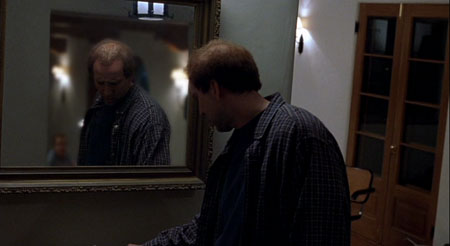
INDELIBLE IMAGE: Returning from a misfired date, Charlie finds his twin brother already back home from a writer’s seminar, brimming over with newly adopted wisdom. As Charlie stands in front of his hallway mirror, Donald’s face is captured in the reflection as he expounds upon his own screenplay’s “image system” involving broken mirrors. Charlie’s expression goes from dour to disbelieving at this inanity, and the viewer sees the movie mock both itself and screenplay tricks. A further twist is added by the fact that the blurry reflection in the mirror is the face of the actual Charlie Kaufman talking to Nicolas Cage.

THREE WEIRD THINGS: Film-within-a-film-within-a-screenplay-within-a-screenplay ; Ouroboros; orchid-snorting

WHAT MAKES IT WEIRD: For all its unconventionality, Adaptation is amazingly self-deprecating. Spoilers unravel in opening scenes and are tossed aside, coastal city elites are presented as real people with the petty little problems real people have, and Nicolas Cage gains a bit of weight and loses a bit of hair to provide the compelling double performance as the Kaufman brothers. Events seem scattershot, only to have their purposes later clarified as the tightly structured flow keeps the viewer jumping from moment to moment, always questioning which parts of this convoluted tale are actually true.

COMMENTS: Between its thorough description of the protagonist Continue reading 225. ADAPTATION. (2002)

LIST CANDIDATE: R100 (2013)

DIRECTED BY:

FEATURING: , Lindsay Hayward

PLOT: A Japanese furniture salesman pays a secret bondage society so that dominatrixes will attack him at random times in public, but things go too far when they start showing up at his work and home.

Still from R100 (2013)
WHY IT MIGHT MAKE THE LIST: By the end, after a relatively conventional beginning, R100 has gone from a one-joke lashing to full-fledged absurdist pummeling. This black sex comedy is demented enough to make the List, but we do wonder whether one of Matsumoto’s other movies might better represent his weird movie legacy.

COMMENTS:The first half of R100 is rather ordinary. Relatively so: most people would consider a movie where a man’s date kicks him in the face at dinner, and where a dominatrix stands beside him and smashes each course of sushi the mortified chef places before him, very strange indeed. R100 begins its life almost as a drama, doling out hints of backstory about our masochistic salaryman, who struggles as a single parent of a young boy with a wife in a coma. The movie eschews the chance to explore his psychology, however; we never gain any insight as to how ritualized pain and humiliation helps him deal with his problems. Instead, R100 spirals off into crazier and crazier directions, as the dominatrix attacks he’s contracted for intensify, start to interrupt his normal life, and threaten the one thing he loves more than a good beating from a merciless leather-clad mistress: his child.

The public attacks on our hero get repetitive, as if R100 doesn’t know how it wants to develop its premise. Then, in the middle of the film, Matsumoto springs a number of oddities and radical tone shifts. There are metamovie interludes which explain the movie’s title: we are watching the work of a 100-year-old director who considers this material inappropriate for anyone younger than himself (thus R100—restricted to those over 100 years of age). The main narrative takes a turn into B-movie territory when our hero is forced to turn against the bondage club after an botched session with the “Queen of Saliva.” You know the movie is completely off the rails by the time the ridiculous “Queen of Gobbling” shows up (and when the film’s producers debate cutting her out of the movie). The climax, which features our formerly meek hero lobbing grenades at an army of dominatrices commanded by a foul-mouthed blond Amazon stuffed into a tight rubber teddy, seems like it could have been choreographed by a team consisting of , and Mel Brooks. And the coda takes the weirdness to the next generation.

The way R100 starts out off-kilter and slides into greater and greater absurdity will thrill many who view the film as a simple comedy. It’s enjoyable enough on that level, but there were hints of depth in the character and themes that were never explored, and this is something of a missed opportunity. Masochism is easily stated as a philosophy—from pain comes pleasure—but it’s nearly impossible for an outsider to comprehend this most counterintuitive of fetishes. Maybe that’s why Matsumoto depicts it as an incomprehensible enigma. Or maybe you just have to reach the century mark to get it.

WHAT THE CRITICS SAY:

“…connoisseurs of weird, twisted sex comedy will revel in its transgressive, audacious mischief.“–Colin Covert, Minneapolis Star-Tribune (contemporaneous)

(This movie was nominated for review by purplefig, who said it was “weird in that wonderfully insightful weird way only japanese cinema can deliver..” Suggest a weird movie of your own here.)

CAPSULE: JAKE SQUARED (2013)

DIRECTED BY: Howard Goldberg

FEATURING: , Mike Vogel, Kevin Railsback, , , Jane Seymour

PLOT: A director makes a self-indulgent autobiographical movie about his failed love life, and, “Twilight Zone”-style, versions of himself in his teens, thirties and forties show up in unwanted cameos.

Still from Jake Squared (2013)
WHY IT WON’T MAKE THE LIST: Jake Squared is like 8 1/2 done as a romantic comedy by a Hollywood phony. It’s a little weird, sure, but mostly you just feel embarrassed for the screenwriter.

COMMENTS: 50-year old, semi-successful indie film director Jake Klein is a helpless romantic, as he himself announces to the viewer minutes before kicking out his lead actor so he can perform the hot tub scene with the three bikini-clad bimbos himself. Later, he bemoans the fact that “some people want to deny the poorest children health care and nutrition so the richest people won’t have to pay a few thousand in extra taxes” while doing his morning breaststroke in his backyard pool. It hardly seems possible, for a movie that boasts about its self-awareness and meta-conceits, but Jake Squared doesn’t really seem conscious of these ironies. It expects us to honestly sympathize with the internal struggle of its wealthy, balding, chick-magnet protagonist, this achingly wounded Lothario, while reserving its scorn for humbler targets, like the airheaded aspiring starlet who wants to convert to Judaism to further her show business career.

Jake admits his autobiographical film project is self-indulgent, expecting us to forgive him his self-indulgence because he’s up front about it. But it doesn’t work that way. When is self-indulgent we forgive him not because he’s candid about it, but because the self he is indulging is so fascinating. Jake, on the other hand, is more like a second generation, not-as-funny cross between and Larry David (boasting the same incomprehensible sex appeal with which these writers endow their surrogates). Elias Koteas does a reasonable job as most of the Jakes (unless we were supposed to like the character, in which case even his workmanlike job can’t overcome the script). The acting in general is a high point; landing the trio of Jason Leigh, Madsen and Seymour as potential paramours was a coup, though again, why these women would be fascinated rather than fed-up with Jake’s agonized narcissism is unclear.

Weirdness is not an issue. The opening introduces us to the primary Jake, the dashing twenty-something actor he’s hired to play Jake, and several of his earlier selves wandering around a party, and then switches to new scenes from Jake’s life (being acted by the hunky stand-in) which he views on his cell phone. For further confusion’s sake, the young actor in the cellphone scenes can also see himself in the party scenes. It gets so convoluted that fifteen minutes in, a new character comes in and explains the premise directly to the camera. The problem is that this is a romantic comedy with an unlikable protagonist, no clear love interest (besides himself), and almost no laughs. It was 45 minutes in before I registered my first chuckle, and that was at a visible boom mic (to be fair, it was visible on purpose). Jake Klein isn’t a terrible person, but we should be paid the same rate as a therapist would to listen to him go on and on about his struggles with commitment; we shouldn’t have to pay for the privilege. Given Jake’s lack of notability, raising him to an exponential power was probably not a good idea.

WHAT THE CRITICS SAY:

“If only Federico Fellini had lived long enough to direct Hot Tub Time Machine, he might have made something like this self-indulgent but agreeably ambitious anti-romcom.”–Stephen Dalton, The Hollywood Reporter (festival screening)

LIST CANDIDATE: WHY DON’T YOU PLAY IN HELL? (2013)

Why Don’t You Play in Hell? has been promoted to the List of the Weirdest Movies Ever Made. Please read the official Certified Weird entry.

Jigoku de naze warui

DIRECTOR

FEATURING: Jun Kunimura, , , Hiroki Hasegawa, ,

PLOT:  A renegade amateur filmmaking crew encounters Yakuza mayhem and exploits it for cinematic value.

Stil from Why Don't You Play in Hell? (2013)
WHY IT SHOULD MAKE THE LIST:  There’s some veritable, unambiguous oddness here—a buffet of sorts. The absurdity, of the cartoonish, chaotic variety, comes in the form of sweeping gesticulations of jokey but sumptuous violence and sardonic romanticism.

COMMENTS:  Singing kids on television ads give us a chuckle, but maybe there are some creative minds in the world, busy talking about movies, possibly having a laugh from time to time. Introducing: “the Fuck Bombers,” a Cecil B. Demented-type of film crew hell bent on the art form as its own explicit end. They value DIY ethics, dedication, and sacrifice for the greater artistic good.  Just keep going and you will be cool, lead director Hirata (Hiroki Hasegawa) implies while shooting lifelong stunt actor and Bruce Lee aficionado Sasaki (Tak Sakaguchi) during an opening street fight sequence. Hirata says he’ll die for movies, but what if he was faced with that ultimate sacrifice in real life, cameras rolling?  Enter roller-skating Miki, king of dolly shots, and his partner in crime Tanigawa, a handheld camera expect, to accomplish Hirata’s filmic needs. After a prayer to the movie gods, it’s time for action.

Now there’s that asininely charming ad for teeth-brushing that keeps coming up; gnashing, gnarling, smiles wide. Everyone knows the song because it’s sung by little Mitsuko Muto, whose dad (Boss Muto) is now in a feud with Ikegami’s Yakuza over an attempted bloodletting, ending with a surprise retaliation from Muto’s crazed wife Shizue. Blood squirts in gallons onto the faces of onlookers.  Hirata looks through the camera:  “It’s just like a movie. Really? Is it cool?” Ikegami sees Mistuko in a living room full of blood, let by Shizue’s hand, and he asks for her autograph while wounded on the ground, but she has no sympathy. Meanwhile, Shizue yells at the presiding officer now holding her in custody over her murderous rampage, infuriated over the possibility that her daughter’s acting future might be halted.

Boss Muto’s plan for his wife’s release involves making the “greatest movie of all time,” starring his daughter Mistuko. It’s kimonos for all once Ikegami (Shin’ichi Tsutsumi) snaps to it and readies for the final blows coming from his nemesis Boss Muto. Meanwhile, the Bombers release “The Blood of the Wolves,” an amateur samurai movie, and are inspired by an aging 35mm projectionist. Muto, the pin-striped, gold chained Yakuza boss, is now at war with Ikegami, whose obsession with Mitsuko has now taken odd ends, as she’s on the run with naïve Koji as he pretends to be her boyfriend for the day. More strife with the Bombers comes when action stars clash with visionary directors, but Sasaki in his yellow jump suit finds redemption in his ultimate performance, a bloody Yakuza battle filmed by Hirata and Koji. The latter humorously projectile vomits (with excessive force, mind you). A script sent by the movie gods saves him from yakuza henchmen and their intensive beatings. “Make it 4 HMI screens,” says Koji to his new film crew, ordered by Muto himself to commemorate his history as a yakuza. The action is the real life battle between gangs, choreographed by Hirata, starring Mitsuko, Sasaki, and others.  “Life’s more fun on the shady side,” says Hirata.

There’s a bounty of violence and gore . Hirata insists to an excited Muto that, to honor Japanese culture, only swords should be used during fight scenes.  “Only swords?  How can I say no?” responds an eager Muto. The limitation is called off in the heat of battle when guns blaze– but why the hell not in this suggestively carnal environment? Just do it now, because there’s no time for a script.  And cut, reset, now action! At some point Koji is inebriated, and limbs are flying everywhere. Mitsuko whispers, in another line of what has become an ongoing series of tender moments during chaotic killings, “if I met someone I love, maybe acting wouldn’t be important to me.” The moments of gore-filled hilarity compare to an Evil Dead movie. Is this 13 Assassins with movie gods, yakuza, and meta-fanatical, filmic martyrdom?

The intimacy is broken up by cops, but there are some twists. Hirata ends up on the run, and in one of the most indelible scenes he melts into pure meta-fictional glory. With the eagerness of a young mind picking up a camera for the first time, Sono’s Hell is a fast-paced, bloody, and humorous romp through the deranged world of the filmmaker as an artist. Just pick up the camera and do it, seems to be the message.

CAPSULE: THE FRAME (2014)

DIRECTED BY:

FEATURING: David Carranza, Tiffany Mualem

PLOT: The (literally) separate realities of a thief and a paramedic intersect.

Still from The Frame (2014)
WHY IT WON’T MAKE THE LIST: Try though it might, The Frame can’t entirely escape the sophomore slump. Jamin Winans’ first film, Ink, was a budget original and a Certified Weird success. This followup has interesting ideas that prove Winans’ talent is not a fluke, but it doesn’t capture the imagination the way the debut film did.

COMMENTS: The production team behind The Frame has been stingy in revealing details of the film’s plot, and after watching it I can see why. The movie does benefit from surprising twists (the first of which is revealed fairly early), and although I don’t think the intriguing concept completely pays off at the film’s end, it’s still a good idea not to spoil it. So, this is as much as I’m willing to say about the plot: it involves Alex, an illegal immigrant and reluctant thief working with a crew who boosts cargo from sixteen-wheelers, who’s looking for a way out of his criminal lifestyle. It also involves Sam, a dedicated paramedic with a troubled personal life and a weekly date with a blurry therapist. The two characters live separate lives in realities that exist at right angles to each other—not parallel, since parallel storylines never intersect, and these two lives do connect, in a very strange way.

I can’t say that the two stories resolve themselves in an emotionally satisfying way, but things do get weird by the end, especially when Sam crashes a film production studio and finds herself stuck in a loop with a self-typing typewriter. There’s also a low-tech, but bold, special effect with Alex that looks simultaneously silly and cool; it’s the kind of thing a Hollywood film would never dare try for fear of looking foolish.

The rigorous father-daughter allegory of Ink is here replaced by a free-form rumination about free will, about the (im?)possibility of escaping from your “frame” (whether that’s a self-limiting frame of reference, or a literal frame of celluloid). Whereas Winans’ debut was a dream/puzzle film, here he opts for a Twilight Zone-y scenario set mostly in the “real” world that feels, at times, unfinished. Each story contains a mysterious pseudo-omniscient figure lurking around the film’s edges whose significance is never fully explained; in Sam’s case, it’s her therapist, while Alex sees visions of a steampunk tinker in a raggedy tophat out of the corner of his eye. The latter character was memorable enough to make the DVD jacket, and to make the viewer wish he’d appeared in more scenes. The ultimate resolution, unfortunately, is arbitrary; the script too cleverly writes itself into a corner, and has no way out except deus ex machina.

All in all The Frame is a mixed bag, a film with pretty big ideas, some of which work and some that fall flat. One thing that can definitely be said in its favor is that it’s a professional looking film that belies its budget. Denver, Colorado is not known as a hotbed of movie talent, but the technical aspects of this film—editing, camerawork, lighting, acting—equal indies made in New York or Hollywood. The Frame makes an excellent calling-card for young leads David Carranza and Tiffany Mualem; both prove capable of carrying an indie drama. They’re flatteringly photographed and show emotional intensity (if not a lot of range, given the quiet and downbeat mood of the story).

The career arc of Jamin Winans reminds me of ; ((One difference between the two is that Jamin has a collaborator, producer, publicist and wife Kiowa Winans, who probably deserves more credit for the finished products than she gets)). both are obsessive fantasists who work slowly, meticulously control their films (including writing their own scores), and eschew commercial compromise. The upside to that methodology is independence; the downside is they refuse studio resources that could help them to realize more elaborate visions. As long as these guys keep coming up with creative ways to reveal the fantastic in the everyday, though, no one here will complain.

You can download The Frame directly from the filmmakers.

WHAT THE CRITICS SAY:

“…a metaphysical urban fantasy that fills the heart and mind equally…”–Rob Hunter, Film School Rejects (contemporaneous)

A digital copy of this movie was provided by the distributor for review.