Tag Archives: Horror

CAPSULE: PARENTS (1989)

Recommended

DIRECTED BY: Bob Balaban

FEATURING: , Mary Beth Hurt, Bryan Madorsky

PLOT: Moving to a new town and going to a new school can be tough on a young boy, but Michael’s problems may be even worse—his parents might be cannibals.

Still from Parents (1988)

WHY IT WON’T MAKE THE LIST: Parents is a wonderful little black comedy directed by Bob Balaban, better known for his many appearances in off-beat comedies over the past few decades (including Moonrise Kingdom, Gosford Park, and as a recurring character on “Seinfeld”). With three-million bucks and an eccentric performance from Randy Quaid, Balaban put together a fun little romp of the macabre combining “nifty-’50s” schmaltz with nightmarish overtones. If really pressed, I’d say it could make the “Certified Weird” cut; but frankly, we’re running out of space.

COMMENTS: Some years bring us big movies—-movies a generation remembers as iconic. The year 1988 brought us classics like Die Hard, Coming to America, Rain Man, and Big. It also brought us Parents—a movie that, like “the Little Engine that Could”, eschews fame but provides a solid performance. Tucked away among dozens of big-name pictures that year, Parents succeeds at everything it sets out to: it is dark, it is funny, and it is a helluva sinister showcase for Randy Quaid. It fared poorly in theaters—not surprising considering the genre (horror comedy), competition (already mentioned), and stars (great actors, but not Hollywood gods). But who cares? Though not quite a qualifier for Certified Weird status, Parents is exactly the kind of movie for our readers.

A jaunty mamba plays through the credits: a pleasant montage of 1950’s hyper-Lynchian suburbia: helicopter shots of indentikit houses; a beautiful mint-green Oldsmobile filled with wholesome groceries and a nuclear family; a friendly crossing guard. But alas, young Michael Laemle (Bryan Madorsky) lacks his parents’ enthusiasm about moving from Massachusetts. Michael sullenly mopes about the house in near silence, refusing to eat any of the left-overs brought from their old home. His mother Lily (Mary Beth Hurt) is a chirpy kind of perfect housewife, maintaining a spotless home while cooking elaborate, meaty meals. Michael’s father Nick is enthusiastic about his job (developing aerosol defoliants) and is keen to fit in with the new neighbors. What’s eating at the boy, then?

The greatest charm of Parents is its narrative ambiguity. Balaban crafts a tone that matches its hyper-kitschy nostalgia with equal parts menace. Colors pop off the screen while a lack of immediate context and chilling musical cues do a lot of heavy lifting. Nick Laemle is prone to telling didactic “stories” to his son, typically to a discordant, darkened score. And the big question—are the parents cannibals?—is difficult to answer. Early on we see Michael witness his parents being romantic, with mom’s lipstick smeared on her and her husband. What develops is a conflation of his parents’ physicality with his paranoia about the nightly meat dishes. Since everything is through the eyes of the morosely imaginative Michael, the fiery ending could be construed as tragicomic, or just straight up tragic.

Unexpectedly, Parents excels in its characterization. Lily’s emotional distress about her boy is palpable; Nick’s inability to bond with his son is moving. And, time and again, the big question of the film pops up. Others may disagree, but I’m of the feeling that all the “trouble” in the story is in the mind of young Michael. Though he’s the central observer, scenes exist in the film that he cannot possibly have witnessed. But I digress. At 81 minutes, Parents is commendably brief. Balaban created a masterpiece in miniature in 1988, one that has aged substantially better than many of its more famous contemporaries.

WHAT THE CRITICS SAY:

“…a deeply ambiguous fusion of the family’s reality and Michael’s psychotic fantasy, where cracks in the surface sheen of 1950s home life expose something deeply poisonous and combustible beneath. Initially signalled by their monochrome presentation, soon Michael’s deranged visions start coming in full colour (and daylight), with only the canted angles and deliriously spinning mobility of Ernest Day and Robin Vidgeon’s camerawork – and the odd animated salami – to mark how off-kilter a view of bourgeois Americana this is.”–Anton Bitel, FilmLand Empire


TALES THAT WITNESS MADNESS (1973) & FROM A WHISPER TO A SCREAM (1987)

‘ Tales That Witness Madness, made for World Film Services in 1973, is clearly patterned after the Amicus horror anthologies. Of course, what better way to emulate the competition than to acquire the man who directed nearly half of the Amicus franchise, along with several of that studio’s top draw actors?

The setup is simple and familiar enough: is the resident psychiatrist of an asylum, giving friend Jack Hawkins (in his final film) a tour of the grounds. Along the way, he tells the stories of four inmates.

In “Mr. Tiger,” Russell Lewis’ imaginary feline pet beast takes a sour view of his master’s verbally abusive parents. Just how imaginary the tiger is questioned after some clawing on the door and blood splattering on Oedipal walls.

A time traveling bicycle is at the malevolent heart of “Penny Farthing.” It stars Peter McEnery as an antique shop owner and Suzy Kendall as his wife. Soon, they discover the bike is literally antique and … we’re so sorry, Uncle Albert.

Still from "Mel" from Tales That Witness Madness (1973)“Mel” stretches credibility when Michael Jayston is more interested in an oddly shaped tree than he is in oversexed wife Joan Collins in something pink from Frederick’s of Hollywood. It’s the most remembered segment for a reason—it’s a camp hoot, with Collins channeling her inner jealous diva. The tree tries to upstage the human competition, which is not an easy task against Joan in a flimsy nightie, wielding an axe.
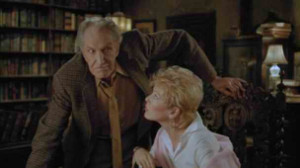
Rita Hayworth was originally cast in the final segment, “Luau,” but bowed out, citing health reasons. replaces her and gives a pallid performance as another jealous diva who happens to be a cannibalistic mother. Although not as well known or as assured as the best Amicus entries,Tales is still an enjoyable example of the genre that confirms Francis as an underrated director.

Most horror anthologies succumb to moralizing. One that avoids that route altogether and revels in its gore and perversity is the underrated From a Whisper to a Scream (1987), Jeff Burr’s first solo feature film. It’s an impressive debut that unfortunately did not lead to bigger and better projects for the director. co-stars with Martine Beswicke, , Rosalind Cash, Terry Kiser, Clu Gulager and the always underrated misfit . Price gives a solid performance in the wraparound as a Tennessee librarian whose knowledge of local history is put to use as he relays four tales to reporter Tyrell, who just came back from the execution of the librarian’s serial killer niece. The cast is uniformly good, especially Gulager who gives a hell of a performance in the first segment as an aging, pathetic grocery clerk whose relationship with his ailing sister (Gulager’s real-life wife Miriam Byrd-Nethery) is clearly incestuous. However, an unrequited love for his boss (Megan McFarland) quickly turns things uncomfortably south, with necrophilia thrown into the sororicidal brew.

White trash thug Terry Kiser is nursed back from the dead by kindly bayou voodoo practitioner Harry Caesar. When Kiser has the chutzpah to bite the hand that feeds him, a horrific fate awaits in this unfathomably grim narrative of dread.

Didi Lanier falls in love with carnival glass eater Ron Brooks, who is trepidatious about running away with her, fearing retaliation from the show’s owner/snakewoman (a delirious Rosalind Cash in her final film appearance). The intestinal finale of imploding razor blades and paper clips is gruesome enough to warrant a shower after. This is also the final film for dwarf Angelo Rossitto, who had most famously starred in Tod Browning’s Freaks (1932).

Cameron Mitchell, once a reliable character actor, emerged from a decade-long slump of in this unsettling Gothic Civil War tale that goes to the “you’re not going there” place. Knowing the war is over, Mitchell and his rogue Union squad take the attitude that it isn’t, but fatefully encounter a band of confederate children. Damien, the Children of the Corn and the killer tykes from that Village of the Damned have nothing on these southern juveniles who reinvent pin-the-tail-on-the donkey and don’t bat an eye at removing one adult limb at a time. Hoping to escape, Mitchell goes pedophile, locking lips with a pubescent and facing a visceral climax.

Still fro,m From a Whisper to a Scream (1987)Reportedly, Price had misgivings about the script and was unhappy with the final edit, feeling it too too extreme and devoid of the sense of nostalgia that drives his screen persona. His is a supporting role, no doubt due in part to his (clearly) failing health. Burr, co-writing with Mike Malone, Darin Scott, and Courtney Joyner, fires on all cylinders, without a weak link, and despite a relatively low budget. Obscure enough to rarely be listed, it’s more refreshingly original than the more familiar fare. Burr considers it as his only authentic film, having since been consigned to commission work.

LIST CANDIDATE: THE LOVE WITCH (2016)

The Love Witch has been promoted onto the List of the 366 Weirdest Movies of All Time. Comments on this post are closed. Please post any comments on the official Certified Weird entry.

Must See

DIRECTED BY: Anna Biller

FEATURING: Samantha Robinson, Gian Keys, Laura Waddel

PLOT: A California witch who casts magic spells to seek out her true love finds that her lovers keep dying.

Still from The Love Witch (2016)

WHY IT MIGHT MAKE THE LIST: The world created in The Love Witch is so obsessively unique—a blend of romance novels, perverse witchcraft fantasies, feminist dialectic, and Technicolor melodramas—that perhaps it can only rightfully described as “weird.”

COMMENTS: One main stylistic feature of The Love Witch is the campy acting—Samantha Robinson’s Elaine speaks as if she’s always lost in an interior world of hearts and unicorns, making her sound insincere even when she’s at her most heartfelt. Other actors take an overly broad, TV-melodrama approach. This technique helps sustain the film’s sense of otherworldliness, but the other, and far more impressive, stylistic feature is the unreal, anachronistic, and impressively detailed mise-en-scene. A girly-girl café where the clientele all dress in pink and white with flowery hats—looking more like bridesmaids than ladies out for a spot of tea—while ethereal blondes play harps and sing medieval love hymns. The local burlesque house, in a lustful red-on-red color scheme, where dancers with feather boas never take it all off but ensorcell the drooling males nonetheless. The Renaissance Faire run by witches, where Elaine and her date “accidentally” end up wed in a mock pagan ceremony. The minutiae of Elaine’s witchcraft rituals, which at one point involves her honoring a corpse with her urine and a used tampon. Clever details and decorative ideas abound in nearly every scene. Reversing the seduction stereotype, Elaine uses a comically oversized brandy snifter to decrease her conquests’ inhibitions. Trish finds Elaine’s witchcraft altar full of bizarre potions and magickal totems, then walks into her adjoining bedroom to discover, oriented in exact mirror image position, a vanity set out with wig, perfume, and makeup.

The smart script is not simplistic in its satire; it prides itself on creating and holding contradictory views. Elaine and her friends toss out ideas about femininity that are sometimes laughably old-fashioned, but are sometimes still with us today, and trusts us to sort out which are which. Witchcraft is shown as harmless New Agey neo-paganism, no more or less ritually ridiculous than Christianity, but it’s also a source of implied abuse and exploitation, and a real threat to the community. And of course, the biggest contradiction of all is Elaine, a mixture of idealism and ruthless cunning, who expresses naïve ideas with a simple conviction that no one can effectively refute, simultaneously a victim and a serial victimizer.

Because the stylistic world Anna Biller creates in The Love Witch is cinematically familiar—with its widescreen compositions, brazen color schemes, cigarette smoking femme fatales and square-jawed cops—many are tempted to go hunting for movie references and homages. Indeed, I was reminded of The Birds (in Elaine’s rear-projection convertible ride up the California coast),  (the nude witchcraft rituals), The Trip (the psychedelic kaleidoscope lens when Elaine seduces the hippie professor) and TV’s “Dragnet” (in the sappy hard-boiled dialogue of the police squad room); others cite , Valley of the Dolls and Beyond the Valley of the Dolls as inspirations. But none of the scenes Biller stages are outright allusions or in-jokes. She absorbs the period style—particularly its vivacious use of the full chromatic scale—-without simply referencing a checklist of favorite films; you’ll search in vain for nods to her specific influences. The Love Witch is a Sixties-era Technicolor B-movie that could have been, but in an alternate universe at a slight tangent to our own. The biggest compliment I can give Biller is to say that she does something for 1960s Technicolor spectacles similar to what did for silents and early talkies: she uses antiquated techniques to create a timeless, abstract setting that reflects her own personality. It’s gratifying to see her receive critical praise for this monumentally inventive and deceptively intelligent feminist statement dressed in Satanic sexploitation robes.

WHAT THE CRITICS SAY:

“The results are wildly over-the-top, in a ‘Beyond the Valley of the Dolls’-meets-‘Dark Shadows’ kind of way, but Biller’s commitment to her vision is weirdly endearing.”–Sean P. Means, The Salt Lake Tribune (contemporaneous)

1972 EXPLOITATION TRIPLE FEATURE: DRACULA A.D. 1972, VAMPIRE CIRCUS, AND THE THING WITH 2 HEADS

1972  is perhaps the most prolific year in the most prolific decade of horror and exploitation films. It’s also the year for what may be the quintessential midnight cult move: ‘ Pink Flamingos, now enshrined as one of the 366 weirdest movies of all time. Blood Freak, which is the first and only “Christian” movie to date about a turkey serial killer, is another Certified Weird 1972 exploitation picture. Competing with Freak fro sheer awfulness was Don Barton’s Zaat (AKA Blood Waters of Dr. Z), which went onto “MST3K” infamy.

In its Blu-ray presentation, ‘s maligned Baron Blood has proven better than its reputation, despite a miscast in the title role. Like most of Bava, it’s stylishly irresistible. The 1972 Amicus omnibuses Asylum and Tales from the Crypt both starred , and were critical and box office successes. Ben, Dr. Phibes Rise Again, and Beware The Blob were all inferior sequels—which is saying a lot in the case of an original monster who was just moving silly putty. tackled the two big undead kahunas (with plenty of added sex) in The Erotic Experiences of Frankenstein and Daughter of Dracula. The Count rose yet again in Count Dracula’s Great Love, starring Paul Naschy. Future King of Cartoons (William Marshall) and director William Crain fused horror with blacksploitation for the first time in Blacula. It was a enough of a box office success to warrant  (superior) sequel in 1973. Unfathomably busy, Cushing and teamed up for ‘ underrated Creeping Flesh, Gene Martin’s cult favorite Horror Express, Peter Sasdy’s misfire Nothing but the Night, and the Hammer opus Dracula AD 1972 (directed by Alan Gibson).

Widely scorned, Dracula A.D. 1972 reunited Cushing’s Van Helsing with Lee’s bloodsucker in a modern setting, even though Dracula himself is confined to a Gothic church. It’s one of ‘s favorite movies. The contemporaneous critical backlash was mostly justified. Lee, probably the best cinematic Count, is reduced to second vampire-in-waiting. But as an artifact of its time, Dracula A.D. 1972 is not entirely without virtue, enough to explain Burton’s affection.

It opens in the previous century with Dracula and Van Helsing locked in mortal combat aboard a stagecoach, which crashes, causing the vampire to be impaled on the spokes of the coach’s wheel. As Dracula attempts to free himself, a battered and bleeding Van Helsing interferes, driving the spokes in deep enough to snuff out the life of his nemesis before dying himself. Witnessing the scene is a Dracula disciple who, of course, leaves with the vampire’s relics (handy for later resurrection). Despite the preposterous   accidental impalement, it’s a red-blooded, Gothic prologue that is followed by 1972’s swinging hippies.

Still from Dracula 1972 ADInitially sounding more like old fuddy-duddy Edward Van Sloan than Peter Cushing, Lorimer Van Helsing, grandson of Abraham, lectures his granddaughter Jessica (Hammer babe Stephanie Beacham) all about the wrong crowd and premarital sex. Pooh-poohing gramps, Jessica heads straight for the wrong crowd, Continue reading 1972 EXPLOITATION TRIPLE FEATURE: DRACULA A.D. 1972, VAMPIRE CIRCUS, AND THE THING WITH 2 HEADS →

CAPSULE: CLOSET MONSTER (2015)

DIRECTED BY:  Stephen Dunn

FEATURING: Connor Jessup, Aaron Abrams, Aliocha Schneider, Isabella Rossellini (voice)

PLOT: A closeted gay teenager who wants to be a horror makeup artist finds himself inhibited from the same-sex experiences he craves due to a traumatic hate crime he witnessed as a child.

Still from Closet Monster (2015)

WHY IT WON’T MAKE THE LIST: If you want a coming out story, and you want it to be slightly weird, this is an option. If you want it really weird, you’d be better off with Der Samurai, however.

COMMENTS: In its short existence, the “coming out” film has already adopted certain clichés: the disapproving macho dad who fears a “wimp” son, the ambiguously homosexual/bisexual love interest, loss of virginity at an ecstasy-fueled rave. Closet Monster doesn’t throw away this boilerplate, but it does cleverly distract our attention from the usual structure with bizarre touches meant to evoke the troubled feeling of growing up different. Monster mixes in tropes from the horror movie (an appropriate import) and, in its most whimsical and salable touch, gives us Isabella Rossellini as the voice of Oscar’s hamster spirit guide (wittily, the pet is ambiguously gendered). A series of hallucinations, mostly stemming from a traumatic homophobic assault Oscar witnesses as a child, round out the weirdness.

Steven Dunn’s direction in his first feature is confident, although when dreamy Wilder enters the picture the will-they-won’t-they second act does drag. The horror angle, which seemed like the film’s  hook, gets pushed aside for the type of dramatic development we’ve seen many times before. But the actors are universally competent, led by conflicted Jessup. Dad Abrams has a nicely complicated character: he is more of an all-around mess—well-meaning but impulse-control challenged—than the simple homophobe he might have been. The horror scenes return at the very end, when Oscar confronts his repressed longings, including hallucinations involving vomiting bolts and a gory impalement with an iron rod. It ends at one of the most marvelously idyllic locations in Newfoundland, a mystical modernist cabin set on a rock outcropping overlooking the sea. Closet Monster is not the whimsically surreal gay horror movie we’ve been waiting for, but it is a decent watch while we wait for someone to perfect the formula.

Closet Monster won the award for Best Canadian Film at the 2015 Toronto Film Festival. At the time of this writing you can catch it streaming on Netflix.

WHAT THE CRITICS SAY:

“Willfully weird tale of a gay youth in a world of confusion. Noisily off-kilter… the determined eccentricity of the entire conceit—liberally laced with moments of hallucinatory surrealism—weighs the movie down, creating an airless ambiance at odds with any youthful verve which might appeal to the viewer.”–David Noh, Film Journal International (contemporaneous)