

DIRECTED BY: William Malone
FEATURING: Dylan Purcell, Cherilyn Wilson, Jeffrey Combs
PLOT: A young woman named Laura suffering from Klein-Levin Syndrome falls prey to the

mental control of a mesmeric killer, Byron Volpe. A young man named Danny happens upon Laura at the hospital and kidnaps her to try and save her from Volpe’s influence.
WHY IT WON’T MAKE THE LIST: Parasomnia isn’t weird. The real life condition certainly is, but the film is messy, disorganized and inconsistent. The parts which are clearly intended to be weird just call up memories of other, better films. It is a bad movie, and there are one or two moments when it almost stumbles upon weirdness thanks to its own sheer clumsiness; but even then it’s not bad enough to make it championship material.
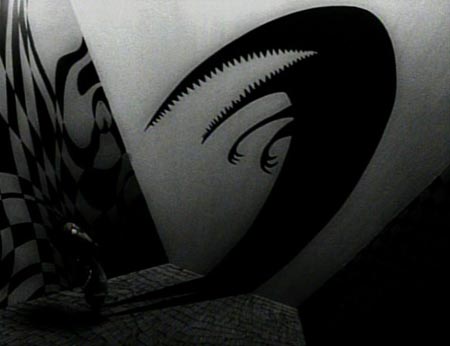
COMMENTS: Sweet Mother of Pearl, this is a bad, bad movie. I went into it full of optimism. The opening scene has Sean Young, looking good, making a very brief cameo as Byron Volpe’s wife; she takes a phone call from her murderous, mesmerist husband and immediately jumps off a balcony. This was a smart move on her part as she then didn’t have to appear in the rest of this interminable travesty. The opening credits are also very stylish. It’s all downhill from then on.
The film is so messy and inept that I assumed it was the director’s first effort. I was surprised to find that, amongst other work, he had directed an episode of the “Masters Of Horror” series and the 1999 version of The House On Haunted Hill. Parasomnia is clearly a low budget work, but that isn’t the problem. Production values are quite high, even though the dream scenes are unimaginative. What lets the film down is the terrible plotting. And it is terrible. There are many examples of the Saturday morning serial, “and with a single bound, he was free”, plot devices. Detectives disappear just when they’re needed, handcuffs suddenly become elastic, professional medical personnel behave like witless fools.
Laura, our “sleeping beauty,” suffers from parasomnia, a sleep disorder that causes her to doze most of her life away. She is also a patient in the worst hospital in the Western world. People are allowed to wander in and out without anyone raising an eyebrow, much less an objection. Danny goes there to visit a friend who is in for “drug rehab.” He’s spending his last days before release polishing the doorknobs that he has taken from all the doors in the hospital. The staff know about this but seem to view it as an amusing eccentricity, rather than a dangerous security risk. On his friend’s recommendation Danny goes down to the “psycho ward” for a gawp at the inmates, including the famous killer Byron Volpe. Volpe is so dangerous that he is kept in Guantanamo Bay style restraints, hanging arms outstretched. His head is hooded because his terrible power is in his gaze. This doesn’t really explain how he convinced his wife to jump off the balcony, over the phone. Nor does it explain how he manages to control Laura when she leaves the hotel. What Volpe is doing in a hospital next door to Laura isn’t explained either; why isn’t he in some maximum-security facility where the nurses won’t run squealing from him at meal times?
Danny is on his way to goggle at Volpe when he spots Laura and wanders into her room to gaze creepily at her. When the doctor arrives you’d be forgiven for expecting him to call security. No, of course not; he proceeds to tell Danny all about Laura even though he’s willingly admitted that he’s just some random guy who’s wandered in off the streets. As if this wasn’t a serious enough breach of privacy, Danny is then allowed to come and visit her whenever he wants. The arrival of some doctors from a sleep institute prompts Danny to kidnap Laura before she can be transferred to their facility.
Once Danny has Laura home, he undresses her and sponge bathes the unconscious young woman. Maybe I’m alone here, but this is not a character I want to identify with. I can’t help but feel that we are meant to see Danny as our romantic hero, rescuing the damsel from the uncaring arms of the medical profession. Step back, though, and he’s a guy who has convinced himself that he has a bond with an unconscious woman with limited experience of the outside world. To further the relationship he kidnaps her; completely unprepared to care for her either emotionally or clinically, he takes her to his apartment, undresses her and fondles her naked body in the name of cleaning her. The next day he shovels cornflakes into Laura’s sleeping mouth, before leaving her sitting up, unrestrained, in a dining chair with the TV on “in case she wakes up”! Then he goes out for the day. What a guy, right? In the evening he even stops off at a bar on the way home, seemingly unconcerned that his charge could be lying in a puddle of urine with a broken neck.
And the film goes on and on like this. To make up for it the weirdness factor would have to be 11, but it’s nowhere near. There are a few dream sequences where Laura finds herself chased by Volpe-inspired creatures through a wasteland of mirrors, but there is nothing original about the scenery or the creatures. The other source of intentional weirdness comes near the end of the film. Volpe has escaped from hospital, thanks to more blithering incompetence on the part of the staff. For some reason best known to himself, he has kidnapped two female musicians, a violinist and a cellist. (I only mention this because one of the weirdest aspects of the film is how these women manage to play full orchestral arrangements on just two string instruments; but I digress). A series of agile leaps of logic and contrived plot devices leads to Danny being handcuffed to a chair, and Laura having a pair of feathered wings crudely grafted to her back. They are imprisoned in the workshop of Danny’s drug-addled friend, who spends his time out of hospital making musical automata. These creations take center stage during the climax of the movie; they are intriguing and stylish, but ultimately just window dressing.
Parasomnia left me with a bad taste, not just because it stole two hours of my life but because there’s a greasy trail of misogyny throughout the whole thing. Danny is not a modern day Prince Charming, he’s a creepy pervert, as bad in his own way as Volpe is in his. The scene which sticks in my mind is Danny taking Laura out for an ice cream, which she has never encountered before. She paddles it around on the café table before rubbing it all over her face and grinning at him childishly. Danny observes that he’s going to have to bathe her again. This would be nasty if Danny was the villain of the piece, but we’re clearly meant to sympathize with him. In case we’re in any doubt as to where our sympathies should lie there’s a little epilogue to reassure us that this relationship was meant to be. It ties in with a rambling early scene in which Danny and a friend discuss music. The friend reappears in the last five minutes with a record that he promised to give to Danny. As Danny and Laura float together in a life support tank, the song blasts out over the closing credits, but it certainly didn’t say “Happily Ever After” to me.
WHAT THE CRITICS SAY:


 ) alongside