Tag Archives: Drama

CAPSULE: MYSTERIOUS SKIN (2004)

Must See

DIRECTED BY:

FEATURING: , Brady Corbet, Michelle Trachtenberg, Jeffrey Licon, Elizabeth Shue, Mary-Lynn Rajskub, Bill Sage, Chase Ellison, George Webster

PLOT: Brian, who is missing memories from part of his childhood, believes that he was abducted by aliens; his investigations lead him to Neal, a street hustler who may have had a similar experience.

Still from Mysterious Skin (2004)
WHY IT WON’T MAKE THE LIST: This searing and graphic drama about two damaged boys and their opposite approaches to dealing with trauma is Gregg Araki’s masterpiece, his best movie by a wide margin. Ironically, however, it’s also his least weird film, with only a few dreamlike moments thrown in to relieve the harsh reality.

COMMENTS: Alternating stories in the lives of two former Little League teammates, one now a teenage hustler and the other a UFO-abduction fanatic, Mysterious Skin plays something like Midnight Cowboy with a touch of “The X-Files.”

The performances of both young leads are astounding, and it’s actually a little unfortunate that Brady Corbet’s turn as nerdy, asexual Brian is overshadowed by Joseph Gordon-Levitt’s sexier performance as a prematurely dissipated teenage prostitute. Gordon-Levitt’s role interacting with the various johns, from lonely middle-aged businessmen to touchingly pathetic AIDS sufferers to the inevitable angry sadist, is simply meatier than Corbet’s, who only spars sexually with a frumpy fellow alien-abduction enthusiast. Gordon-Levitt, in his first major part after concluding his run as an alien inhabiting the body of a precocious kid in the sitcom “Third Rock from the Sun,” announces himself here as one of the great upcoming actors of his generation in his dark performance as a cocky boy-stud who isn’t nearly as in control of his life as he believes himself to be.

Each kid has a very different character arc, but they have more in common than it seems. The story’s big “secret” will probably become obvious very quickly, but the drama doesn’t come in the mystery of the big reveal. This is more of a dual character study depicting opposite but equally dysfunctional strategies for dealing with the unthinkable. It’s difficult to watch at times, but it’s played with exceptional compassion and insight that steers well away from survivor clichés—the hustler’s story, in particular, reveals a disturbing but credibly sick psychology. Scenes with cornfed Kansas grotesques finding mutilated cattle with their genitals removed make the Midwest look a little Lynchian; but, other than a misty shot of a Fruit Loop shower and hallucinatory glimpses of an actual UFO, Akari makes very few departures from raw reality here. The supporting performances are all excellent, as is the unobtrusive shoegaze score. This is filmmaking at its most humanistic.

Araki wrote the Mysterious Skin screenplay from Scott Heim’s novel. According to a Heim interview included on the Blu-Ray edition, the director consulted the original author on the adaptation, although Heim decided to get out of the way and not meddle unless asked after the contract was signed. Heim was then invited to tour with the cast and crew as they took the film on the festival circuit. The dynamic between the original author and the adapter here appears to be a model working relationship.

WHAT THE CRITICS SAY:

“The film has a weird buoyancy…”–Stephanie Zacharek, Salon.com

(This movie was nominated for review by “Tori.” Suggest a weird movie of your own here.)
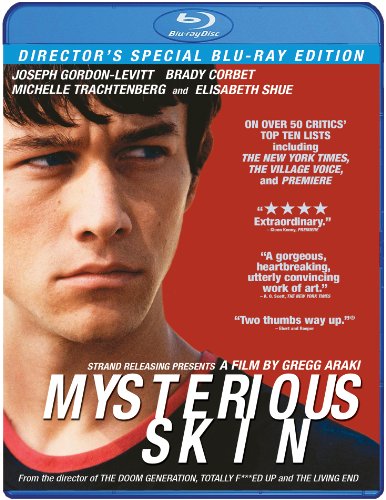
Mysterious Skin (Director's Special Blu-Ray Edition)

  • Factory sealed DVD

New starting from: 100.00 $

Go to Amazon

CAPSULE: THE ROOM (2003)

DIRECTED BY:

FEATURING: Tommy Wiseau, Juliette Danielle,

PLOT: A trusting banker’s fiancée cheats on him with his best friend.

WHY IT WON’T MAKE THE LIST: The Room is certainly… um, unusual (actually, more like delusional). While it’s a qualified “must-see” for seekers of the offbeat, it’s more on-the-surface-stupid than deeply, derangedly weird.

Still from The Room (2003)
COMMENTS: When The Room begins it seems like a normal movie. There is a professional-looking spinning “W” logo for Wiseau-Films, competent establishing shots of the Golden Gate bridge and other Frisco landmarks, and an overture that is not conspicuously awful. Then, in the very first scene Tommy Wiseau strides through the door with his long, stringy black hair framing a face that looks like a cadaver shot up with Botox. “Hai babe,” he says in an unplaceable, lilting mutt-Eurotrash accent that seems vaguely French, vaguely Polish. “I haf sumfink for yoo-ooo.” What follows is a soapy melodrama in which universally-beloved paragon-of-benevolence Johnny (Wiseau) is relentlessly betrayed by manipulative, ungrateful fiancée Lisa. That may seem like a pretty slender storyline to try to hang a ninety-minute feature on, and it is. Wiseau the writer is aware of this fact, and so he stuffs the script full of subplots (not to mention three gauzy slow-jam sex scenes in the first half hour alone, complete with a tasteful shot of Wiseau’s bum for the ladies). Lisa’s mother has breast cancer. Lisa accuses Johnny of beating her. Denny, a teenage orphan Johnny is putting through college, has the hots for Lisa. A couple of friends of the unhappy couple break into their apartment to make out, and are discovered by Lisa and her mother. Denny owes money to a drug dealer named Chris-R. Johnny and his friends put on tuxedos and throw around the football until one of them trips and they call the game off. Lisa lies about being pregnant. The problem with these subplots is that they almost all exist only within the scene their introduced in, and are either completely forgotten or never affect the story in any significant way again.

Still, all of this nonsensicality would have resulted in a forgettably awful movie if not for the odd screen presence of Wiseau, whose incongruous anti-charisma adds a layer of perverse fascination. Wiseau looks two decades older than the twenty-something actors who are supposed to be his friends and contemporaries. His miscellaneous accent and his inability to keep his eyes open past half mast already mark him as an odd leading man, but he is also one of the single worst thespians ever to appear onscreen. While the rest of the cast shows soap opera-level acting skills most of the time—except when whipped into histrionics by the discovery that Denny is involved with drugs—Wiseau struggles to match his facial expression and tone of voice to the situation at hand. He laughs at tragic stories, and barely shows any emotion when he’s fuming mad. When he does manage to overreact—as in his infamous “Lisa, you’re tearing me apart!” line—it’s actually surprising that he has somehow nailed the correct emotion, even if he’s failed to convey it believably.

Wiseau scripted himself as a character with no flaws, except for loving too much. The story is obviously based on post-breakup delusions of victimhood, combined with “she’d be sorry if…” passive/aggressive fantasies. Although I hate to play amateur psychologist, Wiseau appears to suffer from a benign form of narcissistic personality disorder, combined with a touch of high-functioning autism. He portrays himself as a lovable victim, but watching The Room, I only felt embarrassed on his behalf (that is, when not breaking up in peals of laughter at his unintentionally inappropriate reactions). Wiseau’s cluelessness seems sad to me, not endearing like lovable naive auteur like . Perhaps this is merely because Wiseau is still with us, and I’ll be fonder of him once he’s passed on.

Co-star Juliette Danielle was only twenty years old and almost literally right off the bus from Texas when she was cast as Wiseau’s conniving love interest. Wide-eyed and excited to be making a movie, the young girl was so humiliated after the film’s disastrous debut and the subsequent jokes made at her expense that she not only retired from acting, but virtually went into hiding for nine years (she’s only recently emerged as a stand-up comic and actress, finally embracing her notoriety). Making a bad movie is all fun and games, until somebody’s career gets ruined.

On a happier note, co-star Greg Sestero wrote a memoir describing the making of The Room and his relationship with Wiseau (much of whose past, including his nationality and the source of the six million dollars he allegedly spent from his own pocket to produce his trashterpiece, remain cloaked in mystery). Rights to the book, “The Disaster Artist: My Life Inside The Room, the Greatest Bad Movie Ever Made,” have been purchased by a Hollywood group that includes comedian Seth Rogen and 2014 Weirdcademy Award winner James Franco (who may play Wiseau in the film adaptation).

WHAT THE CRITICS SAY:

“…[Wiseau is] a narcissist nonpareil whose movie makes Vincent Gallo’s ‘The Brown Bunny’ seem the apotheosis of cinematic self-restraint.”–Scott Foundas, Variety (contemporaneous)

(This movie was nominated for review by BLAMbert, who rhapsodized that it was “a disastrous train wreck combining a boring story, ridiculous sets, terrible performances, gratuitous sex scenes, unlikable characters, unresolved subplots, and generally incompetent film-making into a confounding and gooey glob of strange.” Suggest a weird movie of your own here.)

366 UNDERGROUND: A PUBLIC RANSOM (2014)

DIRECTED BY: Pablo D’Stair

FEATURING: Carlyle Edwards, Helen Bonaparte, Goodloe Byron

PLOT: Steven (Carlyle Edwards) is a self-serving, amoral author of very mediocre talent. When he stumbles across a crayon-scribbled “missing child” poster with a telephone number and the words “HLEPP ME?” scrawled on it, he figures it to be harmless. Deciding to base a story around it, he calls the number. This leads to an encounter with Bryant (Goodloe Byron) who claims to have actually kidnapped a girl, stating she will be released only if Steven pays a $2,000 ransom within two weeks. Steven initially dismisses Bryant as a morbid prankster—until Bryant begins a relationship with his only friend, Rene (Helen Bonaparte) and starts popping up in his life in apparently coincidental, yet increasingly invasive and unsettling ways.

Still from A Public Ransom (2014)

WHY IT WON’T MAKE THE LIST: To give it its due, this isn’t a wholly terrible film, though it is lacking in certain important factors. That said, the compelling aspects do not come from anything markedly weird, and as such it has no place on the List of weird movies.

COMMENTS: The central premise of A Public Ransom is fascinating: the wrong person finds a cry for help, someone who doesn’t have an altruistic bone in his body. The events that follow can’t be faulted. Indeed, the writing overall is excellent, and it’s not D’Stair’s failing with a pen which make this difficult to view. He casts an impressive shadow with his scripting, and the small cast largely live up to the characters D’Stair has written and fleshed out so well. Lead actor Carlyle Edwards is teeth-grittingly unpleasant as the utter and complete prick Steven. His performance seems a little too mannered at first, but his overwrought, overbearing and obnoxious personality truly matches that of someone who has no awareness of their own obvious shortcomings. Awful people really are like this. Helen Bonaparte tries her best as Stevens’ foil, but her performance is stilted and flat by comparison. It’s difficult to believe in the friendship between them when it lacks such chemistry, especially in some of the more pivotal later scenes. Goodloe Byron’s turn as Bryant is purposefully bland, which really makes his character work for the better. He is very mild mannered and unobtrusive, which makes him all the more disturbing given the possible nature of his actions.

All this is well and good, but a smart script and a functional cast can’t save a film if the director and photographer’s auteur vision is so painfully marred by an inability to hold a camera. Paul VanBrocklin is director D’Stair’s head of photography, and between the two of them they seem barely able to frame a shot in any workable way. The film itself looks ugly, and is a major turn off. It’s true that an amateur film maker might not have access to a high quality camera or a steadicam or the like to make tracking shots work. But ugly, dull and unimaginatively presented still scenes permeate the film to such a point that, while you can see the intent behind the director’s approach (his desire to imitate his influences such as ), the whole thing ends up being a poorly shot and poorly lit mess that drags the viewer away from the strength of the writing. It’s a film with a lot of heart and D’stair should be proud of it for what it is, as it’s head and shoulders above a lot of amateur independent film, making but if he was to turn out another feature it would need to show marked technical improvement to earn a general recommendation.

WHAT THE CRITICS SAY:

“… D’Stair’s cinematic selection is artistically interpretive to say the least, and may not be for everyone.”–Amy Handler, Film Threat (contemporaneous)

More information on A Public Ransom, including a link and a password to view the movie for yourself (at the time of publication), can be found at the official A Public Ransom site.

CAPSULE: NORTHFORK (2003)

366 Weird Movies may earn commissions from purchases made through product links.

DIRECTED BY: Michael Polish

FEATURING: , Duel Farnes, , , , Robin Sachs, Anthony Edwards

PLOT: In 1955, officials try to convince reluctant residents of Northfork, Montana to leave before the town is flooded due to new dam construction; meanwhile, a dying orphan sees a ghostly family and tries to persuade them to adopt him.

Still from Northfork (2003)
WHY IT WON’T MAKE THE LIST: Its monster-dog-on-stilts and odd angel quartet put it in the weird wheelhouse, and it is a well-made movie, but we’ve got to draw the line somewhere. There are better weird movies out there, including at least one movie made by the twin brother team behind Northfork.

COMMENTS: Set in a dusty and doomed, mostly abandoned Montana community that’s about to be buried under a deluge thanks to a public dam-building project, Northfork cultivates a feeling of quiet desperation. An evacuation committee, who dress like undertakers and drive hearse-like black Ford sedans, glide about town trying to convince stragglers to leave town. Meanwhile, in an even less cheery plot, an angelic young orphan lies dying, cared for by the town’s priest, too sick to adopt. His deathbed hallucinations involve visions of a quartet of ghostly beings who may or may not exist outside of the boy’s head. As befits the parched, deathly setting, Northfork is a slow and restrained movie. The performances, especially by Woods as the bureaucrat struggling with the memory of his wife’s death and Nolte as the melancholy orphanage priest, are stoic. Their weathered Western faces are pinched with sadness; their performances are appropriately and affectingly world-weary, but also one-note. Visually, the film is washed out and drained of color—although simultaneously full of sunshine and light, just like the Great Plains during a drought.

This reserved sense of departure is consistent throughout the film, but the one thing that isn’t at all subtle are all the angels. Despite the fact that one of the town’s residents has built his own ark, the celestial symbolism is laid on even thicker than the Great Flood imagery. Wings pop up everywhere, and so do feathers, passing between the dream world and the real world. The orphan is referred to as an angel, and in fact believes himself to be one. Actually, the nods to angels are made so literal that they cease be symbols, and simply become a feature of the plot landscape. The angelism becomes almost kitschy, and works against the restraint shown by the rest of the movie.

While I’ve managed to find a lot to complain about here, Northfork is really a beautiful looking and meditative movie, and one that is capable of pulling out a few weird surprises from time to time (like the wooden dog creature on stilts, and the odd guessing game the evacuators have to play to order a meal at the diner). The setting of the nearly abandoned town, with floodwaters about to descend upon it, is wonderful, but suggests more meaning than the script is capable of delivering. The parallelism between the dying town and the dying boy is thought provoking, but upon consideration the story doesn’t lead us anywhere. Norfolk displays the trappings of spirituality, but it doesn’t have a real spiritual message to convey. The best I can come up with is that the film is pro-immortality, at least in theory.

The scenario was inspired by Northfork Dam, a hydroelectric project instituted during the Depression that buried several small farming communities under a man-made lake. Northfork Lake is in Arkansas rather than Montana.

Michael and Mark Polish are twin brothers; Michael directs (and sometimes acts) while Mark writes and acts. The Metropolitan DVD of Northfork is out of print and fetching a pretty price, so the curious viewer may prefer to try it on instant video instead.

WHAT THE CRITICS SAY:

“It has that vintage Polish pace, their signature arch pomposity and rhythmless weirdness, only this time the brothers had to go and make a cosmic allegory of American dreams.”–Owen Glieberman, Entertainment Weekly (contemporaneous)

(This movie was nominated for review by Kat Doherty, who recalled that it’s “the boy’s trips back and forth between two realities which make up some of the most haunting parts of the film.” Suggest a weird movie of your own here.)

LIST CANDIDATE: UNDER THE SKIN (2013)

Recommended

DIRECTED BY: Jonathan Glazer

FEATURING: , Adam Pearson

PLOT: An alien in the form of a beautiful woman skulks around Glasgow in a white van hunting for single men, whom she collects for some unknown but supposedly nefarious purpose. Eventually she becomes confused by her own temporary humanity, and her physical body starts to shut down.

under-the-skin-UTS_Still_2_hi-res_rgb
WHY IT MIGHT MAKE THE LIST: With an acute vision and a puzzling but highly rewarding plot, Under the Skin is easily among the best of 2014, and may well turn out to be the weirdest. The action moves slowly, but is filled with wonderfully bizarre imagery and powerful space-y scoundscapes. Its storytelling is inventive, and nothing is obvious.

COMMENTS: Under the Skin opens with abstract images of space and birth, with the sounds of a woman learning to talk played over the ambient score. An unnamed biker pulls a dead woman into a van, in which a naked Scarlett Johansson takes on her appearance, and her clothing. The next day, she begins her unexplained quest for bodies, driving around and innocently asking for directions while slyly prying into her prey’s background. If they have girlfriends or family, or are on their way to meet friends, she leaves, but if she determines them to be alone and single, she invites them back to her weird abandoned-looking house. Entranced by her beauty, they follow her blindly until they are absorbed into the floor, sinking into black goo. When she comes upon a disfigured young man (Adam Pearson), she falters in her single-minded mission, and begins to look for human experiences, though she is generally unable to understand them.

Adamantly maintaining a “show, don’t tell” attitude, Jonathan Glazer teases his audience with nibbles of information, encouraging us to assemble the puzzle pieces ourselves. This type of storytelling forces us to carefully consider every image presented, questioning characters’ unstated motives and giving a close reading to each scene. The movie is almost palpably quiet, relying little on dialogue and offering a mix of natural background noise and unearthly music, leaving a lot of room for inner thought to fill in the stillness. We must connect how the silent biker is related to Scarlett Johansson’s character, what purpose the abducted men serve, what prompts the protagonist to abandon her hunt, and why she seems to be struggling with her alien body. All of this information is made available to us, if we pay attention. Every shot is precise and deliberate, with many scenes carefully constructed through the use of hidden cameras—so many of the men interacting with Johansson are at first unaware that they are in a movie. There is an intriguing combination of gritty, rainy urban areas, dark but lush forests, and weird alien spaces, plus the juxtaposition of hidden-camera verism and sci-fi unreality. It is at once unsettling, confusing, exciting, and utterly compelling.

This is, for the most part, understated weirdness. Glazer’s non-expository, matter-of-fact style belies how inventive the film’s approach really is. He reveals an alien’s view of our world, and often makes humanity as strange to his audience as it is to his protagonist. The men’s thickly-accented, slang-ridden speech is often confusing (to this American viewer, that is), and common human rituals are made to appear odd. Why do we wear make-up? Or eat chocolate cake? Or have sex? An extended sequence shows a family spending time on a rocky beach, but the parents leave their toddler on the shore as they swim out to save their drowning dog. The protagonist watches this dramatic scene from afar, a nonpartisan observer, not so much uncaring as she is disengaged, never moved to help or hinder because their plight just isn’t related to her. Even the considerable nudity is approached with a sense of detachment, and made to be completely nonsexual despite the context. Though her origins are never actually mentioned, there is no doubt she is an alien creature, a hunter given human form but never made to understand the person she inhabits. The sick joke is that while visually she embodies the human equivalent of prey—female, beautiful, small, alone—inwardly she is a powerful predator. Under the Skin is a strange and dark thriller that manages to wryly comment on gender stereotyping and (straight) sexual relations without actually delivering any kind of message. As a film, as a story, as a work of art, it simply is.

WHAT THE CRITICS SAY:

“Under the Skin sometimes feels like it should be more elusive, but the moment you try and lock it down it slips away from you, going off into weirder territory.” –Matt Prigge, Metro