Tag Archives: Character study

BORDERLINE WEIRD: FROWNLAND (2007)

Recommended

DIRECTED BY: Ronald Bronstein

FEATURING: Dore Mann, David Sandholm, Paul Grimstad

PLOT: A pathetic loser named Keith lives a putrid existence in his sigh-inducing apartment. He is horribly flawed in every way: vacuous, temperamental, and repulsively stupid. He lives with a roommate he wants to rid himself of, he tries to romance women to no avail, and his attempts to better himself in any way only exacerbate his terminal lameness.

Still from Frownland (2007)

WHY IT’S ON THE BORDERLINE:  The titanic sadness at the center of Frownland is certainly profound enough to be considered weird.  It calls to a part of us that we all carry within: that anti-social, misfit side who feels that, truly, in our heart of hearts, we are ugly and alone.  Only, in Keith, we find that part magnified, personified to a hideous degree.  There is something quietly disturbing about a man struggling with so many problems adapting to society, trying to overcome the shame he feels in himself and his deplorable condition.  But to say that it is weird based on that facet alone is to ignore the unflinching blandness surrounding Keith and the lack of any character whatsoever in the world Frownland creates.

COMMENTS: Cited by many media outlets as a comedy, Frownland is a crushing personal statement of loneliness and isolation in a city of millions.  If this is a comedy, then it is a comedy of the absurdity to which modern life is betrothed.

From the very first moment, Ronald Bronstein fashions an air of shame and anxiety around the central character, Keith, that is hard to shake.  Keith is a dreg of humanity, a product of a lack of any esteem or dignity, and while it doesn’t excuse his behavior at times, it is worth noting that he isn’t exactly like the hideous beast he watches on a televised horror movie in an early scene.  But everything about him is unappealing, from his appearance to his treatment of his semi-friends to the way he lies just to try to relate to other human beings.  He is not even an anti-hero: he’s an anti-anything, a character that admittedly took a lot of guts to commit to film, and one that will live in infamy in the indie circuit for years to come.

Bronstein has a very dark, organic vision that threatens to swallow the viewer in a miasma of dilapidated retro culture.  It has the heart of an angst-ridden 70s independent feature, the set pieces of an 80s European film, the youth-centric mindset of a low-budget 90s film, but for all we know it is set in 2007.  Nothing is given as far as details, and we can only guess while the unsettling score drifts in and out of the background.  It is an effort that many will compare to John Cassavetes, with its heavy mood and deeply troubled characters, but in the rhythms and pacing of the hypnotic dialog Bronstein traces out, I think there is a real visionary here who stands out from his peers.

Frownland is a work of art that tests us on a very cerebral level, and I for one am glad to have seen it.  I think it’s fair to keep this on the borderline for now, but with enough support behind it, it may very well earn its own spot on the List.  For a comedy in which I never laughed once, this might just be the best comedy I’ve seen all year.

WHAT THE CRITICS SAY:

“…either a primal scream issued from a potentially dangerous mind, a wildly original work of outsider art, a doctoral thesis on how not to make friends and influence people, or all (or none) of the above. Only this much is certain: It’s been a while since something this gonzo turned up at a theater near you.”–Scott Foundas, The Village Voice (contemporaneous)

This movie was suggested for review by reader “Rob”. Suggest a weird movie of your own here.

36. PI (1998)

AKA π; π: Faith in Chaos

“Very much like the universe itself, the more technologically advanced we become and as out picture of π grows larger, the more its mysteries grow.”—From “Notes on π” on the Lions Gate Pi DVD

Recommended

DIRECTED BY: Darren Aronofsky

FEATURING: Sean Gullette, Mark Margolis

PLOT: Max, a reclusive mathematics genius, searches for a pattern that will help him predict the stock market with the assistance of a supercomputer he has built in his apartment.  He also suffers from terrible migraines which cause him to hallucinate, and believes (sometimes correctly) that people are stalking him.  As he gets closer to locating a certain 216 digit number that may have mystical predictive qualities, he finds himself caught between the machinations of a large corporation and a mystical sect, both of whom want the knowledge inside his head and will stop at nothing to get it.

Still from Pi (1998)

BACKGROUND:

  • Pi was made for a mere $60,000, financed largely by $100 contributions from friends and family.  Each of the cast and crew worked for an identical salary and a share of the film.  Pi eventually grossed over $3 million domestically.
  • The movie was shot in high contrast black and white reversal film stock (usually used for still photography).  In his DVD commentary Sean Gullette says that Pi was the first feature length fiction film shot this way.
  • Pi won the Directing Award at the 1998 Sundance festival and was nominated for the Grand Jury prize (losing to the now largely forgotten Slam).  It won the main prize at several smaller film festivals.
  • Aronofsky also created a graphic novel called “The Book of Ants” that presents a slightly different take on the story of Pi.
  • This was the first soundtrack scored by former Pop Will Eat Itself frontman Clint Mansell, who has now become an in-demand Hollywood composer.
  • Aronofsky went on to further critical success with the bleak addiction parable Requiem for a Dream (2000); the weirdish science fiction/romance The Fountain (2006); the straightforward drama The Wrestler (2008), which earned Oscar nominations for stars Mickey Rourke and Marisa Tomei; and five more Oscar nominations (with a statuette for Natalie Portman) for Black Swan.

INDELIBLE IMAGE:  A brain crawling with ants that shows up in the strangest places, including on a subway staircase and in a sink.

WHAT MAKES IT WEIRD: Math wiz Max’s frequent migraine induced hallucinations give Pi all the weird cachet it needs, but even without them, the hermetic world created by the mix of grainy high-contrast monochrome photography, rapid-fire montage editing, a pulsing electronic soundtrack, and ideas too grandiose and metaphysical to be completely described would have created a movie seething with weirdness. It also features a tough, streetwise gang of devout Hasidic Jews, which by itself gives it an extra weird point.


Original trailer for Pi

COMMENTS:  “When I was a little kid, my mother told me not to stare into the sun.  So Continue reading 36. PI (1998)

BORDERLINE WEIRD: BAD BOY BUBBY (1993)

Bad Boy Bubby has been upgraded and placed on the List of the 366 Best Weird Movies of All Time. Please read the Bad Boy Bubby Certified Weird Entry and direct any comments about the film to that page. Comments are closed on this review, which is left here for archival purposes.

DIRECTED BY:  Rolf de Heer

FEATURING: Nicholas Hope

PLOT: Raised by his mentally ill mother with no knowledge of the outside world in what is

Still from Bad Boy Bubby (1993)

essentially a fallout shelter, middle-aged Bubby is suddenly released into a modern Australian society he can hardly comprehend, but must learn to fit into somehow.

WHY IT’S ON THE BORDERLINEBad Boy Bubby has a unique tone that’s hard to capture, but the first words I’d choose to characterize it are “relentlessly offbeat,” rather than “weird.”  Sadly, the existence of a Bubby—a child raised in captivity by a crazed parent—is not some weird invention, but is actually torn from today’s headlines.  Although the incidents depicted often strain the bounds of plausibility (only briefly breaking them in the later reels), for the most part de Heer chooses to tell his story using a straightforward, realistic narrative style that makes us believe bizarre Bubby is a real person in a real world.

COMMENTSBad Boy Bubby is a film that moves slowly from deep darkness into light.  It’s often shocking and depressing, particularly in that dingy first third, where Bubby’s unnatural relationship with his deranged mom in their claustrophobic basement hovel is made into a suffocating reality in which we are forced to share.  The saving grace is that the movie always treats Bubby with true affection.  Most of Bubby’s misbehavior, such as his tendency to shake a woman’s breast instead of her hand when he first meets her, comes out of childlike innocence.  But even when Bubby’s truly, purposefully being a “bad boy,” we understand what he’s suffered—even though he doesn’t fully—and we remain firmly on his side.  The script, which could have been ruthless to poor Bubby, rewards him (and the viewer) in the end, and the happy ending feels earned rather than tacked on.

Comic possibilities that were buried with Bubby in the dingy basement apartment emerge when Bubby escapes into the relative light of modern Australian society, but the movie never really threatens to become a comedy.  Bubby’s gift for mimicry raises all sorts of Continue reading BORDERLINE WEIRD: BAD BOY BUBBY (1993)

CAPSULE: CHRISTMAS EVIL (1980)

AKA You Better Watch Out

DIRECTED BY: Lewis Jackson

FEATURING: Brandon Maggart

PLOT: After young Harry sees his father making love to his mother while dressed as Santa Claus, he grows up obsessed with jolly old St. Nick; one Christmas Eve, he snaps.

christmas_evil
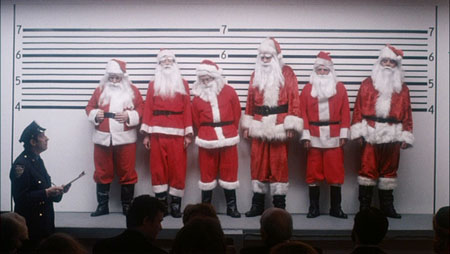
WHY IT WON’T MAKE THE LIST: Christmas Evil has a few nice, weird little touches scattered throughout. Several times the film seems to switch perspective from an objective view to Harry’s skewed subjective view without giving the audience notice. The darkly witty Santa lineup scene, the out-of-left-field Frankenstein homage, and of course the memorable final shot, where Harry completely breaks with reality and takes the viewer with him, are memorable enough. There is also an eerie atmosphere throughout, helped greatly by an unsettling electronic score. Unfortunately, there aren’t enough such high points to justify placing Christmas Evil on the overall list of 366.

COMMENTSChristmas Evil is a serious character study—or, at least, an honest attempt at a serious character study—of a middle-aged loser who lives in a dangerous fantasy world of his own making. There are many little subtle details (catch, for example, the vintage Santa poster depicting St. Nick as a forbidding judge with a gavel) that provide a black comedy feel. On the other hand, it’s very slow to get started and the cheapness of the production often shows to its disadvantage–there’s one terrible editing glitch at the company Christmas party that’s so obvious and jarring, it suggests a loss of financing during post-production. Overall, it’s not nearly as bad as detractors would have it, or as as good as its few defenders (like John Waters) would like to believe. If Christmas Evil were a gift in your stocking, it wouldn’t be a lump of coal, or the keys to a new Mitzubishi Lancer; it would be a pair of cheap but comfy socks in a crazy color scheme that’s not to everyone’s taste.

When it debuted, Christmas Evil (then known as You Better Watch Out) was an oddity: the first film to depict the previously jolly ol’ St. Nick as a homicidal killer. Since then, the holiday vidscreens have been decked with Santa-slasher dreck such as Santa Claws (1996), Santa’s Slay (2005), and the Silent Night, Deadly Night series (1984-1991, with a remake on the way), greatly diminishing the novelty of a psycho Santa. Christmas Evil has little in common with it’s bloody progeny, and is probably the best entry in the sleazy sub-genre it inspired.

WHAT THE CRITICS SAY: “…the best seasonal film of all time. I wish I had kids. I’d make them watch it every year and, if they didn’t like it, they’d be punished!” -John Waters, Crackpot