
The most recent Charlie Chaplin feature to see a Criterion treatment is City Lights (1931).
Released three years after the advent of talkies, City Lights remains, for many, quintessential Chaplin. It was possibly inspired, in part, by Frank Capra‘s The Strong Man (1926), starring Harry Langdon.
Chaplin labored on City Lights for three years, in part due to difficulties with leading actress Virginia Cherrill, in the role of the Blind Flower Girl (which is how she is billed. Like everyone else in the film she has no name, just a simple description). Chaplin spotted her at a prize fight. She was acutely near-sighted and had the look and personality he was seeking. She was not however, a professional actress. Cherril, being an adult of twenty, was far too old for Chaplin to be interested in romantically. Thus, their relationship off-screen was purely platonic, which, probably added to Chaplin’s dismay of not being able to manipulate her. Cherrill was far from starstruck. She was often tardy and frequently challenged Chaplin. At one point the director fired his leading lady, only to bring her back after realizing that starting anew would be disastrous. A clip (from the Criterion edition) reveals the director once put Cherrill through 342 takes. Yet, despite all this friction, Chaplin extracted a remarkable performance from her.
All of Chaplin’s films are primarily actor’s films, rather than being the work of an accomplished director. Montgomery Clift was among those who intensely studied Chaplin’s performance in City Lights. Indeed, Chaplin’s performance here is quite possibly his best.
However, to say City Lights approaches perfection, or is Chaplin’s best film, proves an exaggeration. It is as maudlin as The Kid (1921) and nearly as episodic as Modern Times (1936), but it’s beauty lies in simplicity; and, as far too many hack artists have proven, simplicity, done well, requires consummate craftsmanship and intelligence. Chaplin still serves as the blueprint for simplicity done right. This “comedy romance in pantomime” opens with The Tramp discovered sleeping on a city statue, after it is unveiled. Making minimal use of sound, Chaplin’s politico spews garbled gibberish. Naturally, chaos follows, and it ends, not so subtly, with the Tramp thumbing his posterior at American capitalism before embarking on his city promenade.
The Tramp is menaced by a couple of Newsies, and stops to admire a beautiful statue of a nude woman (a frequently used bit in Chaplin’s film), which everyone else ignores. Shades of things to come. The Tramp is immediately and noticeably more genteel here; far more so than he was when stealing food from babies in his last feature, The Circus (1928).
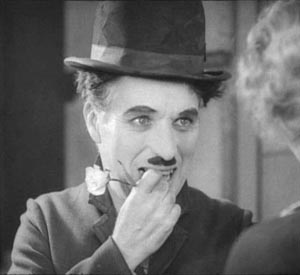 Behind the scenes Chaplin was a case study in manic depression and an obsessive perfectionist. For weeks on end, he agonized to come up with a way the Blind Girl could mistake the Tramp for a millionaire. Then, as he was apt to do, he found his source of inspiration from one of his own earlier shorts. The Tramp, avoiding the Kops, zigzags his way through open doors of unoccupied limos. The Blind Girl hears a limousine door open and the Tramp emerging. Thus, he becomes her imagined millionaire. When the Tramp discovers the Girl is blind, he lays on the sentiment in a way only he could pull off. It is the Tramp alone, in an apathetic society, who sees the ethereal beauty and spirit in her Dickensesque poverty.
With Her possessing his thoughts, the Tramp comes upon a self-pitying alcoholic millionaire who is attempting to commit suicide by throwing himself into the river. Predictably, slapstick follows. Some of it is awkward, but serves the narrative and conceptual purpose of mocking the super rich.
The millionaire gives the Tramp money to buy more flowers from the Blind Girl and even loans his limo out, but it is only when he’s drunk that he’s so generous. Sober, the millionaire is true to his elitist, miserly ways, does not recognize his new friend, and kicks the Tramp out. In order to obtain money for an operation which cures blindness (remember, it is a fairy tale), our protagonist rummages through a series of jobs, including a gig as a prize fighter. Chaplin had used the employment plot device in his Keystone, Essanay, and Mutual shorts. In City Lights, it serves as a distraction. (He would be more innovative with it in Modern Times). Still, it is not a critical detour, and Chaplin regains his footing for the final act.
The millionaire, having returned from an extended European tour, is drunk again, and runs into the Tramp. After the tramp explains he needs a thousand dollars for the Blind Girl’s operation, his inebriated friend donates to the charity, only to have a fumbled burglary and sudden sobriety transform him into an Indian-giver. Desperate, the Tramp flees, money in hand. Pressing the wad of cash into Her hands, the Tramp secures her operation and prevents Her impending eviction.
With a warrant out for his arrest, the Tramp has an inevitable date with the penitentiary. Time served, he shuffles the streets, an object of ridicule and failure until he happens upon a flower shop, run by the now sighted Flower Girl. She, too, joins in ridiculing the transient. But empathy overcomes her and she gifts the Tramp a single flower, which requires touching him. Recognition means pathos and tragedy and per Chaplin’s creed, cue closeup (Chaplin used closeups for tragedy and reserved long shots for comedy. Naturally, he sometimes broke his own rules, but he generally kept to them). This is the divine mother of all cinematic endings. Despite Chaplin’s (increasing) tendency towards schmaltz, he still does it in a far less dated way than other films of the period. Indeed, his silent features have enough identifiable human drama and strengths to outweigh their shmaltzy weakness in far better than virtually any of the saccharine Hollywood productions of the forties and fifties. His own Limelight (1952) is far more passé, perhaps because Chaplin was really only suited to the art of silent cinema (despite claims that his transition to sound was successful).
As expected, the Criterion Collection is extensive. In its HD treatment, City Lights has never looked better, making it even more timeless. Audio commentary from a Chaplin biographer, a (rare) deleted scene, the documentaries Chaplin Today and Chaplin Studios, beautiful cover art, and Gary Gidden’s massive booklet are priceless.
 ” award gifted the recently departed director with something he could not achieve in this mortal coil: infamy. The Medveds will be rightfully forgotten, cast into their suburban purgatory of banality—and if there is justice amongst the lesser gods, then little Mikey and Harry will be personally tended to by Mr. Heat Miser and Mr. Snow Miser in a tailor-made torture pit. In the moral cosmos, Yukon “even among misfits you’re a misfit” Cornelius has knighted the societal outcasts to dole out celestial justice. Rounding out the bacchanal of a Medved hell, little Eddie Wood, Jr., reunites with
  Narrator [Criswell]: “Greetings, my friend. We are all interested in the future, for that is where you and I are going to spend the rest of our lives. And remember my friend, future events such as these will affect you in the future. You are interested in the unknown… the mysterious. The unexplainable. That is why you are here. And now, for the first time, we are bringing to you, the full story of what happened on that fateful day. We are bringing you all the evidence, based only on the secret testimony, of the miserable souls, who survived this terrifying ordeal. The incidents, the places. My friend, we cannot keep this a secret any longer. Let us punish the guilty. Let us reward the innocent. My friend, can your heart stand the shocking facts of grave robbers from outer space?”
 Nightmare Alley is further helped by the bleakly prismatic cinematography of Lee Garmes, who had previously photographed such masterpieces as Josef von Sternberg’s Shanghai Express (1932) and Howard Hawks’ Scarface (1932). Screenwriter Jules Furthman crafts a mostly compelling, pessimistic screenplay (weakened by a Zanuck-mandated semi-happy ending) that falls somewhat short of being the yardstick to measure noir by. Furthman would go one to co-write (with Willam Faulkner) two more noir “classics” ( the classics label being debatable): Howard Hawks’ To Have and Have Not (1944) and Hawks’ cinematic treatment of Raymond Chandler’s The Big Sleep (1946). Art directors J. Russell Spencer and Lyle Wheeler provide exemplary mise-en-scène in their impeccably disheveled carnival settings. Cyril Mockridge composes a taut, aptly grotesque score.
 Those who hoped for a harsh slash and burn attack on Disney and its park practices will need to seek satisfaction elsewhere, but those who feel that the satire is too soft and too on the surface are missing the point entirely. Escape from Tomorrow is a comic nightmare of the subconscious: “Lynchian” has been used many times in descriptions of the film. But Moore isn’t a
  The Intruder has a refreshingly complex script. Two familiar character actors here have surprisingly three dimensional roles: Frank Maxwell as Tom McDaniel sides with integration, but only in loyalty to the law, not from moral conviction. Leo Gordon was typically known as a stock western heavy. Here, he plays the rowdy and uncouth Sam Griffin,driving his wife straight into the arms of extrovert charmer Cramer. When the infidelity is discovered, Griffin does not retaliate, or seek revenge. Rather he advises Cramer to leave town. We do not expect this out of Griffin. Nor do we expect this crass vulgarian (or so he seems at first) to be the only local intuitive enough to see Cramer for what he is. Additionally, Griffin shoulders some of the blame for is wife’s unfaithfulness. This is Gordon’s best role and one of the few times he was given a part worthy of his skills.