
AKA El artista y su modelo [The Artist and His Model]
DIRECTED BY: Luis Eduardo Aute
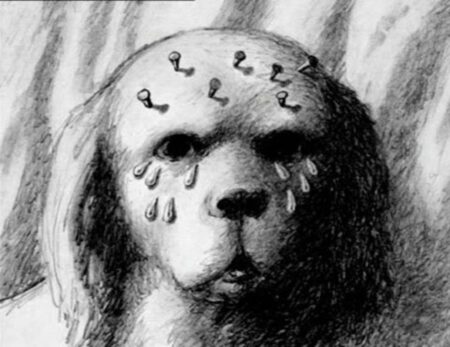
PLOT: A series of vignettes about seven legendary Spanish-speaking painters and their relationships with their models, united by a dog which shares a name with Frida Kahlo’s beloved pet.
COMMENTS: No doubt you’re all familiar with the Barbershop Harmony Society and the annual international barbershop quartet competition it hosts. Well, have I got news for you: just this past week, video of the 2023 finalists’ performances in Louisville earlier this year was posted online, so you now have the chance to see what the coolest kids in a capella close harmony are up to. In particular, you might want to check out the work of this year’s champion Midtown, who clinched the crown with a 12-minute mashup of “Old MacDonald Had a Farm” and the old “Spider-Man” cartoon theme, a performance which turns out to consist entirely of inside jokes. It’s so deep down the barbershop rabbit hole that the explanation merits its own playlist. And if the crowd’s response is any indication, the aficionados are eating it up with a spoon.
Now, why am I subjecting you to this bizarre-even-by-our-standards digression about an arcane and nearly forgotten musical subgenre? Because for weeks, I have been reckoning with what I think of Un perro llamado dolor, Luis Eduardo Aute’s hand-crafted fantasia on the lives and artistic stylings of some of the most famous painters who ever lived, and hearing this professional and utterly impenetrable barbershop performance proved to be a fitting analogue: it’s exceedingly skilled, breathtakingly beautiful in moments, and so far up its own ass that it threatens to cross dimensions.
Aute possessed a variety of talents, from composing chart-topping songs to headlining art shows across Europe to not only writing successful poetry but inventing new forms to increase the challenge. After a while, he began to combine his talents, uniting his artwork, songs, and poems around joint themes and even expanding into film, a medium he encountered early through a job he landed as a second A.D. on Elizabeth Taylor’s Cleopatra. So here is a chance for all of his skills to come together.
It’s a mammoth undertaking. Aute created over 4,000 drawings in pencil and charcoal, often aping the styles of the greats he intends to honor. His assembly is barely animation (save for a couple computer-assisted shots late in the film, Un perro unfolds at a rate of about 3 seconds per drawing), but it flows smoothly through seven different portraits united only by the subjects’ profession and the titular dog. The dog is a curious companion. Named Pain (supposedly like one of Frida Kahlo’s actual dogs, although hers were Xoloitzcuintli and not the generic hound seen here), his presence hints at the constant agony all artists seemingly feel, but he is a loyal friend, protecting his masters and their models against all sorts of villains who would do them harm.
The dangers of both the making of art and the judgment of others seem to be foremost in Aute’s mind. We watch as crowds of celebrities (especially comic filmmakers) look on at Picasso’s Guernica like a Hollywood legend, but the artist himself needs reassurance from Man Ray that he’s done something worthwhile. Salvador Dalì is portrayed as unusually vulnerable, and his model even chops off one of his hands. Francisco Goya is attacked first by flying demons, then firing squads. Aute suggests that to be an artist is to endure trauma.
But maybe not. Divining Aute’s point is purely a guessing game. If you’re not an art historian, Un perro is a baffling collection of surreal images that convey the hauntings of a troubled soul but offer little interpretation. Even if you recognize Goya and his Maja desnuda, or intuit that it’s Leon Trotsky whom Diego Rivera stabs in the head with a Soviet sickle, there’s nothing to tell you why Aute brings them together. And those are just the artists I recognized. I found myself stopping the film frequently to peruse quick biographies of the subjects of Aute’s portraits in hopes of gleaning more insight into what was going on. (I have to confess that I was not familiar with Joaquín Sorolla at all, and his story in the film remains lost on me.) It’s the purest artist’s trope: let the work speak for itself. But what the work seems to be saying here is that it’s too smart for you.
My best hope for understanding comes from the title cards, which describe Un perro llamado dolor as a “libertarian fantasy based on the work and events of the lives of the artists portrayed.” It’s a curious label, given that the main characters in the film are in no way free. They are trapped by their obsessions, helpless in the face of fantastical fears, and able to defend themselves only with pencil or paintbrush. Aute may intend his film as a celebration of their persistence and fortitude, or he may seek to make them seem smaller, more human and fragile. It’s hard to know.
The obtuse nature of the film makes it a strange viewing experience, because it feels like it’s trying hard to push you away. Aute crafts something beautiful, but the experience locks you out, rather than inviting you in. Watching it in a room full of Spanish art historians would make for a very unusual experience. Much like being in an audience of barbershop quartet enthusiasts who laugh uproariously to drive home the point that they get all the jokes… and you don’t.
WHAT THE CRITICS SAY:
“The seven ‘portraits’ of assorted artists and their (usually nude) muses, starting with Goya and ending with Velasquez in no apparent chronological order, bear enigmatic titles like ‘There are no witches, but they do exist’ and proceed with a loopy, angst-filled dream logic that defies exposition. A difficult, arcane film… will prove a hard sell outside the fest circuit, particularly since some of its profiled Spanish artists are virtually unknown here.” – Ronnie Scheib, Variety (contemporaneous)
(This movie was nominated for review by Wormhead. Suggest a weird movie of your own here.)
