Tag Archives: 2017

LIST CANDIDATE: MOTHER (2017)

mother! has been promoted to the List of the 366 Weirdest Movies ever made. Please read the official Certified Weird entry. Comments are closed on this post.

DIRECTED BY:

FEATURING: Jennifer Lawrence, Javier Bardem, , Ed Harris, Brian Gleeson, , Kristen Wiig

PLOT: A poet with writer’s block and his younger wife live alone in a remote house until their domestic tranquility is interrupted by an ever-increasing number of guests.

Still from mother! (2017)

WHY IT MIGHT MAKE THE LIST: Writer/director Aronofsky lets the movie all go to hell—mother! is his most irrational and difficult film, and also his most provocative, with one scene that’s likely to send anyone with maternal instincts packing to the exits. It’s a Hollywood movie with an outsider’s boldness, and it’s going to be punished harshly at the box office for transgressing society’s norms—mostly by blaspheming against coherent realist narrative, the biggest taboo of all. Fans of this site will want to check it out in theaters if at all possible; whether you love it or find it a letdown, it’s a rare “event movie” in the weird genre.

COMMENTS: In its first week of release, the highly anticipated mother! has already been buried at the box office; and even though I have my reservations about the movie’s overall artistic success, let’s pause for a moment out of respect for a fallen brother (er, mother!) who dared to brave the multiplexes with a message of glorious excess, confused metaphor, baby abuse, and general cinematic dementia. Its birth was improbable, its life brief, and we may not see its like for many years.

The scenario is something like a ian joke mixed with paranoia, although the film develops its own crazy identity as it goes on. Wifey Jennifer Lawrence is dealing with a flood of unwanted guests who treat the home she’s trying to refurbish as a bed and breakfast; her husband, grateful for the distraction from his writer’s block, encourages them. It doesn’t help her shaky mental outlook that she’s chugging some sort of urine-colored alka selzer and hallucinating hearts clogging the toilet. Early on, mother! plays like a black comedy, with the audience laughing each time the doorbell rings and a new guest arrives. This black humor contrasts with ongoing gynecological horror imagery: a vaginal bloodstain on her hardwood floor, with the blood trickles tracing a Fallopian diagram on the walls of Jennifer’s womblike basement. The dreamlike flow of the first hour that quickly escalates into the nightmarish once a pregnancy arrives at the same time her poet husband publishes a poetry sensation that brings a horde of cultlike fans to their remote homestead. Over-the-top apocalyptic chaos follows, with a religious wrap-up that left some audience members scoffing out loud. Subtle and focused mother! ain’t; weird, it is.

mother! is susceptible to multiple interpretations, which may be a problem in a movie that appears to aspire to allegory rather than mystification. Apparently, Aronofsky intends the audience to read the film as an environmental parable about Mother Earth. But it can also be seen as a metaphor for fear of procreation (the strangers who sew chaos in the house act just like unruly children), and at the end it becomes a (heavy-handed) Christian allegory (with Lawrence as Mother Mary, paying an even heavier price for humanity’s sins than her son does). And all along, with its poet/God hero, it’s simultaneously playing as an allegory for the artist, and for the way the audience appropriates His work and gives it their own interpretation—yeah, there’s some heavy meta there.

mother! is already infamous for its divisiveness. It was booed by audiences at the Venice Film Festival and CinemaScore audiences gave it a rare “F” rating, while critics have graced it with generally favorable reviews (68% on Rotten Tomatoes at this time, through the usual dissenters are particularly hyperbolic). 2009’s Antichrist (which also refused to give its parent protagonists proper names) may have been the last movie to create a big a chasm between those championing a film as an audacious triumph and those dismissing it as pretentious twaddle. One thing is for sure: simply dropping a superstar like Lawrence into your surrealist movie won’t make mainstream audiences embrace its uncomfortable weirdness. But J-Law should earn a lot of artistic credibility and respect from a role that was quite a bit riskier than ‘s relatively sane and reserved turn in Black Swan.

WHAT THE CRITICS SAY:
“Its dread has no resonance; it’s a hermetically sealed creep-out that turns into a fake-trippy experience. By all means, go to ‘mother!’ and enjoy its roller-coaster-of-weird exhibitionism. But be afraid, very afraid, only if you’re hoping to see a movie that’s as honestly disquieting as it is showy.”–Owen Gleiberman, Variety (contemporaneous)

CAPSULE: THE EVIL WITHIN (2017)

DIRECTED BY: Andrew Getty

FEATURING: Frederick Koehler, ,

PLOT: A demon who appears in a mirror tries to turn a mentally handicapped man into a serial killer by threatening him with nightmares.

Still from The Evil Within (2017)

WHY IT WON’T MAKE THE LIST: The Evil Within is an interesting curiosity, with parts that are authentically creepy bumping up against parts that are genuinely scatterbrained. It doesn’t go quite far enough into dementia to earn a spot on the List of the Weirdest Movies Ever—maybe it would have if its director had lived to fiddle with it for another fifteen years—but fans of fruitcake horror films won’t be disappointed.

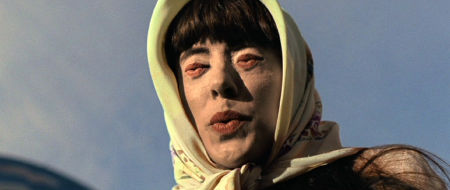
COMMENTS: “I could never know for sure what was a dream and what wasn’t,” says our protagonist at one point. The Evil Within is as disjointed as a bad dream, but there are also dreams within dreams, including a remarkable and long-extended opening sequence that lectures us on the differences between dreams and stories while showing us surreal visions of a burning key in a light switch, a woman with lips for eyeballs, and Michael Berryman unzipping a boy’s body.

It gets weirder from there, in ways that are sometimes intentional, sometimes unintentional. It turns out that in the waking world our protagonist, Dennis, is mentally handicapped, despite the fact that in the opening narration he described a haunted house ride as “the snow-capped summit in the topography of juvenile taste.” Frederick Koehler’s performance as Dennis isn’t terrible, although at times it does uncomfortably approach Donald Trump playing a disabled reporter. The plot is set into motion when Dennis’ reflection begins talking back to him, and gradually talks him into becoming a serial killer. The steps by which the alter ego accomplishes this—by convincing poor, slow Dennis that people will respect his newfound intelligence if he follows his increasingly horrifying instructions—are legitimately chilling. Meanwhile, Dennis suffers more Michael Berryman boogeyman nightmares, which are what the film does best, until a final “reveal” that explains (to some degree) his condition. The conclusion is also fairly bonkers, with animatronic monsters deployed as study aids to help decode the plot.

In many ways The Evil Within is a standard horror film, with serial killer tropes and hallucinatory monsters. But at times it seems like the work of an genuine outsider, one who doesn’t always grasp normal human motivations (why is the social worker so hell-bound on rescuing Dennis from his loving family? Why does the outrageously hot ice cream girl say “Of course it’s nice to see me, I’m outrageously hot?”) Overall, it’s an interesting and brutal, if raw, trip through the mirror: a unique blend of Nightmare on Elm Street, Henry Portrait of a Serial Killer, and Rainman. It shows a promise that suggests that, had he lived, Andrew Getty might have developed into a distinctive horror voice; if he’d been able to tame his own demons and channel his weird impulses, he might have become a genre maverick like .

The story behind The Evil Within is actually odder than the movie itself. The writer/director, who was a grandson of J. Paul Getty and heir to his oil fortune, self-financed the project, spending an estimated $5 million of his inheritance and endlessly tinkering with it in post-production for 13 years, all while battling a methamphetamine addiction. He died in 2015 at 47 years of age, before completing his work. His editor finally compiled the version we now see before us.

WHAT THE CRITICS SAY:

“…it’s already garnering a reputation as one of most singularly strange films to come along in a good while. And rightly so.”–Travis Johnson, Film Ink (contemporaneous)

(This movie was nominated for review by “Russ,” who called it “A flawed film, to be sure, but even moreso: an absolutely fascinating film, a grand example of uncomfortable, outsider art.” Suggest a weird movie of your own here.)

LIST CANDIDATE: THE ENDLESS (2017)

366 Weird Movies may earn commissions from purchases made through product links.

Recommended

DIRECTED BY: ,

FEATURING: Justin Benson, Aaron Moorhead, , Tate Ellington, Lew Temple

PLOT: Brothers who escaped a cult a decade ago receive a videocassette with a strange message and return to their old compound, where it becomes clear that behind the friendly facade of their erstwhile “family” lurks a hazard beyond contemplation.

Still from The Endless (2017)

WHY IT SHOULD MAKE THE LISTThe Endless starts out a little creepy, with altogether too-friendly cult members interacting with the two runaways that defamed their group, before evolving into something skin-crawlingly foreboding. An unnamed, immaterial, but ever-present Entity generates a recurring circumstance found throughout Arcadia Park that puts a new spin on the idea of being “lost in time.”

COMMENTS: A moral found in The Endless is well reflected by the filmmaker’s methods: keep moving. Acting as a veritable two-man band, Justin Benson and Aaron Moorhead do virtually all the heavy lifting in this science fiction(ish)/horror(ish) drama (no “ish”): they direct, star, write, and do the cinematography. They also reach back and pull their previous features (Resolution and Spring) forward along with them in subtle ways. Paradoxically combining pinpoint focus with immense scope, Benson and Moorhead squeeze an infinity into one story comprised of, for lack of a better phrase, many narrative wheels.

An opening montage introduces us to Justin and Aaron Smith (Benson and Moorhead), two brothers barely making ends meet by doing dead-end work, in desperate need of a new car battery. Their rut is interrupted by a parcel containing a camcorder videotape with a message from their past. The “alien death cult” they escaped apparently didn’t pull the trigger. Their visit to their old digs at Arcadia Park starts well enough, but unnerving details begin to accumulate: multiple moons in the sky, hazy atmospheric barrier walls, and ominous rock pillars scattered not-so-randomly around the camp. As Aaron becomes more enamored with cult life, Justin’s aversion spikes. Diving to the base of a buoy in the camp’s lake, he finds two things underwater: another camcorder cassette, and something unimaginably horrific that he barely escapes. Despite this, Aaron decides to stay. As Justin begins his journey home, he stumbles across the true nature of the problem at Arcadia Park, and returns to save his brother.

One could use any number of adjectives to describe how wonderful this movie is—gripping, mysterious, surprising, funny. I’m handicapped because were I to provide any more details, the film’s twists would be revealed. Suffice it to say, temporal manipulation plays heavily in The Endless; the title itself, perhaps, provides a clue. Arcadia Park’s citizenry do not seem to have aged much since the brothers’ departure. Is it merely healthy country living? There’s a heavily locked cabin under the watchful eye of an Arcadian elder. Does it contain guns, or something far more troubling? And as for that mental patient who wandered on to the cult’s grounds, how real are her charcoal drawings of a monstrous nebula looming over the camp? Unfortunately, I can only pose questions to make hints. Surprise is key.

At its screening at the Fantasia Film Festival, there was a point where every audience member was dead-silent, and I’m convinced we were all holding our breath at the same time. Throughout the bizarre adventure of Justin and Aaron, there is a delicate balance of mundane, humorous, and menacing—with a palpable shift toward the latter as the movie progresses. The film’s world and people are self-contained (in more ways than one), and no line is out of place or without purpose. And then there’s the moral to The Endless, as I said before: keep moving. I’d suggest there is also a second moral here: never put off replacing a car battery.

WHAT THE CRITICS SAY:

“…The Endless rapidly develops from a mysterious, elliptical story about cult survivors and strained relationships into a much larger and stranger movie…”–Tasha Robinson, The Verge (festival screening)