Tag Archives: 1996

CAPSULE: MYSTERY SCIENCE THEATER 3000: THE MOVIE (1996)

DIRECTED BY: Jim Mallon

FEATURING: Mike Nelson, Trace Beaulieu, Kevin Murphy

PLOT:  In this feature film from the cult TV show, a man and his two robot companions are trapped in space, forced by mad scientist Dr. Forrester to watch some of the worst movies of all time with only their own witty comments to distract them from the onslaught of ineptitude; in this experiment, they tackle the not-so-bad sci-fi film This Island Earth, in which aliens with bulging craniums kidnap Earth scientists in hopes of rescuing their home planet.

mystery_science_theater_3000_the_movie

WHY IT WON’T MAKE THE LIST:  “Mystery Science Theater 3000” (MST3K for short) was a fun, hip little cable TV show that ran from 1988 to 1999 wherein a man and his robots provided a humorous running commentary on old B-movies (many, like Horrors of Spider Island, of the so-bad-it’s-weird variety).  Although the concept sounds strange, the smart and often very obscure pop-culture and other references that became the show’s comic staple made it more nerdy (in the complimentary sense) than weird in execution.  Most of the movies featured were dull and incompetent rather than bizarre, and when they got their hands on something truly deranged (like The Wild World of Batwoman) the derision heaped on it by the commentators brought the absurdity to the surface and defused it.  Not that this was a bad thing; it’s a devilishly funny exercise, if you’re tuned into the show’s arch sense of humor, but it’s not weird.

COMMENTSMystery Science Theater: The Movie is essentially “MST3K for Dummies.”  It’s a nice lightweight litmus test for neophytes to see if they enjoy the style of humor on display and wish to penetrate deeper into the MST3K corpus (many original episodes are currently released on DVD; the double-disc The Essentials, featuring Manos: The Hands of Fate and Santa Claus Versus the Martians, is probably the best place to start). Distributors Gramercy Pictures were concerned that the “riffing” style of the TV show, which was filled with esoterica and in-jokes, might alienate newcomers to the series.  Therefore, no references to Kierkegard, Bud Powell or “The Courtship of Eddie’s Father” make it into The Movie.  For the most part, Mike, Crow and Tom confine their wisecracks to literal commentary about what’s onscreen: when a mutant hoves into frame, Mike astutely observes that he appears to be wearing slacks, while Tom and Crow quip that the matte painting depicting the alien landscape looks like the planet was designed either by Dr. Seuss or by someone painting a Yes album cover.  The wisecracks come at the show’s typical breakneck pace, averaging perhaps three or four a minute, so there’s probably something here to tickle everyone’s funnybone. Still, the writers seem slightly out of their element in this outing: some of the bits seem too carefully scripted, and they grind out a couple of sex jokes and four letter words just to keep the film from getting a dreaded “G” rating.  After test audiences unfamiliar with the show squirmed a bit at its length, the entire movie (“host sequences” and all) was cut to a mere 75 minutes at Gramercy’s insistence: by comparison, an average episode of the TV series averaged 90 minutes and the unedited (and more coherent) version of This Island Earth ran 86 minutes! [UPDATE 9/3/2013: Shout! Factory’s 2013 release includes the deleted scenes as extras, along with an alternate ending]..

A lot of the critical and fan debate at the time of release revolved around the selection of This Island Earth as the feature film to be mocked.  This Island Earth was well-reviewed on its original release, and although the special effects are far from cutting edge today, many still consider it a minor gem.  It’s neither one of the worst of all time nor any sort of real classic, but it isn’t half bad, a fact which the cast seems to acknowledge when the evil Dr. Forrester checks in at the end to see if the movie has broken Mike’s will and finds his unfazed guinea pig and the ‘bots throwing a “Metaluna mixer” instead.  Despite it’s lack of acute badness (truly taxing schlock would have really alienated test audiences), the sci-fi potboiler was a reasonable choice for this particular venture.  There’s a scientific naïveté to the film that lends itself to gentle mockery (“increase the Flash Gordon noise and put more science stuff around,” advises Crow at one point). More importantly, although the big-headed aliens, flying saucers and mutants with exposed brains look silly today, This Island Earth is still a beautiful looking Technicolor film, with its majestic, unreal pale-blue meteorite explosions and gleaming Space Age gizmos. Looking at the film today is like looking at well-crafted vintage comic book panels from the 1950s, and the visual inventiveness of the film provides a constantly pleasant backdrop to gaze at whenever neither the film’s plot nor the ‘bots quips are quite clicking. A few established critics seemed to accept the movie’s premise that This Island Earth was one of the worst films ever made.  In the context of its time, it’s no worse than the brainless sci-fi thrills of Independence Day were to 1996 audiences, and it’s easily miles above Gramercy’s other big release of the year, the Pamela Anderson misfire Barb Wire.  One wonders what the critics who thought This Island Earth was worthy of such derision would have made of some of the TV show’s more daring experiments in cinematic dreck, such as Monster a Go-Go or Manos?

WHAT THE CRITICS SAY:
“The idea behind what must surely be among the most extreme examples of TV post-modernism is as warped as the concept of a robot made of junk parts observing bad sci-fi and critiquing his man-made relatives…  ‘This Island Earth’ is so bizarrely bad that it’s utterly remarkable. When the comments from Nelson and the robots fall flat, the movie’s own wretchedness takes over.”–Barry Walters, San Francisco Examiner (contemporaneous)

12. TROMEO AND JULIET (1996)

“Body piercing.  Kinky sex.  Dismemberment.  The things that made Shakespeare great.” –Tagline for Tromeo and Juliet

DIRECTED BY:  Lloyd Kaufman

FEATURING: , Jane Jensen, Lemmy, Debbie Rochon

PLOT:  Alcoholic Monty Que and unscrupulous Cappy Capulet have a long running feud dating back to their days as partners in a low-budget sleaze movie studio, and they have passed on their personal vendettas to the next generation.  Monty’s son, Tromeo, falls in love with Cappy’s daughter, Juliet.  The two young lovers must overcome the bloody gangland antics of their friends and family, Juliet’s upcoming arranged marriage to a self-mutilating meat-packing heir, and Cappy’s tendency to beat Juliet and lock her in a plexiglass box, among other crossed stars.

tromeojuliet

BACKGROUND:

  • Original drafts of the script had the parts played by costumed characters from other Troma studio releases: The Toxic Avenger, Sgt. Kabukiman, and so on.
  • Much of Shakespeare’s original dialogue was included in the rough cut, but most was removed after negative audience reaction.
  • Rock n’ roll cult figure Lemmy (of the band Motörhead) played the role of the narrator for free, and also donated the song “Sacrifice” to the soundtrack.  Several less famous bands also donated songs for free or for a nominal price.
  • Shakespearean actor William Beckwith played the role of Cappy Capulet under the pseudonym “Maximillian Shaun” because he was a member of the Screen Actor’s Guild and Tromeo and Juliet was a non-union film.

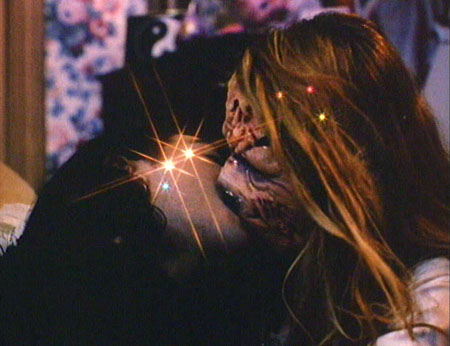
INDELIBLE IMAGE:  Many of the more memorable images in Tromeo and Juliet are too obscene to be depicted in stills.  The best sequence is when Juliet’s belly unexpectedly and rapidly distends and splits open to give birth to…  a surprise.

WHAT MAKES IT WEIRD: Redoing a classic Shakespearean tragedy as a low-budget, offensive farce is a promisingly weird, if obviously gimmicky, premise. Lloyd Kaufman and his Troma team were inspired by the concept, however, and put more creativity into the project than they did in their usual formula schlock fare. The typical Troma anarchy and bad taste reign again here, but the producers add a healthy dollop of bargain-basement surrealism (Juliet’s disturbing sex dreams) and some on-the-cheap arthouse effects (the lovemaking scene in a plexiglass box against a starry backdrop). The result is a movie that’s completely unpredictable, despite a plot known to every high schooler. Tromeo is revolting one moment, and oddly sweet and beautiful the next, an incongruity that only adds to the weird atmosphere.

Short promotional clip for Tromeo & Juliet

COMMENTS: Troma is a low-budget film producer/distributor formed in 1974 to promote Continue reading 12. TROMEO AND JULIET (1996)

CAPSULE: HABIT (1996)

Recommended

DIRECTED BYLarry Fessenden

FEATURING: Larry Fessenden, Meredith Snaider

PLOT: Slacker and (barely) functional alcoholic Sam—still smarting from the habit

recent loss of his father and separation from his live-in girlfriend—finds his health growing worse and worse as he gets more and more involved with a mysterious beautiful woman he meets at a Greenwich Avenue Halloween party.

WHY IT WON’T MAKE THE LIST: Critics didn’t perceive or acknowledge Habit as a “weird” movie, but it is at least a little weird. The movie is bifurcated into two parallel themes: essentially, it’s the story of Sam’s descent into alcoholic dementia, while ostensibly it’s a supernatural horror story. It contains a few surrealistic moments (nude women posing on the streets of New York, a clock moving backwards), a dream sequence that’s redolent of Rosemary’s Baby (complete with yacht), and tons of that spiritual sister of weirdness, ambiguity. Ultimately, the weirdest thing about Habit is the cinematography when Sam takes one of his frequent jaunts around Lower Manhattan: the camera bobs and weaves tipsily, causing us to see the bohemian atmosphere through Sam’s delirious eyes and giving the city a disorienting, Gothic cast. There’s enough odd atmosphere to make the film of interest to weirdophiles as well as indie fans, but it’s not relentlessly bizarre enough to be one of the weirdest films ever made.

COMMENTSHabit is a worthwhile effort, consistently interesting despite being relentlessly seedy and occasionally pretentious (in precisely the art/drama school dropout mold of its main characters). The horror elements are definitely secondary, but they synergize well with the dramatic aspect of Sam’s pathetic story. The literal narrative and the metaphorical aspects of the supernatural subplot merge so well, in fact, that the ambiguity about what “really” happens is simply irrelevant: either of the two possible interpretations is equally satisfactory, and entirely complementary.

It’s somewhat surprising that Meredith Snaider apparently never acted in front of a camera after this role. She did well in a difficult role, but more importantly, she has an intriguing beauty and a willingness to disrobe that should have brought her a lot more work in the film industry.

WHAT THE CRITICS SAY:

“Fessenden’s movie is a sly exercise in ambiguity. More than one explanation fits all of the events in the film, even those we see with our own eyes… ‘Habit’… in the subtlety of its ambiguity reveals ‘Lost Highway’ as an exercise in search of a purpose.” Roger Ebert, Chicago Sun-Times