Tag Archives: 1971

CAPSULE: THE HELLSTROM CHRONICLE (1971)

Must See

DIRECTED BY: Ed Spiegel (Hellstrom sequences), Walon Green (producer and principal photography), David L. Wolper (executive producer)

FEATURING: Lawrence Pressman

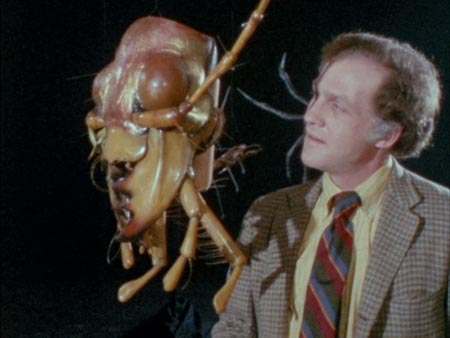
PLOT: The fictional Dr. Nils Hellstrom explains the evolutionary advantages of insects and

Still from The Hellstrom Chronicle (1971)

concludes they are biologically superior to humans, leading him to predict dire consequences for the future of our species.

WHY IT WON’T MAKE THE LIST: Documentaries don’t come much weirder than this, but even the orgies of insectoid sex and violence and Dr. Hellstrom’s flaky mad scientist rants about the inherent superiority of spiders, termites and centipedes can’t raise this to the level of the truly bizarre. Despite the fact that it doesn’t have the goods to rank among the weirdest movies of all times, however, it’s still a beautiful abnormality that’s well worth your attention.

COMMENTS: The Hellstrom Chronicle contains a lot of curiosities, but the heart of the movie are the amazing images captured through (then miraculous) micro-photography: a caterpillar developing from a fertilized cell to a larva in the space of a minute, a shot of beetles locked in a death struggle that widens and pans to show a human couple cuddling on the lawn, individual brightly-colored butterfly scales glowing in the sunlight like Lite Brites. As that last image suggests, there is a psychedelic character to much of this parade of fantastical bug-tography, one that the filmmakers play up as they segue from those super-closeups of wings to shaky cam scenes of fields of butterflies flying through a forest, as Lalo Schifrin’s electronic free-jazz symphony soars ecstatically. From sequences like this we realize why this documentary was so popular on college campuses in the 1970s; you can almost see the clouds of pot smoke rising up in front of the five-foot tall black beetles with their jutting horns silhouetted against the sunrise, and hear the low murmurs of “far out, man.”

With its dissonant sitars, electric pianos dithering over waves of cymbals, and waveform synthesizers wavering in the background, Schrifin’s remarkable score evokes not only midnight trips but also conventional sci-fi giant insect cues, which is appropriate because much of the Continue reading CAPSULE: THE HELLSTROM CHRONICLE (1971)

ISLE OF THE SNAKE PEOPLE (1971)

* This is the fifth installment in the series “Karloff’s Bizarre and Final Six Pack.”

Snake People (AKA Isle Of The Snake People) feels like pure ; that is, Jack Hill the exploitation guru to whom Quentin Tarantino has built an altar. The opening narration is a duller variant of Criswell’s repetitive but puerile Plan 9 From Outer Space (1959) monologue: “During Many centuries in Various parts of the world, Various diabolical rites and ceremonies have been practiced in homage to Various sinister gods who are believed to have Many supernatural powers. These rites are generally known as voodoo!”

Cue nightly voodoo ceremony. , dressed as the priest Damballah (dark goggles, black mask, top hat and cee-gar) carries a skull walking stick. Since voodoo god “Baron Samedi” shares a name with a minor Bond villain, you almost expect Live and Let Die‘s Geoffrey Holder to make an appearance. Captain Labesch (Rafael Bertrand), who does appear, is no Roger Moore. He’s what the narrator describes as an “unscrupulous adventurer taking advantage of the superstition to put a docile native girl under his power, transforming her into a zombie so she will submit to her primitive instinct.” Well, maybe he is Roger Moore in his uncanny ability to make his amorous traits look sluggish. Mexican dwarf character actor  carries a squirming rooster. He laughs maniacally. He inexplicably cries. PETA runs for cover as he decapitates the fowl. He squirts the chick’s blood over a grave site. Rise of the dead docile native girl! Captain Labesch hops into her coffin and, well, all you need to know is that he’s a necrophiliac. Now comes the 70ish pop credits with stylish jazzy font, voodoo drum music, Karloff as a demonic Col. Sanders, and the revelation that this film guest stars Tongolele (i.e., Mexican exotic dancer Yolanda Montes)!

Still from Isle of the Snake People (1971)The ubiquitous , as Anabella, is on hand as niece to Uncle Boris. She’s a bit of a missionary, wanting to rid the world of the evils of alcohol. Lt. Wilhelm (Carlos East) wants to rid the island of voodoo. Such high faultin’ proselytizing is, naturally, due for comeuppance. Tongolele is just the one to give it, too. As a buxom Elsa Lanchester, she belly dances with big snakes, spikes banana milk with venom, and intones “offer your dreams to Damballah!” as she puts the voodoo hex on Anabella. In a freakish dream sequence Anabella sucks on a snake’s head, but Lt. Wilhelm has it worse. He’s hounded by visions of serpents and his men are cannibalized by island babes.

Tongolele takes her voodoo seriously enough to cut off Captain Labesch’s supply of zombie tail, and he foolishly retaliates by playing informant. More cannibalism, more human sacrifices, and Annabella kidnapped by the voodoo snake cult!

Snake People is pure trash cinema that is helped little by Karloff’s presence. Unfortunately, his considerable health issues took even a deeper dive in this film. According to his biographers, the actor spent most of his set time reaching for the oxygen. His performance is rendered numb and he is clearly lost as he struggles to react to his co-stars. His voice is horribly dubbed in the final voodoo rite ceremony, and the film limps towards a non-finale.

Many reviewers have commented that the film is dull and incoherent. With this disparate mix of wacky plot ingredients, it would be difficult to produce an entirely dull affair, but the producers come very close to doing just that. It is minimally aided by its plot’s capricious writhing, Tongolele’s garish, cartoonish personification, and by the morbid fascination of witnessing a horror icon lethargically breathing his last. But these are mere random images, and the opening credits do a better job of conveying that.

LIST CANDIDATE: SHIVER OF THE VAMPIRES [LE FRISSON DES VAMPIRES] (1971)

AKA Strange Things Happen at Night

366 Weird Movies may earn commissions from purchases made through product links.

DIRECTED BY:

FEATURING: Sandra Julien, Jean-Marie Durand, Dominique,  (as Marie-Pierre Tricot), Kuelan Herce, Jacques Robiolles,

PLOT: A honeymooning couple stops at a creepy castle to visit the bride’s distant cousins, but find their hosts have been turned into vampires.

Still from Shiver of the Vampires (1971)

WHY IT MIGHT MAKE THE LIST: The films of Jean Rollin come with a reputation/warning: their mix of artistry and exploitation isn’t for everyone, and they’re all variations on the same idea. The director’s formula is thick Gothic atmosphere, beautiful visuals, mild surrealism, nude female vampires, and an indifference to rational plotting. In terms of making the List, what this suggests is that one Rollin movie might be appointed to represent the director’s entire canon; but, is Shiver the chosen one? We’ll have to see them all to decide for sure.

COMMENTS: Plotheads need not apply to a Jean Rollin movie. Shiver of the Vampires does have a story, but it’s thin and generic, full of the usual staples of the vampire genre: coffins, stakes through the heart, crumbling castles, crucifixes. Rollin approaches this film more like a painter than like a storyteller, and you have to engage with the film as if you’re looking at an art exhibit rather than listening to a ghost story. Certain startling imagery jumps out at you by design—the vampire emerging from the grandfather clock, the goldfish bowl containing a skull, the deadly spike bra—but the decadent backgrounds are just as appealing to the eye. It’s the kind of film where curvaceous maidens in diaphanous gowns walk through dusty corridors carrying candelabras, and there’s always mist wafting across the tombstones at night. There’s ample nudity—the women of Shivers doff their duds at the slightest excuse—but it’s shot with an artist’s rather than a voyeur’s eye for the female form.

Otherwise, however, the sexuality of vampirism isn’t presented with much subtlety; a female vamp is dispatched in a phallic staking ritual, and when nude vampires are exposed to sunlight they writhe in a torment that looks remarkably like orgasm. With liberal use of red gels, aquamarine backlights, and pigmented fogs, the color schemes are brilliantly unreal (proving the Eurohorror tradition of crazed chromatism well predates 1977’s Suspiria). A prog-rock guitar, drum and bass trio dither ecstatically over the action; the electrified score contrasts with the Gothic atmosphere, but it works well to ground the otherwise timeless tale in its contemporary era. There are also unidentifiable, animalistic howls that show up on the soundtrack at strategic points. A pair of nameless “bourgeois vampires” who bow and scrape, finish each other’s sentences, and lecture on the worship of Isis adds further oddness to an already strange story.

Shiver is partly a tribute to and partly a parody of bloodsucker conventions, but the film’s overall tone is hard to pin down, except to say that it’s detached and dreamlike. The human victims’ reactions to their predicament are dazed and out of sync with reality, as if they’re drugged or hypnotized. Isle appears not at all terrified when a strange woman emerges from a grandfather clock in her room (and her modest attempt to cover her bare bosom is woefully inadequate).  After the groom witnesses a vampiric ritual he returns to the conjugal chamber but, rather than rousing his bride to flee, strokes her naked sleeping body. Terror transforms into lust quickly inside Shivers hermetic dream. For decades, Rollins’ slow-paced, arty, irrational musings on the vampire myth have frustrated horror fans looking for old-fashioned bloodletting, but they are subtly strange artifacts that reflect the unique preoccupations of their creator. These fetishistic documents are ultimately of more interest to fans of neo-surrealism than of horror.

The French title, Le Frisson des Vampires, does literally translate as “Shiver of the Vampires,” but “frisson” has a secondary connotation of “thrill” (like the pleasant spine tingles provided a good horror movie shock). Rollins’ two previous features had more salacious titles: Le Viol du Vampire (Rape of the Vampire) (1968) and La Vampire Nue (The Nude Vampire) (1970).

WHAT THE CRITICS SAY:

“… [a] vexing piece of psychedelic nonsense…”–Robert Firsching, Rovi

104. WILLY WONKA AND THE CHOCOLATE FACTORY (1971)

“What is this, a freak out?”–Violet Beauregarde

Must See

DIRECTED BY: Mel Stuart

FEATURING: , Peter Ostrum, Jack Albertson, Julie Dawn Cole

PLOT:  Charlie is a poor boy supporting his mother and four bedridden grandparents with the earnings from his paper route.  When eccentric chocolatier Willy Wonka announces he will be awarding a lifetime supply of chocolate and a tour of his mysterious candy factory to the finders of five golden tickets, Charlie wants to win more than anything.  When he, along with four bratty companions, finally meets the exceedingly odd Mr. Wonka,  Charlie finds the factory, and its owner, far stranger and more magical than anything he could have imagined.

Still from Willy Wonka and the Chocolate Factory (1971)

BACKGROUND:

  • A note for those who believe product placement and corporate tie-ins are a recent phenomenon in movies: although this film was based on Roald Dahl’s bestelling children’s novel “Charlie and the Chocolate Factory,” it was retitled to incorporate the Wonka name in order to promote the release of real-life Wonka candy bars (which were still made up until 2010) by Quaker Oats, who financed the production.
  • Dahl himself wrote the original script, but it was extensively rewritten by an uncredited David (The Hellstrom Chronicles) Seltzer, reportedly to Dahl’s displeasure.  (It’s worth noting that Dahl, like most authors, pretty much hated every adaptation of his work).
  • This was the only movie Peter Ostrum (Charlie) ever acted in.
  • The movie just broke even at the box office, but became a cult sensation thanks to television screenings and home video.  In 2003, Entertainment Weekly ranked Willy Wonka and the Chocolate Factory as the 25th biggest cult movie of all time.
  • The score was nominated for a “Best Music, Scoring Adaptation and Original Song Score” Oscar but lost to Fiddler on the Roof.
  • Despite the fact that he was rejected for the role of the candy shop owner in the film, Sammy Davis, Jr.’s 1972 rendition of the film’s first musical number, “The Candy Man,” became a #1 hit and a staple of his live shows.
  • Charlie and the Chocolate Factory, Tim Burton‘s 2005 adaptation of the same material with as Wonka, is somewhat closer to Dahl’s original novel.

INDELIBLE IMAGE: Wonka’s face, bathed in flashing red and green lights, as he shrieks incoherently at the end of his terrifying trip down a psychedelic tunnel of horrors.  It’s the capping image of a horrifying scene that’s been scarring unsuspecting children for 40 years now.

WHAT MAKES IT WEIRD:  Is it Gene Wilder’s ultra-eccentric performance as the charming but vaguely demonic candyman in a purple velvet jacket and burgundy top hat who suavely arranges for wicked children to hang themselves with the licorice ropes of their own vice? Or the chorus of orange-faced, green haired, dwarf laborers who sing moralizing “Oompah Loompah” tunes after each victim ironically offs him or herself? No, we all know it’s the bad trip boat ride, where Wonka recites Edgar Allan Poe inspired verse (“By the fires of Hell a’ glowing/Is the grisly reaper mowing?”) as the craft careens down a tunnel of horrors while colored strobe lights flash and avant-garde footage plays on the walls that tips this celebration of imagination into the weird column.


Original trailer for Willy Wonka and the Chocolate Factory

COMMENTS: When I was a kid, they used to play Willy Wonka and the Chocolate Factory on Continue reading 104. WILLY WONKA AND THE CHOCOLATE FACTORY (1971)

CAPSULE: APHRODISIAC! THE SEXUAL SECRET OF MARIJUANA (1971)

DIRECTED BY: Dennis Van Zak

FEATURING: John Holmes, Billy Curtis, and anonymous hippies

PLOT: A pro-pot documentary touting the aphrodisiacal properties of the titular herb, with brief

Still from Aphrodisiac!: The Sexual Secret of Marijuana (1971)

hardcore sex scenes to illustrate its key thesis.

WHY IT WON’T MAKE THE LIST:  It’s an absurd, exploitative historical oddity that’s worth noting, but it’s not nearly odd/hilarious enough to crack the List of the Best Weird Movies ever made.

COMMENTS: Aphrodisiac! The Sexual Secret of Marijuana is an example of a type of film of enormous importance in the history of film censorship.  (Yeah, that’s why we wanted to check it out…)  In the years before Deep Throat (1972) beat the censors in court, would-be pornographers were trying to stay on the good side of the Roth obscenity test, which concluded that a work could discuss and arguably depict sex if it was not “utterly without socially redeeming importance” and so long as “the dominant theme of the material taken as a whole” did not “appeal to the prurient interest.”  A few sleaze sellers pounced on the documentary format as a promising way to provide “socially redeeming importance” while avoiding appealing “to the prurient interest” (at least, “as a whole”).  They released daring films with titles like Man & Wife: An Educational Film for Married Adults (1969), Pornography in Denmark (1970), and Sexual Liberty Now (1971) that included some hardcore sex scenes amidst the “serious” (i.e., seriously boring) discussion of social issues.  Aphrodisiac! falls into this brief tradition, but it’s extra-shameless in its willingness to meld sexploitation with drugsploitation while wrapping the whole thing in a semi-sincere wrapper of social relevance.  Aphrodisiac! bounces back and forth between documentary nuggets, obviously fake “man in the street” interviews, and graphic illustrations of cannabis’ connubial powers.  As a documentary the film is far from incisive, but really not as shoddy and misleading as you might have expected: prohibitionist Harry J. Anslinger’s central role in influencing public opinion against the “killer drug” is highlighted, as is New York City mayor Fiorella La Guardia’s much-ignored 1939 study concluding that marijuana posed little threat to public health.  We also learn (correctly) that George Washington grew Continue reading CAPSULE: APHRODISIAC! THE SEXUAL SECRET OF MARIJUANA (1971)