
We’ve taken all your nominees (minus a few duplicates and ineligible titles) and come up with 44 current Apocrypha Candidates for the readers to select their favorite. The winner will be written up as an official Apocryphally Weird entry; other movies that get high vote totals will receive extra editorial consideration. You may only vote for one movie and you may only vote once, so make it count! Voting closes on June 15.
SATURDAY SHORT: HOTEL KALURA (2022)
A woman whose thoughts are plagued with chaos meets a man who would literally move the moon for her.
POD 366, EP. 120: THE LEGEND OF THE DAY SOMETHING WEIRD CRIED (FOR TWO VOICES)
366 Weird Movies may earn commissions from purchases made through product links.
Discussed in this episode:
An Evening Song (for Three Voices) (2023): Read Giles Edwards’ review. Graham Swon’s dreamlike experimental drama about two writers and their scarred maid in the 1930s just finished a token theatrical run; we expect it on VOD soon, and will let you know when that happens. An Evening Song (for Three Voices) official site.
The Day the Clown Cried: Swedish TV channel SVT announced this week that an employee of the company that co-produced Jerry Lewis’ The Day the Clown Cried illegally copied reels from the workprint film onto VHS tape in the 1980s. You can view a clip from the interview (in Swedish) announcing the discovery (and including some very short background snippets as proof) at their site; scroll to the second video at the bottom of the page for the English captioned version. There’s also this article at “Icon” (in Swedish). On the off chance you don’t know what this is about or why it’s a big deal: in the early 1970s slapstick comedian Jerry Lewis made a sincerely intended drama movie about a clown who is sentenced to a concentration camp where he entertains children before they die. At first Lewis was enormously proud of this anti-Holocaust statement, but when he previewed the dailies to some friends the reaction was, shall we say, not encouraging (Harry Shearer was quoted as saying “This movie is so drastically wrong, its pathos and its comedy are so wildly misplaced, that you could not, in your fantasy of what it might be like, improve on what it really is.”). Lewis (and the screenwriter) shelved the movie and insisted that it would never be released; he relented late in life and donated some incomplete footage to the Library of Congress, with stipulations that it could not be shared until June 2024, and even then could only be publicly screened with permission from his estate. The difference here is that this is apparently a relatively complete workprint that could theoretically be restored and released, although only in an unofficial, unsanctioned underground version.
“House of Psychotic Women: Rarities Collection Vol. 2”: The four movies in this femme-forward set are thrillers Butterfly Kiss (1994) and The Glass Ceiling (1971), “dramatized documentary” The Savage Eye (1959), and, most excitingly to us, Juraj Herz‘ Gothic melodrama Morgiana (1972). The set includes hours of special features including 7 short films, one of which is a made-for-TV vampire musical by Herz! Buy “House of Psychotic Women: Rarities Collection Vol. 2”.
In My Skin (2002): Read Pamela de Graff’s review. This unexpectedly lavish UHD/Blu-ray edition of the auto-cannibalism shocker advertises 7 hours (!) of special features, including 4 short films from director Marina de Van. Buy In My Skin.
Queer (2024): Luca Guadagnino‘s adaptation of William S. Burroughs‘ 1985 novella of the same name. It’s our reader-suggested queue (and will soon be out of that closet). Buy Queer.
Rats! (2024): Read Giles Edwards’ festival mention. Soon-to-be cult comedy now on Blu-ray, with an orgasm-themed set of special features. Buy Rats!
“Something Weird” streaming: The independent streaming channel “Cultpix” struck a deal to acquire the (complete?) Something Weird catalog for streaming, meaning the works of pre-70s exploitation auteurs like Doris Wishman (among others) will migrate there. Be aware Cultpix includes (vintage) porn and is 18+ only. Visit Cultpix.
No guest is scheduled for next week’s Pod 366 (unless you count El Rob Hubbard, who is indeed scheduled). In written content, Shane Wilson gets curious about Felix the Cat: The Movie (1988), the previously-mentioned El Rob Hubbard worships The Cathedral of New Emotions (2006), and Enar Clarke reviews an Inflatable Sex Doll of the Wastelands (1967). Plus, we close our Apocrypha nomination contest on Sunday, announce a winner, and open voting on Monday. Onward and weirdward!
CAPSULE: AN EVENING SONG (FOR THREE VOICES) (2023)
366 Weird Movies may earn commissions from purchases made through product links.

DIRECTED BY: Graham Swon
FEATURING: Deragh Campbell, Hannah Gross, Peter Vack
PLOT: Barbara and Richard, married writers from the East Coast, move to the Midwest and hire Martha, a quietly pious local, as their maid.

COMMENTS: One narrator evokes simple matter-of-factness; the second narrator segues into a reminiscence of another world; and the final narrator readily apologizes for what he’s about to do. These three voices in Graham Swon’s feature, An Evening Song, are its body, spirit, and mind; with the three characters—an innocent country local named Martha, the disillusioned writer-prodigy Barbara, and her mentally restless husband, Richard—conveying the film’s philosophical pull and tug. Events do literally happen in An Evening Song (indeed, it is loosely based on real events and individuals), but Swon has crafted more of a meditation oscillating around a narrative through-line than a traditional drama.
Over the course of eighty-odd minutes, Swon’s players perform the strange and gentle decline of a marriage on the rocks. Relocating to the Middle of Nowhere, Iowa, two different writerly types observe their hired help from their own perspectives. Barbara, having begun to give up on life more than a decade prior, has reached a critical stage of ennui that is only slightly alleviated by the discovery of this mysterious, scarred country girl, who seems to embody a delightfully unsolvable riddle. Richard, devoid of any bent towards mysticism, is commendably observant and empathetic, and entranced by Martha as well—but as a riddle to attempt solving. Under the couple’s gaze, Martha gazes back: she perceives Barbara’s ethereality with admiration, but also perceives Richard’s constantly ticking pragmatism with appreciation. We have here a love triangle, of sorts.
But in what way? Swon raises many questions in this film—and wanders (with purpose) down many avenues. Richard, bless his heart, accommodates to his utmost, and for all we can observe is impossible to offend, disappoint, or anger. (This is for the best, no doubt, as he has found himself dropped right in the middle of two particularly conundrous individuals.) Barbara does love Richard (maybe, probably), but longs for a life in the mystical “nowhere” reminisced throughout her narrations—which Richard cannot provide. Martha, on the other hand, does: her piety and humility raise her to ineffable heights in a dream she conveys to Barbara during a climactic, quiet encounter in a placid field, after which the story pivots and moves irrevocably toward the dissolution of Barbara’s will to remain on this plane of existence.
The song continues, narrations bump up against one another and fuse, with all three becoming harmoniously concurrent during a contemplative, sleepless night-and-day meshing of perspectives. This film is no Eraserhead, to be certain; but it is a curious experience. With full marks for dreamy ethereality, Swon’s pocket-sized meditation manages a tension from its competing and complementary voices, creating something nearly imperceptible, maybe close to a nothing, but which lingers in the mind like a mystifying apparition.
An Evening Song (for Three Voices) completed a short run in New York last week and will play at the Acropolis in Los Angeles for one night only, May 29. We’ll let you know when it’s available online.
WHAT THE CRITICS SAY:
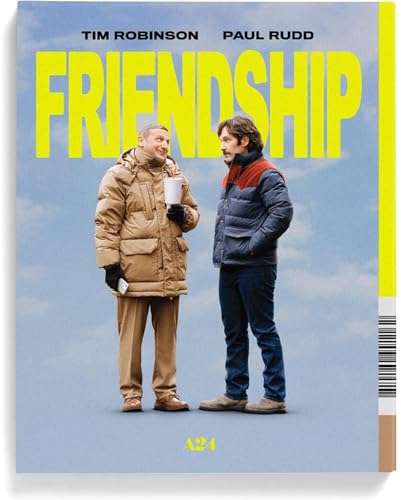
CAPSULE: FRIENDSHIP (2024)
366 Weird Movies may earn commissions from purchases made through product links.
DIRECTED BY: Andrew DeYoung
FEATURING: Tim Robinson, Paul Rudd, Kate Mara
PLOT: A middle-class family man develops a bro-crush on his new neighbor; after a series of faux pas drive a wedge between them, he undertakes increasingly desperate measures to get his friend back.

COMMENTS: Tim Robinson’s comedy speaks to that part of the brain that worries about the men’s room faucet malfunctioning and splashing your pants so it looks like you wet yourself right before you have to deliver a speech in an important business meeting, so you draw attention to it and try to make light of the situation, only to have the joke bomb as you stand there in a silent room in wet slacks. In a way, he’s the perfect guy to take on the trending topic of “male loneliness.” But then again, if you are interested in a cathartic take on this troubling phenomenon, Tim Robinson is precisely the wrong guy to look to.
Robinson’s Craig seems relatively normal at first, if a bit boring and nerdy, but grows increasingly deranged as the pic progresses. The object of his Platonic affections is a grown-up “cool guy”; new neighbor Austin, a TV weatherman who plays guitar in a rock band on the weekends, knows a secret entrance to City Hall that runs through the sewers, and sports a great head of hair and a mean mustache. Before meeting Austin while dropping off a misdelivered package, Craig seems content to work his corporate gig designing ultra-addictive apps and to stay home in the evenings reading the paper. But there are hints of discontent: his wife, a cancer survivor, confesses to their support group that she hasn’t had an orgasm in months, and she’s constantly ditching Craig to hang out with her ex. (Craig is also disconcerted that his teenage son still kisses mom on the mouth). Craig initially doesn’t think he needs Austin in his life, but he’s almost immediately smitten after hanging out a few times. But when Austin tries to incorporate him into his wider circle of friends, Craig screws things up, and then his behavior grows increasingly deranged as he becomes obsessed with winning his friend back: breaking and entering, literally abandoning his wife, toad-licking. You know, guy stuff.
Friendship sits in a liminal space between mainstream comedy and an absurdist comedy. There is enough structure to ground audiences, but it gets shaggier as it goes along . It’s biggest asset is its unpredictability, but that is also its biggest failure. Craig doesn’t seem real, or like a comic exaggeration of a real person: he’s too biopolar, pathetic and mopey one minute, manic the next as he lashes out in misdirected anger at a big client after being upstaged at a pitch meeting. That inconsistency gives the project the feeling of a bunch of sketches strung together—sketches that might have worked better as isolated bits on Robinson’s Netflix show. Robinson’s persona seems like it would be perfect for a supporting role as the quirky best friend of a film’s protagonist, but he makes for an uncomfortable anti-heroic central presence—which I suppose is the point.
Friendship ultimately has little to say about male friendship; read literally, the movie suggests that men are better off without male friends. Although Craig’s downfall begins with humiliating gaffes—e.g. walking into a patio window—he gradually becomes the victim of his own pride. He becomes less goofy and more narcissistic—he’s not so much upset at missing out on Austin’s companionship as he is offended at being rejected. Rather than being a lament on the pitfalls of male friendship, Friendship becomes more of a character study of a selfish, shallow jerk whose family suffers while he obsessively pursues a pal as the status symbol he thinks he needs to add to his pile of job, wife, son, and house. At first, Craig screws up his chances by missing the proper social cues, but he increasingly turns to perverse self-sabotage. He goes through a lot of pain and disgrace, but ultimately deserves it all. And this is a less interesting direction than what the premise originally promised. When a despairing Craig anxiously decides to take a psychedelic trip, he’s promised an awe-inspiring death and rebirth, but the actual experience is rather a letdown. That’s not quite a metaphor, it’s just a laugh—and that’s the best way to take Friendship. It’s an odd comedy coming from a skewed perspective, but not a particularly incisive or game-changing one. But the laughter in the theater proves that the right audience will want to hang out with it.
WHAT THE CRITICS SAY:
- Paul Rudd
- Tim Robinson
- Andrew DeYoung
- 2025
- A24