APOCRYPHA CANDIDATE: INFINITY POOL (2023)

366 Weird Movies may earn commissions from purchases made through product links.

Infinity Pool is currently available for VOD rental or purchase.

Recommended

DIRECTED BY:

FEATURING: , , Jalil Lespert, Cleopatra Coleman,

PLOT: A foreign couple on vacation accidentally run down a local while driving drunk and learn of that country’s strange legal arrangement: in death penalty cases, for a generous monetary donation, they can substitute a clone for execution.
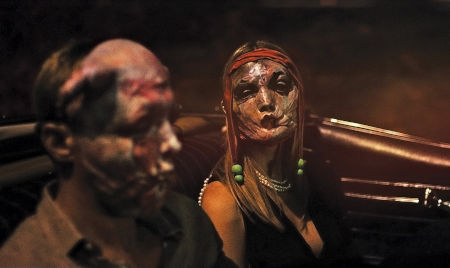
Still from infinity Pool (2023)

WHY IT MIGHT JOIN THE APOCRYPHA: Cronenberg fils continues his plunge into the deep end of human darkness with Infinity Pool, a feverish nightmare of sin and excess spiked with hallucinogens.

COMMENTS: Infinity Pool takes place in an uncertain locale—an island paradise that might be in some Adriatic outpost of Eastern Europe (where it was actually filmed), or the Muslim world, or Oceania. Detective Thresh, tourists’ point of contact with the otherwise unseen government, has a vaguely Nazi-ish aura about him. Street signs and license plates are written in an alien language unknown on this planet. The time is also uncertain: for all intents and purposes the story is set in the modern day, except that this unknown backwater inexplicably possesses cloning technology, including complete personality and memory duplicating, that must be centuries away from realization. In short, Infinity Pool contains within it exactly what it needs to enact its parable, nothing more or less. The insular reality of the setting is as isolated as an all-inclusive resort protected from contact with the populace by huge fences and armed guards, where only a filtered simulacrum of authentic culture exists.

Cinematographer Karim Hussain, who has shot every B. Cronenberg film so far, uses disorienting techniques—vertical 360 pans, extreme closeups of lips and eyelashes, a strange shot where Thomas Kretschmann‘s silhouette turns into a pinheaded alien—to remind us that we’re in an exotic land defying norms and expectations. These stylistic excesses are capped by two epilepsy-warning, -styled psychedelic montages—one deployed to the depict the psychological effect of the doubling process, one the result of an orgy sparked by an indigenous hallucinogen—featuring swirling lights, disco balls, nude women, and, most disturbingly, a nipple oozing… something. These heavy techniques magnify Infinity Pool‘s weighty mood of moral doom.

Skarsgård is good as James, a writer who reveals less and less character as the film progresses. His decline is inevitable and believable: who among us would have the courage to defy the devil’s bargain Thresh offers to escape permanent oblivion? Still, Mia Goth dominates the film, cementing her position as horror’s nonpareil femme fatale of the moment. The ginger domme grows larger as Skarsgård shrinks. She has a wine-guzzling blast as a depraved seductress peeling away masks to reveal what seem to be infinite layers of evil.

The events of Infinity Pool work as pure moral horror, but also operate on a two-tiered satirical layer. As a social critique, the film illustrates first-world exploitation of poorer countries, while on an individual level it plumbs the perverse depths of self-destructive behavior. The rich selfishly appropriate local culture by stealing grotesque ceremonial masks for a disguise to perpetrate additional crimes. Meanwhile, sinking into hideous hedonistic excess, James finds himself engaging in shockingly literal self-abuse. The rich treat the poor as expendable, and James objectifies himself to escape responsibility for his own crimes. The premise naturally invites speculation about the nature of identity: an exact clone of myself with all my memories isn’t exactly me, but what is it? A mystery and a horror.

WHAT THE CRITICS SAY:

“If you’re willing to surf on the wonderfully weird and wild wavelength of ‘Infinity Pool’ it is indeed a singular, and unforgettable, ride.”–Katie Walsh, Los Angeles Times (contemporaneous)

APOCRYPHA CANDIDATE: PLAYING WITH FIRE (1975)

Le jeu avec le feu

366 Weird Movies may earn commissions from purchases made through product links.

DIRECTED BY: Alain Robbe-Grillet

FEATURING: Anicée Alvina, ,

PLOT: Carolina fails to be kidnapped by a sex-trafficking syndicate, but that does not stop her father from playing along with the crooks as an excuse to send his daughter to a curious health clinic.

Still from Playing with Fire (1975)

WHY IT MIGHT JOIN THE APOCRYPHA: This bafflement features a hearty portion of stylistic and narrative eccentricities, but it might be imperfectly described as Jean-Luc Godard helming a Hostel movie while promised of a cash bonus for every tableau featuring a naked chick.

COMMENTS: Alain Robbe-Grillet indulges in a bold combination of erotica, thriller, and shaggy-dog story in Playing With Fire. The first half-hour alone is a cavalcade of coyly directed nonsense: a reminiscence about an erotic picture book; an exploding doll leaving a cats-paw burn mark; a fabricated cry for help on the back of an Arc de Triomphe postcard; a pair of goons with the graceful articulation of marionettes. And so on. There’s more than a touch of Godard in Playing With Fire, and a hearty portion of lian commentary. Considering the source, this is unsurprising. Robbe-Grillet’s greatest contribution to cinema was providing the screenplay for ‘ cryptic and beautiful chef d’œuvre, Last Year at Marienbad, but he had a long directorial career afterwards where he was left to his own mischievous devices.

The mischief begins with a voiceover by Georges Balthazar de Saxe (a stately Jean-Louis Trintignant, positively oozing “monied patriarch”) as the camera points at the household servants nominally acting out domestic tasks. The maid dusts a picture frame as an excuse to linger by the master’s door. The all-too-upright butler randomly passes a polishing cloth over nearby furniture, but is primarily focused on taking snap-shots. He sets the mantel timepiece to 4 o’clock. Why? Who can say. And more to the point, why is it that Carolina de Saxe (Anicée Alvina) failed to be kidnapped despite the considerable coordination efforts of a shadowy group of sex slavers?

I am convinced that Robbe-Grillet is playing with us—he practically admits as much in the title. There is a seeming precision to his efforts, but a tell-tale bit in the first act is heavy enough of a wink to discourage any serious lock-picking. After having been drugged in his garden by agents of the sinister syndicate, Georges de Saxe converses with his butler about the matter. There is an obvious shot of butler cocking his head toward the house, as if there were a sound. Moments later, the gesture is repeated, this time in response to an actual audio cue. This whole film is meta-charade.

The ensuing romp brings Carolina to a mental-clinic-cum-sex-dungeon, where the voyeurism motif established by the camera-clicky butler is cemented. The waif wanders a hallway arrayed with innumerable doorways with a photograph of each occupant. Inside, pukingly rich bourgeoisie enact pseudo-sadistic tableau featuring the young woman advertised on the exterior. Similarly, Playing With Fire is a showcase of our storyteller’s cinematic prowess, and wit. The nonsensical (“All men’s moustaches are fake”) mingles giddily with the sinister (threats of rape and bodily harm are scattered throughout the film like so much confetti). If you ignore the comedy, you’re left with an obtuse art-house Hostel morass. But the comedy and absurdism are real (so to speak), and it’s best to watch Playing With Fire as if not much on-screen actually happens—which is probably the point Alain Robbe-Grillet is trying to make.

WHAT THE CRITICS SAY:

“A weird madcap tale that benefits from gorgeous scenery and cinematography, experimental arthouse editing, and arousing sexual vignettes.” – Ken Kastenhuber, McBastard’s Mausoleum (Blu-ray box set)

APOCRYPHA CANDIDATE: STRANGE CIRCUS (2005)

Kimyô na sâkasu

366 Weird Movies may earn commissions from purchases made through product links.

DIRECTED BY: Sion Sono

FEATURING: , Issei Ishida, Rie Kuwana, Hiroshi Oguchi

Still from Strange Circus (2005)

PLOT: At a surreal cabaret show, 12-year-old Mitsuko tells her story of parental abuse culminating in the accidental killing of her mother and her own attempted suicide; suspecting her story is made up, publishers hire editor Yuji is enlisted to ferret out the truth.

WHY IT MIGHT MAKE THE LIST: Sion Sono has a lifetime pass to immediate consideration for our list, and this blend of truly disturbing scenarios, intriguing imagery, and repeated misdirection is exactly the kind of thing to catch our eye. He begins with subject matter so taboo and depraved that he seems unlikely to emerge with any kind of a reputation, but he then tucks it inside such a labyrinthine puzzle that qualms about the material are subsumed by wonder at how he’s going to pull it all off.

COMMENTS: The three-act structure of Strange Circus is almost too simple: Act I is the horrifying tale of an abused girl, Act II is the mystery over whether the girl’s story was made up by a popular novelist or recounts her own terrible upbringing, and Act III is the solution to that mystery. Couldn’t be more basic.

The movie as executed is anything but simple. Sion Sono knows the difference between shock and surprise, and he deploys both in their turn, choosing just the appropriate jaw-dropping image to fit the moment. It’s not merely that he can keep you off balance. It’s that he knows just the right way to do it.

Consider the first third of the film, which is a straight-out horror show. The scenario is utterly appalling: Mitsuko’s father forces her to watch his rough copulations with her mother and then eventually forces her into direct participation. In sync with this moment, Mitsuko’s world becomes visibly grotesque, with blood-red walls and a repeated transference with her mother. The girl’s suppressed turmoil is given form in the staging that makes her school look like an abattoir and her home resemble a crumbling mansion.

The middle section offers up something quite different. We meet Taeko, a mysterious novelist whose idiosyncrasies and domineering behavior are shocking in their own way, but no longer metaphorical. The strange carvings on her wall? The disguises that she uses to masquerade in public? Her habit of writing while wearing a negligee, sitting atop a cello case, and stuffing spaghetti in her mouth? There’s no filter for this strange behavior. What you see is what you get. In fact, only a couple stray trips into the fantasy world are found here, and pay attention to them when they come, because they’re a clue as to what awaits us…

…in the final act, when the true source of the awful tale of Mitsuko is revealed. This is pure Grand Guignol, and while the revelations are completely over-the-top and deliberately outrageous, a look back suggests that Sono has played fair with us all along. Alone, it might threaten to tip over into absurdity, echoing the wild finales of films like Performance or Beyond the Valley of the Dolls. But as crazy as it gets, it’s unquestionably earned.

Masumi Miyazaki is doing tour de force work here, essentially playing multiple roles and earning the audience’s affections even when her behavior borders on reprehensible. Strange Circus, it turns out, doesn’t just have an unreliable narrator, but is about the making of an unreliable narrator, and her performance taps into mystery, empathy, and beauty to sell you on characters you might have abandoned as irredeemable. A special mention also goes out to Rie Kuwana, who is heartbreaking as young Mitsuko, still radiating innocence even in the face of the indignities heaped upon her. (I made sure to watch the behind-the-scenes documentary for assurance that the actor wasn’t enduring the miseries of her character.)

Strange Circus is not easy to watch, especially in its opening scenes of household terror. But it is utterly audacious, and doesn’t waste its ambitions by coming up short with its revelations. Strange Circus is strange indeed.

WHAT THE CRITICS SAY:

“No matter how weird things get it’s always coherent and we always know that we’re being shown something that is “really” happening, albeit shaded behind denial and mental illness and wishful thinking. Sono’s playing by his own rules perhaps, but he’s still playing fair. When the ending comes, it doesn’t elicit ‘WTF?’ but ‘Oh! I get it!’”–Jeremy Knox, Film Threat

(This movie was nominated for review by ginanoelma. Suggest a weird movie of your own here.)

APOCRYPHA CANDIDATE: FUZZY HEAD (2023)

366 Weird Movies may earn commissions from purchases made through product links.

Recommended

DIRECTED BY: Wendy McColm

FEATURING: Wendy McColm, , Jonathan Tolliver

PLOT: Pursued by the police, Marla is dogged by memories as she attempts to get a grip on what happened after a fateful evening at her mother’s home.

WHY IT MIGHT JOIN THE APOCRYPHA: Presented as a thriller, McColm’s intensely personal film explores guilt and inter-generational trauma in a style reminiscent of Lynch, Tarantino, Fincher, and even . Thus equipped with its own storytelling tool-kit, Fuzzy Head shifts gears faster than you can say “unreliable narrator.”

COMMENTS: From what Marla can piece together, her mother is dead. The fact that she has not slept in almost a week doesn’t help her understanding of the situation. It also doesn’t help that she’s faced years of emotional abuse from mom, interrupted by moments of emotional clarity and ineffable love. Marla’s own tragedy consists of her being forced to cope with oblique hints from her mother, “a woman who was never heard in her pain.” McColm translates the disorientation of “fuzzy head”—a semi-clinical condition whose symptoms include problems with focus, memory, and logic, often stemming from a sense of hopelessness, worthlessness, and guilt—onto the screen with intensity at times, softness at others, absurdity, despair, sympathy, and humor. All the while, they thread a narrative whose focus is woven from muddled tatters into a crystalline whole.

Blank asks Marla, “What happened to your mother?” Marla is screaming, flailing; Blank is her best—and only—friend. Marla wants to kill her mother. Perhaps Marla did. Police have questions, but not as the string of faceless therapists Marla endures as she attempts to discover what happened that one night, and what has happened her entire life. Her brain snaps back to a memory of triumph: firing a six-shooter into the air when she successfully rides her bicycle without training wheels. Her mother stands by proudly. Her brain snaps back to a memory of debasement: being forced to walk across the shards of a kitchen glass she dropped. Her mother stands by in disgust. Marla’s memories crash upon her as she navigates her life, waking up in a cheap motel serviced by a strangely insistent housekeeper. Memories mingle with present-day experience, and she doesn’t always know what’s real, particularly when interacting with Blank.

For those out there baying for symbolism, Fuzzy Head comes up aces. On her journey toward redemption, Marla’s dreams give her access the worst parts of her self and her experience. A sign to hang on her door for the maid. A key dangling from Blank’s rear-view mirror. The six shooter she buys back from a sympathetic local (“I think I killed my mother with that gun”, she admits; “Yeah, we all feel that way sometimes,” the seller replies). Lynchian touches include a theremin solo in an empty nightclub. Tarantino time-loops and snap-cuts keep up the pace. Fincheristic perception-humor takes the edge off when events become too stinging. And the cast of recurring, unreal-maybe-real personae bring to mind the continuous efforts of the guardian angels secreted in Jacob’s Ladder.

Fuzzy Head is a stylish and stylized film. Pondering the influences, Wendy McColm might be accused by some as being derivative. Not by me. As with just about any and all filmmakers, the methods they use are lifted (and altered) from those who came before. Indeed, the last “new” movie I remember seeing came out in 1991. The directors I’ve mentioned have developed a language of cinema for those of us who are frightened, disoriented, confused, and amused, and Wendy McColm’s second feature film shows an already mature storyteller finessing to convey “fuzzy head”: desperate sadness, acute loneliness, and traces of confused amusement. In so doing, McColm tells a decidedly personal story in such a way that spectators like ourselves can look on with satisfaction.

No word on Fuzzy Head‘s post-festival distribution plans at the moment; we’ll let you know when we know more.

WHAT THE CRITICS SAY:

“…a hauntingly beautiful and surreal exploration of childhood trauma… a strangely affecting and expressive feature with a heavy emotional core.” -Brian Fanelli, Horror Buzz (contemporaneous)

THE SEVEN FACES OF JANE (2022)

366 Weird Movies may earn commissions from purchases made through product links.

The Seven faces of Jane is currently available for VOD rental or purchase.

DIRECTED BY: Julian Acosta, Xan Cassavetes, Gia Coppola, Ryan Heffington, Boma Iluma, , Ken Jeong, Alex Takacs

FEATURING: Gillian Jacobs, Joel McHale, , Emanuela Postacchini, Chido Nwokocha

PLOT: Jane experiences love, loss, joy, and bewilderment on a road trip mapped by eight different directors.

Scene from The Seven Faces of Jane (2022)

COMMENTS: To stimulate creativity, the early Surrealists created a game where one artist would build on a previous artist’s work without seeing it. They called the game “exquisite corpse” after a sentence born of this process, a sentence which is also the first thing the viewer sees in The Seven Faces of Jane: “Le cadaver equis boira le vin nouveau.” “The exquisite corpse shall drink the new wine.”

Jane is an exquisite corpse, a surrealist experiment. There are overtly surreal moments, such as the garishly eccentric diner patrons laughing at Jane (Gillian Jacobs) fighting her doppelganger. But the very design—8 directors contributing to the same story blind to what the other directors are doing—leads to Jane being the same but different in each segment, highlighting the nature of character as the collaborative product of writer, director, actor, and so on. With eight different directors, there are actually eight different Janes. (Seven segments plus bookends = eight.)

Jane drops her daughter off at camp and finds herself on a bizarre and unplanned road trip. The southern California backdrop ties the film together visually. Each director showcases it differently, but from the beach to the desert to mountain trails, from Mexican street vendors to early 20th century bungalow neighborhoods, So Cal is the mainstay in this ever-fluctuating movie.

Each segment explores someone Jane could be, or could have been. Most tell stories of love and loss and identity in straightforward or dreamy ways. But the last one, “The Audition,” directed by Alex Takács (AKA “Young Replicant”), takes the story right off the rails in the best kind of way. Set in a mausoleum and a sedan on the back of a car hauler, “The Audition” uses the absurd and the surreal to prod its character’s consciousness.

Jacobs, who is a steady force throughout, continues to deliver as someone on the brink of coming undone. Seemingly no longer able to sustain all the different versions of herself, she fights, gives up, regresses, and disappears, only to become who she needs to be when it’s time to pick her daughter up from camp.

Jane has some shortcomings. The quality of the segments is uneven, and because of the brevity of each piece, there’s no time to build sympathy for any character besides Jane. It is also a disconcerting juxtaposition to have such an ordinary subject for such an experimental movie. The Seven Faces of Jane has been called a “failed experiment.” And by the standards of a mainstream movie, maybe it is. But as an experiment, at least for the Surrealists (and this is a surrealist experiment), if the exquisite corpse stimulates creativity in the artists, it’s a success.

WHAT THE CRITICS SAY:

“The problem is that most of the segments are too tied to a bland realism and narrative cliche to create the collective sense of unease and/or delightful disorientation that the surrealists prize.”–Noah Berlatsky, Chicago Reader (contemporaneous)


Celebrating the cinematically surreal, bizarre, cult, oddball, fantastique, strange, psychedelic, and the just plain WEIRD!