THE GORGON (1964)

This post is part of an ongoing series on Hammer horror director Terence Fisher.

The Gorgon (1964) has a hopelessly silly synopsis: it’s basically a werewolf story transplanted onto a minor Greek myth with an even more ridiculously executed monster (complete with rubber snakes in her hair). Yet, with a stylish script from John Gilling, sublime characterization, and poetic beauty, Terence Fisher enthusiastically managed to transform this irredeemable trash into an artistically rewarding experience. Impossible, but true.

The Gorgon is an oddity in the Hammer cannon. Its pacing is deliberate and forlorn. The “monster” is the mythological Gorgon Megaera, inhabiting amnesiac victim Barbara Shelley, who again gives a performance well above that of the standard Hammer glamour girl. Unfortunately, Shelley does not play Megaera herself, a poor decision which blunts the tragic impact of the production.

For several years a number of unexplained deaths have occurred, during the full moon, in a small German village. The most recent victims are a model and her artist boyfriend. The father of the late artist, professor Jules Heitz (Michael Goddliffe) inquires into his son’s death but is met with resistance from the entire town, including old Dr. Namaroff (Peter Cushing). Namaroff has a motive for evading the truth, since he is not-so-secretly in love with Carla Hoffman (Shelley), whom he knows to be the Gorgon.

Although the human identity of the Gorgon is blatantly obvious from the start, it is the pathos projected by Cushing’s Phantom of the Opera-like hero (scarred by unrequited love) and Shelley’s genteel torment (inspired by the doctor’s jealousy and evasiveness) that creates the striking emotional milieu throughout the film.

Professor Heitz soon falls prey to the Gorgon. The scene plays out first in the beautifully atmospheric castles ruins, during the autumn moon, where Heitz spies the shadowy figure of the Gorgon.  Running from the horrible visage of Megara, Heitz makes it to his office and lives long enough to write his second son, Paul, a letter as he slowly and memorably turns to stone.

Barbara Shelley in The Gorgon (1954)Paul (Richard Prasco) is a student of Professor Karl Meister (Christopher Lee, in a rare, and quite good, turn as a sympathetic character). Paul is given leave from school upon the news of his father’s death. Like his father, Paul meets the same resistance from Namaroff and the townspeople. Carla is sympathetic to Paul’s frustrations and a love triangle develops, which enhances the inevitable tragedy of all three characters. One scene in particular conveys the expressionistic iciness of the film. Carla, in hopes of escaping the town and the shadowy spirit of Megaera, meets Paul in the same ruins in which his father met his fate. Carla sits regally in a throne-like chair and descends, fur coat draped around her shoulders, shuddering from the coldness of the season and the dread spirit lurking. The scattered, elegiac autumn leaves with their somber hues weave a spell akin to a doomed medieval fairy tale; Carla, inexplicably, cannot resist, much like the Gorgon’s victims cannot resist the act of looking at her deadly face.

Professor Meister, who has arrived to assist Paul, knows that it is Carla who is possessed by Megaera, but Paul passionately rejects his professor’s conclusion and is even more intensely driven to get Carla away from the town and Namaroff. Namaroff, channeling Lon Chaney tragic magic, sacrifices himself for his unrequited love, but he is not the only victim. Indeed, the film ends quite pessimistically.

Fortunately, the title character is, for the bulk of the film, only briefly seen, half emerging from the shadows of the columned ruins, or in one evocative scene, in the reflection of a dark pool. In the climax, when Megaera is finally seen full on, the letdown is severe enough to nearly wreck the film. Still, The Gorgon is a refreshingly unique oddity in the Hammer canon, thanks, in no small part, to a director who took the most unlikely material and crafted it into something poetic.

76. KONTROLL (2003)

“I had something in mind for most of the scenes and images in the film and almost without fail, people have interpreted those moments differently… What I’ve really learned in this process is that it doesn’t really matter what I think I’m doing, that’s the beauty of it really, that once it’s out and there are all these hundreds of other eyes trained on it, it becomes a conversation.”–Director Nimród Antal on symbolism in Kontroll

Recommended

DIRECTED BY: Nimród Antal

FEATURING: Sándor Csányi, Eszter Balla, Bence Mátyássy, Gyözö Szabó, Lajos Kovács, György Cserhalmi

PLOT: Bulcsú, a Budapest metro transit cop, copes with eccentric passengers and incompetent coworkers as he pursues a veiled serial killer.  Living and sleeping in the tunnels, Bulcsú is bullied by tormentors, chases gang members, dodges trains and follows a mysterious girl as he tracks a murderer who pushes passengers under speeding engines.  As the killings continue unabated, suspicion eventually turns toward Bulcsú himself.

Still from Kontroll (2003)

BACKGROUND:

  • Director Nimród Antal was born in Los Angeles (of Hungarian ancestry) and moved to Hungary to study filmmaking at the Hungarian Academy of Drama and Film. He made his first feature film, Kontroll, then returned to the U.S. to direct conventional Hollywood products, most recently Predators (2010).
  • The city of Budapest allowed Antal access to the subway system to shoot the film during the five hours per night the trains did not run.  A man claiming to be the Director of the Budapest Metro appears in a prologue to the film to stress that Kontroll is a work of fiction and that real Metro employees do not behave in the ways depicted.
  • Kontroll won the Prix de la Jeunesse (Prize of the Young) at the 2004 Cannes Film Festival. It was the first Hungarian film to screen at Cannes in twenty years.
  • Antal cited Andrei Tarkovsky, Stanley Kubrick, Terry Gilliam, Martin Scorsese, and Beat Takeshi as influences on Kontroll.

INDELIBLE IMAGE: The most enduring image is a metaphor for the troubled Bulcsúis’s transcendence. The kontroller hides in the underground sanctuary from the real world above. But the outside is only a symbol. Bulcsú is really seeking refuge from himself and his feelings. Uncertain about his own emotions, and lacking in confidence, avoiding the world above is his way of postponing self-confrontation. What then, can be more symbolic of his waiting deliverance than the symmetrical image of the great, silvery, central escalator leading to the bright lights and certain reality of the surface? Bulcsú knows he must eventually ascend it but he has not yet the courage to face that eventuality. Will his love for the mysterious, bear-costumed Szofi become the key to unlocking his emotions and freeing himself?

WHAT MAKES IT WEIRD: Kontroll is a fantasy that stands alone in its enigmatic singularity. The film craftily assimilates drama, suspense and social satire into a multifaceted story in the unusual setting of an Old World subway. Director Antal surprisingly succeeds at combining an unlikely set of plot elements. He decants the chaos of social rambunctiousness, the absurdity that entails when authority dictates regulation at the simplest levels of its jurisdiction, and a survey of attitudes and life’s daily ironies into an imaginative story. The resulting integration creates a unique, alternative viewing experience.


Original English language trailer for Kontroll

COMMENTS:  Hydraulics hiss, rails clatter, and trains blast at high speeds in the dimly lit, Continue reading 76. KONTROLL (2003) →

CAPSULE: JESUS CHRIST VAMPIRE HUNTER (2001)

DIRECTED BY: Lee Demarbre

FEATURING: Phil Caracas, Maria Moulton, Murielle Varhelyi

PLOT: The Son of God recruits retired Mexican wrestler “Santos” to help him defeat the

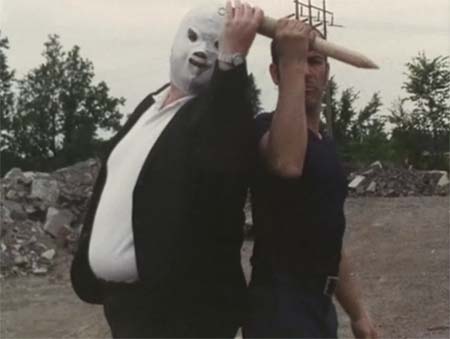
Still from Jesus Christ Vampire Hunter (2001)

vampires who are preying on Ottawa’s lesbian population.

WHY IT WON’T MAKE THE LIST:  It’s defiantly odd, but not consistently funny or entertaining enough to rank among the all-time greats.  If you saw any two-minute stretch of JCVH selected at random, you might be convinced that this was a work of camp genius; but string 45 such segments together, and the comedy value runs a little thin.  It’s a hard movie to peg: in its own way, given its low budget, its a sort of masterpiece, and at the same time it’s sort of a disaster.  I think that if it had offered us one less overlong kung fu battle, and one more song and dance number, it might have had a shot at exalted weirdness. Ultimately, though, just as the tone is more irreverent than blasphemous, the style is more zany than weird, and that should keep it off this particular List.

COMMENTS:  Jesus Christ Vampire Hunter is a stew of pop-cinema leftovers, mixing kung fu with horror, Mexican wrestling and even scraps of blaxploitation, all seasoned with a hint of sacrilege.  Like all peasant cuisine, it will be comfort food for many, but offend some refined palates—it’s definitely an acquired taste.  The technical aspects effectively evoke the feel of late seventies/early eighties exploitation movies, with drab urban cinematography, sound obviously added in post-production, and even a cheesy “waka-waka” funk theme as the heroes cruise down the highway. The action scenes are a problem here: for one thing, there are too many, and they’re too long. They’re just competent enough to remind us that they’re not quite up to snuff; Phil Caracas’ Jesus shows reasonable high-kicking athleticism, but he’s no action hero, and it would have been funnier and more endearing if he’d been clumsier. At any rate, the movie can’t be accused of false advertising. The campy/sacrilegious title scares off the squares and the fundies (though it’s obvious the filmmakers are clearly fans of JC’s philosophy of love and tolerance, if not proponents of his divinity). More to the Continue reading CAPSULE: JESUS CHRIST VAMPIRE HUNTER (2001) →

WHAT’S IN THE PIPELINE

Next week, we’ll be revisiting the surreal Hungarian subway thriller Kontroll (2003), and we’ll also take a look at a couple of movies from the reader-suggested review queue: Estonia’s The Temptation of St. Tony, which will be released on DVD in about a month, and the 2001 cult comedy Jesus Christ Vampire Hunter.

In regards to weird search terms actual Googlers used to locate the site, what this week lacked in quantity, it made up for in quality.  First off, though not the weirdest search term we’ve seen, we proud to announce that 366 Weird Movies comes up as Google’s #1 result for a search on the phrase “inexplicably topless” (with quotes).  We were stunned by the question “”why is chorus line such a weird movie” (if the searcher thinks A Chorus Line is a weird movie, our listings will scramble their brains), and also by the person searching for “terence fisher nude” (if you’ve ever seen a picture of director Terence Fisher, who’s a dead ringer for Henry Kissinger in the right light, you’ll understand why this request shocked us).  We found “japanese porn director uses meditation to bring mass orgasim” to be a pretty weird search, as well; but the one that disturbed us the most, and wins our vote for weirdest search term of the week, is “charles bronson child panty.”  There are just so many ways to interpret that phrase—none of them good (we immediately pictured a line of girl’s underwear an image from Death Wish printed on them).

Here’s the ridiculously long reader-suggested review queue (more after the break): Jesus Christ Vampire Hunter (next week!); The Temptation of St. Tony (next week!); Songs From The Second Floor; Possession; Wild Zero; Nothing (2003); The Peanut Butter Solution; Perfume: The Story of a Murderer; Faust; Sublime;  Pink Floyd: The Wall; Zardoz; The Films of Suzan Continue reading WHAT’S IN THE PIPELINE →

Celebrating the cinematically surreal, bizarre, cult, oddball, fantastique, strange, psychedelic, and the just plain WEIRD!