Category Archives: Capsules

CAPSULE: BUDDY BOY (1999)

366 Weird Movies may earn commissions from purchases made through product links.

DIRECTED BY: Mark Hanlon

FEATURING: Aiden Gillen, Emmanuelle Seigner, , Mark Boone Junior

PLOT: Francis, a lonely, emotionally stunted man living with his stepmother, begins spying on Gloria; after a chance encounter on the street, they strike up a romantic relationship, but Francis becomes increasingly violent and unstable.

Still from Buddy Boy (1999)

COMMENTS: Like the– hybrid the world was waiting for, Buddy Boy arrives with a healthy blend of paranoia and violence, neatly planting the man-against-the-world narrative inside a milieu of seediness, squalor, and surrealism. It’s a heady brew, and the success of the whole thing rests on the shoulders of our central character, a simple man who may be deeply mentally disturbed.

Francis’ unreliability is clear from the outset. Coming home to his apartment, he finds his stepmother laid out on the floor dead, an empty bottle of cleaning fluid at her side. He lays the old woman in her bed as if unsure of what to do. But by the next morning, she is quite evidently back among the living with no explanation. Did she ever die? Did any of what we’ve seen actually happen?

This uncertainty is central to the dilemma of Francis. When he watches Gloria through his peephole, he sees her heartlessly chopping up bloody cuts of meat in direct defiance of her professed veganism. And yet, when he confronts her, only vegetables are to be found. He’s understandably confused, and his uncertainty transitions steadily into horror. He scrubs his bloody hands raw with Ajax. He wears gloves and a mask to keep out the germs he imagines are everywhere (more than two decades ahead of schedule). He sees his own head served up as the main course at a dinner party. And at no point does he ever seem to entertain the notion that there might be something wrong with him. He’s that most terrifying of victims, the one who is certain he’s the only one who is sane.

At every turn, it’s becomes increasingly clear that Francis has seen the lie he wants to see, proof the world’s mendacity and his own unworthiness. As a result, you start to doubt everything onscreen. Just how likely is his relationship with Gloria? What does she see in him, and why is it enough to overcome his own self-loathing? Is his hideous stepmother (Susan Tyrell, in a performance that starts in fourth gear and accelerates from there) anything like the monster we witness, or is this just his frustration running wild? Meanwhile, the visions compound: he’s positive he’s seen a missing girl in the photographs he develops at a grungy photo processing shop. Guests at a dinner party are openly hostile to his faith, while his own priest seems to be a charlatan. People on the bus seem to be getting sicker and sicker. And what is wrong with the bathtub, anyway?

Trapped as we are inside Francis’ head, it’s ultimately impossible to trust anything we see. That’s damaging to Hanlon’s story, because once we lose the find reality in the things Francis experiences, there’s no suspense or surprise. Aiden Gillen’s central performance goes a long way toward holding the whole thing together; he’s enormously sympathetic, even as he makes choices that are increasingly worrisome. As the stakes heighten, though, it starts to feel artificial. Sure, Francis’ world is driving him mad. But in a life this hollow, a world this grim, any other outcome seems impossible.

WHAT THE CRITICS SAY:

“Fans of serious decadence (you know who you are) are vigorously advised to check out a curious, unsettling, darkly conceived and absolutely fascinating little film opening in a shroud of silence, called Buddy Boy. Not since Roman Polanski at the pinnacle of his European weirdness have I seen a film this strange and riveting… leaves you shaken, with a penetrating vision as poisonous as gangrene.” – Rex Reed, New York Observer (contemporaneous)

(This movie was nominated for review by Brian, who called it “very weird, very compelling, very memorable.” Suggest a weird movie of your own here.)

CAPSULE: PLEASE BABY PLEASE (2022)

366 Weird Movies may earn commissions from purchases made through product links.

DIRECTED BY:

FEATURING: , , Karl Glusman

PLOT: A gender-bending leather gang awaken unfamiliar desires in a beatnik couple.

Still from Please Baby Please (2022)

COMMENTS: Please Baby Please is queer, defiantly so, in both the new and the old senses of the word. This movie is proud to be what it is—which is a perverted, experimental non-binary comedy/melodrama/musical, or something like that. This is a film that describes itself as featuring “bisexual lighting,” and that somehow makes perfect sense when you see it. It seems like the script was written to answer the question, what would happen if the leather daddies from Scorpio Rising took over the set of West Side Story?

That last connection is referenced explicitly in the movie’s opening scene, where a leather clad gang prowls the streets in finger-snapping rhythm. These aren’t the Sharks or the Jets, though, but the Young Gents, an ultra-macho bunch of reprobates with a dangerously non-hetero vibe. When happily (if platonically) married couple Suze and Arthur come across the gang standing over a couple of freshly beaten corpses on the street right outside their apartment, their libidos are separately ignited by the heart-pounding excitement. Please Baby Please doesn’t feature a lot of narrative; there is an arc to the couple’s journey, but most of it is revealed through oddball exposition (most of the characters in this movie talk like Dead End Kids enrolled in NYU’s Gender Studies masters’ program). Much of the rest comes in musical production numbers: Suze’s sexual awakenings are depicted in a series of musical fantasies, including one where the Young Gents take turns ironing her ass.  We’re also treated to interludes like a drag queen in a Bo Peep bonnet and flowery eyelids singing a love song in a phone booth. The fine musical accompaniment ranges from exotica to mellow acoustic bass jazz to poppy torch songs; the choreography is simple but effective, more dependent on the dancers’ outrageous wardrobes than on the moves they perform. True to the 1950s style, everything is repressed, and there’s little actual sex: we come upon two motorcycle dudes doing nothing more than hugging passionately in the men’s room. The characters do talk dirty, but in the context of gender roles rather than personal desires. Only the final scene breaks the no-onscreen sex rule.

Please Baby Please is obsessed with masculinity. Arthur has built his entire life philosophy around how doesn’t want to be a man, doesn’t want the pressure of always having to be a contestant in a toughness competition with other males. That doesn’t mean he’s not attracted to masculine surfaces, though; to the rippling abs, mesh-clad pecs, and leathery bulges of the Young Gents. The motorcycle gang stands for the masculine ideal in all its muscly, sneering, rough-mannered charm. In 1953, Marlon Brando in The Wild One evoked an outlaw desires for rebellion and domination in female audiences; Tom of Finland was simultaneously (and more lastingly) co-opting the same biker imagery for the gay subculture.  Please Baby Please is aware how ludicrous a caricature of manhood all this chrome and black leather is; that’s precisely why it’s fascinated with this iconography. This objectifying beefcake spectacle is especially weird because it’s shot through multiple lenses: a female director looking at men through the homosexual male gaze.

Handsomely geeky Harry Melling ably handles his duties of playing a closeted homosexual in a rewarding but familiar way, but much of the praise for Please Baby Please comes for Andrea Riseborough, whose over-the-top vamping wins over even the film’s detractors. Her acting choices all seem to be formed by asking the question, “how would Nic Cage play this scene if he were a housewife caught in a sexless marriage?” She gyrates in a corset, howls at the moon, breaks into a spontaneous Bert Lahr impersonation, and acts crazier and crazier (and more and more like a man) as the movie progresses. This risky material could sag limply if not aroused by hyperbole, so it’s hard to imagine the movie succeeding without Riseborough’s committed insanity setting the tone.

‘s cameo was much-hyped, but underwhelming; the most significant thing is the vote of confidence she casts by lending her name to this esoteric project. We did notice an old friend showing up as co-writer: . Please Baby Please is currently in a limited run exclusively in theaters; we’ll update you when it becomes more widely available.

WHAT THE CRITICS SAY:

“…the film’s over-the-top approach and awkward pacing prevent this defiantly bizarre concoction from resonating deeper than its surface fascination. “–Toff Jorgensen, Cinemalogue (contemporaneous)

CAPSULE: THE GIANT CLAW (1957)

366 Weird Movies may earn commissions from purchases made through product links.

DIRECTED BY: Fred F. Sears

FEATURING: Jeff Morrow, Mara Corday, Morris Ankrum, Edgar Barrier

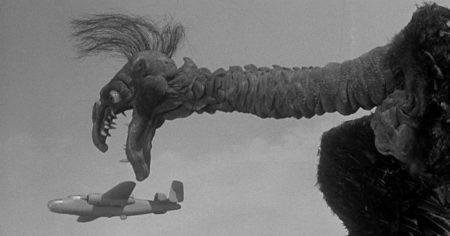
PLOT: When an unidentified flying object terrorizing the globe is discovered to be an enormous, grotesque bird, the planet’s collective scientific brainpower and military might are brought to bear against the winged menace.

Still from The Giant Claw (1957)

COMMENTS: One of the great stories of cinema is the tale surrounding the production of Jaws. It seems the robotic shark that was built to terrorize the citizens of Amity was temperamental at best, unusable at worst. Accordingly, director Steven Spielberg was forced to scrap many of the intended scenes featuring the automated predator, instead resorting to obfuscatory tricks to keep the villain hidden until the last possible moment. This ended up working to the film’s benefit, as the star’s delayed entrance only served to magnify the tension. Spielberg had stumbled backwards into brilliance.

Of course, it’s questionable how much his tactics would have worked had the ultimate reveal of the shark not paid off the suspense. Once the chum-shoveling Roy Scheider comes face-to-face with Bruce the animatronic carcharodon, then we’re off to the races, because the reveal has justified the withholding. You can believe your eyes. It is the black-eyed, remorseless killing machine we were promised.

In some respects, The Giant Claw faces precisely the same dilemma. The filmmakers want to hold back the full and awesome power of their beast for as long as possible. We get hints, of course: blurry visions of an airborne foe, evocative descriptions of a flying creature “the size of a battleship,” an enormous footprint indicating the immensity of the monster, and many Spielbergian stares into the unseen maw of a force to terrible to behold. But at some point, the monster has to be revealed. And when at last it is… my goodness, how can I do this justice? Can it even be conveyed? I mean, here are just a few examples of my peers attempting to reckon with this thing:

All true, and that last one probably comes closest to illustrating just Continue reading CAPSULE: THE GIANT CLAW (1957) →

CAPSULE: MONA LISA AND THE BLOOD MOON (2021)

366 Weird Movies may earn commissions from purchases made through product links.

Mona Lisa and the Blood Moon is currently available for VOD rental or purchase.

Recommended

DIRECTED BY: Ana Lily Amirpour

FEATURING: Jeon Jong-seo, Kate Hudson, , Evan Whitten, Ed Skrein

PLOT: A young woman with telepathic powers escapes from a mental hospital to New Orleans and is befriended by a down-on-her-luck exotic dancer.

Still from Mona Lisa and the Blood Moon (2021)

COMMENTS: Society’s fringes probably have no storyteller more sympathetic than Ana Lily Amirpour. From her shadow-filled debut A Girl Walks Home Alone at Night, through the sun-soaked dystopian Bad Batch, and now with the perpetual street-light glow in Mona Lisa and the Blood Moon, Amirpour has maintained a fascination with folks on the periphery of civilization. While the likes of Harmony Korine dwell in tragedy, staging his tales amidst the horrific grind of poverty, Amirpour regards tragedy as nearly an afterthought—it’s present, certainly, in all its violence and sadness, but overcome through the by-the-nails vibrancy that courses through every character. The misunderstood get a fair shake; the downtrodden have their small pleasures; and, just as importantly, the inexplicable remains that way.

It is possible that Amirpour arranges her films around the music. Every scene glides along to a rhythm, with every character slotting perfectly into their dancing role. Mona Lisa makes this focus explicit with the second of its primary characters, Bonnie Hunt (a delightfully trashy Kate Hudson). As a middle-aged stripper, she’s showing signs of wear, but still has the moves, and always holds her head up high. The titular Mona Lisa (Jeon Jong-seo) possesses a feral artistry, first when slinking around her cell at the mental hospital, then when wandering the side streets of New Orleans. Even awkward neophyte Evan Whitten fits with the choreography as Bonnie’s pissed-off-and-confused son: a boy who escapes his daily troubles and unwieldy self through “hashing,” or, as he explains, “dancing aggressively. To metal!” It’s appropriate, then, that the one “hero” here—and my favorite character—is the hyper-chill DJ by the name of “Fuzz”; explaining his sobriquet, he glides Mona Lisa’s hand over his facial hair and scalp, “See? It’s soft.” It’s a rough life out there, so you gotta take it easy.

After the harsh glow of the opening asylum, the remainder of the movie is washed in the ambient late-night-light of the one town where everyone is welcome. Whereas Las Vegas’ inclusivity is tainted (it wants your money), New Orleans is the city for all-comers, a bacchanal which demands only that you let others revel alongside. The camera work is smooth, gliding unobtrusively—staying chill—as Mona Lisa’s meandering journey unfolds. Most everyone is bottom of the barrel: strippers, drug dealers, loiterers, townsfolk, and even the cops coming across as workaday stiffs who aren’t seeking a hassle. Like a mellow Jell-O, everyone moves along with the underlying thump of the background house music.

Mona Lisa starts with no explanation of its protagonist; a policeman’s background research into the mysterious young woman brings up zilch, a slight foray into supernatural refuses to elucidate matters (a Voodooienne consulted by the cop leaves it at, “You don’t pick Voodoo, son. Voodoo picks you”), and things wrap up with an escape from the authorities toward… Well, the geographic destination is Detroit, but otherwise no hints are given and no promises are made. Amirpour’s interests aren’t in pointlessly digging for root cause behind life’s sturm und drang. All you can hope to do is dance to life’s wave and, as a fortune cookie advises the cop at the start, “Forget Everything You Know.”

WHAT THE CRITICS SAY:

“Par for the course with writer/director Ana Lily Amirpour (A Girl Walks Home Alone At Night and The Bad Batch), Mona Lisa and the Blood Moon lives and dies off a hypnotic wavelength that’s increasingly bizarre… The blunt themes are worthy conversation starters, and the film is still strange enough to recommend, but by the end, all the best elements might as well be sacrificed to the blood moon itself.”–Robert Kojder, Flickering Myth (contemporaneous)

CAPSULE: MASKING THRESHOLD (2021)

366 Weird Movies may earn commissions from purchases made through product links.

Masking Threshold is currently available for VOD rental or purchase.

Recommended

DIRECTED BY: Johannes Grenzfurthner

FEATURING: Voice of Ethan Haslam

PLOT: A man performs experiments in an attempt to find the source of the tinnitus that is driving him mad.

Still from Masking Threshold (2021)

COMMENTS: It’s no surprise that Masking Threshold isn’t getting a big theatrical release; it’s more of a miracle that it was able to play in a few theaters at all. This has nothing to do with the film’s quality and everything to do with its style: this is a film that is (almost) entirely narrated by the protagonist, while the camera focuses (almost) exclusively on closeups of objects for the entire runtime. A movie that plays like a paranoid podcast illustrated with a succession of moving slides—sort of a contemporary feature-length version of La Jetée—is a hard sell in any climate, but particularly at a time when movie theaters are struggling to put butts in seats.

Fortunately, the scaled-back nature of the project means it will play well on small screens (although it would be nice to hear that crucial sound mix emanating from Dolby surround-sound speakers). Despite the fact that it may only be a MacGuffin for the protagonist’s deeper psychological issues, sound—the rustle of fabric, turning of pages, test tones the protagonist generates for his own reference—-provides the texture of the film. The movie quietly ushers us into the protagonist’s mind, as we hear none of his background tinnitus in the early going, but the hum slowly and subtly creeps into the soundtrack, scarcely noticed, until by the end we hear these subtones too. These minute variations in drones, unidentifiable rustlings and buzzings, and oscillations have tremendous significance to the protagonist, but to us they remain esoteric. The movie’s production values are low, so visuals cleverly rely on extreme closeups of carbon dioxide bubbles, slices of bread, algae, ants, and mouse corpses, supplemented by various charts, graphs, alchemical prints, blinking diodes, repurposed memes, and so on. The protagonist’s face is never clearly visible. The movie is presented as a YouTube diary by one of those “independent researchers” whose peculiar-to-insane preoccupations fail to strike a chord with a mass audience; his impassioned Reddit posts leave him the subject of trolling and lols.

This is a strange movie, in that the first-person monologue script would work just as well as a short story; in a way, Masking Threshold is nothing but multimedia-enhanced prose. But that makes it a triumph; a movie literally constructed from objects found around the house or bought at Home Depot, Best Buy, and Petco, is inspirational. The protagonist is erudite (the movie is full of fascinating trivia) and arrogant; his inner monologue is profound when discussing the philosophy of science, and myopic when interpreting the results of his own experience. His narrative voice put me in mind of the antihero of ‘s “The Tell-Tale Heart,” while the madness resulting from his investigation onto cosmic phenomena evokes any number of victims. (It’s noteworthy that both authors get a “thanks” in the credits). Not to say that Grenzfurthner’s script (co-written with Samantha Lienhard) lives up to those classic influences—but it does update that psychological horror template with timely references to Internet culture, Q-Anon, and “doing your own research.”  Masking Threshold is a successful, immersive, and credible experiment in diving into one man’s particular rabbit hole universe.

WHAT THE CRITICS SAY:

“…his paranoid, obsessive quest digs its own rabbit hole of increasingly unhinged weirdness, escalating from the unhygienic ick of growing algae and such to… well, if you suspect a narrative like this must inevitably lead to homicidal violence, you’d be right.”–Dennis Harvey, 48 Hills