Category Archives: Capsules

IT CAME FROM THE READER-SUGGESTED QUEUE: SONATINE (1993)

366 Weird Movies may earn commissions from purchases made through product links.

DIRECTED BY: Takeshi Kitano

FEATURING: Takeshi Kitano, Aya Kokumai, Tetsu Watanabe, Masanobu Katsumura

PLOT: The yakuza dispatches an enforcer to Okinawa to resolve a dispute between rival gangs, but the ensuing conflict threatens the future of his clan and his very life.Still from Sonatine (1993)COMMENTS: If you made a checklist of essential gangster-film elements, Sonatine would check a lot of boxes. Lone assassin, shootout in a bar, car bombing, cute moll faithfully standing by, thoughts of retirement balanced with the inescapability of the criminal lifestyle… they’re all here, and yet not one of them hits in the way you expect. Sonatine is unquestionably a crime film, particularly the Japanese-yakuza-chronicle variety, but it operates at a wildly different pace than its brethren.

At the time he made Sonatine, Takeshi Kitano was as close as Japan had to a “king of all media,” having found success in film, television, and even stand-up comedy. This project, however, found him ruminative and depressed. So it’s probably no wonder that his mob middleman, Murakawa, is similarly disenchanted with his life. Audiences were well-trained to expect an antihero with deep emotions, but very little would have prepared them for the taciturn, blank-faced hitman presented here.

When Murakawa complains that he lost three men on his last assignment, his protest—“I don’t like it”—feels like it would be a threat for retaliation coming from anyone else. But as Takeshi delivers it, it’s a resigned grump. Faced with other threats or inflection points, his response at every turn is quiet contemplation. Rivals have bombed his headquarters? Quiet contemplation. One of his underlings shot in the head right in front of him? Quiet contemplation. He witnesses an ugly attempted rape? He slaps the perpetrator, then quickly shoots the surprised assailant in the belly before quietly contemplating the victim. Murakawa is tired and devoid of hope, a character well-past finding bursts of violence to be alarming or invigorating. Takeshi does more to point up the essential hollowness and indignity of organized crime than 20 film scoldings could accomplish.

The desperate blankness of Murakawa brings brief moments of diversion and happiness into stark relief. As he and his underlings are stowed away at an Okinawan safehouse, he finds moments of pleasure that are surprising in their simplicity. A game with folded-paper sumo wrestlers is transformed into a live-action version, and Takeshi’s smile is captivating. He also has fun shooting fireworks and prankishly digging sandpits on the beach. But he knows all too well that death is close at hand; no pleasant distractions or pretty admirers can solve the fundamental malaise.

The climactic showdown is the ultimate proof of Takeshi’s concept: cornered on all sides, Murakawa plans and implements a bloody revenge on his foes. True to form, we see almost none of it, save for distant flashes of light and smoke and brief intercuts of bloody reprisals (set to the Tangerine Dream-esque score of legendary composer Joe Hisaishi). There’s no joy in it, no escape, no “one last showdown” to give him a brighter future, even if the plot conspired to provide him with one. Filmgoers expecting a gritty crime drama must have found this slow, grim-faced character study a strange proposition. But say this for Takeshi: his checklist might have been different than his audiences, but all his boxes are checked.

WHAT THE CRITICS SAY:

“Sonatine doesn’t encourage a straight reading, where logic dictates meaning and importance. When our normal responses are broken down, we relate more directly to the film… at a time when action movies typically hand us a canned experience, [Kitano’s] pictures carry a charge of originality.”–Patrick Z. McGavin, The Chicago Reader (contemporaneous)

(This movie was nominated for review by film izle. Suggest a weird movie of your own here.)     

CAPSULE: RETURN TO SILENT HILL (2026)

366 Weird Movies may earn commissions from purchases made through product links.

DIRECTED BY:

FEATURING: Jeremy Irvine, Hannah Emily Anderson

PLOT: A painter’s drunken dreams and a mysterious note lead him to the ghost town of Silent Hill, where he searches for his lost ex-lover amidst the eternally smoldering ruins.

Still from return to silent hill (2026)

COMMENTS: Aficionados will tell you that “Silent Hill 2” is one of the greatest video game stories ever told. I trust them, but this adaptation by Christophe Gans, returning to the Silent Hill series after a highly disappointing middle installment from another director, does nothing to support their claim. (Evidence of it faithfully recapturing the look of the game, on the other hand, is much stronger.) What we get here is a gilded but mediocre psychological horror that never explains why it needs to be set in the rapidly deteriorating “Silent Hill” universe—except for the fact that it’s a spooky locale.

And indeed, the film is at its best when it’s merely prowling about the town, encountering swarms of beetle-like insects, headless zombies squirting acid from a torso orifice, and spider-like corpses. It’s fun just sightseeing: the ashy gray streets and the eerie hallways of the town’s dilapidated tenements have a bleak beauty. But even Silent Hill’s essential hauntedness is starting to have diminishing returns. The series’ signature monster, Pyramid Head, is scary—terrifying, in fact—the first time you see him. Three movies in, he doesn’t have the same impact. Unlike in a game, this lumbering behemoth is never a threat to catch a protagonist.

Irvine and Anderson are competent leads whose main virtue is that they’re easy on the eyes. The supporting cast does not stand out, and it seems that most of their characters have been cut for time (Eddie serves no purpose in this plot, and could have been left out entirely). Akira Yamaoka’s evocative music again features. The star, such as it is, is the production design and visual effects.

The plot is the biggest issue. Yes, the movie will get weird, but only in that tired “the borders between reality and hallucination start to blur” approach that now seems to animate 5-10% of low and mid-budget horrors. The info drops explaining James and Mary’s generic love affair hardly create a strong emotional rooting interest, and the backstory of the mysterious cult isn’t developed enough to create a meaningful plot engine. In a nod to the video game’s multiple possible resolutions, the movie has conflicting, contradictory endings. The technique doesn’t work at all in the context of a movie adaptation, particularly for people who’ve never played the game. Don’t Return to Silent Hill in theaters. If you do, don’t say you weren’t warned.

Walkout note: the only other people in my theater, a couple, walked out with fifteen minutes left to go.

WHAT THE CRITICS SAY:

“…between unnecessary lore changes and a lack of thematic heft in some of its storytelling, the filmmaker’s return to the franchise is a weird mix of exciting recreations, gorgeous visuals and disappointing execution.”–Grant Hermanns, Screen Rant (contemporaneous)

CAPSULE: LUTHER THE GEEK (1989)

366 Weird Movies may earn commissions from purchases made through product links.

DIRECTED BY: Carlton J. Albright

FEATURING: Edward Terry, Joan Roth, Stacy Haiduk

PLOT: Imprisoned as a juvenile for a murder spree, Luther is released on parole and terrorizes a family in a remote Illinois farmhouse.

Still from Luther the Geek (1989)


COMMENTS: What is the goal of imprisonment? Some argue deterrence. Others rehabilitation. A few would make the case for vengeance. Or perhaps it’s some combination of these. Carlton J. Albright and his team put these socio-philosophical concerns aside in their chronicle of Luther the Geek: a madman who began as a mad lad, murdering three people after a formative encounter with a circus performer who ripped open the necks of chickens for the amusement of the crowds (and to earn his much-needed liquor).

Amongst that crowd, Young Luther is thrown to the floor in a scuffle—smashing out his front teeth in the process. Fast-forward twenty years (all of them in prison), and his parole is reviewed by five prison officials, among them a “bleeding-heart” female who notes Luther’s commendable behavior prison, his lack of speech notwithstanding. Luther, you see, merely clucks. By a vote of three-to-two, he’s set loose, and the inevitable ensues.

Albright lucked out finding a performer like Edward Terry, since to whatever degree it may be argued that Luther the Geek works, it could not work without Terry’s all-in performance. His Luther is not fit for society, and quickly murders again. An hour or so of this eighty-minute movie takes place in an out of the way farm, during which—through a series of commendably paced, shot, and edited chase, scuffle & violence set-pieces—various victims are bloodily dispatched by the titular geek.

Why are we here, though? The pay-offs will interest slasher fans. Titillation seekers get their thrills from the buxom daughter. The rest of us may find Luther the Geek an oddity (if not a weird-ity) worth checking out. Through much of the dialogue-free performance from Terry, I was reminded of 183’s Angst. Luther the Geek sort of plays out like that German film’s American hick cousin. Indeed, one weakness I found in Angst is not present in Luther: there is no inner monologue. We have no real idea why this nut is doing what he’s doing; and Luther is all the more terrible and, perhaps, sympathetic for this lack of elucidation. As a violence picture that goes for the throat, there’s a strange undercurrent of pathos—and a remarkable finale that doesn’t chicken out.

WHAT THE CRITICS SAY:

“What happens when a horror film refuses to dampen its premise with humor, even when the premise itself borders on the absurd? LUTHER THE GEEK answers that question by committing, sometimes uncomfortably, to a nightmare that never pauses to reassure the audience it’s in on the joke. This is not a standard slasher, nor a self-aware cult oddity; it’s a blunt, regional exploitation film that believes in its monster completely, for better and for worse.” — Chris Jones, Overly Honest Reviews

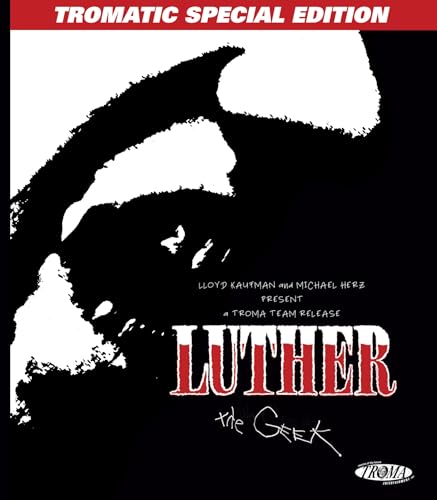
Luther The Geek (Tromatic Special Edition)

  • A young country boy is plunged into the depths of homicidal madness after witnessing the strange exploits of a carnival “geek.”

List Price : 19.95

Offer: 13.97

Go to Amazon

CAPSULE: THE BLOODY LADY (1980)

Krvavá pani

366 Weird Movies may earn commissions from purchases made through product links.

Recommended

DIRECTED BY: Viktor Kubal

FEATURING: Voice of Jela Lukesová

PLOT: A young maiden transforms into a sadistic lady after a short affair leaves her heartbroken, and the myth of Erzsébet Báthory, the Blood Countess, is born.

Still from The Bloody Lady (1980)

COMMENTS: It starts innocently, with vivid and warm color palettes, visual gags, and a young princess dancing and playing with the forest animals, like something out of a Disney movie. But do not be fooled; this lady is Elizabeth Bathory, and things will suddenly take a turn for the grim, the weird, and the macabre.

When the young girl falls sick while in the forest, a peasant takes her under his protection and care. Something akin to love blossoms. But this love is doomed to remain unrequited, as the princess will have to return to the palace eventually, leaving behind as a memento… her heart.

This slightly grotesque gesture is not  only a symbol of her love and devotion towards the peasant, it underlines the grief their separation brings. With the gift she becomes figuratively and literally heartless. She stops caring about others—people or animals—and her hardened feelings transform her gradually into a cruel beast, finding comfort and joy only in tormenting others.

The drawings, till this point vibrantly recalling 60s and 70s psychedelia, grow darker with and an ominous night color palette emerges.  Like the mythical Snow Queen, our heroine develops cruel instincts as a way to cope with her frustrations. She turns into what we would call “evil”, although she is never just a caricature, retaining her humanity even in the movie’s most WTF moments.

She turns a servant into a pawn for her evil doings. His job will be to seduce young virgins and lure them inside the castle, where the countess awaits ready to turn them into a bloodbath for her own pleasure and self-care. More murders and mayhem follow, climaxing in a suggestive scene combining nudity, seduction, and sharp nipples.

Although dialogue is mostly absent, the soundscape is a major part of the world-building. Orchestral music, often melancholic and with a slow tempo,  introduces us to the darkest moments of our tale. Psalms, resembling satanic calls, accompany the grotesqueries. And everything culminates in a deeply lyrical ending.

This is not a sensationalist portrait of the legend of Bathory, but one that strives to find her humanity. Humans are revealed as deeply flawed creatures, but with a prospect of salvation sometimes—but not always. The story can be considered as a parable, an allegorical commentary on the perpetual fight of good vs evil inside our psyche. The Countess’ young servant, a dirty-looking dark-haired man, is a symbol of impure evil. The blond, angelic peasant Elizabeth fell in love with at the first place is a vessel of light, a messenger of bliss and pure good—even when he fails to make a difference.

WHAT THE CRITICS SAY:

“[Kubal’s] trademark style involving very simple lines, shapes, and colors was first put to use in commercials and child-friendly short subjects, but here he lends it to something much stranger and darker that feels like a Saturday morning cartoon splashed with nudity and blood.”–Nathaniel Thompson, Mondo Digital (Blu-ray)

The Bloody Lady [Blu-ray]

  • A collection of feature and short films by the influential Slovak animator, Viktor Kubal.

List Price : 39.99

Offer: 19.98

Go to Amazon

IT CAME FROM THE READER-SUGGESTED QUEUE: TURBO KID (2015)

366 Weird Movies may earn commissions from purchases made through product links.

DIRECTED BY: François Simard, Anouk Whissell, Yoann-Karl Whissell

FEATURING: Munro Chambers, Laurence Leboeuf, Aaron Jeffrey, Edwin Wright, Michael Ironside

PLOT: In a post-apocalyptic future, a young kid discovers the fighting gear of the legendary Turbo Rider and sets out to topple the tyrannical overlord Zeus.

Still from Turbo Kid (2015)

COMMENTS: Turbo Kid lays down its ace right from the get-go, as a gravel-voiced narrator describes the grim vista of a tomorrow carved out by nuclear winter and acid rain. “This is the future,” he intones, as a boy on a BMX bike pedals into frame. “This is the year 1997.” Time for a quick double-check on the year this came out… yep, and we are truly underway.

The 366 Weird Movies archive does not lack for films from four decades ago that employed a low budget and suitably barren locations to depict the world-after-the-end-of-the-world to audiences. (Just off the top of my head, I can think of three such movies that I myself have reviewed.) Recent years have seen several attempts at nostalgic pastiche, but Turbo Kid stands alone for setting “80s desolation romp” as a target. In particular, it’s the product of the serial nostalgist collective Road Kill Super Stars (aka RKSS, which consisted of this film’s three writer-directors, until Simard was booted last year for criminal sex charges); when their proposed contribution to the anthology The ABCs of Death was rejected, they had more than enough ideas to expand the concept into a feature.

Considering that Turbo Kid’s sole objective is to recapture that special 1980s mix of futuristic nihilism and naïve can-do spirit, the effort is remarkably successful. The empty fields and gravel pits in Quebec that stand in for the future’s wastelands are suitably desolate. Costuming and production design tap into the mixed milieu of flashy colors and big hair roaming around what look like abandoned sewage treatment plants. Plenty of props serve as icons of the era, from Rubik’s cubes and Nintendo Power Gloves to the ubiquitous BMX bikes that serve as everyone’s transportation around the barren wasteland. (Not that bicycles would be the most unusual form of transport to dominate the coming hellscape.) Plus, the synth-fueled musical score by Le Matos is both pitch-perfect and tiresome in a way that’s era-appropriate, and is supplemented in the font-of-the-future opening credits with the most fitting rock song choice imaginable, a fist-pumping anthem from Stan Bush (of “The Touch” fame). If you’re fooled for a moment into thinking that this was churned out in 1985, that’s fully intended, because Turbo Kid doesn’t want to just capture the feel of these 80s low-budget sci-fi epics; it wants to be one of them.

This commitment to verisimilitude extends to the film’s cast, who play everything straight enough to sell the movie’s central joke. Chambers is just the right kind of bland hero, not looking anywhere as young as his outward level of maturity, but fully selling The Kid’s sweet ignorance. As his sidekick and love interest, Leboeuf’s perky Apple turns out to be the most delightful, refreshing thing that Turbo Kid brings to the party. Her indefatigably chipper vibe initially seems like it’s going to become annoying fast but quickly becomes the animating force in the film, with a naively joyful spirit that makes a crucial revelation about her character land with a nod of approval instead of a roll of the eyes. And then there’s the filmmakers’ most crucial piece of casting, landing master of scene-chewing villainy Michael freaking Ironside to do the thing he does. Undoubtedly, he could play this part in his sleep, but while his work here is effortless, he’s in no way phoning it in. He plays the heel with all the acid-tongued vigor of his younger days, in which he no doubt celebrated getting cast over Kurtwood Smith. Ironside even makes a virtue of the directors’ most questionable choice, surrounding Zeus with a less-than-skillful set of minions who leave the overlord shy of his most supervillainous aspirations. It’s a bit of postmodern irony that’s out of place in Turbo Kid’s otherwise resolute commitment to the homage.

Perhaps the thing that most distinguishes Turbo Kid from its ancestors is the remarkable level of gore. It’s not as though these films are devoid of viscera, as any Mad Max entry will demonstrate, but RKSS is relentless, with a seemingly inexhaustible supply of fake blood spewed via every manner of stabbing, decapitation, and explosion. This festival of fluid is impossible to take seriously, presented in an extremely cartoonish manner, and resembling nothing so much as Sam Peckinpah’s Salad Days. It can be outright funny at times, like a sawblade on a helmet that turns its victim into a screw top, or a body that lands squarely atop another person like the most unwieldy hat. So it’s one of Turbo Kid’s better surprises that the orgy of violence ends up showcasing the film’s sweetest moment, a romantic tableau that’s only enhanced by the surrounding rain of blood.

Given the opportunity for parody, Turbo Kid opts instead for direct mimicry, an odd choice by itself, but one that makes the finished film more earnest than weird. That does make the film a charming watch, if a weightless one. That 80s trash was pretty fun, and this re-creation is pretty fun, too. It’s a low bar, but clearing it is a decent way to spend an hour or two.

WHAT THE CRITICS SAY:

“…a wildly discordant, schizophrenically adorable, gore-soaked fantasy set in an deserted industrial wasteland… Add in the other nutso, hilarious touches, and you have the garnish you need to turn your sweet tale of friendship into a Friday night blood feast.” – Patrick Feutz, Inside the Blue Paint

(This movie was nominated for review by film izle. Suggest a weird movie of your own here.) 

Turbo kid

    New starting from: 39.99

    Go to Amazon