All posts by Shane Wilson

IT CAME FROM THE READER-SUGGESTED QUEUE: QUICKSILVER HIGHWAY (1997)

366 Weird Movies may earn commissions from purchases made through product links.

DIRECTED BY: Mick Garris

FEATURING: Christopher Lloyd, , Raphael Sbarge, Missy Crider

PLOT: The mysterious Aaron Quicksilver shares two tales of ill-fated individuals: a traveling salesman who encounters a suspicious set of novelty clattering teeth, and a plastic surgeon who finds that his hands have developed minds of their own.

Still from Quicksilver Highway (1997)

COMMENTS: Horror on television is a tricky proposition. The genre frequently relies upon visceral shock and gore, elements too unseemly for broadcast, which is why the most successful series either emphasize psychological terror or abscond to cable where the standards are looser. But Bless Mick Garris for continuing to try. He is responsible for five Stephen King TV adaptations, including takes on classics The Stand and The Shining. Plu,s he’s well-versed in the televised horror anthology, with credits in “Tales from the Crypt,” “Freddy’s Nightmares,” and “Masters of Horror.” If anyone is going to make Quicksilver Highway work, it’s Garris.

He doesn’t, though. That’s not necessarily his fault, of course. The film is a busted pilot, with two unrelated episodes inelegantly slammed together. They both traffic in body horror, a genre that is never going to get a fair hearing on network TV. The small-screen budget is also a limitation, with simplistic special effects (including some terrible CGI) and overly broad acting. The stories are also heavily padded to fill out 45 minutes apiece, with long diversions into pointless philosophical debates and weak character monologues arriving right at the moment when the story really needs to be gaining steam. Mostly, though, the finger needs to be pointed at the material, which is best described as “better on paper.” Neither of these are horror short story classics from genre masters King and Clive Barker, but one can see how they managed to create a sense of unease though their unlikely subjects. But visualizing them, without the reader’s imagination to hide behind, reveals them as low-stakes and low-impact. 

The King story, “Chattering Teeth,” relies upon a familiar trope from the author, an innocent-looking object that carries with it bad juju and sinister intent. A classic monkey’s-paw scenario. In this case, the object is an oversized set of windup walking choppers, which the protagonist somehow imagines is going to be the perfect gift to appease his disappointed son. When the novelty mandibles attack a nasty hitchhiker, it’s impossible to see it as anything other than an actor forced to pretend-wrestle with a goofy prop. The teeth need to have a “creepy doll” vibe in order to work, and they just don’t.

The second tale, Barker’s “The Body Politic,” finds greater success by indulging in sublime silliness. Here’s a villain we can get behind: human hands which have somehow become imbued with the spirit of Che Guevara, calling for liberation from the oppression of being attached to Matt Frewer. They are ridiculous little gremlins, speaking to each other with Smurf-like voices and hyperactively gesturing at each other while plotting their revolution. They’re risible, but they benefit from a couple solid jump-scares and the full commitment of Frewer, who actually does some pretty nifty acting with opportunities for his face and his hands to play conflicting emotions. Once again, though, what probably reads as spectacularly macabre on the page becomes ludicrous on screen, as when Frewer outwits a whole platoon of severed hands by leading them off the roof of a building, resulting in the jaw-dropping sight of dozens of hands flinging themselves into oblivion. I am sure you’re supposed to laugh in shock. The laughter you get is different.

The connective tissue is our good Mr. Quicksilver, a sort of wandering troubadour of the grotesque. He repeatedly insists that his tales have no moral, but contempt for his audience positively oozes out of him. Lloyd is a curious choice for a narrator. Already odd with his spiky red hair, black peasant’s blouse and knee-high leather boots, looking for all the world like Johnny Rotten in a witches’ coven, he’s an actor we often recognize for his manic interior that threatens to break into the open. This puts him at odds with the cool detachment he tries to project, the hint of judgment from on high that we associate with Rod Serling in “The Twilight Zone,” Vic Perrin in “The Outer Limits,” or even David Duchovny in “Red Shoe Diaries.” It’s telling that, the moment he gets someone to join him in his trailer for a pleasant meal, he immediately jumps into an indictment of America as a land of lies and darkness. (He’s not necessarily wrong, but it’s hardly an icebreaker.) It’s hard to understand why someone would sit through his spiel. Intriguingly, one can easily imagine Frewer in the role in a slightly lower-budget version.

Quicksilver Highway isn’t bad, just extremely inessential, an empty-calorie snack that’s not a career highlight for any of its participants. If you’re driving out west and happen to pass by a strange-looking man in a Rolls-Royce towing an Airstream trailer, don’t stop for one of his stories. Not because of the horrible fate that awaits you. But because there are so many better things to do.

WHAT THE CRITICS SAY:

“It’s odd, it meanders, it has unusual moralist tales, and it’s totally goofy. It’s not great, but it has a charm that’s hard to resist.” – Jolie Bergman, Horror Habit

(This movie was nominated for review by Dave Pistol. Suggest a weird movie of your own here.)     

IT CAME FROM THE READER-SUGGESTED QUEUE: EL CONDE (2023)

366 Weird Movies may earn commissions from purchases made through product links.

Recommended

DIRECTED BY: Pablo Larraín

FEATURING: Jaime Vadell, Gloria Munchmeyer,, Paula Luchsinger,

PLOT: Auguste Pinochet, former dictator of Chile and centuries-old vampire, contemplates whether it is time to finally die, and invites his family to his remote compound to discuss the dispersal of the fortune he looted from the country.

Still from El Conde (2023)

COMMENTS: In a world filled with so much death, it is one of the cruelest ironies that the people you want most to die never seem to oblige. Day after day, they go around fouling the very air they breathe and incurring your helpless wrath, a fact that honestly seems to fuel them and stave off their seemingly inevitable demise even longer. Sure, they may give off signs of ill health or mental decline, but they never actually take the crucial stuff of shuffling off, no matter how many Big Macs and Diet Cokes they clutch in their tiny hands. It’s exasperating.

Pablo Larraín feels your pain. Augusto Pinochet finally exited the Chilean presidential palace in 1990, but he continued to linger in the world for another 16 years, and in the public consciousness still after that, his crimes having had an immeasurable effect on the psyche of the nation. It probably explains why so much of Larraín’s career (when not profiling the notable unhappy women of the 20th century) has been devoted to examining Chile’s troubled soul. Still, El Conde marks the first time that he has confronted the man directly, and that appears to be because he has finally figured out who Pinochet really was: an undying, bloodsucking vampire.

Mapping the traits of a legendary monster onto the life of the man who disappeared thousands of dissidents turns out to be a fairly short walk. Pinochet’s hunger for power is attributed to his beginnings as a loyal soldier in the army of Louis XVI, where his distaste for revolution and anti-monarchal movements were born. From there, he goes from country to country helping to stamp out uprisings, until he finally arrives in Chile to lead the violent overthrow of the socialist government of Salvador Allende. Invoking the vampire legend is a canny choice, because it not only connects Chile to the broad historical arc of oppressive dictatorships, but provides a context to help understand the grotesque body count under Pinochet’s rule. It actually becomes more comprehensible to attribute it to a monster.

The luscious black-and-white cinematography (courtesy of Edward Lachman) lends an authenticity to the story of exclusively awful people. Vadell is suitably cadaverous as Pinochet, and his retinue — his duplicitous wife, his loyal majordomo, his venal children — all embrace their evil eagerly. The one character who never really clicks is Carmen, the undercover nun who Luchsinger infuses with a kind of wide-eyed wonder in almost every moment. This is intriguing when she openly encourages Pinochet and his family in their delusions of victimhood and entitlement, confusing when the narrator is telling us that she is an immensely powerful instrument of vengeance, and truly spectacular when she clumsily but eagerly takes on the capacity to fly. Compared with the vampire Pinochet’s austere, imperious flights over Santiago, Carmen’s tumbles in the sky are genuinely enchanting.

Ah, that narrator. She turns out to be the most important character in the piece, as her plummy upper-crust British tones point the way toward the film’s larger thesis. If you have an ear for voices and think she sounds awfully familiar, you’re probably right. It really is too delicious a secret to be spoiled (if you absolutely must know, let me just say that giving it away even by showing you a picture would be Crass), but it speaks to the larger metaphor that Larraín wants to convey. Pinochet, he tells us, did not arise out of the mists unbidden and commence a reign of terror. He was made, birthed by the same forces that always seek to enforce a rigid division of haves and have-nots and to reap the benefits. Ultimately, El Conde is not really concerned with the specifics of Pinochet or even Chile. It’s about the vampires who have sucked the lifeblood of humanity for centuries and (as the epilogue shows us) will continue to do so. We can take some comfort in the knowledge that death comes for everyone, but the evil that feasts on our ideals, our arts, our conception of what it means to be free… that evil is undying and elusive. The wish is not enough.

El Conde is a Netflix exclusive.

WHAT THE CRITICS SAY:

“…kinda funny, very weird… The quirkiness of the characters and their brutal honesty create dialogues brimming with acid humour and sarcasm. This form of communication, along with the surreal situations that take place, make a very original and entertaining piece…” – Lucía Muñoz, Cut to the Take (contemporaneous)

(This movie was nominated for review anonymously. Suggest a weird movie of your own here.)

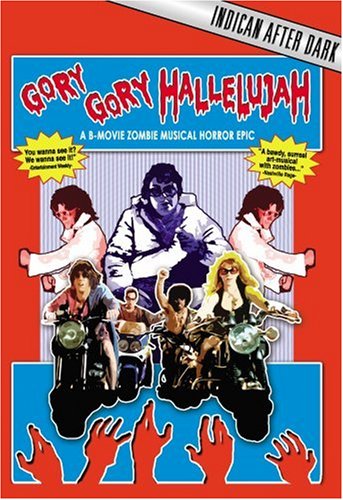
IT CAME FROM THE READER-SUGGESTED QUEUE: GORY GORY HALLELUJAH (2003)

366 Weird Movies may earn commissions from purchases made through product links.

DIRECTED BY: Sue Corcoran

FEATURING: Angie Louise, Tim Gouran, Jeff Gilbert, Todd Licea, Joseph Franklin

PLOT: Four aspiring actors on their way to New York run afoul of increasingly dangerous obstacles, including a group of rowdy Elvis impersonators, a backwards fundamentalist hick town, and a zombie apocalypse.

COMMENTS: Satire, the playwright and Algonquin wit George S. Kaufman opined, is what closes on Saturday night. Nevertheless, aspiring filmmakers frequently turn to satire as a means to walk the line between mass-appeal populism (near-parodistic references to familiar material) and fringe-appeal provocation (harsh critique of sociopolitical foes). All of which is to say, Gory Gory Hallelujah has the aspirational sweat of satire all over it. Unfortunately, Kaufman seems to have its number; Gory Gory bleeds out quickly.

Gory Gory has so many targets for its smug disdain that it plays like a sketch film. The opening salvo takes on the insular and pretentious world of theater, which is admittedly made even more amusing with the reveal that this delusional production of the Gospel is being staged in the theatrical mecca of Seattle. But that’s all forgotten once we set off on a road trip, a genre that revels in wacky mismatched personalities. From there, the targets are set up like the shooting gallery at a fair: here’s the crazy fight with a gang in a bar, here’s the hypocritically moralistic small town, here’s the evil lurking in the woods. The scenes are mileposts, rather than logical stops along the way.

This is a film that is not the slightest bit interested in nuance. Consider our central quartet of heroes, who check an impressive collection of boxes for character stereotypes: militant black man who nonetheless endures countless indignities; self-proclaimed feminist whose sexual and materialistic impulses frequently overrule the cause; nebbishy Jew who finds every opportunity to remind you of his faith; blissed-out hippie flower child whom the film wants to position as closeted, but who is actually ravenously omnisexual. That’s all there is to them; barely 24 hours after having watched the film, I’ve completely forgotten their names, and that’s just fine. They’re not characters; they’re trope delivery systems.

Title notwithstanding, Gory Gory Hallelujah isn’t really a horror film. The screwed-up small town feels like a low-rent retread of Nothing But Trouble, the witches’ coven is just an excuse to take a jab at man-hating lesbians, and the undead are lumbering actors with Green Goddess dressing smeared on their faces. I suspect if you asked director Corcoran and screenwriter Louise, they’d tell you they were making a comedy, a -esque everyone-is-awful romp that lets them flirt with edginess without having to catch any flack. Every once in a while, the film threatens to go somewhere truly daring, like the smarmy land baron’s reference to some “accidental lynchings” that hints at a truly vengeful motivation for the zombie uprising. Most of the time, though, the targets are only the most obvious, offering variations on the theme, “Aren’t these people just awful?” They are. It’s not a revelation.

The closest the film gets to a point-of-view comes in the admittedly unexpected finale, when the death of absolutely everyone presages a revival-hymn closing number that suggests we’ll all be equal in the great beyond. Whereas before everyone was greedily nasty to each other, now they’re all dancing arm-in-arm, united in brotherhood after they’ve cast off the pesky need to breathe. It would make for a solid mission statement if there’d been even a hint of it prior to the closing minutes of the film. As it stands, it’s just one more radical shift in tone for a movie that has already lurched awkwardly from one setpiece to the next. Gory Gory Hallelujah has a lot to be angry about, but just doesn’t have the heart for it. Maybe in the next life.

WHAT THE CRITICS SAY:

“Tripping over the line between silly and stupid, camp comedy “Gory Gory Hallelujah” — the title is the best part — emerges more sub-Troma than subversive…aims for bad-taste hipster satire in the John Waters vein. But co-creator/editor/thesps Sue Corcoran and Angie Louise should have left at least one job — screenwriting — to a third party.” Dennis Harvey, Variety (contemporaneous)

(This movie was nominated for review by Christopher Fox. Suggest a weird movie of your own here.)         

THEY CAME FROM THE READER-SUGGESTED QUEUE: GHOSTS BEFORE BREAKFAST (VORMITTAGSSPUK) (1928) / APOCRYPHA CANDIDATE: ALICIA (1994)

366 Weird Movies may earn commissions from purchases made through product links.

Recommended (for both)

Repression in a society is often noticed first in the arts. When works are banned or proscribed for subject matter deemed offensive to the state, or when artists and their patrons are threatened if they do not alter their messages so as not to displease the powers that be, an attentive eye can pick up the seeds of repression being planted. One might even notice it in attacks on the programming at the national center for the performing arts. Today, our attention turns to a pair of short films that are in the orbit of repression: one that was its victim and one expressly about it.

The title card that precedes “Ghosts Before Breakfast” points the finger  clearly at its tormentor: “The Nazis destroyed the sound version of this film as degenerate art.” The accusation seems absurd to modern eyes, so it’s instructive to recall, in the march to World War II, just how much the ascendant Fascists despised modern art, especially surreal and abstract works. No doubt that attitude came from the top, considering failed artist Adolf Hitler was a strict devotee of classical styles. Dictatorships are always humorless scolds, though, and the Third Reich was especially obsessed with a devotion to German propriety and order. Director , who literally wrote the book on Dadaism, was always going to run headlong into trouble.

Nothing that ensues in “Ghosts’” 500-second running time would seem to merit the iron jackboot of censorship: a bow tie refuses to stay knotted, body parts detach and spin around, and men disappear behind poles. (That last is a nifty special effect once accomplished by your humble correspondent.) Most notably, a quartet of bowler hats liberate themselves from the tyranny of resting upon men’s heads, choosing instead to fly about the neighborhood in flock formation until tea is finally served. It’s mostly lo-fi camera trickery in the Méliès tradition, not overtly serious at all. (Occasionally, one can see the strings on the hats and even the shadow of the marionette’s pole, and it detracts from the short’s charm not a whit.) Richter is always a playful surrealist (witness the giddy way he skewers the evangelization of capitalism in Dreams That Money Can Buy), and “Ghosts” captures that spirit in its simplest form. It’s light, it’s fun… no wonder the Nazis hated it.

WHAT THE CRITICS SAY:

“Featuring unimaginably brilliant special effects achieved through the use of stop-motion animation as well as live-action tricks, the film chronicles the delightful protests of objects ranging from hats to water hoses. The entire short is structured like a relentless magic trick, inviting the audience to witness a bewildering spectacle where the laws of physics completely break down.” – Swapnil Dhruv Bose, Far Out

Oh, how they would have utterly loathed “Alicia,” Jaume Balagueró’s nightmare musing on the abhorrence of femininity. After our young heroine menstruates during a moment of idle self-pleasure, uniformed thugs haul her away to become a kind of indentured remora to a hideously bloated creature. Alicia’s act of defiance is to have the temerity to reach sexual maturity, at which point she is a commodity for the beasts to consume and discard. Balagueró’s film (a student work that presages his future efforts such as the REC series) exudes a palpable sense of a terrible power that punishes people for who they are.

In less than 8 minutes, there’s no time to be subtle, and Balagueró dials up the unsettling and odd atmosphere well past the initial premise. Alicia herself (played by twins Ana and Elena Lucia) is as white and smooth as a cherub, the very essence of purity before her blood drips onto a book titled “The Drama of Jesus.” Rubber-clad troops force the girl to consume a goopy slime that emits from their masks and drill into her neck in a cascade of oily fluid. When she finally emerges from this dark underworld, she exits through a refrigerator, as if she has only been kept around as food. Meanwhile, the final shot is the ogre framed with the shape of a cross, just in case you’re wondering whom to implicate. The theme of the punishment women endure is explicit, but the concept is dressed up in grotesque imagery that carries the slight story up to another level.

Film is storytelling, and storytelling is speech. Richter may have only intended to tweak the establishment, not rouse the beast; Balagueró was clearly prepared for whatever expressions of offense or disgust might come his way. But both are compatriots in cinema, for storytelling is also bravery, and there’s nothing weird about standing up for their voices.

WHAT THE CRITICS SAY:

 “…a disturbing and even suffocating atmosphere in which we also glimpse hints of the purest Cronenberg every time the mutilations of the flesh come into play.” – Rubén Collazos, Cinemaldito (translated from Spanish)

(“Ghosts Before Breakfast” was nominated for review by Rafael Moreira; “Alicia” was nominated for review by Morgan. Suggest a weird movie or two of your own here.)

IT CAME FROM THE READER-SUGGESTED QUEUE: WAVE TWISTERS (2001)

366 Weird Movies may earn commissions from purchases made through product links.

AKA DJ Qbert’s Wave Twisters

DIRECTED BY: , Eric Henry

FEATURING: DJ Qbert, Yoga Frog, D-Styles, Flare, Buckethead

PLOT: When the dastardly Lord Ook deprives Arrow Town of the Four Lost Arts of Hip Hop — rhyming, scratching, breaking, and graffiti — it’s up to an intergalactic crew of dentists to liberate the town through the power of sick beats.

Still from "Wave Twisters" (2001)

COMMENTS: Faced with a video album based on the musical stylings of a national and world champion DJ known as the Jimi Hendrix of the turntable, the last thing I would have expected was a coherent narrative. Yet that is what we get in Wave Twisters, a hip-hop sci-fi musical in which rapid-fire scratching and carefully chosen radio drama samples combine to tell a story that would have been at home in the days of Buck Rogers and Flash Gordon. From the outset, the movie’s strongest claim to weirdness is that it’s so unexpectedly linear and focused. 

Don’t mistake that for any pretensions of depth. The story would not be out of place alongside the cheap sci-fi serials shot in Bronson Canyon in the 40s and 50s; strange aliens attack, and a group of square-jawed heroes save the day, complete with cliff-hanging chapters that slowly advance the conflict. It remains first and foremost a platform for the real star, DJ Qbert’s scratching wizardry. Qbert’s album came first, and it was up to directors Garon and Henry and co-writer/art director Doug Cunningham to transform the soundscape into a visual tale, while leaving Qbert’s original work intact. Considering the challenge, the result is impressive, with a charming comic book feel that takes advantage of limited animation. The images lend a broader sense of humor to Qbert’s sardonic wit; the DJ may have enjoyed finding a snippet of a classic serial villain declaring, “I am the Red Worm!,” but it’s the filmmakers who add lascivious gloss by putting that dialogue in the mouth of a symbiotic parasite residing in the navel of a baby in a luchador mask.

Perversely, it’s the beats that inadvertently drag down the story. With all the tunes working at roughly the same BPM, there’s not much variety in the energy, and you can feel the story slowing down to keep pace with the score. For example, a side trip wherein graffiti expert Honey is captured by the enemy is intriguing, especially as she is transformed into an ostrich. It looks cool, but it’s a dead end for the plot, and overlong as an eye-catching visual. Similarly, set pieces like an assassin stalking the crew down a hallway are tense for the first few seconds, but in short order the repetition becomes tiring. The visuals are in sync with the soundscape, but they never quite harmonize.

If nothing else, Wave Twisters is worth the watch to see Qbert and his colleagues in action. Amusingly, they are deployed in live action as agents of the bad guys, using their rapid-fire scratches and sonic tweaks as weapons against enemies of the state, but it’s remarkable watching them do their thing at breakneck speed. If it takes a wacky tale from the Golden Age of Science Fiction to show off the awesome instrumental power of the turntable, then by all means, get those dentists to space on the double.

WHAT THE CRITICS SAY:

“‘Plot’ clarity ain’t a high priority here, as ‘Wave Twisters’ blitz-riffs on everything from hip-hop and sci-fi mythology to vidgames, toys, Japanese anime, manga tomes, Godzilla pix, Hanna Barbera-style toons, even retro dental-hygiene ads. The in-jokes and absurdist gags fly by so fast that many viewers will be eager to re-experience pic on DVD and other manipulation-friendly formats.”–Dennis Harvey, Variety (contemporaneous)

(This movie was nominated for review by Katie. Suggest a weird movie of your own here.)