All posts by Alfred Eaker

Alfred Eaker is the director of Jesus and Her Gospel of Yes!, voted Best Experimental Film in the 2004 New York International Film and Video Festival (which can be downloaded from DownloadHorror.com here), and the feature W the Movie. He writes the column "Alfred Eaker's Fringe Cinema" for this site, covering the world of underground film, as well as regularly contributing essays on other subjects.

A.I. ARTIFICIAL INTELLIGENCE (2001)

Once or twice a decade comes a film that polarizes audiences, particularly of the American variety. This is not surprising given that few Westerners, spoon-fed on undemanding aesthetics, even know how to watch film. Recent examples of divisive cinema include Noah and Birdman from 2014. Both appeared to be genre films of sorts.

The audiences going to Noah jumped off the church bus, expecting to see the cinematic equivalent of a Velcro bible lesson with rosy-cheeked prophet loading friendly snakes into his wooden yacht, capped off by a “Love American Style” rainbow. Instead, they were pounded by Aronofsky’s brass knuckles of mythological and theological diversity, with a Creator who actually cared about his planet. The result was widespread provocation.

Birdman was a sort of belated, near perfect follow-up to Batman Returns (1992) (never mind that it was a bird instead of a flying rodent). s Bruce Wayne was off-kilter as his alter ego, and the hyperkinetic actor was tailor made for this iconic role, revealing slivers of a manic-depressive personality as he played ringmaster in a freak show carnival. Birdman takes that development further, exposing the actor behind the actor behind the suit. Audiences, desiring more blockbuster mayhem, were treated to something far more idiosyncratic and original. By and large, they responded like a hostile bull charging to a flag of artsy-fartsy red.

Of course, both the Bible and comic books have scores of zealous adherents, particularly when it comes to cinematic treatments of the objects of their adulation. Science fictions fanatics are made of similar stuff. When ‘s Prometheus was released in 2012, the Alien fans were deeply offended by the lack of a guy in an H.R. Giger gorilla suit. In place of mugging Ritz Brothers and Bill Paxton was the beautifully enigmatic pro-choice seeker Noomi Rapace. Too original for bourgeoisie creampuffs, Prometheus stole the fiery expectations of the sci fi formula. Genre disciples screamed blasphemy and branded Scott as Judas.

Eleven years before Prometheus, there was the Steven Spielberg/ hybrid A.I., which was, perhaps, saddled with more preconceived notions and baggage than any film of the last half century.

The introductory obstacle was the Spielberg proselytizers, who hoped for heart-tugging family fare about a cute plush toy. Knowing that A.I. had been attached to the late Kubrick, Spielberg’s sycophants probably had the most misgivings.

Still from A.I.: Artificial Intelligece (2001)The second obstacle came from the church of Kubrick. Now that Stanley was dead, he was, of course, canonized. In that parish of holy auteurs, there was much weeping and gnashing of teeth among the parishioners. That populist antichrist, Spielberg, was not Continue reading A.I. ARTIFICIAL INTELLIGENCE (2001) →

READER POLL FOR ALFRED EAKER VS. THE SUMMER BLOCKBUSTERS: THE CANDIDATES

With summer just around the corner, it is time for the 366 reader base to vote on which four summer blockbusters to send me to review. The candidates below are listed in order of release. Be sure to view the entire post; you will vote at the end.

Poster for Avengers: Age of UltronThe Avengers: Age of Ultron: Director Joss Whedon has a sense of style, produced the cult fave “Firefly,” and is good at managing an ensemble cast. Of course, it’s going to have , who should be playing all the men in-tights characters (but obviously cannot). The best moments in this film’s predecessor were in its first third, before it began wallowing in its excesses, descending into an out-of-control -styled assault on the senses with floating July 4th black snake thingies chasing people in the streets amidst falling glass. I dread the idea of even one man-in-tights saga, let alone a whole cast full of them.
Mad Max: Fury Road: Director sacked the fascistic , which is a promising start. However, Miller’s last Max entry was thirty years ago. Since then, his work has been confined to kiddie fare. Additionally, this film has been described as one long chase scene, as if we needed more of that.

Tomorrowland has a first rate ensemble cast and an equally first rate director in Brad Bird (Mission Impossible: Ghost Protocol, Ratatouille, The Incredibles, and The Iron Giant). This may be the most promising of the summer entries.

Pitch Perfect 2: Features a first time director in Elizabeth Banks, although she did produce the 2012 original, which I have not seen. Although the original garnered some good reviews, the trailer to the sequel looks like a hopelessly adolescent film filled with people all too easy to hate. Unless the film surprises, this may be the nadir of summer releases.

Spy looks almost equally unbearable and obvious. Director Paul Feig was a critical darling with Bridesmaids (2011), but that might prove his one-hit wonder. The Heat (2013) was by the numbers. It starred the female Adam Sandler: Melissa McCarthy. McCarthy, who also was in the insufferable Tammy (2014), returns to collaborate with Fieg.

San Andreas: A disaster film from perennial hack Brad Peyton (Journey 2: Mysterious Island and Cats and Dogs: The Revenge of Kitty Galore) starring monosyllabic Dwayne Johnson, who makes  look like a sensitive intellectual actor with range. Has the disaster genre really gone anywhere new since the Towering Inferno (1974)? At least in the Irwin Allen days, one got to see “A” stars burst into flames.

Jurassic World: A third-rate rehash of a film that was not very good to begin with. The plot sounds almost identical to the 1993 Spielberg Continue reading READER POLL FOR ALFRED EAKER VS. THE SUMMER BLOCKBUSTERS: THE CANDIDATES →

FELLINI SATYRICON (1969): THE CRITERION COLLECTION ON BLU-RAY

“The quintessential Fellini film. There are orgies, murders, abductions, rituals, all presented coolly, without editorial comment—as might a Warren Commission Report from Mars.”—Vincent Canby

Although Fellini Satyricon (1969) has already made the List, its re-release as a Criterion Collection Blu-ray warrants additional coverage. The previous MGM DVD Edition was threadbare, and although it thankfully kept the film in circulation, you can now donate your copy to a  virgin (although making Satyricon your first would be unwise).

Actually, my MGM DVD has proven quite handy over the last decade, being one of my most coveted films for the bourgeoisie to walk out on. More than once it has been useful in ridding myself of unwanted guests, or those who have overstayed their welcome. Rather than repeatedly looking at the Seiko on my wrist, all I had to do was slap Satyricon into the player and within a half hour I would, without fail, find myself alone enjoying the company of my dear, beloved, beautiful late Siamese cat, Betty.

The last time I pulled it out was possibly the most beneficial to me: a family member, for some reason, decided to drop by; which would have been fine, except that he brought with him his hopelessly constipated Bible-beating fundamentalist girlfriend, who proceeded to “enlighten” and “warn” me about the upcoming rapture, lest I be “left behind.” I neither argued nor even looked at my watch. I merely smiled, popped in Satyricon and—bam—in a record time of seventeen minutes, sister So-and-So was outta my door. I gave Betty her trout and lay back, thanking both St. Federico and MGM. Although Betty broke my heart by suddenly, and without warning, flying off this mortal coil, she can now join Federico and my wife and I (in spirit), looking down from trout heaven at a crystal clear Criterion Satyricon. I am willing to bet that, with this release, I can beat my seventeen-minute record the next time an uptight cinematic illiterate or artless boob darkens my door.

Of course, the film was loosely based on Petronius’ ancient satire, and all that history is covered here. As with Roma (1972) Fellini includes his name as part of the title, not out of ego, but to inform the view that this is Fellini’s personal interpretation of the satire, not Petronius. Conventional wisdom says that with Satyricon Fellini entered a whole new plane of eccentric (some would say excessive) personal filmmaking, daring to produce a work which does not strive to be populist. Fellini counted this, with 1976’s tragically unavailable Casanova, as his most perfectly realized film.

Director of Photography Giuseppe Rotunno supervised Criterion’s digital restoration, which renders the viewing experience an entirely new film. The difference is almost akin to seeing a painting in the flesh as opposed to looking at in an art history reference book. From the rich pigments of the clothing to the caked face paint of the extras, the vivid background colors, reddened skies, bluish serpentine caverns, and even the subtitles (a new and improved English translation), this is a radical improvement over MGM’s release. As a product of the late 60s, Satyricon is mesmerizingly psychedelic. The fabric of Fellini’s hellish milieu never looked so sumptuous and inviting. Additionally, its absurd dialogue, spoken in multifarious languages, and the Nino Rota score are at their most cacophonous.

Starting with the audio commentary track, the extras are aptly idiosyncratic. Not recorded directly for the Blu-ray release, it is instead an expansively informative “Behind the Scenes Diary,” recorded in 1971 by Eileen Lanouette Hughes. She covers Fellini’s original vision for the film, how that vision evolved during production, provides behind the scenes descriptions, the history of the film’s funding, explains Fellini’s processes and casting decisions, and compares Petronious’ satire to Fellini’s finished adaptation.

“Ciao Federico,” is an hour-long documentary produced by Gideon Bachmann in 1970. Showing the behind the scenes interaction between director and cast, it reveals Fellini as something of a taskmaster, albeit one who quickly apologizes for belittling his actors. Among the visitors to the set, we see  and his doomed wife, Sharon Tate.

The director discusses everything from the latent morality of the film (aka godless violence) to Gene Shalit’s waxed mustache in a series of interviews. An interview with DP Rotunno reveals the director’s aversion to creating a realistic ancient Roman world; he desired instead a mythical, artificial look.

Classical scholars, film consultants Joanna Paul and Luca Canali expand on Hughes’ commentary in the “Fellini and Petronious” supplement. On set photographer Mary Ellen Mark amusingly recounts anecdotes of working with Fellini (and the director’s sycophants).

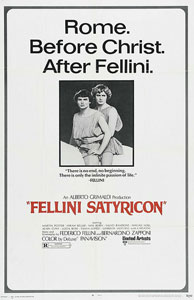
Fellini Satyricon Poster“Felliniana” is a hi-res slideshow from Dan Young’s epic Satyricon memorabilia, including a collection of provocative posters.

An extensive essay booklet by film scholar Michael Wood accompanies the original theatrical trailer, closing this release. It is enough for several nights’ worth of cozy, entertaining, academic foreplay before consummating with the film itself. A wholeheartedly recommended, essential release.

INGMAR BERGMAN’S MAGIC FLUTE (1975)

The conductor Bruno Walter once suggested that “The Magic Flute,” rather than the unfinished “Requiem,” was Mozart’s true valedictory work. While there have been many great recordings of “The Magic Flute,” Wilhelm Furtwangler’s famous performance stands out for its pronounced mysticism, which justifies Walter’s claim.

In Milos Forman’s superb but highly fictionalized Amadeus (1984), Mozart (Tom Hulce) dismisses “The Magic Flute” as vaudeville. The jealous but perceptive Salieri corrects Mozart: “It is sublime.” Although “The Marriage of Figaro” and “Don Giovanni” represent Mozart’s greatest achievements in opera, “The Magic Flute” is nearly an equal masterpiece that transcends its “vaudeville” genre. As with audio-only recorded performances, there have been numerous excellent filmed performances. Both David McVicar’s imaginative, yet traditional “Flute” for the Covent Garden and ‘s abridged English language version for the Met predictably dazzle.

The opera’s fanciful dressings of Masonic symbolism, mythological dragons, sorcerers, bird catchers and a silly plot can, under less perceptive direction, distract from Mozart’s philosophical “higher meaning.” In worst-case scenarios,”The Magic Flute” can be rendered like a Humperdinck “Hansel und Gretel” for the powdered wig audience. The opposite extreme can also be taken. In 2006, Kenneth Branagh produced a predominantly well-received, full-fledged film version (in English), which transported librettist Emanuel Shikaneder’s scenario to the First World War. In 2007, Martin Kusej, always a controversial director, used provocative conducting from Nikolaus Harnoncourt to transform the opera into an amorous, Expressionist nightmare.

While none of the aforementioned productions entirely short shift the composer’s context, ‘s 1975 The Magic Flute remains the proverbial yardstick by which all other film versions are measured. This is due to the director’s spiritually sagacious cinematic and musical aesthetics (he was an accomplished organist and musicologist, which super-conductor Herbert von Karajan sensed when he enviously wrote Bergman on seeing the film: “You direct as if you were a musician. You have a feeling for the rhythm, the musicality and pitch.”)

Bergman had unsuccessfully tried for years to mount a production of “The Magic Flute,” finally getting his chance in 1975 with a  television offer. He later said that making this film was the best experience of his career. His enthusiasm is contagious. Bergman worked with conductor Eric Ericson and the Swedish Radio Symphony Orchestra, and the film fully gives the appearance of an actual live performance. It isn’t, and although the singers lip sync to their own prerecorded voices, few have complained about it in forty years. It is sung in Swedish instead of the usual German, but only the most constipated opera buffs (who may be among the bitchiest inhabitants of Earth) have objected.

“Real” movies of operas (the aforementioned Branagh production) employ actors to lip synch for the singers, which rarely works, because in opera, the drama is in the arias. From the outset, Bergman wanted young singers, as opposed to established opera stars or actors, feeling that this would convey a sensuous warmth and energy. His instincts proved astute. Heading the cast is Hakan Hagegard as the charming bird catcher Papageno. Josef Kostlinger is an ideal, square-jawed Tamino, and the aptly named Ulrik Cold exudes the right amount of perfected menace as the sorcerer Sarastro. Irma Uriila as Tamino’s object of affection, Pamina, alongside Britt-Marie Aruhn, Kirsten Vaupel, and Birgitta Smiding as the Queen’s three ladies all capture the winsome quality of the composer’s characters. Elisabeth Erikson is the consummate Papagena (be prepared to utilize the repeat button for her duet with Papageno) and Birgit Nordin is a beautifully manipulative Queen of the Night.

Bergman and director of photography Sven Nykvist open on the “audience,” fluidly gliding over a sea of captivated faces, including Bergman’s young, cherubic daughter. Throughout the opera, Bergman repeatedly cuts away to her reaction (a few times too many). Still, rather than being a visual cue, prompting us to react likewise; we sense instead that she is participating in the dream with us.

Still from The Magic Flute (1978)With production design by Henny Normak (who also assisted Karen Erskine in costume design) and sets by Anna Lee-Hansen and Emilio Moliner, Bergman solves most of the problems with filmed opera. He emphasizes “The Magic Flute”‘s artificiality, wittily elevating us past the banality of hyperrealism. By utilizing the malleability of film as a medium, Bergman avoids the traps of limited action in the opera’s “real time,” employing inviting close-ups which, for once, are not gimmicky.

Admittedly, Shikaneder’s libretto is occasionally wayward. Bergman actually tightens the plot and quickens the pacing with his script, which parallels those Bergmanesque themes of human love as the authentic antidote to spiritual loneliness.

The result was overwhelming critical praise, which the late Pauline Kael summed up: “It is a blissful present, a model of how opera can be filmed.”

BEAUTIFUL FILMS: WERNER HERZOG’S NOSFERATU THE VAMPYRE (1979)

‘s Nosferatu (1922) rightly ranks on nearly every historian’s list of the greatest films to emerge from the silent era (as does his Sunrise). Murnau’s concept of the vampire manages to embrace its absurdities and simultaneously repel us. Probably as much “Varney The Vampire” as Dracula, Murnau’s demonic, Victorian count is more a diseased, toothsome, carnivorous rat than a crepuscular Valentino. Murnau, who served as his own cameraman, artistic director, designer, and editor, and did his own lighting, filtered this greatest of all vampire films through his perfectionist sensibilities (only ‘s 1932 Vampyr has a comparable, but contrasting beauty.

Of course, the vampire genre became increasingly ludicrous. Worse, Dracula and his cohorts became dull, repetitive, and insignificant. The Lord of the Undead became so tame that producers tapped Sheridan Le Fanu’s lesbian-tinged “Carmilla” (repeatedly) in an attempt to reinstate an edge, which suited the 1970s sexual revolution. Despite mixed results, it worked to a degree (We have yet to see buxom lesbo vampires selling breakfast cereal, but give it time).

Just when we thought the masculine bloodsuckers had given up the ghost to their more interesting female counterparts, , of all directors, gave new vitality to a very old story by doing something out of the ordinary with his 1979 homage to Murnau, Nosferatu, The Vampyre (1979).

Herzog’s Nosferatu boasts a startling aesthetic with stained hues and bizarre, cool pacing. Petrified interiors strikingly contrast stony exteriors seething with grey life. Cinephiles wax endlessly about Stanley Kubrick’s obsessive use of sterile whites to parallel opaque reds. Herzog utilizes greys, browns, and whites much differently. Lack of color conveys something seething with life, but not life as typically defined. ’s whitened, fleshy count pierces the bluest skies and greenest forests.

One of Herzog’s motives in making the film was a chance for a second collaboration with Kinski (they first teamed up for 1972’s Agguire: The Wrath of God, while Woyzeck immediately followed Nosferatu in the very same year). Due to copyright restraints, Murnau was unable to use the names of Bram Stoker’s cast of characters. Fifty years later, Herzog did not have to contend with the author’s estate, and although he utilized the familiar names, Herzog took liberties with the story.

Still from Nosferatu the Vampyre (1979)Kinski’s is a surprisingly sympathetic performance that still manages to convey grotesque mania. Kinski’s Dracula is as inimitable as Max Schreck’s in the 1922 original. Although both actors took the count-as-a-rodent approach, Kinski’s arouses a pronounced degree of empathy. Playing opposite Kinski’s bleached bat is the gossamer  as Lucy. Mina is jettisoned completely. Apparently, Herzog felt Lucy was a more compelling character (Sadie Frost, as a concupiscent Lucy, validated that point in Coppola’s 1992 Dracula, wholly dismissing ’s waxen Mina). Adjani is in every way Kinski’s equal. You can’t take your eyes off of this enlivened, spectral figure. Unlike Murnau’s Greta Schroder, Adjani is no dormant sacrificial lamb. It is she, not Harker (Bruno Ganz) or Van Helsing (Walter Ladengast), who is the film’s protagonist.

Herzog reinstates the novel’s contrast of the sacramental with the Satanic (Schreck’s count is an anti-Semitic caricature preying on Schroder’s German virgin). Lucy actively tracks down Dracula’s heterodox sanctuary, eradicating it with the Eucharist. 

Paradoxes abound: White rats (thousands, millions of them) gift the vivacious breath of disease. The Transylvanian aboriginals (echoing the populace of Aguirre) contrast with urbane Londoners. Humor pierces a milieu of soulful solemnity when Dracula, in chalky voice, says: “I thought he’d never leave,” after his sole encounter with the raving Renfield (). The redemptive goal is offset, in the film’s climax, with cynicism.

As expected, Herzog is too authentic an artist to produce a mere fan film. Nosferatu The Vamypre is stamped with the artist’s personal aesthetics, giving at least some credence to the occasional claim that this homage actually surpasses Murnau’s original.